
RMC House Rules – Character Creation #3 – Rolemaster Races

Rolemaster Logo

I am not suggesting many changes to the Rolemaster races in my RMC variant but first a bit of background on the long running ‘issue’ of Elves and Self Discipline.

Elves and Self Discipline

Most elves in Rolemaster based games get a -20 on the Self Discipline (SD) stat. SD happens to be one of the stats used to determine your Stalk & Hide skill and Meditation skill.

When most people see that -20 they assume that elves have no self control or discipline which is not the way Tolkien’s elves are generally portrayed. Rolemaster elves are the direct decendants of Tolkien’s elves as the roots of Rolemaster are set in the world of the MERP (Middle Earth Role Playing) franchise.

Furthermore when you notice that when you read about the stalk and hide skill the elves -20 should be treated as +20 and that elves get a natural +20 to meditation. It strikes me that if you are having to ‘fix’ the figures because of something you did earlier then the initial thing was wrong.

Elves are not irrational and impulsive and clumsy. You firstly have to remember that all stat bonuses are relative and not absolute. Originally the common man had no penalties or bonuses at all and that all the tables were constructed as the common man being the absolute norm. From that point races are describe relative to a common man so if a typical dwarf is stronger than a common man then it gets a strength bonus. In this way elves are seen as being less disciplined than a man. Not bad at discipline, just less discplined than our common man. This idea was prompted by the idea that elves being immortal have all the time in the world to complete tasks and most problems tend to resolve themselves if given a few centuries to bed in. Your common man with a short and often hard life has to act now. An elf could spend several thousand years building an empire, a man probably has no more than 30 years if he wants to have any time to actually enjoy it!

I have no problem with this concept of ‘relative’ stats. I do have a problem with the elves -20 because obviously this is the wrong implementation if the rule has to be applied only some of the time or additional fixes have to be put in place to fix the problems that the rule introduces.

I would argue that although elves may not be as hasty as humans to interfere in affairs their long view almost breeds more self discipline in that they are inherently patient and this builds tolerance. If you have to cancel out the penalties for mediation and stalking then why not just forget the whole thing?

In my rules there is no SD penalty for any elves including half elves.

Base Hits

There is a table known as “04-01 RACE ABILITIES”, on that table it tells you the hit dice used for each race. Common men get a d8 as do some elves and halflings. Other races get d10. Why? Rolemaster is a d10 based game. The only places where you get all the other polygon dice used is in the variable amounts of healing from some herbs.

My first reaction was to say everyone gets a d10 hits but then I decided to go in a completely different direction.

The way hits are calculated in RMC is your Con stat/10 plus the accumilated dice rolls plus your Con stat bonus as a percentage. Almost every race gets a con bonus so most people get a few extra hits from this. So if you have a Con of 76 and a total of +10 Con stat bonus and you bought 4 ranks in Body development as an High Elf you would have 8 hits from your Con (76÷10) plus 4x1d10, lets say that comes to 28 plus 10% of the total from your con bonus. So 8+28=36 plus 10% = 40 hits.

Some GMs I have played with say re-roll hit points if you get a 1-3 on the dice and others have given out maximum hitpoints at first level. Letting the characters have a decent number of hit points gives the GM more freedom in what he or she can throw at the party.

With that in mind I am going to give a little, take a little and simplify things a little.

In my rules you always get maximum hits, so 8 for a human, 10 for an high elf and so on but you no longer get the con bonus percentage. So under my rule the above character would get 48 hits being (76÷10)+4×10=48. So we now have diceless body development. In fact as you will see all of character creation is now diceless.

Background Options

In table “06-01 RACE BACKGROUND OPTION TABLE” each Rolemaster race has a number of background options ranging from 2 to 6. I personally feel the options in Character Law were a bit limited and those in Companion One were too powerful. I like the HARP and RMU talents and I nearly included them but at the end of it they just seemed a bit ‘wrong’ to me. Instead I am going to steal another RMU feature and that is Knacks. In the RMU beta rules all characters get to pick to specific skills that get a +5 bomus. this makes a character just a little bit better than their peers in that particular skill. It is a one time only bonus and is always fixed at +5 and cannot be doubled up. I am going to replace the background options with knacks but each character will get between 2 and 6 knacks depending on race.

Race Background Options
Common Men 6
Dwarves 5
Halflings 5
Orcs 5
High Men 4
Half-elves 4
Wood-elves 4
Greater Orcs 4
Trolls 4
High-elves 3
Fair-elves 2

This does reduce the impact of background options but then I never liked the way that some good rolls could turn a character into an almost superman and likewise a bad roll could cripple them or destroy the players concept of the character they wanted to play. This solution puts the player in charge, is non-random and always give the character a slight advantage without making a massive impact. They are far easier to administer than Talents and Flaws.

RMC House Rules – Character Creation #1 Stats

Rolemaster Logo

Brih has been posting some of his groups house rules or hacks. This has inspired me to put forward some of my proposed house rules for an up coming game.  I have alluded to many of these in the past but I have never listed them explictily. So there is Part I of character creation namely generating some stats.

My favourist game ever for character creation was Champions (or Hero System as it is now). That gave you complete freedom of all of time and space to drw your inspiration from and all the characters were equally balanced. Hero System was a point buy system and so that is where I intend to go with character crreation.

I went through the Rolemaster RM2 companions over the weekend and none of them had a point buy system for RM2 or RMC. If there was one for RMSS/RMFRP I don’t know it as I don’t have any of those books. I have drawn my inspiration from some of the RMU beta rules.

There seem to be three philosophies with RM point buy systems. Firstly you have a big pool of points and all your stats start at 0. Second, you stats all start at 50 and you have a small pool of points and finally all stats start at 50 but you buy stat bonuses not the stats themselves. The first option is the one that my PBP Spacemaster GM has employed. There we rolled 10D10 and added that to a base 700 points to give our point total to spend. The third option is the one used by RMU. You get 10 points to spend on your stat bonuses. you can get more points by taking minuses on other stats.

I am going to use the middle option of all stats start at 50 and you get 250 points to spend on your stats. You can lower a stat to get more points somewhere else if you want.

The flaw in my system would be that in standard RM stats anything between 26 and 75 give you no bonus or penalty there is no reason why not to reduce any stats you do now explicitly need down to 26 and spend those points boosting other more important stats.

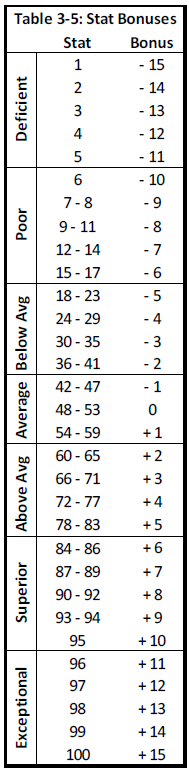
To counter this I am going to use a smoothed stat bonus table. While I am talking about stat bonuses I am also going to adopt the RMU standard of smaller stat bonuses that get added together for skills rather than the averaged method used in RMC/RM2. So what does this stat table look like?

The Stat Bonus Table from RMU Beta 2

This table discourages ‘buying down’ stats as the penalties for low stats start at just 47.

The only complications come from ‘single stat’ rolls. As an example if a player asked “Can my character remember reading anything about this legend as a student?” I would normally ask the player to roll a Memory (OE D100 roll with their Memory stat bonus as a modifier) roll to which I would add or subtract a difficulty factor depending on how well known the legends are. A character with a Me stat of 90 in RMC would have a +10 stat bonus. In this stystem that is just a +8. Your DB is normally equal to your Qu stat bonus but that too is reduced.

To address this all single stat checks will be made with the stat bonus doubled. This now makes DBs slightly higher for lightly or unarmoured characters and stat checks slightly easier. Especially as you will get a small bonus from a stat as low as just 54.

Looking at the bandings in the table here you will see the labels Deficient to Exeptional. These are used for the costings. Each +1 or -1 in the average band costs or gives 1 point. So it costs 9 points to go from the statng 50 up to 59. The Above Average band all cost 2 points so it costs an additional 46 points to get the same stat up to 83. It costs 3 points for the Superior band and 4 points in the exceptional so to get a stat up to 90 costs (9+46+21) 76 points in total.

Reducing stats works the same way.

Stats do not give any development points and I have kept all 10 stats. I was tempted to go with the HARP 8 stat version but that would lock me into the HARP skills system.

The 200 point pool means that a typical character can have two stats up at about 90 and all their other stats at around 54-55 easily within their budget.

Potentials are all 100 right across the board but I will cover potential stats next time as well as stat gains.