The theme of 2017

I have been looking back at a few posts from this year. One of the recurring themes seems to be that none of us are in love with Channelling magic. I have stated that you could do away with it and roll the spell lists into mentalism and essaence very easily. The very core concept that Channelling magic is an act of god makes no sense at all when you take Shadow Worlds gods into account as they are not divine beings, just very powerful mundane ones.

Brian’s rewrite of the respective clerical base lists really shows what Channelling could have been but isn’t.

Does channelling magic need more love?

I think the problem with the Channelling realm is twofold. The first is Life Giving. If it is in your campaigns and generally available then it takes a major element of threat out of your games. If you don’t allow it then you have taken the one thing that Channelling can do that no one else can out of the game.

The other problem is the Paladin. This the ultimate icon of the Channelling realm. The pin up boy of heroines everywhere. To make the Paladin work in off the shelf Rolemaster required all sorts of patches and fixes. The RoCo1 profession is generally considered overpowered and without the ‘transcend armour’ skill potentially non functioning. If you play with fully featured encumbrance rules then the Paladin is in trouble again.

On the other hand a Mentalism Paladin works just fine and there is already a profession. I mean of course the Noble Warrior, that is a Paladin without gods.

The Forgotten Realms is the setting for my campaign. In this setting the idea of clerics Raising Dead is not a problem. It cuts both ways in that dead characters can be brought back but so can evil villains and an arch Nemesis. (Do you reckon the plural of Nemesis is Nemesi? Spell Check doesn’t like it!)

I have a game running right now that is RMC pretty much Rules As Written (RAW). That game has professions and all three realms. I am hoping to start a game later this year with my profession-less, level-less, Realm-less and with emphasised Stats. If that test game works as well as I had hoped and the players have fun then that could be the death of the Channelling Realm for me!

An explosive situation…

Imagine this set up.

It is a small walled town or more accurately a settlement. To the east of the market square is the manor house, to north at ground level are a few shops to cater for trade caravans and above them a hostel or flop house for itinerants. The west has the gate house and the south facing on to the market place is a taverna with seats spilling out into the square.

Our characters should ideally be sat at the taverna, outside. Maybe they are waiting to meet a patron or even waiting to get paid? We will come back to the characters later.

The sun is just coming up over the town walls and it is going to be a fine day.

Let us take a look behind the closed doors and behind the shutters.

In the manor house we find a home is shock and disarray. During the night the master of the house has been assassinated and the only living heir is missing. Guards were killed at their posts and often without any sign of struggle. The women folk are in shock and the men are split between the hawks who want to turn the town upside down to find and kill the assassins and the doves who are only concerned with the safe return of the missing heir. A runner was sent to the gate house before dawn to tell them there were assassins in the town and to not let anyone in or out.

Across the square the gatehouse is filled with pent up energy. The gate will not open today. Eyes are scanning the horizon outside the town looking for any trace that armed men and a hostage may have escaped during the night while others scan the town looking for suspicious foreigners.

At the flop house on the top floor we find a group of eastern looking assassins. Maybe they are of some ancient holy order dedicated to refining death to an art maybe they are masters of infiltration.  right now they have look outs watching the market place looking for the first signs that their work has been discovered and of the heir who is still to die. Three storeys below them one of the shops is that of a weaponsmith and pawnbroker. The owner was wakened not too long ago by the missing heir who was looking for a safe place to hide. The last thing his dying father had said was run and protect yourself, you must survive. Our young heir has no experience of weapons, more adept with a pen than with a sword. As it is easy to use the young heir is shown how to load a heavy crossbow. The weapon is heavy and awkward for the young man and whoops! A loosed bolt shatters a pane of glass in the shop front and flies across the empty square towards the taverna.

So our characters are sitting their minding their own business, just waiting to get paid when the crack of breaking glass grabs their attention. Does the bolt hit anyone? Who knows?

So what happens next? The party draw weapons and head across the square? Do the assassins see the heavily armed players charging their hiding place? I have the assassins suddenly rappelling down to the square on silken ropes, a blur of scimitars and curved daggers.

What do the guards do when they are suddenly faced with a market square filled and erupting battle? Out into it all rushes an embarrassed and somewhat ashamed young heir who can only stammer “I am so terribly sorry, it was an accident…” knowing he may have hurt someone with his errant crossbow bolt.

All of this attracts the attention of those in the manor and the first sight of the young heir is enough to bring the remaining household guards from the manor charging out to save the son.

So how do your players react to this? Obviously the entire powder keg situation here is contrived and the trigger is applied by you the GM.

Even if the party does not charge into the attack the second the young heir steps out into the square to apologise the assassins are going to leap into the attack.

So can the party work out who are the good guys, who are the bad guys and who is completely innocent? Can they resist letting off fireballs in a now rather crowded market square?

Will the heir survive?

There is no real point to this post other than that I was reminded this week that the original reason for starting this blog was to provide playable material so there you go, a little town encounter for you.

‘Appy Inspiration

I have been gallivanting around Iceland for the past week or so and being surrounded by reminders of elves, known locally as the hidden people, trolls and giants is quite good for gaming inspiration.

Ironically possibly the best bit of inspiration that came to me was nothing to do with the fantasy rich local culture but from my mobile phone.

We all recognise that magic items are not just about +15 weapons, daily spell items and multipliers. It is the more colourful items that can give a campaign its flavour.

I installed a Aurora Borealis forecasting app on my phone as soon as I arrived and it was pretty good and we did indeed see the lights display when forecast. When you see the northern lights it begs the question of what on earth must the first people to see it have thought. No wonder so many cultures have myths and legends of magic. Without our scientific understanding of ionisation and solar winds magic would probably be the next most logical rationalisation.

So if these displays of lights are created by magic then surely you could either tap into that source of essence or read from them some heavenly enlightenment or foreknowledge. Knowing when they were going to appear and where would be really useful and I am sure many a seer or astrologer would want a magical device that could predict the northern lights. A sort of ‘orb of the heavens’ sort of thing.

So this set off a train of thought. In our culture ‘there’s an app for that’ is a bit of a joke but what if for every app there was a magical item?

Looking in the itunes store at the most popular apps I see that a QR reader is one of the most popular apps. I can easily see that materialising as a crystal of attunement (runes).

Spirit level apps seem popular and in magical terms imagine an item that combined the low level spells of mannish scale and the lay healer diagnosis spells that could tell you so much about the target. What form it would take is open to interpretation. I am personally envisioning a set of lenses and crystals through which the user peers.

There are countless musical instrument tuning apps and they would make great magical items that any bard would love.

Voice changer apps can be reimagined as Sound Mirage based items.

The more I look at the range of apps available the more I possibilities I can see and for the most part based upon first through third level spells. Not that everything has to be tied directly to a spell in spell law but items that are simply useful whilst not being exceptionally powerful are easier for the alchemists of the world to create and are more likely to be created if they do not cost the earth or take forever.

I think the take away from this is that if you are looking for ideas to perk up a treasure horde or to make an NPC a bit more interesting then you can get some interesting ideas from either itunes or Googles app store.

Evil Healers?

All this talk about channelling got me thinking. There was also a thread on the forum of someone wanting plug and play adventures.

The problem with plug and play rolemaster adventures is that no published adventure can ever know what options are in play and which aren’t. As a rule of thumb you could optional rules relating to character creation in the companions made PCs more powerful, not less. If you accept that premise then any adventure written against the core rule books would be varyingly under powered when used with characters created with optional rules, spells and skills from the companions. As an example the core RMC core rules has no option for two weapon fighting styles which in many games are extremely common. Stunned manoeuvre is another skill that can have a huge impact on the outcome of a fight.

Any adventure where the PCs had twice the attacks and could shrug off stun results would have a huge advantage over adversaries who didn’t and couldn’t.

So bearing that in mind I am not going to give you any actual stats as you will have to build the enemy to fit your game and challenge your players characters. What I want to do is suggest what to me seems at first an unusual choice of villain.

This little adventure is completely off the top of my head, untested and unplayed. You should use it for inspiration only!

The Evil Healer

At first thought Healers would not necessarily seem the natural choice for an evil mastermind or villain. I think the prejudice comes from the idea that healers do good things to people and most people don’t want to piss off their healer. If anyone was going to coerce a healer and force them to do bad things, they are more likely to bad people themselves so a vengeful healer is most likely to be still on the side of ‘good’ or at the very least an anti-hero. Or that is what I was thinking until I stopped thinking of the healer as a one dimensional, personality free cliche.

Separate the person from the profession and  there are a multitude of reasons why you can justify an evil healer. Think how many stories there are based around experimenting on people or animals or even individuals that can get a twisted pleasure from being around the suffering of others or even their own.

For this adventure idea I want to think along the lines of having a whole ‘party’ of terminators after the PCs. What made the movie Terminator so cool was his unstoppable nature. In this little adventure at the heart of it is a simple band of brigands lead by an evil healer. The brigands have become incredibly successful as they are almost impossible to put down. Their leader can just put them back together and back on their feet again.

The healer will need the healing base lists including transference but I also  suggest adding Symbolic Ways, Light’s Way and Calm Spirits.

Back when this band started out the Healer assumed control buy using Calm Spirits to completely disarm literally and figuratively the original band of brigands and an crossbow bolt to the back of the head dispatched their former leader.

The current band is made up of two warriors, a thief and a monk. The skill level of each is up to the GM and the party that wander across this place.

The band’s hideout is littered with stones inscribed with magical symbols (using Symbolic Ways) that provide the band with a number of magical effects. Some are used as traps such as stones in the floor that when stepped on cast Calm spells. I will leave the level, number and position of these to the GM as having a single character ‘Calmed’ may be a big problem to a 1st level party but a Calm III may be more of a challenge to a higher powered group. As the brigands have been here for years any and every stone that is suitable has been enchanted to give the brigands every advantage. There are stones that will heal, protect and so on. All of these are well known to the brigands and they will use them to their best advantage while keeping them a secret if they can.

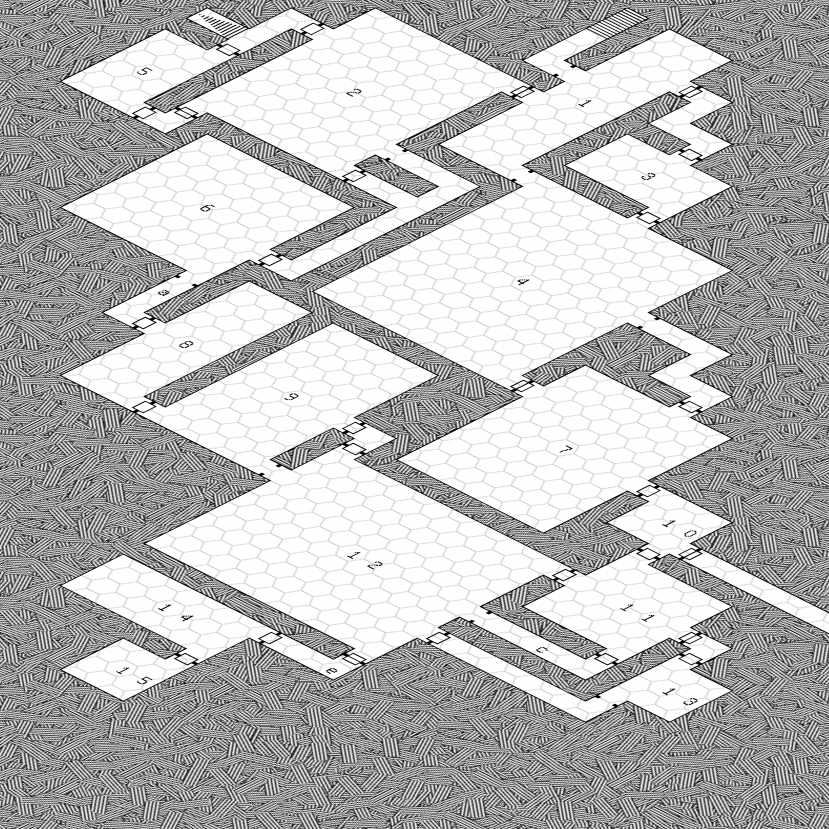
The band’s ‘lair’ is an old and now abandoned mine building. The stairs in the top left lead down into the collapsed mine tunnels. The rest of the rooms were once store rooms, workshops, dormitories, kitchens and all the other supporting services for a working mine.

The GM can dress this place as they see fit.

Much of the complex is still unused.

  1. This hall is used as both kitchen and mess hall. The corridor leading off of here ends in a natural chimney that draws the smoke from cook fires away.
  2. The centre of this room is set up for sparring and martial training. Around the periphery are assorted weapons, shields and armour that the band have accumulated over the years.
  3. These are the private quarters of a warrior.
  4. This is the groups main living area. Along one wall is an odd assortment of stolen furniture that is used for storing non-cash loot.
  5. This is the healers private quarters.
  6. These are the private quarters of a warrior.
  7. This room contains barricades and wall shields the group could use to defend their home should they ever need to. Invaders would be permitted to get this far and no further.
  8. unused
  9. unused
  10. The entrance hall is serving as little more than a tack room for the bands saddles and tack. The actual mounts are kept outside in a corral that is hidden from easy discovery.
  11. This room is piled high with junk. There is a way through but it is difficult to spot. The intention is to make it easy for band members to pass through but create the impression that the way is blocked to the untrained eye. The sort of thing they have done is lean bunks and pallets over the openings so there is no line of sight.
  12. This has been turned from a workshop into a gym for the Thief and Monk to hone their skills.
  13. The private room for a monk.
  14. This is the private chamber for a scout or thief.
  15. The thief’s walk in wardrobe.


The players should meet the brigands outside of their lair. They [the brigands] will attempt to size  up the party before deciding if they are a good target or not. If they decide to rob them then they will wait until the party are a long way from the nearest town or village and then try and steal their horses in the night. If the party look too tough then if they cannot steal them then they will kill them. Once the party are stranded then the brigands will try and pick them off. They never fight to the death. They know that as long as they can get home they will be healed up and can try again. Nothing is worth getting killed for.

The brigands can and will come back night after night and grind the party down if they have to.

Mobile Apps and RPGs

In the real world right now I am studying Android development and Java programming. As a roleplayer I simply cannot do this without thinking about how I could use this to make bespoke roleplaying tools for my phone.

I am also a big fan of open source software and freeware.

The only real problem with creating Rolemaster apps is that RM is such a closed system that ICE would never agree to anything open source that anyone could take, change, expand and share.

Anything I could create would have to be somewhat generic. The most generic of rpg apps has to be the dice roller and there are hundreds of those available.

Somewhere there is a middle ground of more useful than a dice roller but system agnostic enough to avoid the intellectual property rights belonging to ICE but also useful to the RM fan base.

Does anyone have any ideas?

Dyson’s Dodecahedron

I am truly terrible at maps. Thankfully one of the best fantasy cartographers I have ever come across is Dyson Logos. His blog, Dyson’s Dodecahedron, is an immense resource for maps including amazing isometric layouts.

This particular one…

Vault of the Ghost King

…is ideal for those of you of a Shadow World bent. The elevator just smacks of higher technology. To my mind even the spiral stairwell would quite possibly be beyond many cultures.

I am thinking of using one of Dyson’s maps for the session of fruitless searching that I mentioned last time. I guess that many GMs will have already discovered Dyson but I thought I would feature him anyway just in case there are GMs out there who have not discovered him yet.

You should certainly check the blog out.

An exciting long and fruitless search

One of the requirements of my unfolding story is that the party have a long and fruitless search for Randall Mourn in the Spiderhaunt Forest.

The challenge is how to make that exciting to play?

The adventure as written says that the party are pretty much looking for someone who cannot be found until the villain of the piece wants to draw the party in.

I am inclined to really draw this out with entire side plots and adventures rather than trying to emulate such a long search and then resolve it in a single weekend of gaming.

So here is a question for you all. If you were on a quest to find Randall Mourn would a period of side quests none of which actually find Randall be off putting?

Happy to bite the bullet

I have been thinking about game design a bit recently, triggered by the comments about realism vs abstraction. All game systems are inherently compromises between realism vs abstraction, complexity vs simplicity or rules ligth vs rules heavy.

I have seen a lot of articles that imply that simple rules and rules light go had in hand whereas the reality has in my experience been the opposite. If you have a very simple rule for each situation then you can easily end up with tens of hundreds of simple rules, one for just about every situation. AD&D is a prime example of this with just about everything being handled in its own unique way.

I have complained in the past that RM2 was totally inconsistent with the way it handled skills with different pricing structures for musical instruments and weapons to the way you buy martial arts to the way you buy most other skills. Some skills give +1 per rank and others +5/+2/+1/. Some skills cancel out penalties while others have built in failure penalties such as failing your quickdraw roll. The whole skill system is a hodge podge of different mechanics.

Intothatdarkness’s firearms rules sound the opposite of that in that they are based upon one core metric, the energy of the prjectile based upon muzzle velocity and mass which should mean that any and every possible firearm should be able to be modelled with just one mechanism. The firearms tables I have seen before worked on the idea of one table per ‘type’ and a mk 1 would be a very light version, mk2 would be a pistol, mk3 a carbine, m4 a rifle and mk5 some kind of support weapon. I think the idea of a table for pistols, one for rifles and so on makes more sense and most combats could be carried out with just one or two tables. so very little page flicking between combat charts.

Into is also using a 2 second combat round which is my preferred interval. Cutting a round down into such small chunks makes what is possible in a round more limited so and so player declarations become simpler. I like this as trying to protect someone while they spend 5 rounds trying to pick a lock can be quite intense under fire.

It sounds like Into has also solved the critical issue with firearms. Under bought and paid fore Spacemaster or modern day RM all projectiles were doing puncture criticals and soon enough every possible critical has been delivered and recieved and the excitement of ‘what will the critical say?’ is lost. By having a critical table by location rather than by weapon that should give loads of possibles.

I am not a fan of adding in additional rules but these sound right up my street.

Also relating to comments made this week Brian said that he had rolled all magic into essence and I am defintely heading in that direction myself the more I tinker with spell law. I definitely agree that magic is magic and the false barriers between the realms do not seem to add more than they detract.

Well, that is about the sum of my musings this week. It has been one of those weeks with no gaming on my part and the next planned session is so far away that it in itself is not stoking the fires of the imagination.

Pulling at loose threads

How many loose ends does your campaign have trailing behind the PCs? I have only been running my face to face game for a few years now, playing maybe 40 hrs a year or so and yet already there is a trail of loose ends, uncompleted quests and unsolved mysteries.

I have intentionally set up two concurrent story arcs. The point of having two is that I don’t want the campaign to feel linear or railroaded. One plot often interferes with progress in the other and the inter-weaved stories are richer and more complicated than a single story.

On the other hand too many loose ends do not add to the overall story, in my opinion. I think that too many loose ends can leave the players feeling frustrated and for the GM more balls to keep in the air if he is to keep tabs on every loose end.

Something I learned from solo rpgs is to keep a log of plot lines or more accurately loose ends. This simple technique first of all made it blatantly obvious how many loose ends there were. It also made it pretty easy to plot in mopping up these loose ends as I prepped future sessions. I am not saying that you have to nicely clean up every loose end in the very next session but when an opportunity presents itself it can be very fulfilling for the players to finally track down  loose end.

For the GM it can also mean less work. Why create a new assassin when there is one in the characters’ history already? My player characters are hanging around a 50 mile radius area and bringing people back into the story is pretty easy right now.

It isn’t just me that says keep the total story lines count down. Look at classic sci fi and fantasy TV series and although you may get a different adventure every week you rarely ever get more than one over arching story arc that spans from episode to episode.

I have no idea if there is an optimal number of story arcs to have in a game but I bet it is more than one would expect. When I started thinking about this I thought the right answer is two but that I think is way too low a number.

Firstly one needs the main campaign plot. I also think you should have a side plot to stop it all becoming to linear as I mentioned above. Each PC should probably have a story arc that comes from their character background and I would say that each character should be able to spawn their own story arcs, most PCs do not start out wanting to become a lich lord or whatever but the GM should be be able to accommodate those that are compatible with the game.

I make that two story arcs for each player and the campaign. That also fits with that is happening in my campaign now.  Or to be more exact, I have more than the twelve (five PCs and the campaign times two) story lines  and loose ends and that is why things seem somewhat crowded and my players often forget who did what to whom and why.

The forgetfulness could be middle age but having too many plots, NPCs and clues floating around certainly doesn’t help.

01,00,66

I missed my regular post last week as I was away on one of my gaming weekends. This time I got to play my 1st level Lay Healer as well as GM my Forgotten Realms game.

I have been accelerating my players progress so far and this time at the en dof th esession they finally broke 5th level. This is where I wanted them to be and now the game starts to get serious.

There were a few interesting things that came up over the weekend.

Firstly is the sequence of dice rolls in this posts title. I really, really try not to fudge dice rolls. roll in the open and my players know that.

Any weapon, in any combat those three numbers you really do not want to come up in that order. That was the one and only contribution to a combat by my Hobgoblin chieftain with his ‘trusty’ scimitar. You can work out for your self what happened to him.

I have been working on pushing the limits of how big a force you can throw against low level characters before the sheer number of random rolls will overwhelm them. If you have twenty archers then the odds are that one will get an open ended every single round (I haven’t done this, it is just an example).

The party were making their way up a single track goat trail into a mountain range. They were approaching the tree line when up ahead they could see a flock of monstrously large birds dive bombing something out of sight. The elves in the part could see the birds taking to the air again with dripping lumps of meat in their talons and eat rising bird was being mobbed by the other members of the flock. One character has no maths skill at all so for him there where ‘a great many’ birds. The other elf was better educated and put the number between 70 to 80 individuals.

The creatures were Gorcrows and I had used them to replace the Stirges specified in the original D&D module that was the backbone of the adventure. The birds were feeding on some horses that they had killed. The horses were an important clue for the players as they were looking for a lost patrol and these were their horses.

I wasn’t going to throw 75 beasties at the party in a single shot. I had a few Gorcrows spot the party and break away. This gave me 15 to play with against 5 characters. The birds circled a bit like your classic vulture and then first few peeled away to dive into the attack. These first few were dealt with using a sleep spell. This gave the party some confidence that they could tackle them. The next wave was 5 or 6 gorcrows and a combination of sleep spells and thrown weapons brought them crashing to the ground. Finally the third wave of 7 dived down to attack, too many to sleep even when fast casting without prep. A few got through the barrage of magic and thrown weapons but the birds didn’t stand a chance. A few hits of damage were done here and there a single A crit.

The fight and scent of fresh blood had attracted the attention of the main flock. As the party saw the cloud of birds turn into a stream angling towards them you have never seen players evaluate their options so quickly!

The used what cover they could find to hide them selves from the birds (who fell upon their fallen comrades) and made their way into the next valley where they had their first encounter with wild magic. This is not too dissimilar to an Essence storm.

Wild magic can produce a great number of different effects and have different manifestations. This particular one was very large and actually covered the entire area that the main adventure was going to take place in, several square miles of mountain range. At the first encounter all they got was tingling feelings and hairs standing up on their arms or the back of the neck but as they continued they saw the full scale of the anomaly. In game terms they started to recover power points almost by the minute. The further in they got the more power they regained. It was only when they tried to cast a spell that things were not so good. Every spell cost no power to cast but it did deliver a Stress critical equal to the spell level (1st = A, 5th = E and a 6th would have been an A + E critical).

As a GM my objective was to make the players seriously consider each and every spell they cast. It certainly did that.

The adventure I was basing the session on had two major features, the first was a terrible D&D style trap that had no connection the time or place that the adventure took place in and a collection of monsters.

The monsters were supposedly in a sealed tomb that had not been disturbed for 300 years before a landslide revealed the entrance. The doors were magically sealed so no monsters could wander in from outside.

I removed everything that should have starved to death. This left just one encounter that the players fully understood and chose not to engage in. As it was with magic doing as much harm to them as to anyone they were attacking that was probably the right answer.

I was worried that this would be an anti climax but actually the players enjoyed a relatively easy win for a change and a nice clean “we had a task and we completed it” session.

The next encounter was another mass battle. one thing had lead to another and the players know they have to meet someone in a monster infested forest. Everyone one knows this is a monster infested forest and the party are well armed and provisioned.

We had the players trying to ambush and war band of goblins and hobgoblins while they [the goblins] were trying to set up an ambush. The goblins spotted the party so decided to set an ambush. So the party were trying to sneak into position when the goblins got the drop on them.

I had about 30 goblins to play with but I decided the chief would not commit his entire force against just 5 travellers. So 12 of his toughest attacked the party. The party reverted to type again and sleep spells flew about willy nilly accounting for over half the attackers. Once melee was engaged the superior level of the party soon took its toll on the goblins.

I then allowed the party to turn the tables on goblins. The odds were 18 to 5 or more realistically 18 to 4 as one of the party is a non combatant. The result was again more goblin mince meat.

All of these mass battles were really won by the parties use of sleep. They have two casters who can cast up to Sleep VII. In addition the party are now feeling more confident in their own abilities and starting to work more effectively as a team.

The party are all now 5th level and I think at this point they are growing into their strengths, the sorcerer is starting to diverge from the warrior mage who is diverging from the elemental warrior and so on.

Next time though they will need to find a new tactic as the monsters will be getting significantly tougher!