One of the areas that AI like Chatgpt can excel is generating fantasy languages. Not just word emulation, but grammar rules. I’ve been playing around with expanding the vocabularies that have floated around Shadow World books since the original Iron Wind, with a focus on Iruaric and Kugor (the language of Dragonlords). I start with uploading the current available words from the Master Atlas to create a baseline for the AI to work from. Kugor was interesting since it seemed to relate to, or draw, from Norse or Scandanavian influences. I’d be curious if that was intentional on Terry’s part.
The following is a basic first run with a sampling of results:
Kugor
Kugor appears to have a rich tapestry of words, with distinct sounds and themes focused on power, nature, elements, and societal structures. We’ll create new words that reflect and extend these themes, ensuring they’re phonetically aligned with what you’ve shared.
Given the established vocabulary’s emphasis on strong consonant sounds (like “g,” “k,” “r,” and “b”), use of double vowels for emphasis, and thematic focus on elements, creatures, and societal roles, the new words will follow suit.
Nature and Environment
Storm – Raathuon
Volcano – Shaangarn
Iceberg – Raathkarn
River – Biarkael
Valley – Karnbrod
Meadow – Prykachaw
Sun – Utumkodur
Creatures and Beings
Wolf – Drayn
Eagle – Kodry
Serpent – Ssovalg
Giant – Hoerkarn
Witch – Womuulga
Wizard – Womawga
Societal and Conceptual
King – Folmgaak
Queen – Folmgaakur
Hero – Breyaalc
Villain – Gartgaath
Treasure – Utumwomul
Curse – Gaarkchaur
Objects and Artifacts
Sword – Daagutum
Shield – Aalkaed
Book – Cuivagak
Potion – Rúansig
Crown – Aedfolm
Jewel – Eanwomul
Actions and Properties
To Conquer – Druskarn
To Betray – Gartkraaw
To Celebrate – Brechaw
To Enchant – Womuulchort
To Discover – Uscurackarn
To Heal – Prykawomul
Additional Vocabulary Expansion
Natural World and Geography
Thunder – Raathlyyg
Lightning – Piriig
Forest Glade – Chawlocha
Ocean – Aactoskuur
Mountain Pass – Karnny
Volcanic Ash – Shaangdes
Creatures and Beings
Sea Monster – Aactosdrak
Mountain Spirit – Karnorg
Forest Guardian – Horlyalc
Sky Serpent – Awduussoi
Ancestral Ghost – Androskhomul
Societal Roles and Constructs
Chieftain – AWkanga
Sage – Fawshrydrul
Craftsman – Arxduleer
Emissary – Druulkaag
Rebel – Ordir
Concepts and Abstract Ideas
Oath – Kodulryt
Exile – Iirmord
Alliance – Chaaggagur
Ritual – Yhomechooth
Prophecy – Koduldrul
Objects and Artifacts
Rune Stone – Orguscurac
Heirloom Sword – Daagutumleer
Enchanted Cloak – Womuulain
Druidic Staff – Uscuractarmen
Ship’s Figurehead – Progaorg
Actions and States
To Envision – Piriidrul
To Enchant – Uscuracchort
To Forsake – Gartord
To Illuminate – Piriolias
To Reign – Kangaoran
I think this is an encouraging first step! AI tools will actually build rules around verb and adverb usage, conjugation, gender use and perspective. My own usage is around building a word toolkit that is phonetically related to the baseline and generating compound words and short phrasing. However, someone with a deeper understanding of language building could really run with this.
We’ve already been working on a central repository for non-commercial Shadow World artwork, it would also be helpful to create a wiki dictionary with expanded lexicon of the more prominent languages. I’m simultaneously working on Iruaric which I’ll post up next, but the Elven languages might be very interesting given Terry’s initial work in the Tolkien setting.
Again, as a disclaimer, I understand the concern and issues around AI generative material, but I also see powerful tools able to expand on Terry’s work without a disruption of canon.
I was reading James recent blog over at Grognardia, and it made me think about the current state of this blog and what topics to write about in the future. While James has written more posts (orders of magnitude more), I’m currently sitting at 426 posts over the last 10 years. That’s not bad considering I’ve had lots of downtime and gaps in my output.
Also like James, it’s harder for me to find new material to discuss and/or I realize I’ve already written on the topic years ago. I always thought it was odd when someone would tell me they couldn’t remember how old they were (it tracks now that I’m in my 50’s), and it can also be difficult to remember what I blogged about five, eight or even ten years ago! I think I’ve mined some interesting angles with Rolemaster and Shadow World, but I’m not sure where else I can go with this. Inspiration will occur, but I suspect at a much slower rate.
So where does that leave us? RMU is finally out (mostly), Terry has passed leaving Shadow World indeterminate, TTRPG’s are as popular as they have ever been, and there are numerous channels to explore gaming topics. What conclusions can we draw from these basic observations:
The environment is right to promote Rolemaster/RMU. The system is still one of the few “complex” systems for gamers looking for more verisimilitude. Just like in the early 80’s, players converted to Rolemaster for greater realism or grittiness. Those conditions still exist today–most games embrace simplicity and “rule lite’ structures; there will always be a need for complexity for maturing gamers. It’s a cycle. We need a blogger to cover RMU rules and issues.
Shadow World is still a viable setting for Rolemaster and with a bit of tweeking, RMU. I’ll continue to focus on SW as my main blogging topic, and continue to produce material for that setting. I’m currently focusing on using AI tools to leverage that effort.
In general we need more writers with other viewpoints, ideas and material to contribute to this blog. If you prefer long form over short tweets or discord give blogging a try. There isn’t much RM blogging out there, so it might be better to consolidate output into the Rolemasterblog?
Overall we need to keep the Rolemaster flame lit. RMU has drawn new users and brought old users back. When they search the web they need to find a home, content or a community to engage. Basically there are 3 choices: Rolemaster Forums, Rolemasterblog and RM discord servers.
Sometimes it’s hard to gauge engagement when there is a lack of comments–so let me ask directly. What do you like to read about? Is there material or topics that we haven’t touched upon? Is there something we should focus on more? What material would you find more engaging or comfortable commenting or participating in?
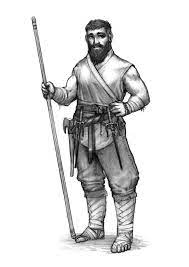
It’s been a long time since I’ve played a character in Rolemaster. Early on I became the GM and have filled that role to this day. But when I did play it was usually as the Warrior Monk “Caylis” (who later became a regular NPC in my Shadow World campaign). In general Monks have been problematic in RPG’s–with some cool abilities but lot’s of weaknesses and shortcomings. Like many of RMs professions, the Warrior Monk was drawn from the templates D&D provided.
Some memorable special abilities in D&D include “Feign Death” and “Quivering Palm”, neither of which made the translation to RM. Due to RM’s lack of inherent professional abilities, RM’s Warrior Monks were just unarmed fighters with a few low cost skills like Adrenal Defense and Adrenal Moves. So unless you play a spell-casting Monk, you didn’t have much for special abilities and had some limitations:
Inability to wear armor or be encumbered to utilize Adrenal Defense
Martial Arts were arguably not effective against animals and much larger creatures.
No parrying.
Martial Arts have to be developed in Ranks, so the most effective Rank 4 will lag in development (and skill bonus).
Early rules did include some options for quick strike, multiple attacks and engaging multiple opponents and also had rules for Weapon Kata so Warrior Monks had some increased combat abilities, but were basically slightly less effective fighters. While I still am a fan of Warrior Monks they definitely had their limits. So where do Warrior Monks fit into Shadow World?
Fortunately, Terry incorporated both the Warrior Monk and the Monk into a famous monastic institution: The Changramai Monastery. As Terry notes in Emer I, the Monastery is more of a school and training center than a true monastic or religious organization. Nonetheless, the Changramai were renowned for their fighting ability and the school hires out skilled Changramai to serve as bodyguards throughout Kulthea. To be hired out, Changramail need to have achieved at least the “Third Veil” which is around 10th lvl.
There are a number of references to the Changramai in Canon with which we can construct a better picture of the Changramai. Some mentions in the books include:
The Nomikos Library used Changramai extensively as guards throughout the facility. Nomikos Changramai are 6th lvl.
The Nameless One is protected by 4 Changramai.
The “Black Velvet” Brothel also uses Changramai as guards.
Kyan Kim is a named NPC and trained in the Changramai school, living in Eidolon. He is 8th lvl.
The Monastary was established in 2500 Second Era. “It is believed that the Changramai are disenchanted Xiosians who left the service of the Titans”
Terry introduces a new special weapon: the Jata. This is a thrown, circular, 3 bladed weapon that has virtually magical properties to attack multiple targets AND return to the thrower.
There are a number of other references of powerful figures in both Eidolon and Haalkitaine that use Changramai for guards. The implication is that they are either very competent, or so feared that they are never tested. But how does the realities of the Warrior Monk profession stack up to this reputation? Throughout the books, Changramai are described as “imposing”, “intimidating” and:
Changramai monks can catch arrows, run on walls, leap incredible heights, punch through stone walls, and defeat half a dozen well-armed foes simultaneously with their bare hands.
Are fearsome experts at unarmed combat. It is said that they can see things invisible and know a liar by his voice.
Certainly Monks, with their spellcasting ability can perform some of those feats, but are Warrior Monks truly that adept? If you look at Changramai stat block, the typical Nomikos Changramai is 6th lvl, has 90 hits, AT1 with a 90DB and has a 90OB using MA Strikes R4. Depending on your liberal use of Adrenal Moves, Warrior Monks would be hard pressed to “punch through stone”, “leap incredible heights” or “catch arrows”. As an added comparison, using Jaiman stat blocks, a Erlini Sentinel is 5th lvl, has 85 hits, AT1 50DB and a 90OB is Short Sword. Really not much of a difference. Changramai are basically comparable to many of the rank and file warriors in the Master Military Tables found throughout Shadow World books.
Of course those are rank & file. We would assume that the Nameless One, or Haalkitaine Royalty would engage higher level Changramai as befits their position, status and wealth. But even higher level Warrior Monks are just going to comparably scale up by level in comparison to Fighters. They still won’t have those legendary abilities ascribed to them, or attainable by Monks via their spell lists.
But if you want to “Punch Up” the abilities of Warrior Monks, or just the Changramai Warrior Monks, I would offer up a few of my own solutions:
I eliminated the development Ranks for Martial Arts and instead use the Ranks as the effectiveness of the combat style. This is similar to the size limitations found on in the various Claw Law attack charts. The Changramai and Kortri Ta Shiin styles are Rank 4; lesser unarmed combat might be limited at Rank 1, 2 or 3. This represents the superiority of these fighting styles and reflects the deadliness of the Changramai combat system. Removing the Rank skill development also frees up a TON of DP’s for Warrior Monks to expand in other skills.
I allow for parrying with martial arts–no bracers needed. If parrying is really a proxy for an offense or defense posture, than even an unarmed combatant can emphasize active dodging/defense over a full attack.
I use specific weapon modifiers, unarmed combat has very low modifiers for initiative, engaging multiple opponents and attacking and engaging targets in 360 degrees. This gives martial artists a implicit advantage over weapon wielders for a variety of combat situations and allows them to engage multiple opponents with the least amount of penalties. This chart also includes penalties for parrying missile weapons–allowing Changramai to swat arrows away!
I’ve modified Adrenal Defense and rolled in the “Yado” secondary skill. This allows Changramai to not only parry missiles but to catch them.
I use a modified Adrenal Strength and Speed that further benefit martial artists.
I have unlimited skill rank development and a modified rank bonus progression that allows for characters to accelerate a few skills through focused development. The creates a tradeoff between average development of a broad array of skills or fast development of a smaller, focused set of skills. This seems appropriate to a unique combat school like the Changramai Monastarey.
Finally, I use a “no profession” system to my Shadow World campaign. Changramai Monks are neither “Warrior Monks” or “Monks” and have access to the BASiL Mentalism “Self” Spells. With these lists and the changes above, the Changramai skills are complete, indeed they are powerful as depicted in the Shadow World books.
Have you utilized the Changramai in your game? Have your players ever faced off against them or perhaps have Changramai training?
I’ve blogged about the various, unique aspects of Shadow World as a setting, but today I thought I would note some very specific things that differentiate Shadow World and are great additions to the game.
Favorite Familiar:
Tameki. Introducted in the Cloudlords of Tanara, Tameki are small animals resembling black Terran housecats. Tameki have short, silky blue-black fur, large blue or violet eyes, and upstanding triangular ears. They differ from cats in that their paws have longer, dexterous ‘fingers’ and their torsos are slightly shorter. Very acrobatic, these small creatures are able to leap amazing distances.
Obviously cats are featured a lot as Wizards and Witches pets, but Tameki are just enough that they feel familiar and different enough to add flavor.
Favorite Material:
Keron. A black, very shiny alloy. The substance is strong but flexible and holds a keen edge. When polished it has such a high luster that it looks wet or oiled. It does not corrode, and should be treated as enchanted.
I don’t use alchemy spells in Shadow World to enchant item bonuses. Instead I rely on Kulthea’s naturally occurring metals and alloys that can be forged by smiths. (Thus, I don’t need to have groups of 30th level Alchemists working in sweat shops batching out Laen or Eog items). Keron is Shadow World’s “Mithril”–a cool material that is intrinsically tied to the setting.
Stone/Mineral/Gem:
Bloodstone. A soft, sandy stone dark red in color, this material can stop a would bleeding up to 5 hits per round! In seconds. This is often overlooked, but what an incredibly valuable stone. Better than a herb or a spell, portably and rugged.
Baddie Critter:
Gogor. Not unlike gargoyles or huge bats in form, Gogor are black as midnight, with tough hides and leathery wings. They stand about 7 feet tall. Their heads are elongated with a certain reptilian appearance. Huge, protruding green glowing eyes see in complete darkness.
I’m a fan of all the artificial and specific “monsters” in Shadow World, but Gogor are a good foe for a capable group. My players have some remorse from opening stone jars found in an ancient facility. What they hoped was treasure….
Special Weapon:
Kalta. A Loari Dart Pistol with a 10rnd clip. Very cool, practical, and not game changing. I’m a fan of small projectile weapons and thrown weapons. They add a coolness factor to combat, are a unique skill for players and they don’t impact game balance.
Riding Animal:
Kith. A giant six legged panther? Sign me up for that!!!
Cool Item:
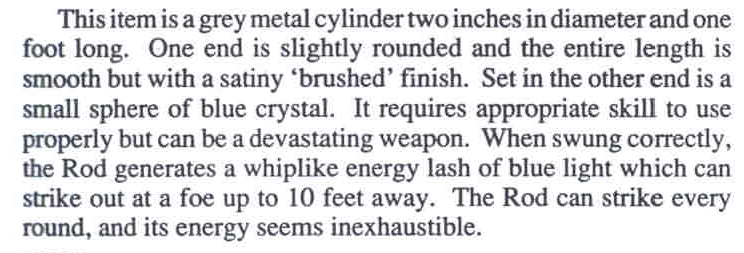
Rod of Tanys. Not magic, but a tech remnant, this grey metal cylinder is 2″ diameter and 1 foot long. No it’s not a light saber, it’s a “power whip”!!! There A LOT of cool magic items that Terry has created, but I like the cinematic nature of this weapon.
Favorite Practical Spell:
Warning Portal. Found on the Warding Power list in EMER and SWMA, this simple spells allows the caster to set a magical trip wire across a portal. If someone crossed the barrier, the caster is alerted. This is a 1st level spell. It’s practical, reliable and needed in an adventuring group. I’ve been working on BASiL warding spell lists, and this good spell design.
Those are just a few of my favorite things. I found that on each re-read of the SW books I found something new, something I forgot or a new idea is sparked. Are there any particular things in Shadow World that appeal to you?
If you are like me (mid 50’s) and have been playing Rolemaster and using Shadow World since it’s release in the late 80’s, the publication of the Emer box supplement was a huge step forward for the Kulthea world setting. By 1990, there were over a dozen Shadow World products, but until Emer, only 2 were written by Terry: Shadow World Master Atlas and Jaiman: Land of Twilight. The other 10-12 products were by third party authors. While all of them have their strengths as game supplements, they were generic adventures that were shoe horned into the game setting and did relatively little to expand world building.
Before I dive into my thoughts on Emer, let’s quickly review where “Canon” was in 1990 and the two Terry products mentioned above. For the most part, the Shadow World Master Atlas (SWMA) was fairly generic, establishing a few SW tropes: Navigators, Loremasters and Dragonlords but mostly was meant to connect Rolemaster to a useable setting. These elements were kernels of ideas from the Loremaster module series and expanded and built off of that early material. The Flora and Fauna book was mostly generic creatures straight from Creatures and Treasures and covered all the basics from standard D&D. The timeline was only 2 or so pages and didn’t add any depth that the later Emer regionals provided.
If the SWMA set the table for the setting, Jaiman was the meal. Clearly not a regional book as it was titled, it nonetheless brought a specific tone and style to the setting. A lengthy adventure tied various elements together and promised a larger world (The Grand Campaign took this further), cool “dungeon” style tombs embraced Terry’s architectural background and fused high tech elements in a fantasy setting. It was light medieval fantasy but there was a hint of darker things: Evil Gods, Unlife and enigmatic Lords.
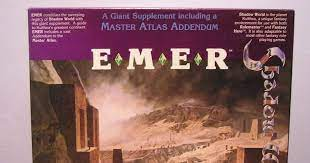
In my opinion, Emer brought a whole new vibe to Shadow World: more mature, more grimdark and more malevolence. One aspect that contributed to the look and feel of Emer was the artwork. You can’t talk about the Emer box set without referencing the incredible box art done by Les Edwards. I suspect that art launched hundreds of adventures and sold many on the Shadow World setting. Prior to his death, Terry even planned on carving the City of the Dead out of the Emer IV supplement to give it it’s due. For more Les Edwards art; interestingly, he did the cover art for the fighting fantasy books by Ian Livingstone who IIRC did one of the Shadow World fantasy fiction books?
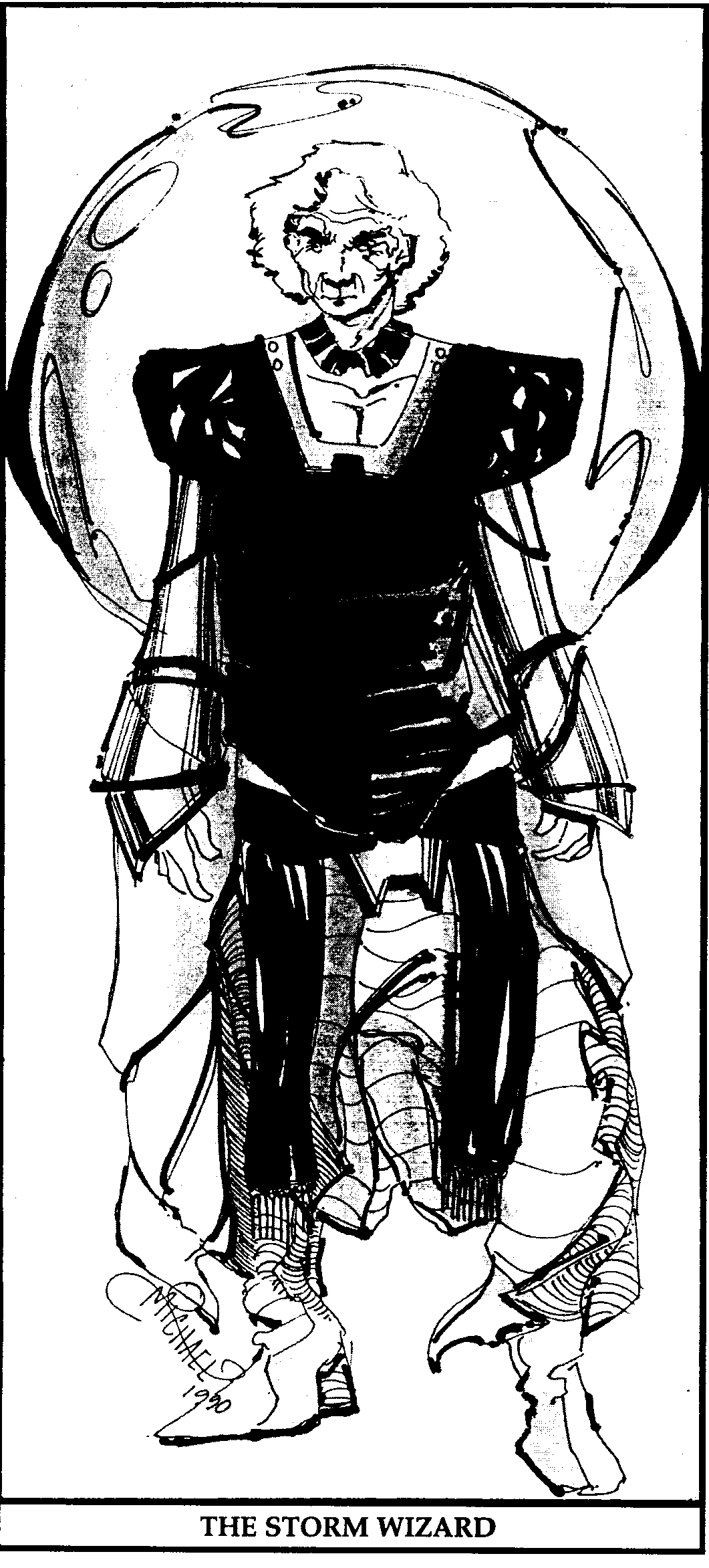
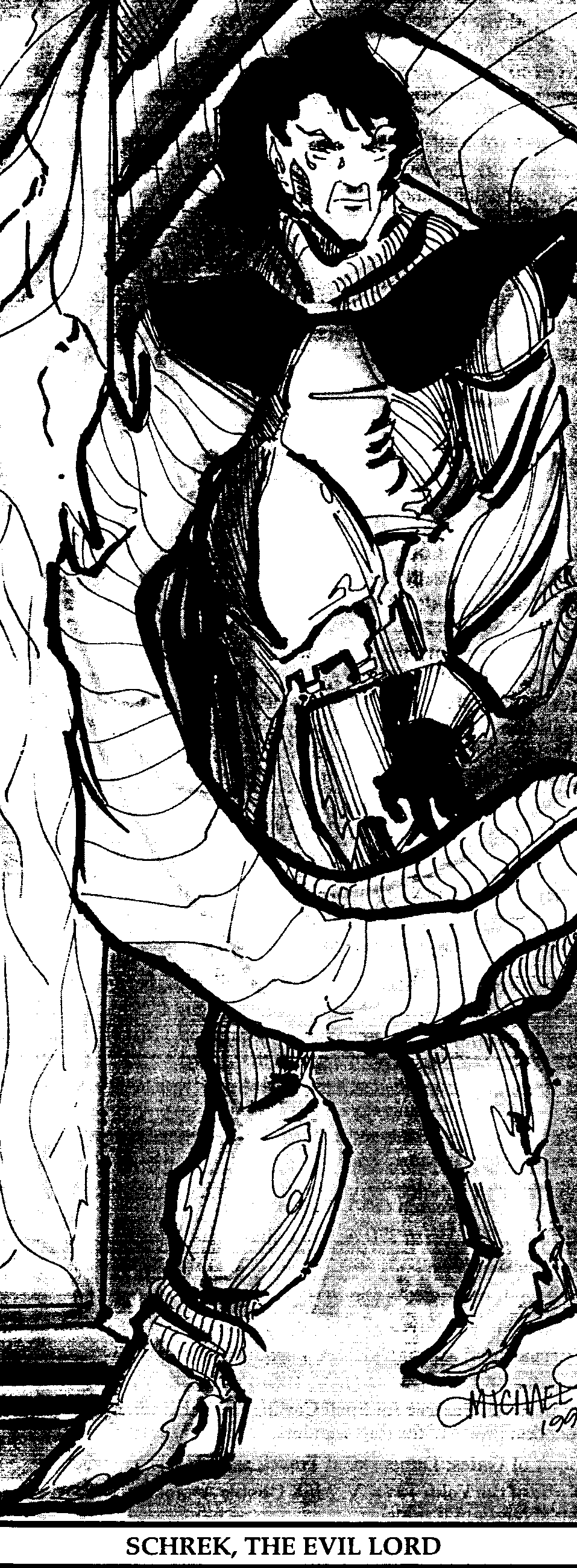
Besides the box cover, the interior art was different than that found in SWMA and Jaiman. This piece appears to be done by Michael Alexander Hernandez. It feels modern, perhaps even futuristic but foreboding. It certainly lent a different tone to the setting from previous books.
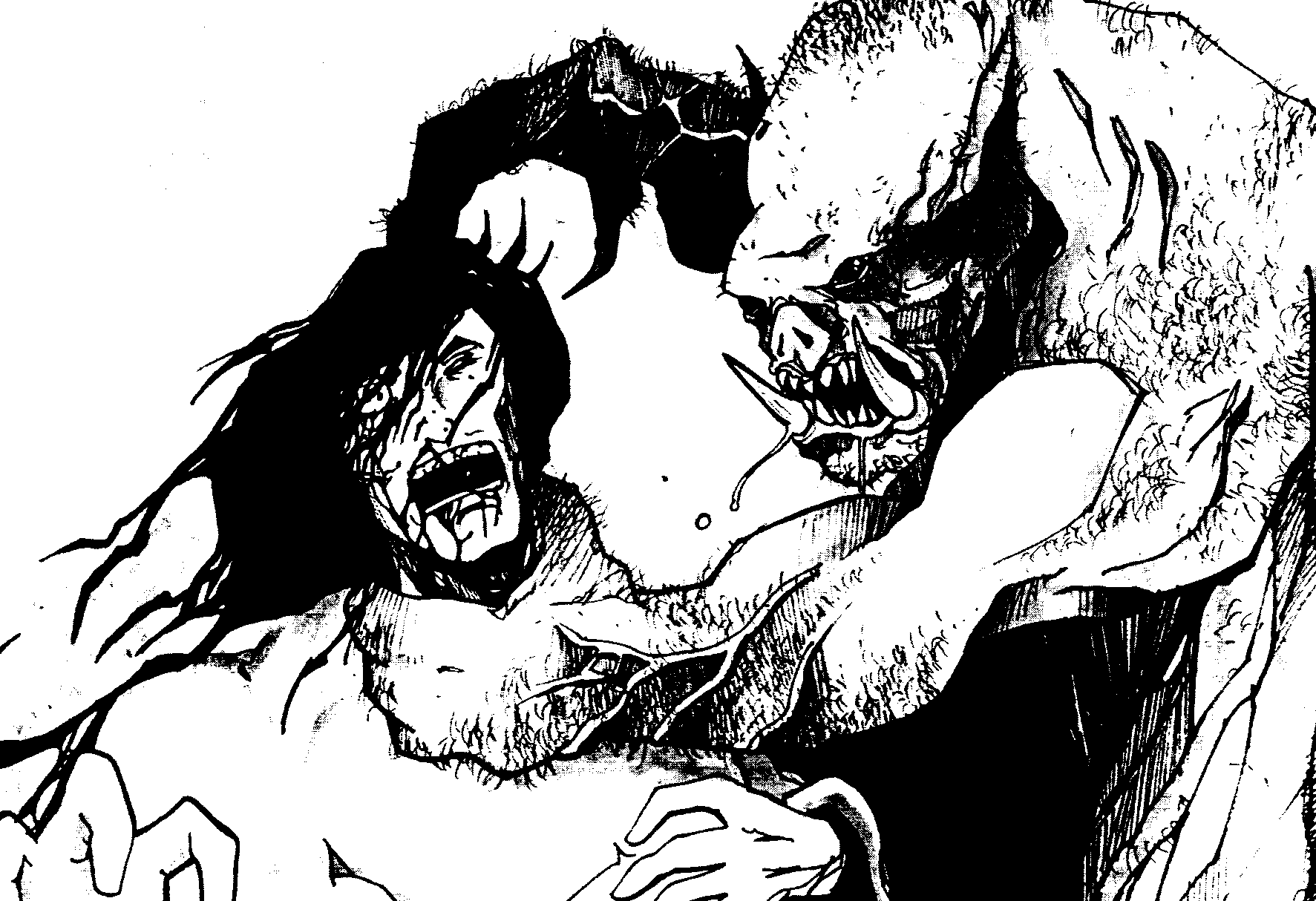
This piece doesn’t seem to have an artist signature, but it’s in the same style. While B/W, it appears to have a Lugrok tearing into the victims skull…is that rivulets of blood on his face?
History of Emer
The timeline and history of Emer introduced several powerful factions: the Jerak Ahrenrath, the Eight Orders and the Masters of Emer. In further work, the Masters have sort of disappeared, but the Jerak Ahrenrath and the Eight Orders become integral to the wider plots of Emer and the future of Kulthea itself. For me this is entirely new material that expands the Canon; none of this material was seeded in the earlier Loremaster series nor hinted at in the SWMA, so it was a delight to read and shifted my view of the setting–for the better.
Flora & Fauna
Again, Emer added to canon with some new plants and creatures. As I have argued, SW needs more of this and less Terran standard critters and plants to help in game immersion. One of my favorite (if you’ve read Priest King you’ll know this):
It’s important to note, that many of the Canon SW books introduce new flora and fauna, but these weren’t all included in future Atlas’s. For instance, the Shalish, Frask or Boerk were never included in SWMA 3 or 4. I believe I compiled a full list of plants/creatures from all of the core books to be included, but I think it’s a failing that they weren’t included in MA’s.
Races
With a new canvas to paint and a huge land area to fill in, Terry was able to expand on the races found in Shadow World. Of note are the Kuluku. Most of the new Emer races seemed to finalize the racial types found in all later books.
Geography
Part V of the main book covers the various regions which, like the rest of Kulthea are wide ranging in styles, cultures, topography and climate. The Essence Flows are given less credit for this phenomena, and I think that the later de-emphasizing of the Flows as Barriers was a lost opportunity to reinforce a key element of the setting.
This section is further expanded in the later Emer regional books and all, if not almost all of it, is found in those later books. (except for the pending and final quadrant Emer IV)
For me a few takeaways:
Kaitaine really needs it own supplement. From the glassed roof grand marketplace to the Palace of the Bankers.
Krylites are very cool and make a better foe than Orcs.
Part XI (slight spoilers)
I recall reading Emer for the first time and it was this section that really shifted by view of Shadow World. The Jerak Ahrenreth, the “Secret Circle” and it’s history became a more compelling plotline than some abstract Dark God or Evil NPC Magician. A dense world spanning history tied the past with the present made this evil and twisted cult the long term antagonist(s) for my Shadow World campaign. Much of the material seemed familiar and is reminiscent of the Court of Ardor (but that’s ok, cuz that was cool too)
The Circle of 8, the Adherents and the cool citadel layouts are Terry at the top of his game.
ATLAS ADDENDUM
The second book included in the Emer Box Set is the Atlas Addendum and this is where all the new material and cool stuff can be found.
Part I is a grab bag of topics and delves into world awareness, the nature of “good” vs “evil”, more details on other planes, and even advice on modifying Navigator charges.
Part II is the extended timeline, specific for Emer and greatly expanded in later books.
Part IX Places of Power includes a number of magical, mysterious and relevant places in SW. Most can be moved around and used anywhere. My f
Part VIII and Part X:Other Powers& Goodies
But the Jerak Ahrenreth wasn’t the only power introduced in Emer. Terry introduced is to the Eight Orders of the old Emerian Empire, let by Aldaron (a nod to Star Wars?). There is great material here, either as foils for the group or as possible back grounds for the players. And there are Yarkbalkas! We also learn about the Storm Wizard, who is retconned in later work and his 4 mysterious Storm Heralds.
The Dark Gods
Perhaps the biggest addition to Other Powers is the inclusion of the Charon pantheon, the Dark Gods. Of course this is a major expansion to the setting and impacts the metaphysics of the game, channeling and future SW products.
Artifacts& Lost Technology
Often time we buy and read supplements for the “goodies” and not necessarily to use in gaming. NPC stats, fortress layouts and cool magic items. The Emer box set delivers in spades with a good list of artifacts and notable items. I believe that most of these were never incorporated into later Master Atlas’s, so the Emer Box set is the only source for this material. Notable items include (finally…) the Ilarsiri, the Starsphere, the Leafblade, a number of books which I missed in my previous blog, powerful staves, and a slew of Lords of Essence items. Also included is the Lense of Strok, which was my McGuffin for my high level adventure series: Legends of Shadow World.
Other bits. Terry also threw is a more comprehensive look at magical materials, some Warding and a few other Spell lists and pretty good Encounter Table that I used for my version.
So why is Emer Box set worth a look?
It appears that only Emer III is currently available on DrivethruRPG. The Emer book will provide an overview over the whole continent–including Emer I & II and the pending Emer IV.
While the material was included and expanded on in Emer I-III, it was a better template than that used in Jaiman. (Assuming Xa’ar is Jaimain: NW; Wuliris is Jaiman NE; Tanara is Jaiman SE and Haalkitaine is Jaiman SW). A broad overview of a continent with smaller regional supplements seems a better format.
The addendum was the precursor to the desired “Artifacts and Technology” supplement that Terry always hinted at. There is cool stuff in this supplement.
It leaned further into the fusion of scifi and fantasy.
It established a globe spanning danger that could anchor any long term campaign.
Combined, the SWMA and the Emer Atlas basically “fixed” core canon material. Besides some smaller regional powers, some expansion on the Jinteni and some discarded ideas (like Jewel Wells) the framework is all there for future work.
Like many SW products, the Emer Box Set will never be reprinted. Perhaps the Addendum could be republished as a PDF? Or even better, a Master Compendium could be collated from all of this disparate material.
Ultimately, the Emer Box Set was the maturation of Shadow World as a setting, laying the groundwork for all subsequent material.
It never fails that I when I go through the various SW books I find something that “slipped through the cracks”. Sometimes it’s a reference to a Loremaster that is never listed anywhere else, or a herb that is brought up once and was never included with the master list of herbs and poisons.
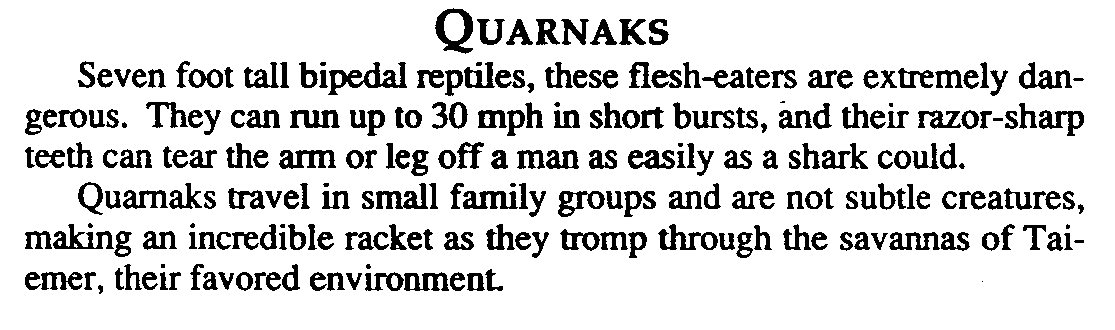
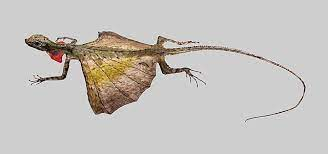
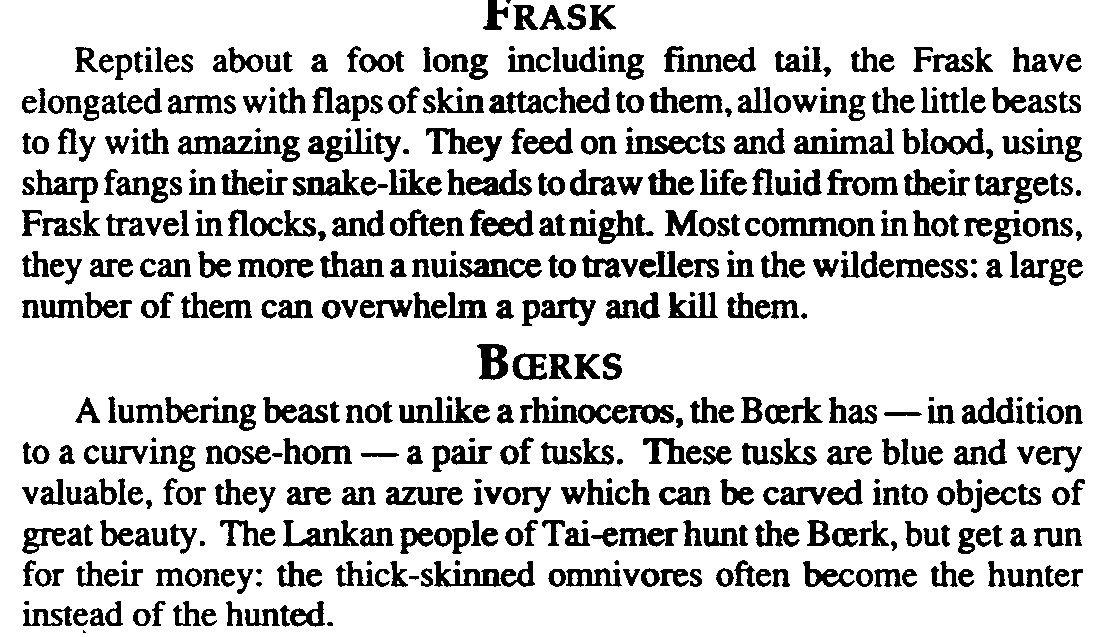
I’ve been going through the original Emer: The Great Continent boxed set as part of a review and I found these two critters:
I’m a firm believer that the Shadow World setting needs to lean into specific creatures, races and “monsters” and not rely on generic fantasy creatures like skeletons, vampires, orcs etc. So I rather liked both of the creatures and especially the Boerks “azure ivory” which is a great addition to the list of valuable trade goods and special material to be included in alchemy and magic item creation.
I checked for these creatures in Emer I, II and III, Master Atlas 3 & 4 but can’t find them. Did I miss it? Were they renamed and I skipped over it?
It’s been 5-6 years since I blogged about a new encompassing Shadow World “Master Atlas”. Since Terry’s passing it’s unlikely that we might see it, but most of the material is there, ready to be collated and reorganized, and new material fills in gaps without altering Canon.
I thought it was worth revisiting now that RMU is being rolled out. I don’t think it would difficult to move RM stats and rules to a support supplement and make the setting rule agnostic.
One of my favorite Shadow World blog topics is examining the unique elements that makes SW my choice of setting and showcases Terry’s creativity. I firmly believe that if Shadow World were to continue it should be a “2.0” version that embraces key elements, eliminates some generic tropes and also allows for SW to be used in other game settings–and adapted for RMU. That’s sounds like a tall order, but I don’t believe it requires a significant amount of new material, just a strong editorial pass.
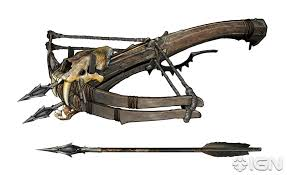
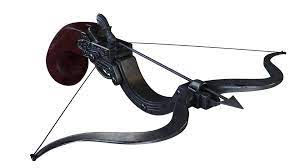
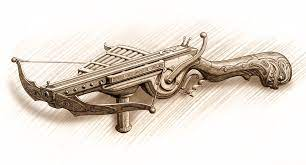
Shadow World already has cool, cultural weapons, but they aren’t emphasized. In this blog I wanted to talk about the various cool dart guns and crossbows that are sprinkled throughout Terry’s work. Given the various tech levels in Kulthea and access to unique and superior materials, it’s possible to standardize some of these weapons to add to the atmosphere and uniqueness to the setting. So, instead of using a generic “light crossbow” the player or NPC may use a “Dyari Handbow” or a “Janak Springbow”.
So let’s look at a few crossbow weapons found in Shadow World.
GoldenEye Eye of Nygoret.
A beautiful light crossbow, of mahogany with a golden alloy bow (+15) and a special spring mechanism that allows it to be re-cocked quickly and fired every round without penalty
Kedrick Bularis.
Double Crossbow: A compact weapon that nevertheless has the full range and power of a full-sized heavy crossbow, it also has two stacked bows and twin triggers. Thus, two shots can be fired before reloading. There is a ‘safety’ switch, and a device also holds the loaded quarrels in place, so the bow may be carried primed and loaded.
Sulfean Kuldir.
Dart Gun: A curious, baroque affair, it looks like a contorted pistol of some kind. It is fashioned of a variety of fine metals and woods, and fires tiny metal darts with the same effectiveness as a Light Crossbow at 1/2 hits. It holds clips of 12 darts, and can be fired 2x a rnd
Wurliis.
Heavy crossbow with four ‘bows.’ Can fire one shot at a time, two shots at the same target (each at –5) or all four shots at one target (all at –10) before having to be reloaded and cocked
Kalta:
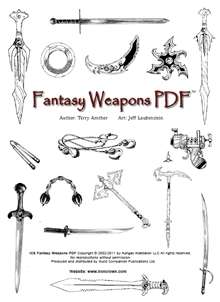
Featured in the Rolemaster Fantasy Weapons supplement. Loari Dart Pistol. Fire 2x/rnd (missile & melee). Can be poisoned. 10 dart clip. (Also used by the Prince Guard in Eidolon)
Per the descriptions, none of these devices appear to operate due to magical properties; instead they are just technologically advanced. I’ve started assigning different types of crossbows to certain cultures rather than the generic weapons found in Arms Law. This is just a small part of Shadow World, but one that should be expanded on.
Has anyone come up with their own unique, cool weapons?
Despite it’s reputation as a “kitchen sink” setting, mostly due to the inconsistent tone set by third party authors, I’ve always thought Shadow World had a unique feel driven by Terry’s artistic sensibility. I’ve written about the Many Flavors of Shadow World before and I’ve always appreciated the blends of genres: fantasy, sci-fi, anime and even goth and horror. Despite my own lack of interest in standard fantasy tropes, I acknowledge that there is still huge interest in the “Dark Lord/Dark Master” trope in roleplaying and pop culture.
Luckily, Terry has included this trope in many parts of Shadow World! Putting aside Lorgalis and other “Dark Lord” NPC’s in his fleshed out works of Emer and Jaiman, the Master Atlas outlines some other parts of Kulthea that might be readily adaptable for a traditional “Against the Darkmaster” style campaign.
Where might one look? Wrangôr
Per the Master Atlas:
Wrangôr: This is a realm of Lugrôki (Orcs), and Lugrôk-hybrids, the result of centuries of captured slaves being interbred with the Lugrôk population. This has created a race smaller than the true “High Lugrôki” but able to function during the day as well as at night. They are no less ugly, however. This program has been under the Dark Master, a shadowy dictator who, with his War Troll guard, resides in a citadel outside the port city of Vashtak. The “Dark Master” of this realm is a Dyar Elf, a powerful Mystic who rules through terror and brute force—concepts which the Lugrôki understand all too well.
This is the only substantive reference to Wrangôr in any of the books, typical of the short summaries found in the Master Atlas. Wrangor is located on the eastern part of Thuul, the continent west of Emer that is begging to be fleshed out! It’s proximity to Emer’s southern reaches makes it accessible to adventures based out of EMER book III.
In short, if you enjoy the straightfoward nature of an evil Kingdom and a mysterious Dark Master, Shadow World has that too!
I’ve written dozens of blog posts about my thoughts on the future of Shadow World and now with Terry’s passing, it’s unclear if there is even a future for the setting. Of course, there are many RM users that have no interest in Shadow World and there are other settings that might not fit quite neatly into the world. But that’s true for any setting; I have no interest in the Forgotten Realms or Tekumel (although that setting is intriguing for it’s “alienness”!
But now we are at a crossroads. RMU is being rolled out without any supporting setting or adventures; Terry won’t be writing anymore material; and yet, TTRPG’s are more popular than ever AND building a new world setting for any game system has a high barrier to entry for anyone.
Look at the cover art for EMER. Wow. Look at the material Terry has written over 30 years. Again
How might Shadow World survive or even prosper now?
An aggressive re-statting for RMU.
A d20 version.
A flexible game license for writers to place their adventures in the Shadow World setting.
An editorial schedule of micro-adventures, modules and regional books over a 5 year horizon.
While some resources would need to be deployed (art, page layout and editing) much of this framework is already in place. I wrote about this HERE in early 2021….
I’m not a big believer in “production by committee”, but we already have a core group of productive resources that could be deployed. Rolemasterblog has proven consistent material for over 8 years, over 70 adventure hooks and multiple publications. I’ve written extensively about Shadow World and have posted up quite a bit of SW material here and on the RMForums. My brother Matt (Vroomfogle) is the Shadow World moderator at the RMForums, was the architect and project manager for the SW Players Guide, was the early primary author for RMU Core, ran the Nomikos library, and was a participant in many RM products in the 2000s.
There is a roadmap of ideas, products, role-out and support–what do you think?