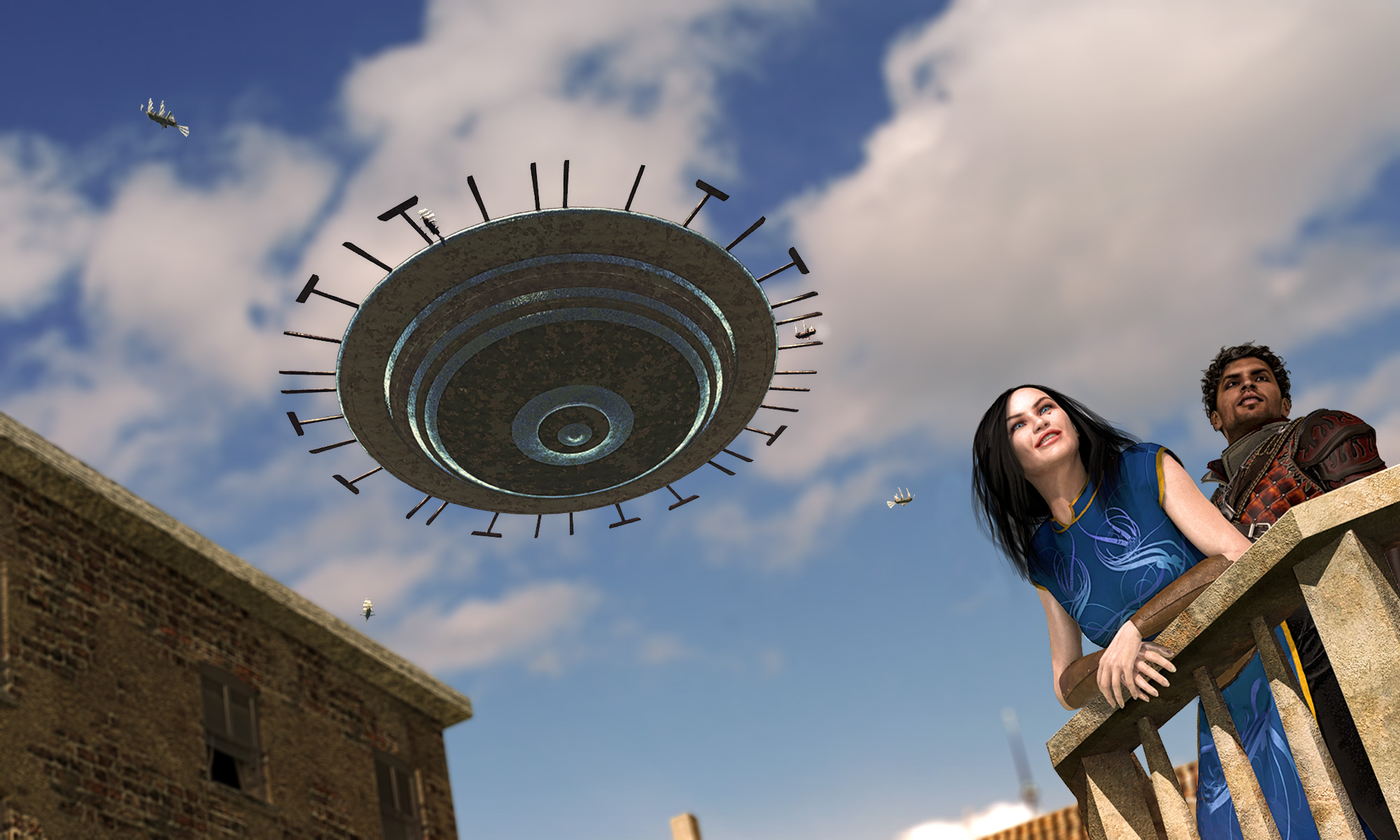
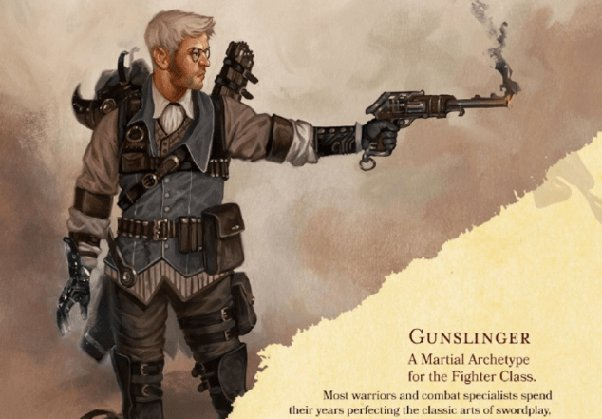
It’s no secret that Shadow Worlds history encompasses a vast range of civilizations with “technological levels” ranging from Stone Age tribes to advanced post-physical societies. Terry often stressed that magic and high technology could often be indistinguishable and most of his SW books contain high tech items. In between those two extremes are a spectrum of technological advancements that are found scattered throughout Kulthea: the lightning guns used by the Krylites, the airships and barges designed by the Elves of Namar-tol and even bicycles that are appearing around Eidolon.
But one tech period is rarely found on Shadow World: civilizations and tech based on chemical reactions and the use of fossil fuels. More specifically, gunpowder and the advent of explosives and guns.
The fusion of guns and magic have become a popular theme in fiction, but Shadow World has some built in roadblocks that seem to prevent widespread use. In the Master Atlas we find this:
Gunpowder: The secret of this potentially devastating tool is far from being unlocked, by even the most advanced cultures on the Shadow World. The power of magic has stagnated any desire for a chemical explosive, and the mysteriously fluctuating effects of the Essænce can have a transmuting effect on chemical reactions.
I expanded on this a bit more in my own SW campaign:
The “Viir” seems to fundamentally change both ionic and covalent bonding for molecular and macromolecular structures. In practice this energy field is distorting chemical interactions and material structures most acutely—
In short, the Essaence is disruptive to chemical reactions and/or Magic itself precludes the need for such technology. Why invent a grenade when many people can cast a Fireball or Firebolt?
Personally I like the mix of tech and possible settings that can be found in SW, and introducing guns and related tech can add a new element to gameplay. So how can explosives be introduced to Kulthea:
Outsiders. Kulthea has been explored by off-planet visitors. Some have arrived in spacefaring vehicles while others via “portals”. If they have explosives or munitions they might be reliable–for some period of time. Either you could argue that their chemical properties are stable due to their production off-world, or that it takes time for the Essaence fields to corrupt their potential.
Demons.The Fifth Pale is a nightmarish place of industrial technology gone mad. Smokestacks and gigantic refinery-like superstructures fill this world, which is constantly enveloped in a luminous steam. The rhythmic wheezing of bellows mixes with the clatter of gears and the roar of engines. Foul pools of chemicals, theiroil-slicked surfaces aflame, illuminate open-scaffold elevators, steel mesh platforms, and large, baroque machines of incomprehensible function. It’s seem common sensical that Demons from this realm could have guns, explosives and munitions.
Tinkerers & Alchemy. Expanded alchemy rules and perhaps a tech based profession (not using spells) can provide an avenue for guns, explosives and other violent delights. Of course, Kulthea based chemistry should not be reliable, but really, isn’t that half the fun?
4. Those damn Elves! Of course the Elves in Namar-tol are experimenting with chemical based combustion, explosives and projectiles. Here we have it, the beginning of it all:
5•45: Emer: The Lankan Empire sends a small fleet across the Circular Sea from their port of Kûru-kal, with the goal of seizing the northwestern Loari isle of Surt Naduum. The first warboat barely reaches shore before airborne Loari battleships appear and drop exploding canisters—“ bombs”—on Lankan ships. This marks the first known use of chemical explosives since the Interregnum. The Lankan ships are destroyed and the few Lankani who reach shore are captured. Námar-Tol sends a warning to the Lankani that any further aggression will be met by overwhelming force.
I’d be interested in your take on guns, gunpowder and explosives in your own SW game!
I had a few messages regarding my most recent post on Earthwardens & Dragonlords, so I thought I would revisit another of my SW topics: the Xiosians. I’m reposting this from a Feb 2018 entry with some changes.
One of the more dense and information rich sections of the Shadow World Master Atlas is the timeline. By the 3rd Edition of the Master Atlas, the timeline has reached 25 pages and would be much longer if it incorporated all the local and regional timeline material found in other SW books. In any event, the timeline is a rich resource for a GM, not only offering unlimited adventure hooks but providing endless opportunities to explore Kulthea in different times. Sprinkled throughout the time though are many unanswered questions, cool hints and vague references that Terry has yet to explain or explore in detail. One of my favorite: the Xiosians.
Xio (I. Shield) Cadre
def. A monastic warrior cult formed in the First Era by the Ka’Ta’Viir ruling families to use as loyal household guards and special forces. The Xio combat techniques became the foundation for most other martial forms that followed.
(P. Xiosians a.k.a. Xo, Xso, Xsosians)
The Xiosians were first mentioned in the original Master Atlas: Warrior-Priests that were servants of the Masters of Emer and rode flying magical chariots. In Emer I we got a few more pieces of the puzzle with several mentions:
Warrior-mages on huge steeds begin purging the wilds in central Emer, driving out the ubiquitous Gark and Lugrôki hordes. These knights are harbingers of the coming of the Masters.
They rule through an order of warrior-mages (the Xiosians)
It is believed that the Changramai are disenchanted Xiosians who left the service of the Titans (In fact, some are…
I thought this sounded like another group of mysterious warriors that fly on magical steeds and purge the wilderness: The Cloudlords of Tanara.
I wanted to tie together a number of loose ends: the origins of the Changramai martial culture, ancient militant orders with ties to the Althans/Ka’ta’viir, mysterious warrior cults and the genetic origins of special warriors like the Cal-chah and Guarlu. I had an idea that tied them all back to the 1st Era.
The Althans and the Ka’ta’viir are primarily an advanced intergalactic imperial society. But there is also a strong oligarchy element of immensely wealthy merchant families. It’s not a leap to assume that both leaders and powerful “Houses” would have their own security force to provide defense, corporate espionage and personal protection. This is not an original idea. The Romans had their “Praetorian Guards“, the Emperor had his Royal Guard, and in Dune every Major House had it’s own army, formally independent from the Emperor‘s own military forces. (the Dune setting fit’s well with the Althan/Spacemaster/Kulthea dynamic).
History:
Few organizations in the Shadow World’s early history have had a greater impact on the development of Kulthean martial culture. The Xio Cadre were the personal bodyguards of the Ka’Ta’Viir during the First Era. Originally Althans, the Xiosans pursued aggressive eugenics programs and genetic and physical modifications to create the most adept warriors in the Althan Empire. Too few in number to be an effective military force, the Xiosans became an extension of ruling Ka’Ta’Viir political power. While serving primarily as bodyguards, Xiosan Cadres later became a symbol of personal wealth, extravagance and power among the ruling families.
Initially one central organization, the Xio Cadre grew into several dozen Cadre “Temples” each under the patronage of a particular Ka’Ta’Viir family. Over time the temples reinforced patron loyalties and developed distinctive styles of dress and appearance. While Xio warriors were adept in modern combat systems, the Ka’Ta’Viir would have their Xiosan guards attend public ceremonies in distinctive cultural garb: shining armor, swords and flying mounts that played upon Althan classical mythology and heroic memes. Xiosans warriors performed in elaborate athletic and martial performances during Ka’Ta’Viir social events and were used to mediate family or business disputes in proxy combats. A few individual Xios became celebrities in their own right, either through martial or athletic prowess.
The Legacy of the Xiosans:
Scattered remnants of the Xio Cadre survived the First Era: either with their Ka’Ta’Viir patrons in cryogenic hibernation, or were off planet during the worst of the conflicts. During the Interregnum, refugee Xiosans merged with indigenous cultures or established new settlements, slowly diluting their singular genetic traits. Still, interbreeding passed along many beneficial aspects of the Xio physical traits: the Zedrahin, Zor, Udahir and Shay all possess some of the size, physical characteristics and strength of the Xio warriors. It is believed that pure Xiosans still survive in the Eastern hemisphere with their Ka’Ta’Viir Lords, but out of a dozen Cadre Temples in the West only a handful of facilities and warriors survived:
Vale of the Merisia. The abandoned Sunlords Temple in Tanara still held armor, weapons and the offspring of their Steardan mounts when it was discovered and occupied by a Rhakaan expeditionary force during the Second Era. Using the equipment they found, the Zorians assumed the role of the mythical “Cloudlords”, emulating their Xiosan predecessors.
Changramai Monastery. The Changramai monastic order was a rebirth of the Xio discipline. The monastery was built upon the bones of a ruined Cadre temple. The Halls are intact, but the knowledge to access the security door has been lost. (The key is interred with Master Changramai).
Votania. Sun Cadre. The Masters of Emer built their palaces alongside an abandoned Xiosan Cadre Temple. The Masters repopulated the temple with their own servants. Adopting the flying chariots and weapons of the Sun Cadre.
Western Thuul. The Temple was reoccupied in early second era by a splinter group of Xiosans. They attempted to build a new settlement on Barzu-chaa (South Eastern Thuul) but the City-State was destroyed after conflict with surrounding cultures. The surviving Xiosans fled: some moved permanently to the Cadre Temple located in the Sullen Mountains while others fled east to the Gufu Rainforest where they are believed to be an offspring of a lost giant race. While still large of stature, most of the surviving Xiosans are a product of mixed heritage and have lost many of their defining physical attributes.
Mur Fostisur. The Mountain Enclave of the Udahir was originally a Xio Temple. Now the Udahir and their flying mounts occupy the vast hold.
Scholars whisper of a darker chapter in the Xiosan history. It is rumored that some Xiosans were ultimately bent to the will of the Unlife and became its most feared warriors: Heralds of Night. More chilling stories are spoken among the Loremasters: that Kadeana performed experiments on her own Imperial Cadre. Six and sixty Xio warriors she used for her most terrifying creation: Shards.
{Note: Terry actually establishes that Kadaena created the Shards via “Elor’s Text. MA 4th Ed. p.192. It’s logical to me that she would use her “super soldier” Imperial guards in that horrifying experiment!}
The Ka’Ta’Viir were not naïve to the physical threat of the Xiosans. Their proximity to the inner sanctums of the Ka’Ta’Viir and the Lords’ own paranoia made them cautious. Part of the genetic modifications included behavioral conditioning: Xiosans cannot attack a Ka’Ta”Viir and indeed had to submit to their will. Additionally the Xiosans were made more susceptible to the Essence (which only the Ka’Ta’Viir controlled at that time) and they themselves were not able to tap the powers of Essence.
PHYSICAL TYPE: Tall, muscular, black hair, dark eyes.
MOUNTS: Lesser Black Dragons
ARMOR: Dark red poly-steel armor and seamless visor less black helms.
WEAPONS: Laser Pistols, Energy Swords
NOTES: Less ostentatious than the Cadres of the lesser ruling caste, the Imperial Cadre were the personal guard of the Empress Kadeana. Their training center was a closely guarded secret and the Cadre rarely participated in ceremonial displays. Despite Kaedenas defeat by Doenku and the Soulsword, the Imperial Cadre had already made a pact with their mistress. In a lengthy process, the Imperial Cadre volunteers became immortal servants in a new incarnation: that of the Shards. The Cadre Commander, Shar-Bu is now lord of the I-Lat.
CADRE: SunLords (Xio-Kygar)
PATRON: House Tessananta
LOCATION: Vale of Merisia, Tanara Jaiman
FOCUS: Althan Classic Mythology
PHYSICAL TYPE: Tall, muscular, blond, blue-eyed.
MOUNTS: Steardan.
ARMOR: Golden Plate & Greaves
WEAPONS: Hand Axes, Sunswords
NOTES: This abandoned facility still held armor, weapons and wild Steardan when it was discovered and occupied by a Rhakaan expeditionary force during the Second Era. Using the equipment they found, the Zorians assumed the role of the mystical “Cloudlords”, emulating their Xiosan predecessors
CADRE: Lightning (Xio-Pizik)
PATRON: House Terra
LOCATION: Changramai Monastarey, Choak Mnts, Emer
FOCUS: Martial Arts, Athleticism, Adrenal Focus
PHYSICAL TYPE: Varied.
MOUNTS: Anti Grav Bracers
ARMOR: Black cloaks, Black Masks w/yellow bolts.
WEAPONS: Changa,
NOTES: The Lightning Cadre were perhaps the most dedicated to the physical arts. Athletic ability, acrobatics and unarmed combat were the focus. The cadre put on elaborate displays of martial prowess combined with amazing ariel feats using their anti-grav arm and leg bracers. They could seemingly “fly” through the air.
CADRE: Claw (Xio-Raax)
PATRON: House Centarus (still exists as a powerful trade and banking conglomerate…)
LOCATION: Mur Fostisyr
FOCUS: Berserker Troops.
PHYSICAL TYPE: Large, dark-haired, and heavily muscled. Claw Cadre was feared for their combat prowess and mercurial nature.
MOUNTS: Fire and Ice Dragons.
ARMOR: Spiked Plate and Force Armor.
WEAPONS: Over-sized battleswords. In modern combat they wielded heavy laser cannons and disentagrators.
NOTES: The Temple was discovered and settled by the Udahir but had been looted long before.
CADRE: Steel (Xio-Tok)
PATRON: House Letrati
LOCATION: Votania, Emer
FOCUS: Deception, misdirection, subterfuge
PHYSICAL TYPE: Tall, dark hair, grey eyes, light skin
MOUNTS: Anti-Grav Chariots
ARMOR: Grey Armor, Chamelion Cloaks
WEAPONS: Wide leaf bladed short swords
NOTES: The Masters of Emer built their palaces alongside a Xiosan Cadre Temple. It’s not known whether any original Xio pledged service to the Masters or the Temple was repopulated by others.
CADRE: Onyx (Xio-Uxya)
PATRON: House Thorenian
LOCATION: Sullen Mountains, SW Argyla
FOCUS: Tribal, Physical Form, Animalistic
PHYSICAL TYPE: Dark skin, silver eyes, silver/white hair
MOUNTS: Kith
ARMOR: Silver metallic armor, Jewelry
WEAPONS: Black Laen Longsword & Shortsword
NOTES: The Temple was reoccupied in early second era by a splinter group of Xiosans. They attempted to build a new settlement on Barzu-chaa (South Eastern Thuul) but the City-State was destroyed. While still large of stature, most of the surviving Xiosans are a product of mixed heritage and have lost most of their defining physical attributes.
Obviously, playing a pure Xio warrior or even a partially full blooded Xio could be unbalancing. But I incorporated 2 significant drawbacks for Xio: behavioral inhibitors against Ka’ta’viir and the inability to use Essence and an increased susceptibility to Essence effects. Of course, a player with only a small amount of Xio ancestry would have less inhibitors but conversely would have less genetic benefits as well.
CONCLUSIONS:
I like tying “current” Shadow World elements to the ancient past. Terry used the word “Legacy” a lot and much of the Shadow World story is tied to the Althans and Ka’ta’viir from the 1st Era. The Xiosians’ legacy can be found in the martial skills of the Changramai and the physical stature of many of the races found on Kulthea.
Two of my favorite elements of Shadow World are the Earthwardens and the Dragonlords. Both groups represent incredibly mysterious but powerful influences in Shadow Worlds history. Until the Xa’ar supplement, which delved into the origins of the Earthwardens in more depth, we only knew that both groups sprung up in the early Interregnum without further explanation.
However, it was the Dragonlords that really fired up my imagination but while they are ubiquitous in Shadow Worlds history, there has never been an “origin story”. It wasn’t until the Xa’ar supplement that a solution clicked in my head and tied up quite a few loose ends. I would cite the following excerpts from various SW books:
One such group actually became trapped in the event horizon of a singularity and suffered a time dilation of many thousands of years before they were able to escape.
These K’ta’viiri built enchanted places of guardianship to help protect these weaker races, and came to them as teachers and counselors. They would become the Earthwardens, and they inhabited the Shadow World for a period sometime between 70 and 50 thousand years ago, though almost certainly not for that entire period. Apparently after a time they felt they had done all they could, and departed again for space. However many of their structures survive, some of an enchanted stone, and some—like the Coral Roads—are living legacies.
Note: This establishes that the Earthwardens are actually Ka’ta’viir that returned to Kulthea during the middle of the Interregnum period.
c. 1500: Founding of the Four Orders (Elder, Oak, Nya, Thorn), Elven animistic groups dedicated to protecting the natural order and combating demonic and other evil forces (demons remain relatively common,trapped in this plane after the Wars of Dominion; and within a few centuries the order will face the threat of the Unlife). The original founders are four remaining Earthwardenswho elect to stay behind. They do not divulge their true nature to their Elven followers; nor do they fully reveal the powers of the Isle of Lost Magic. They teach the ways of nature and related professions. Each possesses a staff of the named order, and they (and their Elven successors) are called the Guardians of those staves.
Notes: This establishes that not ALL of the Earthwardens left as mentioned in the first section above. Not only did they establish the Four Orders, there is a Druidic/Animistic legacy created.
re: Taranians. Over time they added settlements on other continents and connected to them via a high-speed underground rail system, which they referred to as the Subshuttle. Exactly why they went to the expense and trouble of constructing a tunnel system under the ground and beneath the oceans is unclear, but it is believed that either the skies were unsafe because of a proliferation of hostile creatures and/or beings,
Note: Something was happening on the surface that motivated the Taranians (and Worim) to build underground. Were Dragons ruling the sky and the lands of Kulthea?
There were only a few hundred of them, along with mates and offspring, but they decided to remain on Kulthea and do their best to restore their world to its former beauty. They would keep a low profile, remain aloof from politics and power, but they would aid the fragile peoples in need where they could. They built protected roadways, and constructed magical guardians who could be summoned to fight against the terrible demons that now walked the earth. They kept apart from the Jinteni and Wôrim and the Elves for the most part, and faded into legend as those civilizations rose. Like all the K’ta’viiri, the Earthwardens were powerful masters of Arcane Essænce, but in particular they were able to tap the Channeling power from the earth like few others. Thus they had great ability to manipulate nature as only the most talented Animists can today. Also, when they returned to Kulthea, they abandoned most technology in favor of Magic—though both were somewhat unreliable in the fi rst fi fty millennia or so after the fall of the empire.
Notes: The Earthwardens went from Arcane magic to “Channeling from the Earth”. This should not be confused with Channeling from Orhan as it appears the Althans and Ka’ta’viir were unaware or perplexed by the Lords. “Channeling from the Earth” should be seen as a tapping of primal power from the planet: Flows, Foci etc.
Earthwardens, who spent most of their energy on rebuilding the planet’s ecosystem. They received unexpected help in that from the Fey Folk of Orhan: Naiads, Dryads, Oceanids and others. They came to respect these spirits and work in cooperation with them, though even they never fully understood the nature of these ephemeral creatures, created by the hidden Lords of Orhan.
Notes: Again, we see a collaboration between the Earthwardens and “Fey” powers. Very Animistic/Druidic.
Around 40,000 years before the beginning of the Second Era, most of the Earthwardens decided that their work was done, and wanted to resume their travels. Their ship had remained in orbit during this rebuilding, and they hoped to embark on a great journey to another galaxy. A handful—and their descendants—remained on the Shadow World to continue their efforts. A few survive on Kulthea to this day, but most have retreated to a simple, reclusive way of life.Some like to refer to themselves as ‘The Elders.’ One is the Storm Wizard; he was always the most talented at creating magical golems.
Notes. Quite revelatory! Here we see conclusively that “some” Earthwardens stay behind.
[ Andraax gives one of the Dragon Rings, the Daath Leerssoi (K. “Maker of the Shadow Drakes”) to Tev Yu’um, a Lotana Mentalist who is also a clanlord in the T’sai steppelands of NE Mulira. This ring allows Tev to assume the form of a blue Air Drake. It becomes apparent to Tev over the centuries that the ring has other powers than allowing its wearer to assume dragon-form: he gains knowledge of the Great Drakes—including their language—and is granted a lifespan akin to those creatures.]
Note: The Daath Leerssoi are basically the opposite of the Dragon Helms. They allow mortals to assume the shape of Great Dragons (while the Helms allow the Dragons to assume mortal form). But this is not just a physical change but imparting of knowledge and language.
[Yu’um knows that people are growing suspicious of his secretive ways and mysteriously long ‘lives,’ and he fears that he is losing the ability to control himself in Dragon-form.
Note. Using the Dragon ring risks him being subsumed by “Dragon-form”; becoming more creature. We should assume that this risk exists for the other rings as well. Are some Dragons in SW actually mortals lost to their rings power?
A Blue Dragon is spotted several times …. [It is in fact Yaalc Muul awakened, but his mind is unstable: most of the time he does not remember that he is actually human.]
And:
In dragon form now he is more animal than man, and he rarely reverts to his human state any more except to go back into slumber.
Note: Again, there is this idea that the transformation into Dragon kind subsumes a “humans” personality and memories.
Tev Yu’um was given one of the Daath Leerssoi (K. “Maker of the Shadow Drakes”) by Andraax. It is a ring that allows a human to assume the form of a dragon, with virtually all the powers and abilities of that dragon. He was given the Kodul ring, which transformed him to a Blue Air Drake: a fl ying dragon, but with a breath weapon comparable to those of the Great Drakes
Note: Here is is even more clear that the rings are akin to the Dragonhelms and the powers of a Great Drake.
Ssoiayig Saer (K. ‘Caves of the Drakes’ Birthplace’), the ancient secret breeding caves overlooking the Silver Scales Lake.
Note: A clue to the origin of Drakes? Does this ancient place preclude the idea that Dragons were another experiment of the Lords of Essence?
[The Dragon Helms are completed, and the Six gather. What they do not know is that Krelij, using the knowledge gleaned from Oran Jatar, has also made six rings. These rings, which he names the Daath Leerssoi (K. “Makers of the Shadow Drakes”), allow a human wearer to assume the powers of a dragon.
Note: The Rings are created at the same time as the Helms by Krelij.
So what should we make of all this?
Dragons, Great Drakes and Dragonlords were “birthed” sometime during the Interregnum and probably not a remnant of the 1st Era or a product of Orhan.
The Earthwardens slowly assumed new “earth and elemental powers” and worked with the Fey creatures and Elves to rebuild Kulthea.
Some of the Earthwardens stayed behind on Kulthea while the rest left about the same time as the emergence of the Dragonlords.
Around the time of the Dragonlords appearance, the skies of Kulthea became dangerous and non-terrestrial races (Taranians and Worim) were forced to build/hide underground?
The Dragonlords are avatars of Kulthean earth powers: elemental creatures that can “ride the flows” and control great powers.
There are magical helms and rings that have similar but opposite powers: one to turn Dragons into men and the other to turn men into Dragons.
RM Companion I references the “Ritual of Ascension” that allows a Mage to transcend into a Drake/Dragon.
Terry never circled the square, but is it reasonable to argue that the 6 Dragonlords were Earthwardens that underwent the “Ritual of Ascension” to become permanent guardians of Kulthea? After the Ritual the “nature” of being Dragonkind overwhelms their past memories and Althan/Ka’ta’viir background and they become more “wild” and elemental; even being construed to be “evil”. Certainly, some of the Dragonlords more than others, but as Terry notes: their motivations and behaviors are unfathomable to mortals.
That’s my theory and solution. Have any SW users come up with something else?
Note. This is a blog article I posted back in 2016. I wanted to revisit the topic again and add some additional thoughts.
One of the more distinctive attributes of Kulthea is the presence of Essaence Flows, Storms and Foci. I would argue that Essence Flow is the primary differentiator for the Shadow World, a setting often described as generic and “kitchen sink“.
From the original Loremaster modules, the back page blurb:
Clusters of islands and small continents dot the surface of the the world. Myriad cultures and peoples lie separated by sheer mountains, treacherous reefs, and the powerful but invisible Flows of Essence.
Churning like ocean tides under the Five Moons, the Essence ebbs and flows, its eddys and currents dictating unseen barriers and centers of power. Some have learned to trap that power.
Travel across the world is perilous, though some have made it an art: the aloof Navigators will transport anyone anywhere –for a fee.
For many, myself included, that blurb was the defining description of the setting. I’ve discussed the importance of other elements of Shadow World: the Loremasters, the Dragonlords and the Lords of Orhan, but the fundamental trait of Kulthea is the various manifestations of the Essence.
Essaence manifestations have shaped cultures and history, provided a raison d’etre for the Navigator Guilds and added a unique flavor to the campaign world. In the earlier Loremaster modules the Flows seem to be more ubiquitous; splitting and separating regions and isolating pocket cultures throughout Jaiman. Not only was this a great campaign hook, but provided a “sensible” explanation for the disparate cultures, races and even climates within a relatively small geographic area.
In later SW modules, the Flows seemed minimized and moved to the background. Early SW supplements often included regional maps of the flows while later books mention them but don’t specifically call them into the gameplay or narrative. I’ve talked to quite a few people who have used Shadow World for a setting. Each handles Flows in differing degrees:
Slight. The Essence Flows are invisible paths of energy that explain spellcasting and powerpoints.
Modest. Essence can manifest as energetic storms with some unpredictable effects.
Average. Flows can occasionally manifest as invisible “walls of force”. Essence Foci, while rare, are concentrated centers of energy. Travel is normal, with an occasional annoyance or impediment.
Strong. Essence Flows are a regular part of gameplay, but are generally atmospheric but duly impactful. Travel is a bit more difficult, but Essence obstacles are temporary or delaying rather than problematic.
Extreme. There are established, permanent Major Essence Flows that are physical barriers, random but frequent Essence storms that can have varying but impactful effects and Lesser and Major Foci that have significant impacts on gameplay. Travel is restrictive and will invariably require a Navigator or planning and routes will be determined by known Essence Flows.
I would guess that most players/game groups that have adventured in Shadow World would describe the Essence as falling somewhere on that scale. But I would also point out that many of the elements of Shadow World ONLY work with #4 or #5. If you are playing within #1 to #3, there probably is no real point (or commercial demand) for costly Navigators. I would argue that the Shadow World is unique as a setting the more potent and extreme the Flow of Essence are depicted! Essaence Flows should be seen as an essential NPC in SW campaigns: always present, unpredictable, and frequently impacting the storyline and gameplay.
Essaence manifestations can play a number of roles in gameplay and GMs should embrace this element:
Disruptor. A sudden and dangerous Essaence storm can change things quickly! PC’s or enemies may be forced to flee or find cover. Spellcasters may be drained of needed PP’s or find casting to be too unpredictable due to the fluctuating power.
Limiter. A temporary or permanent Essaence wall can block PC’s from travelling to certain areas that the GM is unprepared, too dangerous for the group to explore or to create an obstacle for the group to overcome.
Balancer. A Foci can provide PC’s with added Power Points needed to overcome a more powerful adversary or replace spent PP’s to allow the PC to continue the battle. An Essaence storm could hamper a powerful spell casting opponent or agent of the Unlife.
Re-locator. Essaence storms can have spatial or temporal vortexes to move PC’s to a new place or time! If you want to avoid a time consuming trip or introduce the PC’s to a distant point on Kulthea than a temporary portal could do the trick! Additionally, you could move the PC’s back or forward in the SW timeline!
Not only do Essaence effects add great flavor to the game but they inject a constant randomness that plays much different than typically fantasy RPG’s. If you aren’t maximizing the use of Flows, Storms and Foci in your SW game then here are a few suggestions and thoughts:
Make sure that Essaence effects are included in your random encounter tables. If you are using tables that aren’t SW specific or don’t have Essaence effects included, than replace a category with them. Or if there is a “No Encounter” result than use Essaence effects instead.
If you aren’t using random encounter tables than make it a point to include at least 1 effect per day to reinforce it’s presence to the players.
Remember, not all effects have to be serious. A faint odor of ozone, a “tingling” or a slight power surge remind players that they are dealing with an unpredictable and dangerous power.
The more Essaence Flows appear in your game the more helpful Navigators will appear. While “Jumps” might be prohibitively expensive, the PC’s will probably need to hire a Navigator to bypass an Essaence Wall or traverse a particularly dangerous route. This also a great money sink to keep excess wealth from accruing!
Many notable places (temples, fortresses, holy sites etc) are found at or near Essaence Foci. The Foci could have beneficial, harmful or unpredictable effects on magic within its radius or even different magical “rules”. (ie no Force spells, or double power Elemental effects) This can make an “ordinary” dungeon crawl into a unique adventure experience!
Essaence Flows also impact local and regional weather. Use that in your games–changing environment conditions can affect combat and travel, but also add significance to Animists, Druids, Magicians and Rangers that have outdoor and weather related spells!
Those are just a few ideas for maximizing the use of Essaence Flows, Storms and Foci in your Shadow World campaign. One last thought. I would recommend a book that came out in 1977 that I feel gives a small taste of what Essaence Flows could be like in your SW campaign. Check it out: Time-Storm by Gordon R. Dickson.
I’m curious how other SW GM’s are maximizing their use of the Essaence Flows?