So this is 2018!

I am really excited about 2018. We have a new ‘thing’ to look forward to and that is Nicholas’s Singularity. You should read the Directors Briefing for more.

Since November 2014 I have tried to post every Monday and Friday, sometimes I have missed a day but more frequently we and I have posted much more often. For 2018 I am moving my Friday post to Saturdays. The focus of this Saturday post will be publications. We have the 50 in 50 adventures in conjunction with Azukail Games. These tend to be released on a Saturday. In addition there is the Monthly fanzine which from this month’s issue will have a regular Shadow World section. To start with it will mostly involved serialising Brian’s downloads. I am 99.99% certain that I can twist Brian’s arm to write some new and unique Shadow World content going forward.

The next exciting thing is the new RMU play test game I will be running. I am using RPOL for hosting it. I created the game this week and I will be contacting the players later today to get their usernames so I can add them to the game. I am hoping this will be a rich vein of content for the blog. It has to be the rpg equivalent of “The proof of the pudding is in the eating.” It is one thing to be talking about what we think of this or that rule in RMU but to be actually playing it puts our money where our mouth is, so to speak.

So all that remains is for me to wish all of you a great 2018.

RMU Attack Tables

I have spent my down time over Christmas working on a spreadsheet to create attack tables in the most usable format we have seen so far.

The biggest issue with RMU for me has been the size rules. There were two issues really, firstly, in incessant math required to even work out how much damage an attack does. It may be relatively simple math but it is a mechanical step that slows down almost every attack. In fact it is more than one step as a quick calculation is needed to work out the size of the attack before the attack roll and then a calculation after the attack roll to calculate the damage. Size also still effects the OB and DB of the targets, according to Beta 2 but that may have changed and it then adjusts the critical.

My second issue with the size rules is that it looks like a solution looking for a problem. The same progression that is being applied via the size rules is being applied every which where regardless of whether it works or not.

On one hand the proponents that like the size rules are seeing this as an elegant solution unifying many disparate game mechanics. Those, like me that do not like the rules just see a bad rule wrongly applied.

It is possible that I am wrong, according to Mrs R that has happened before.

To that end, the game I am going to run this year is going to use the size rules but there are some attack chart layouts that have been suggested on the forums that precalculate the size shifts.

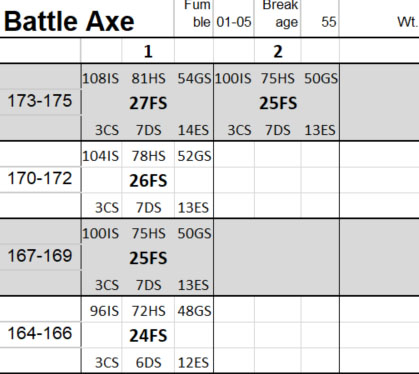
So stating in the bottom left with Diminutive, then tiny, small, the bold result is the medium, then the top row, right to left is big, large and huge.

That image is from the spreadsheet I am working on. Merkir from the forums has shared a Google Sheet that will generate attack tables on the fly for any of the standard weapons. If I paste that into my spreadsheet it then explodes every individual result into the seven displayed sizes. That takes away one of the game slowing steps.

Another option is that once you paste the Merkir table into the spreadsheet you can apply adjustments to it. So Rather than a short sword being a Dagger +1 size I can apply a +10OB shift to the Dagger table and then generate a dedicated Short Sword table. I can do the same for two handed swords so they are no longer Broadswords +1 size. This takes away one more size calculation.

I accept that magic and things like charging will always involve a size shift. I do not have a problem with that. I personally feel that +1 size for charging is a retrograde step that harks all the way back to D&D basic rules where a charge just gave you double damage. +1 size does basically the same thing and ignores 40 years of increasing sophistication and any attempt to model what happens in the real world. I am happy to accept the size solution as it fits nicely with my desire for fast and simple rules.

The sizes of the damage shifts in my tables do not follow the RAW in beta 2. As Hurin has pointed out the RAW favours smaller attackers by giving them disproportionate amounts of damage. The result being that rabbits being overly dangerous.

My tables will diverge slightly from the standard tables and it is all down to rounding. Normally if you were doing 0.4 of a hit in damage you would expect that to be rounded down to nothing. The problem with this is that all touch magic requires a successful unarmed attack that delivers 1 hit. If you have a small or diminutive spell caster it is impossible for them to cast any magic against a foe in AT 9 or 10. For that reason I have chosen to always round up to the next whole hit in damage. So if the Medium attack did at least 1 hit then at all sizes at least 1 hit will be delivered.

This puts my charts mostly towards Hurin’s toned down charts, without the killer rabbits, but fractionally above them so a bit from a rabbit will still do 1 hit if it hits where the Hurin formula would have rounded down to zero.

What I have left to do is mostly donkey work of copy and pasting my spreadsheet formula into hundreds if not thousands of cells. I cannot just fill the spreadsheet as the formula has too many nested functions that Excel cannot cope with updating all the references to the look up tables. As soon as I have something to show I will share some finished tables with you. How much I can share is a different question as I think I am really on the edge of the Beta NDA if I start sharing complete sets of attack tables!


Merry RMU Christmas

You will be glad to know that I am not actually here on Christmas morning writing a blog post. For me it is Christmas eve and family are all dozing on the sofa after lunch.

I am spending any boring moments reading up on RMU as I have not used it much. I have decided on a few rule choices and house rules.

  1. First up it is definitely a No Profession game.
  2. No Passive bonuses from skills such as footwork, running and Shields
  3. Stats will be point buy.
  4. Skill Costs, the 9/12 (Combat Skill #4 and Closed lists) will be 7/10.

Behind the scenes I have the combat tables spreadsheets from Merkir and Thrud from the forums. I will be using the 7 sizes on a single table, see this thread for an idea.  I need to make these tables but I will be trying to create unique tables for every weapon in use in the game. Related to the tables I will be doubling the basic #hits damage done by each attack.

That is all I have for now.

Merry Christmas to everyone! Have a great day!

Is it better to beg forgiveness or ask for permission?

Rolemaster Unified Character Law Cover

I know for certain that it is a damn sight faster to get things done if you just do it and then ask for forgiveness afterwards.

Here is my dilemma and objective. I spent last evening rereading all of JDales ‘New Tables’ thread to try and come back up to speed with RMU. The motivation is to try and put together a set of rules I am happy with that use the rules as close to what will be in the final released game as possible.

The cornerstone will be the No Profession profession as that is RAW. There are lots of things that I want to house rule and the problem is do you house rule and have a better game or do you play RAW and have a viable play test?

I am coming down on the side of house rules. ICE have had years of play test feedback and the impression I get now is that the rules are pretty much set. Even with house rules I would not be changing EVERYTHING so all that remains unchanged will be viable playtest feedback.

What I would like to do is play a game and then publish my impressions here on the blog. Now that is very dodgy considering the NDA but if I do not publish the rules as written, which is what I think the NDA is there to prevent, then I feel morally comfortable with that.

I would then want some players who are happy for the game to be publicly discussed although obviously they would not be discussed, just their characters and what happened in the game world.

The blogs would then cover character creation, the selection of the house rules and the official optional rules and how the game sessions played out.

I would run the game as a PBP so that I had a written record that I could then review for the blogs.

This blog exists in part to promote RM in all its forms so publicly promoting RMU has to be part of its remit surely?

My Christmas Day post will be the list of options and house rules that I intend to use, these will be up for discussion so anyone else that is playing RMU can chip in their own suggestions as to anything they think I will regret.

Adopting BASiL

I had a strange week last week. I was away at the weekend and ended up spending the entire week trying to catch up with what I should have done over the weekend and so I was a busy week. The end result was that I quite simply forgot to post something on Friday. I don’t think I have ever simply forgotten before!

I have been batting ideas about for a few years about what I want to do with magic and spell law. I instinctively want to get rid of the realms as an archaic D&D legacy concept. I don’t like lists as they turn every wizards spell book into a carbon copy of every other wizards spell book. That is an exaggeration but the principle is the same. No magician that can cast Fireball cannot cast everything else on either Luminous Elements or Fire Law because them come not as spells but as giant sized bolt-ons of all or nothing.

I have loads of ideas how to fix all of this but I simply do not get to play often enough to actually test my solution let alone revise and improve it.

So I have decided that I am going to adopt BriH’s BASiL as my core magic system. This is both a personal decision and it really has no bearing on anyone else but also a public one. All the monsters I create that have magical abilities or innate lists will now be BASiL related.

I am a bit behind with uploading even the monsters I have to the wiki so I will make changes to those I haven’t uploaded as I get around to them. This week I am writing an adventure based around a troupe of Sprites so I will create a sprite monster for the wiki. This will be the first native BASiL monster as they will have innate magic at the core of the monsters design.

Another consequence is that the fanzine is turning into a GMs magazine containing adventures and monsters. Rather than having to point readers to the blog every time to download the spell list before they can use the monster and/or the adventure I will be publishing BASiL bit by bit starting in Jan 2018. I checked with Brian this week if he is okay with me publishing BASiL this way and he gave the green light so it all looks good.

The final consequence of my decision seems to be that it is one big task removed from my unending to-do list that now means I can get on with other things. So that looks like a win-win situation for me. For BASiL it now means that Brian knows that it is really being used elsewhere, which is a nice feeling for people who put our their own work. It also means that it [BASiL] will be at the heart of adventures and our free monster wiki.

Finally, my to-to list got three Rolemaster things completed or removed from it this week and seven things added. Is this normal?

Playing for time

Have any of those reading this ever played an adventure backwards?

What I mean is, your group sits down, you hand out the character sheets and then say “You are stood on the rocky ledge with a precipice falling away into darkness at your feet, opposite you the rock cliff face disappears up into the darkness above your heads. Waves of heat emanate from the depths below. The only sound is the approaching beat of leathery wings, you have found the subject of you quest, the Dragon Lord is coming. What do you do?”

Having played out the finale you can then retrospectively go back and reveal how the players got there.

To take this one step further you could just suddenly reference an NPC they have never heard of, one that didn’t feature in that first/last scene. As soon as someone notices this new NPC, you put the current scene on hold and play a flashback to how the party met that NPC and how they joined the party. Once that is played out you then pick up the previous scene exactly where you left off.

If you use miniatures then you could prepare tableaus of the key scenes and reveal them every time there is a cut in the action.

If you were playing this traditionally the session(s) may go like this.

  1. The players get given a quest to slay a dragon
  2. they adventure into the mountains
  3. they meet a hermit/ranger who can show them the way into caves
  4. battle with dragons kin/defenders
  5. hermit dies
  6. adventure further into caves
  7. dragon lord end of level boss
  8. joyous return to the starting point.
  9. Deliver whatever thing the quest giver demanded
  10. Start next adventure

To play it in an alternative manner could go like this.

<session 1>

7. dragon lord end of level boss
1. The players get given a quest to slay a dragon
2. they adventure into the mountains <cut scene>

<Session 2>
4. battle with dragons kin/defenders <cut short>
3. <flashback> they meet a hermit/ranger who can show them the way into caves
4. <concludes>battle with dragons kin/defenders
5. hermit dies

<Session 3>
8. joyous return to the starting point.
9. Deliver whatever thing the quest giver demanded
10.Start next adventure

So why even attempt this?

What I am thinking is that sometimes ending a session with the successful conclusion of the quest can seem a little contrived. It is a bit like when you know the perilous scene in a movie isn’t the end because you still have an hour to run. Ending the session at the end of a quest can sometimes rob the end scene of some of its energy, or even, if you know that your players have to leave at a particular time to catch trains or planes then you could hurry a scene up to get to a convenient stopping point. Putting the end of the quest at the front of the session means that for an action ending (point 7 above) it gets a real wow! factor. For a story ending (point 9 above) ‘the end’ is obviously not ‘the end’ and so does not bring with it a loss of energy.

So imagine again that you took your players character sheets and made multiple copies. To one you tippex out their primary weapon and replace it with “Blade of the Balrog”. As soon as your player notices you stop the scene and play a flashback where the players play out a scene that ends with the character acquiring the Blade of the Balrog. If someone dies you pass a prepared note to one character saying that “You have a vial that contains a shard of a saints soul, if someone on the point of death is anointed with it they will be restored to life.” If anyone questions where this came from then, you guessed it, cut scene back to before the character died and you have a challenge where the prize is the vial.

I have painted this very much in a hack and slash sort of way but then my main group is a hack and slash group. It actually works even better in a role play heavy session. In a hack and slash group if someone dies in the opening/quest completing battle then it doesn’t matter as they were alive and well in all the flashbacks so they are still included. You may have to keep people alive through some mechanism if they were alive at the start of the battle; they must arrive in that state. Without the hack and slash element then chopping and changing the time line is easier.

This time imagine an adventure where the players start trapped in a collapsed mine. Where you would normally describe the setting and NPCs if the players were in a normal scene, this time you do the same but you put much more emphasis on the NPCs, as if the characters know them. It soon becomes apparent that someone has triggered the mine collapse trapping the characters and NPCs here. As the characters talk to each NPC it triggers a series of flashbacks as to who they are and the players learn why they are here in the mine and what part of their back story. Think alone the lines of a TV detective in the final scene where they reveal who the killer is.

As a session format it certainly is challenging and something different. Any thoughts or experiences?

The Monster Wiki

This morning the monster wiki was born.

So right now there are only about four or five monsters in there. I have two dozen more to add just to bring it up to date with the monsters I have converted over so far.

I also need to organise the navigation to make them findable. I need category pages and links to individual monsters. The basic site search will find them but as you can imagine searching for Orc will find a lot of pages not just the monster description.

In theory anyone who is logged into the blog should be able to edit any monster, add any monster and so on. If you want player races then get stuck in! Over this weekend I will try and bring this up to date with the monsters I have so far. Having said that I am away this weekend so progress could be limited! If anyone has any thoughts then fire away. I will do anything and everything to make this as useful as possible.

The most important thing to keep in mind is that none of us own these monsters, they are a gift to the RM community and free for anyone and everyone to use.

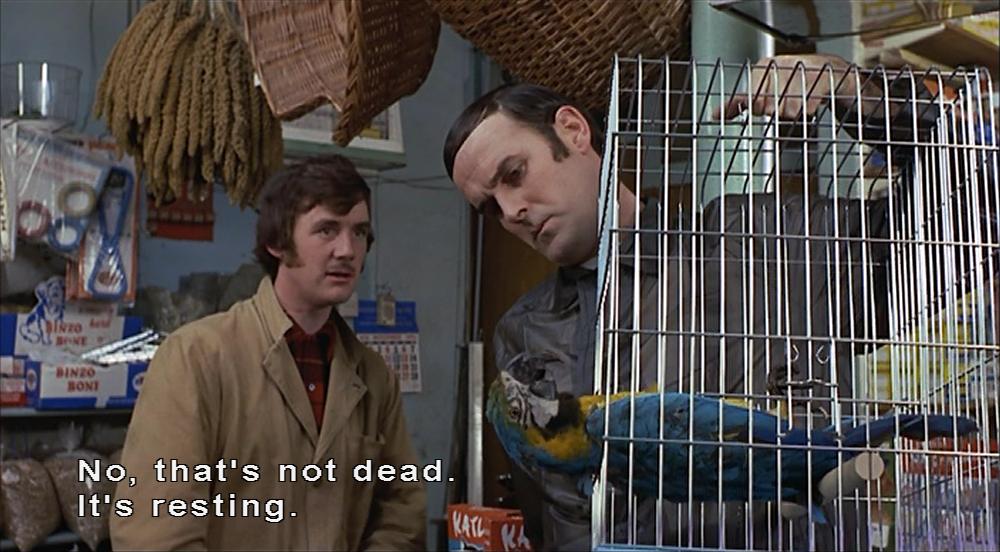
Remarkable bird, the Norwegian Blue

I sometimes worry that with all the deconstructions and house ruling that we can end up not supporting Rolemaster but character assassinating it.

I also worry a bit about the fact that we all agreed to a non disclosure agreement to not discuss RMU publicly and now that is very much what we do.

I have also been up since 4am and I am not feeling particularly mentally scintillating right now so I want to point out something that may or may not have happened, not with a bang but with a bit of an under the radar whimper.

Way back when, many moons ago, BriH suggested 50 in 50 we tossed a few emails about and someone suggested that things like new monsters, new spells and new magic items were one of the things they always liked about the original D&D modules.

So when I wrote one of my contributions to the 50 in 50 adventures I create a new monster. I then promptly forgot about the monster and moved on.

The point of making the monster was that it would be my intellectual property, not ICE’s. Therefore I was perfectly entitled to publish its stats as long as we skirted around the fact that it was a Rolemaster adventure.

Well, on Saturday, when Azukail Games, published Where Eagles Dare I believe they published the first ‘free’ monster, that is free as in speech not free as in beer. As it happens I have written and published other RM adventures with more monsters in the Fanzine between writing Eagles and now but that is not the point.

Monsters, monsters everywhere!

I have had another one of my thoughts. I have a set of conversion rules I have created for getting from D&D 5e to a sort of generic RM, based upon the starting characters I was sent. It was suggested that the monsters would be better if they had skills and I think that is probably right. It was also suggested that giving monsters professions would be good. I think that is probably would be good as well.

So, what I was thinking was  this. I am going to install a wiki plugin for the blog. I will then create a page for every monster I have created so far and continue to do so for all future monsters.

The advantage of the wiki is that if for example you think a monster should have Ambush as a skill then you can edit the monster yourself and add the skill. From that moment on everyone can then see that skill. Furthermore, for skills that work significantly differently such as expertise in RMU vs skills in RM2 for example, you can add a modification to a monster and mark it as for a particular version.

Also, if I have created one or two basic versions of a monster but you want a shaman, that I haven’t created then you can add yours as either an additional monster or add it on to the bottom of the monsters page.

If anyone wants to use these monsters in their own adventures they can then link directly to the monsters page. This way they always get the most up to date version.

Another advantage is with magic and innate spell lists. So far I have listed genuine RM spell lists but anyone can go back over the monsters and reference the BASiL list that best fits.

This new monster section will appear on the menu navigation some time this week and I will start adding in the monsters.As with most wikis you will be able to see the change history and previous versions should you have to.

Is Arms Law Broken?

The only things that RM really has that no other system comes close to is Arms Law with its descriptive criticals and black humour. Everything else is pretty run of the mill, the skills are the same skills found in just about every rpg, stats are stats. The spells are for the most part just reworkings of standard fantasy fare. The only stand out feature is the combat system.

But Arms Law doesn’t work and really has never really worked. How many times have you had someone stood behind a wall get hit in the leg? Why can you never shoot a dragon in the wing? Ignoring Size rules for a second why does a glancing blow from  the jaws of a Tyrannosaurus Rex do the same damage as a glancing  blow from a mouse? The promise or the premise was that to hot and damage were combined so a good hit did more damage than a hit that barely succeeded but you can roll a 1000+ with an open ended roll followed by a poor critical and do no more damage than a mediocre roll followed by a decent critical. In fact a roll totalling 150 is identical to a roll totalling 1000+ unless you start adding in optional or house rules. The promise of the better the attack roll the greater the damage doesn’t really work.

The criticals are supposed to add flavour and a gritty realism to combat but if the text refers to a body part that is impossible to hit, due to cover or doesn’t exist it just makes more work for the GM to translate the critical text into something viable.

I don’t think one can really call 10th level ‘high level’ in a game where there is an explicit range of 1st to 50th but a combat centric character can easily have an OB up around the +150 by 10th to 15th level with 20-30 ranks, plus a stat bonus, level bonus and superior weapon. So as long as you can roll more than the targets DB you will max out the table almost every single time.

Then there are the criticals against super large creatures. The whole idea of weapon specific damage does out the window at that point and everything from martial arts to crossbows do exactly the same damage effects.

Then we get to tiny through to huge attacks and rank one to four in martial arts. The idea of damage caps work for maximum damage but not for minimums, mice can out bite dragons.

One of the things that people asked for was attack tables that went over the 150 cap. The 175 cap really did nothing to solve the problem that caused the complaint in the first place. If anything the fact that RMU kicks off play at 3rd level makes the problem worse as characters will have table busting OBs sooner. The RMU solution is DB inflation with actively-passive-running-footworky-shieldy-dodgy-parryingmajiggy.

Arms Law does not work but we put up with it like an old dog that smells like a damp rug and farts constantly, because we love it and we could not imagine living without it.

The size rules attempted to  solve the problem of an identical final attack roll from a mouse and a dragon bite doing the same damage, while removing the damage caps. This is the only thing that the size rules did well. If we use the compound tables with a bulk of the most common sizes all one table then you get a sticking plaster that functions in this particular instance.

The flaw is in the core Arms Law mechanic.

Roll the dice + skill + mods – DB -> look up the result, roll critical (if any).

This has never changed and is the core problem.

I am not suggesting this as a fully thought out solution, I am writing it on the hoof but…

If you took the bit that says +mods and moved it so that you get…

Roll the dice + skill – DB -> look up result, roll the critical (if any) + mods.

I have cheated a bit there as things like cover and magic and being stunned would effect DB but that is not what I want to focus on.

By adjusting the critical for size, something like +/-10 for each size step difference may work. Rearrange the results so the lowest critical results are feet and shins and the highest are shoulders, neck and head and you have a result that mice would be really pushed to ever bite a giant above the knee and if a dragon takes a swipe at you it is unlikely to hit your foot.

One of the breaking 150 options was to add +1 to the critical roll for every 10 over 150. This would work perfectly well. Now rolling up in the multiple hundreds would make a difference. You would not be rolling 500+ and then getting a critical of 01 and no bonus.

You can scrap criticals A to E and just have 100 possible critical results on a linear scale, maybe 2% or 5% apart. Now all criticals can be open ended!

Size need not be the only critical mod. If DB is about hit or miss, that is where parry belongs. Shields on the other hand can be used to turn a blow away, thus adding to DB, or by putting the shield in the way thus protecting the person so that can be used as a critical mod.

Cover may not add to your DB but it could protect against criticals from 01-30 for a low wall or from 31-80 if you are stood behind a cart with your head and feet visible but the rest of your middle section hidden.

Weapons could come with a critical mod. You are highly unlikely to stab someone in the foot with a dagger as you would have to really reach down intentionally to do so. A battle axe though is probably more likely to do a wound to the lower half of the body, (I stand to be corrected there as I am just spieling off ideas as they come to me). I can imagine parrying an axe coming down at my head or shoulders but the momentum and follow though taking the axe head down to the legs or even feet. As long as the size mods out weighed the weapon adjustments you are still most likely to get stabbed by a hobbit in your leg or abdomen, not the neck or shoulder.

All of a sudden you don’t need the size based multiples and reading up or down a critical tables in multiples of +/-10 is much much easier to do on the fly.

We no longer need this forced size multiples such as charging adding +1 size, now that becomes a critical mod. You even get to finesse things by making charging a penalty to hit, after all you are running around, but a bonus to the critical.

You do not even need the attack table any more. The attack roll becomes a 101+ skill check. You can combine the damage that would have been on the table into the critical descriptions so the skill roll is little more than a pass/fail/fumble roll.

If you combine armour references into the criticals e.g. If foe has a helm then +12 hits, otherwise foe is stunned 3 rounds +22hits. You now can roll out location specific armour and armour by the piece. Imagine an electricity critical  ‘Strike to the upper arm, if foe has metal armour then it is fused into a single piece -20 to all actions using that arm +20 hits, stunned 2 rounds. If organic armour then armour is destroyed +10 hits else, +15hits and burning 1 hit/rnd.’

We can add in breakage so all attacks are two d100 rolls either attack/fumble, attack/breakage check or attack/critical. That is nice and consistent with every action being two rolls ALWAYS.

Another alternative is that you have a traditional attack table of sorts but scrap criticals A-E. You now rename the columns Legs, Arms, Abdomen, Torso, Neck/Head. This makes it relatively easy to do called shots, you take a penalty to hit but choose the column for the critical. Weapons tables skew the columns to match the sort of weapon. So knives and daggers that are unlikely to hit something out of arms reach, like the feet do more arm, abs and torso criticals. Cover exclude unreachable criticals and position shifts the column left or right so attacking from above is more likely to hit the head than the feet. In this system you could have a single page of additional  Krush, Puncture and Slash Criticals but with columns for Wing, Tail, Tentacle and Fin. If a beast doesn’t have legs then the GM can substitute the tail column, if there are no arms then you attack the fins. Another creature may be all tentacles, head, body tail.

Arms Law was probably conceived on a wet Wednesday afternoon are a particularly dissatisfying D&D combat. Since that time it has remained basically unchanged for going on 40 years and not one of its shortcomings have ever been addressed.

The ideal solution may well be a combination of all of the above or things I have not even dreamt of but the fiddling around the edges of RMU’s Arms Law is not the right solution and solves nothing.


Extending the maximum result to 175 compared to 150 does nothing especially if people walking around with a +285OB. The 175 cap is a drop in the ocean. The most powerful PC I ever had had an OB of +193. It was extremely unusual for me not to do an E critical on almost every round. I don’t thinking going to 175 would have changed that.

To round it off, I think Arms Law is the heart of Rolemaster and unless it is looked at really critically and made fit for purpose then all the tweaks in the world will just make it slower and more cumbersome and not solve the real problems.
 

Land of the Basilisk

So this week I am on holiday in Basel, Switzerland. Now I don’t know which way around it went but either the basilisk is named after Basel or Basel is named after the monster.

This is a city that celebrates its monsters even the Munster (cathedral) has the basilisk front and centre.

The basilisk is just to the left of the main entrance.

In the town centre is a hole in the pavement and a plaque that says that if you look down and the basilisk sees you. Its sight will kill you. Which begs the question of where is the health and safety there then? I do wonder if my travel insurance would pay out, probably not if I had put myself in danger by looking for the basilisk.

Basel sits on a geological fault line and is prone to earthquakes. It is easy to imagine why the city could have grown up with the belief that there was a subterranean monster living under it.

Now I do like putting inspirations together and I woke up this morning with the outline of a Christmas adventure. Imagine a peaceful holiday scene in a provincial town. The townsfolk gather in the market place to sing songs of thanksgiving by candle light.

Then the ground starts to heave and convulse (rolling moving manoeuvres to remain standing) as masonry starts to fall from buildings (fall/crush attack table from 40′ up).

Panic ensues and people scatter just as the central temple beside the square explodes in a hail of stone and fire. As the dust clears, where the temple once stood is now a dragon slowly flexing its wings and most of its length still hidden in a great hole in the ground from which it emerged.

I am picturing a red scaled dragon wreathed in smoke and flame.

Your gift to the characters if of course instant hero status if they save the town and a bucket of experience if that is the way you roll.

Basel’s Basilisk