Don’t It Make My Brown Eyes Blue

Rolemaster Logo

Imagine for a minute a player asks the perfectly reasonable question of “Can I remember what colour her eyes were?”

What I have always done in the past was ask for a skill check using the characters Memory stat bonus as the skill bonus.

When I moved from RM2 to RMC and the threshold for success went from 101+ to 111+ for most casual stat based tests success required an open ended roll. If that was reasonable 19 out of 20 trips to the shops for me would probably end in chaos and that could not be right. For me 1 in 10 trips to the shop ends up with me bringing home the right thing.

So I started thinking about these non-skill rolls. Not everything has a governing skill. Simple tests of memory, trying to catch a plate before it hits the floor or trying to lift a portcullis.

I have often thought that Stats in Rolemaster are largely irrelevant. Once you have rolled them you only ever use the Stat Bonus and never the stat. The exception is body development that uses 1/10th of the Con stat for base hits.

In eliminating the body development skill I have previously suggested using Con + 1/2 SD to find the Total Hits. That would give a starting character a typical 75 hits. That is more than the default starting hits under the RAW but that is not a bad thing. It gives starting characters a bit more longevity and is slightly more realistic than a starting character can take 18hits and a 10th level character can take 150hits. Why is the more experienced character so much more damage resistant?

I don’t use level so there will be no levelling up. I do use a RuneQuest style skill improvement. You roll higher than your current skill total and upon success you gain a skill rank.

I use a similar scheme for stat gains. During periods of rest & recovery you can roll against your stats. If you roll higher than your current stat then your stat increases by 1. You can only roll against stats that have been used. What that means in practice is if you used the Trickery skill you would put a small tick against the skill itself and against Pr and Qu. When it came to doing the tests for improvement then you could roll against those two stats and the one skill. This means that the skills you use tend to improve and the stats you are using tend to improve.

So going back to my simple memory test, to get a result of 111+ just to remember if your girlfriends eyes are Brown or Blue seems a bit of a tough call. That is a open ended roll for most people. If as a GM you wanted to put in a difficulty factor for recalling facts that character saw or heard weeks or months ago then the test becomes almost guaranteed failure pretty quickly.

What if we didn’t use the stat bonus but the actual stat? So Joe average has a memory of 50. What colour are his girlfriend’s eyes? Roll 111+  on 1d% OE +50. That pretty much gives a 60/40 chance of failure which in my experience seems pretty realistic, or is that just me?

So what about lifting a portcullis? Now with an average stat of 50 you, as GM, have scope to put a difficulty factor in there. Sheer Folly is a -50 so trying to lift a portcullis on your own would still require an open ended roll. That also seems realistic. If the character had the Athletic skill then by all means let him or her use it but you cannot make simple tests of strength dependent on such a skill. You cannot tell me that someone with a strength of 90 cannot lift something heavy without learning to play football first?

The final missing part of the puzzle is the racial differences. High Men are about the strongest commonly played race and they get a +10 strength bonus. Elves get a bonus to Memory. If you were to roll these Stat based tests as Stat + Racial Bonus then you would retain the flavour of the races.

Using this method what you get is more competent PCs, greater flexibility as a GM to challenge the characters and Stats gain greater importance beyond just a measure for finding the stat bonus.


Solo Roleplay Part III

So this time I am going to show you how you actually do ‘solo roleplay’. I am going to use the Mythic GM Emulator although it is not my favourite. There is an online version here.

So here is an opening scene for you. Take you favourite character, in your favourite setting and right now they are in a copse of trees over looking a ruined and abandoned manor house. It is dark, the moon has risen but is hidden by a thick layer of cloud. An owl hoots near by. Somewhere in that house is rumoured to be the blood stone. An artefact in the form of a worn and rounded granite rock the size of your fist that bears the thumbprint of one of the gods. If the legends are true placing the blood stone on the chest of a deceased person will return them to life for seven days.

So that is our plot, opening scene and character. One a piece of note paper jot down any NPCs from the characters past that may have a bearing, past villains that are still around, other adventurers they know if in the region or anyone else that could possibly crop up. Also make a short list of any ongoing story arcs that could come up again. These are the start of your thread list. The top of that list should of course be trying to find this blood stone.

So if you were playing this in a conventional game you would probably ask about lay of the land, maybe available cover, approaches and so on. There is no need to ask any of those, just make it up. It is a ruined manor so chances are it does have a drive way or road in some disrepair leading up to it. It probably has out buildings. Your setting will give you most of these answers. If this is Pern then there could be a ruins of the dragon culture. If nobility travel by carriage then there is probably going to be stables and a carriage shed. You decide. The first question we are really interested in is what can you see and what can you hear. Asking the question “Can I see any light down there?” is the perfect Yes/No format question for this style of play. First of all you make your perception roll. Use all the regular Rolemaster modifiers. Looking for lights on such a dark night is pretty easy as they stand out. If you fail the skill check then it is irrelevant if there is light to be seen or not as you didn’t see it. If you made the check then if there was a light then you saw it. So we need to know the answer. Turning to the mythic engine we need to decide how likely the answer is to be yes. I think the answer is unlikely. The stone is not being held by something as simple as a local bandit or such. If it was that simple it would have been recovered centuries ago. Of course your answer could be different, it is down to the sort of game you want and the world you are in. So my question looks like this in the GME (GM Emulator).

You can ignore Chaos for now. Click the Ask a Question button and you will get an answer. So in this case even if you made your perception roll there was no light to be seen.

Our adventure continues with the here doing any other investigations he or she thinks of and slowly approaching the house. Maybe you have been making stalking rolls to approach quietly, maybe you rode up the drive on your mount. That is entirely up to you. My character has circled to the rear of the ruins quietly and is looking in through a gaping window opening trying to see if there are any signs of recent habitation. This time the perception roll was made and I got this answer.

An extreme no means not only no there is no sign of recent habitation but as definite as you can be that there was no recent habitation. I would say that even the floor in this room has collapsed down into the cellar below, the ceilings have gone and the beams that held it up lying scattered across the yawning hole in the floor.

My character out of interest in this example is Silas a 5th level Illusionist.

Maybe you want to check in more of the ground floor rooms first? So we sneak around a bit, making a few more skill checks, perception rolls and so on. Eventually you make your want into the ruins and a successful perception check about hearing any movement in the house forces the question and gets this response.

So the answer is no, you cannot here any movement but we have an event. The focus ‘move away from a thread’ means things just got more difficult for the character. If this adventure is the only one on your threads list then the result applies to this adventure. If there are several threads on the list then roll randomly to see which thread it applies to. The meaning  is often cryptic. I am going to assume that this is the only plot on the thread list so this applies to this thread. Things are about to get more difficult. Recruit wounds could mean that Silas is about to get hurt. My first thought is that the floor may give way, it is an old house and we have already seen one collapsed floor. As the floorboards crumble and disintegrate under his feet Silas attempts and fails and acrobatics roll and ends up on his back in the cellar looking up at the clouds as leaves, broken bits of rotting wood and dust rain down on him. I roll the normal falling damage and luckily he takes just a couple of hits and no critical.

I am going to end the first scene there and start a new scene. The reason is that the first approach and investigation was all about stealth and caution. After the fall, stealth has somewhat gone out of the window. Think of it in cinematic terms. We would certainly had the director shout “Cut!” immediately after the fall and the next shot would be down in the cellar. I like to start and end my scenes when the director would shout “Action!” and “Cut!”.

At the end of each scene ask your self is the character in control of the situation? If the answer is yes then reduce the Chaos by 1. If the answer is no then increase it by 1. Silas is not in control so from the starting point of 5 the Chaos is now 6 for future questions. We can also use the GME to evaluate this new scene.

You can see the new Chaos level of 6. The Scene resolution says that the scene has be altered. This means that what you may have been expecting is not what actually happened. I was expecting a store room or wine cellar but that is not what we now have. The GME also says NPC action. Someone else has caused this altered scene and finally we Adversity dispute. The first thing that comes into my head here is that someone caused that floor to give way and it plies that someone else is also trying to get this stone. From Silas’s prone vantage point, looking up he can actually see that the joists of the floor above have been sawn through. Some one did this on purpose. Looking around he can see that the cellar has been cleared somewhat and there are signs that this has been used as a resting place. There is a bed roll over their and some cooking pots in the corner. We also add the unknown NPC to the NPC list.

Starting at the bottom of the manor house and working up is just as good as starting at the top and working down. There is a doorway out of here into a second cellar chamber. It is extremely dark so that question comes up again about can we see any light, torches, lanterns, that sort of thing. A successful perception roll is made and the GME is asked the question. This time the answer came up as a Yes. Logically if there was an NPC or monster in the next room then they would have already reacted to Silas coming though the ceiling so the light has to be reflected light from somewhere. I decide that in that next chamber are is the surface evidence of an excavation. Someone is digging some sort of tunnel or shaft. There is light playing on the ceiling from a torch or lantern down below the ground.

I am going to stop here. I hope you can see how you can build the story up. If you go with your first instinct when you see these cryptic hints from the GM Emulator and what they could mean. The setting and surroundings are what you would expect from the scene you are setting. The results of the Emulator, the altered or interrupted scenes can force you to add twists to the story. If Silas were to hear the NPC talking to themselves down the shaft that could beg the questions are they male? Are they human? Can I understand the language? A yes or no there will relate back tot he character and the languages they know. It could add a political twist to this adventure. If Silas were to cast Long Ear I (Essence’s Perceptions 5th level) what can he learn about the NPC from their mutterings?

Solo roleplay like this can be great for creating adventures, you play it solo, let the GME take you through all sorts of twists and turns. Keep notes and then put your players through it. It is great for creating interesting back stories for your PCs. How they earned that first 10,000 exp.

Imagine your GM wants to run a political campaign set in an Arabian setting. You will be starting at 3rd level. You want to play a mystic. Do some solo plays at first, second and third level in this setting with typical Arabian nights type plots and see what spells/lists you actually want or end up using.

There is of course one more use for solo play. My wife likes to watch shows like Strictly, The Voice and this new Let it Shine which I cannot bear. With solo play and an online GM emulator I can pick up a solo adventure as and when I want to. Over time you pick up a rich list of NPCs and interweaving threads. You can play game systems that your normal group cannot all agree on and otherwise sit idle on your shelf. I bought myself HARP at Christmas 2015 and it is never been played  as our group are die hard RM players but with Solo play I have been on several adventures and got to know the rules.

Solo play cannot replace proper face to face play amongst friends but then PBP doesn’t replace that either. Solo play is just another aspect of our hobby that can be used by any player or GM. It is hard at first to know what you can just decide and what you should ask the GME. You don’t want to turn the game into 20 questions and you don’t want to ask world breaking questions either. ‘Does my God strike down the infidels?’ is a perfectly valid question but it is highly unlikely and the chances of an exceptional NO answer are quite high. What is the worst possible thing that can happen if you are hoping for a divine intervention to save you? There is a fair chance it involves a gate and a couple of Pale Vs.

If you have any questions about Solo play then ask below in the comments.
Solo Roleplay part II

Solo engines are frequently designed to work with scenes and threads. Scenes are like the scenes of a film. If your characters are in the tavern and then decide to go and seek an audience with the local priest then typically that would be two scenes and you could skip the travel in between. I say typically as you will see later things can happen.

Threads are individual story arcs or plot hooks that can could take the story in a different direction or change the way the character sees things. Typically in a solo game there will be several open threads. You can include the main plot you are on but also any unfinished business in your characters backstory and those from your NPCs backstories just to get you started.

They typical out put from a solo engine is the answer on the yes/no spectrum. In addition to that you can get a variety of other prompts. With these prompts it is up to you to think how can I work this prompt into the story while staying true to the setting.

Interrupted Scenes

The grand daddy of all the true solo engines is Mythic. Mythic is both an RPG in its own right but the solo engine is also sold as a separate standalone product. I don’t recommend it as for me it is too slow and too complicated. Mythic has the concept of the interrupted scene. What this means is that although you may decide that you are going to go and see the local lord something will happen before you get there. Interrupted scenes can make the world that the players inhabit seem to have a life of its own. Things happen that complicates their life. It doesn’t have to bad or game changing but if it deflects them from the intended course who knows where that may take them.

Random Facts

Some solo engines have random fact generators. These are typically a pair of words or short phrase, often an adjective and a noun. The idea is that you can try and work that into your game. Imagine it produced the phrase work hard vehicle and you had an interrupted scene. It would be far from unusual for the characters to be walking to see the lord and find the main street in chaos and blocked by an overturned wagon, livestock being chased about and a general chaos of shouting and recriminations over the cause of the accident. Random facts can encourage you to add hints of flavour and texture to your games that you may not have otherwise thought of.

Random Events

Every solo engine I have looked at has random events. This are short little instructions such as move towards a thread or introduce an NPC. What they mean is not immediately obvious. The first one means that during this scene something should happen that helps the characters advance one of the open threads. You should keep a list of the open threads and of all the NPCs in case you get an event like this and you can just roll randomly to see which thread it applies to. Moving towards a thread could be the characters hearing a rumour or gaining a bit of information. It could be seeing a familiar face in the crowd of people chasing the escaped chickens.

Introducing an NPC is a fairly common event. You should see NPC in its broadest possible definition. The Town Guard as an organisation could be considered as a single NPC just as individual guards can be NPCs. Nothing says how big a role this NPC has to have. It could be that with our overturned wagon we have the town guard turn up and try and impose some control and order the PCs back out of the way and shut the road. That doesn’t sound very exciting but that same guard could crop up again later and recognise the PCs. He could even be there alibi if he can place them at a particular time and place.

So Why Solo?

Solo engines are great prepping tools. It sounds almost counter intuitive but using a dice system can be more creative than your own mind. The reasoning is that we can fall into the habit of making assumptions. We all know what a tavern looks like so just a word or two about the quality of the place and how busy it is is all we give. While you are prepping the PCs visit (if you even do that) if you made a Solo engine roll it could suggest that somehow the stay there should help or hinder the PCs in an unexpected way. I just used the Mythic engine and it came up  with Move away from a thread.  Waste randomness. So what does that mean? Maybe something will happen at the tavern that will make life harder for the PCs. The waste randomness part to me suggests maybe some form of gambling going on. Would it harm the PCs if they lost heavily at dice? What if even if they won (one of the PCs may be very good at dice) but it turns out they have been palmed off with fake or worthless coins?

In this way each and every locale gets a bit of life or  colour that you may not have otherwise thought of.

Keeping hold of the threads

If you keep a list of the story arcs in your campaign from every thread in the characters back story to the major plot lines behind the campaign the solo engine can keep threads active that could otherwise be forgotten. I have a character in my game that, according to his backstory, is supposedly looking for his long lost mother. In fact he has not mentioned her once since the game started and in the past session when an NPC told the party that if they went to a particular location one of them could learn something about their family he just looked blankly at the rest of the group as if that had no meaning to him at all. It is easy for plot hooks or loose ends that you dropped weeks, months or years ago to simply get forgotten. What could take years to play for us players may actually only be a couple of weeks for the characters and they probably would not have forgotten. The solo engines gentle tugging at random threads can prompt you as GM to keep those threads alive and interwoven with the game world.

Finally, and I have only ever done this once, I have run an entire impromptu session with no prep at all, no plot, generic NPCs from the master list in Character Law and no one really noticed. There are several online versions of solo engines that deal with all the dice and tables for you. you just have to keep a list of NPCs and threads and interpret results. In that sort of game the better and more creative your players are the more fun it is!

Next time I will show you how to actually solo play RM using a couple of different solo engines.


An introduction to Solo Roleplay

I thought I would write a short mini series on Solo Roleplaying, what it is, what it is good for and how to do it. At first glance the very idea of Solo roleplaying is almost oxymoronic, how can a hobby so dependent on conversation and social interaction be done on your own. Isn’t that just day dreaming?

Firstly I would say that solo roleplaying is slightly miss named. It should really be GM-less roleplaying. You can solo with a whole group of players or just a single player, namely yourself. The only thing you don’t need is the GM.

So how is this going to work?

I will get into the actual mechanics in a future post but the principle is this. You use your imagination to fill in 90-odd percent of the details but when you come across a key point, to phrase it as a yes/no question and roll the dice. To show you what I mean imagine your favourite RM character is in the dungeons of a castle and you are trying to escape. I hope you can see the character, the dark passages of the dungeons and so on. Your character reaches the end of the passage. If you were playing this in a group you would probably ask the GM “Are there any guards?” At that point you would roll the dice.

The rules and tables that make up a solo roleplaying set of rules are called an engine. A solo engine is a little like a magic 8 ball but give an answer something like ‘no, and…’ to ‘no’ to ‘yes’ to ‘yes, and’. You can think of that as almost open ended down, fail, success, open ended up. If you have ever had your players make a moving manouvre roll then you have been using a solo engine.

Player “Can I leap the chasm?”

GM “roll your MM”,

Player ” open ended downward, -200″

GM “Not only do you fail to make the leap but you fall and take 8hits and are stunned for 2 rounds.”

Anyone who has rolled a MM or a random encounter have to some extent abdicated their GMing responsibilities to the dice.

Solo engines just formalise this into a set of rules that take account of how likely the answer should be yes or no and how to move the plot or adventure on.

Solo engines also normally have a mechanism for plot twists or a chaotic factor that can force the story in a different direction. Normally you just use common sense for that setting to fill in the details. If you are in the dungeons of a human king then chances are the guards are going to be humans armed with culturally common weapons and armour. If you are in a orc stronghold then they are likely to be orcs. You don’t need to roll to determine that. Likewise the solo engine does not replace skills. If you want to pick a lock the you don’t ask the solo engine, you roll your skill.

Solo engines can be as complex as dozens of rolls from pages of tables to a single roll of 1d6, but they all do the same job to a lesser or greater extent.

In the next installment I will go more into why you may want to look into solo engines.


Life Giving

Funnily enough both Brian and I spent some time over Christmas planning a few blog posts in advance to take a bit of pressure off. Brian published his on Wednesday and has a proper Shadow World bent to it. Inspired by the same forum post I wanted to take a look at what Life Giving actually means in terms of practicalities for the PC.

If I remember correctly D&D’s Raise Dead spell left the newly returned to the living person on 1hp for a week while they recover. I think you had to be a 9th level Cleric to cast it as well.

I was thinking today about Rolemasters equivalent which is Life Giving. As with most RM spells there are multiple versions Life Giving I, II, III, IV, V and True. They start at 12th level and Life Giving True is the 50th level biggy. What changes between iterations are two parameters.

When Life Giving I is cast not only does the caster have to successfully cast the spell but the person being brought back to life needs to roll under their constitution on a D100. With the first version for every day that the person was dead 10 is added to that percentage roll. Now technically the spell can bring back anyone who has been dead for up to a year but for that to happen they would have to roll under their Con stat with +3650 on the dice. That is a hell of an open ended downwards roll. In practice a successful raising is unlikely to happen if they have been dead for more than 5 days unless they were built like and Ox.

Once a person has been brought back they are at -100 to all actions for a period of time. With Life Giving I that period is 100 days for every day dead. So if you were dead for two days then you are at -100 for 200 days. That is a bit of a steeper tariff than the 1 week at 1hp back in my D&D days.

So imagine a PC is killed and it takes three days to get them to a suitable cleric. The character rolls under their Con despite the +30 on the roll. They are now at -100 for 300 days. That is the best part of a year. I think that pretty much puts the character out of the game. Unless the entire party decides to do a year’s worth of spell research to bide their time while the character recovers I cannot see that character remaining part of the party. In my RMC game the party came together about 4 weeks ago. When they met they were 1st level now they are mix of third, fourth and fifth level. That has been non-stop high combat fighting for their lives. What would be the disparity in the characters if one took a year off while the others carried on? Obviously the levelling would tail off slightly as exp demands got tougher and I have been accelerating the characters though their first few levels to allow them to grow into their skills, but still I think you are looking at a 10 or 15 level difference if you extended that a year into the future.

Life Giving I will put your character out of the game despite being technically being alive.

Life Giving I is not that useful for characters/PCs but it is brilliant for NPCs. It is a damn sight easier to interrogate someone who is alive than someone who is dead! It is easier to claim the reward for returning the kidnapping victim if they are still alive and not every bounty is Dead or Alive, some are a bit more specific. Life Giving I is a great spell when cast by the characters rather than on the characters.

Now this is a playing group ‘thing’ but we do not tend to play beyond 20th level if we even reach that level. In my level less game spell lists rarely get above 20th level as that requires an open ended roll for each spell about 19th.

So what does a 20th level Life Giving look like? This is much more useable. The roll under your Con penalty is +1 for each day dead so our three day dead character has just +3 on the roll. That should hopefully be doable. The recovery time is 1 day for every day dead, so just 3 days in this case. That is Life Giving IV. There are not going to be many 20th level casters around but if you can find one and they are prepared to cast the spell then that is viable for PCs to carry on their careers.

Of course that is just the mechanics in the core rules whether your game world and the gods agree is a completely different issue!

2017 ahead

Well we have completed the 12 days of Rolemaster as Christmas is now over.

We thought we ring a few changes for 2017 and the first of these is that we have a new blogger!

Hurin is a stalwart if the ICE forums and an avid RMU play tester. His Rolemaster background is very much RM2.

We have a new schedule. Individually we will be creating less posts. I will be posting every Friday or ‘something for the weekend’ as I like to think of it. Brian will be posting on Wednesdays. There will be weekend round ups as well. This gives us room to bring you Hurin’s posts and we hope to have a fourth voice to announce soon.

We also hit 500 twitter followers over Christmas which is really cool. The last time I looked we were at 520+.

I am hoping that in 2017 we will be able to bring you more product reviews. ICE certainly seems to be gearing up for more and more frequent new products.

So until next Friday, when I will post the second instalment of my RMU play test, have fun.

5th Excepting Perception, Stalk & Hide and Body Development, of all the skills in all the books which one would you say is the single most important for a player to take?

Brian: Attunement. In our rules, every spell ability in an item, power storing, recharging etc all require attunement skill. Plus, many althan/ka’ta’viir devices use mental interfaces which can be accessed with attunement. So even non spell-casters should have some ability, especially at higher levels.

Peter: Lore skills particularly those relating to herbs. Whether you use Herb Lore, Herbalism or Lore:Technical. I suspect that my game is a bit more hack and slash than Brian’s but being able to select the right herb and apply it is a key skill for my players.

4th In my opinion the best bit of RMU is…?

Brian: Hands down it’s the size rules (which may be changed or modified). Such a useful tool for scaling deadliness of a creature, spell, object or trap within the rule frame. I understand that many people didn’t like the math, but it really is fantastic.

Peter: This was a hard choice and I am wavering between two possibles. I love the experience rules. I first saw them in HARP and I am really pleased to see them being used as the default rules in RMU. I was using the HARP rules, house ruled into my RMC game but now I am using the RMU rules in their place. My other love is Spell Law, pretty much all of it from the completed spell lists to the use of the spell aquisition skill as spell mastery.

Interestingly Brian and I are on different sides of the RMU size rules argument. I found the rules cumbersome, awkward and terminally slow. They initally really applied mostly to Arms Law and I though I could just junk all of Arms Law and rewrite my existing combat tables to fit RMU, which I probably will do anyway. That was before I saw Creature Law and the normalised creatures. It is a tribute to RMU and all flavours of Rolemaster that it is so modular that something as central as these rules can be changed without breaking the system.

3rd Of all the companions and ‘laws’ which book could you not be without?

Brian: I don’t really use any of them now, but Companion I had a lot of material that could have been “core” or included in RM. Paladin being the most obvious. Arcane magic was ok, but I didn’t feel it was necessary to classify it as a realm. Battlerunes were very cool and we just rolled them into Open Essence at the time.

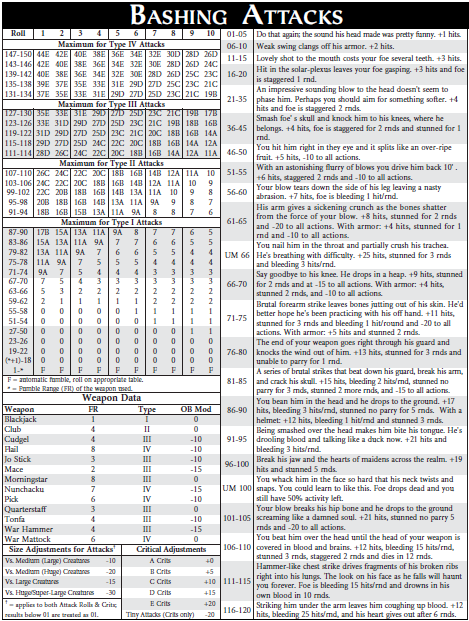
Peter: No surprise here but the RMC Combat Companion is my book I could not be without. I thnk it is one of the ‘lost’ books because of IP issues and mine is falling apart but I have scanned and OCRed much of it into word and the condensed combat tables I hand typed into Excel. What you get is a few professions if you use them, armour by the piece which I derived from HARP I believe, weapon katas and fighting styles which puts two weapon combo back into RMC and the jewel in the crown the condensed combat system. There is a sample below and you can see that you get the 10 armour types, criticals that are not split into Slash, Krush, Puncture but rather customised to the type of attack, so arrow criticals for bows, dagger criticals for short blades and the like. You get many weaons per page and the size modifications tucked into a corner. You can run entire combats without having to turn an page if the weapons are similar enough. The only drawback is that the same criticals come around again a little too often. That is why I have excel versions of these pages. There are only 18 attack pages of which 6 are frequently used. Those 6 I have rewritten the criticals keeping the effects the same in terms of hits, bleeding and stun etc., the location the same but just changing the prose descriptions. I started with two copies and used to swap between sets for each game session to keep the criticals varied but I now have a couple of pages with three versions after being inspired one evening. This book and the condensed combat system really triggered my appetite for simplifying RM as combats became so fast and exciting to run that it made everything else look slow by combarison!

2nd Best layout/structure in a RM product?

Brian: One of my favorite is Uda Tyygk, in the Iron Wind. Hidden fortress, the Thyfuriak. Very cool. Reminds me of a toy I used to have: the mountain fortress from MAC (mobile action command)

http://www.ebay.com/itm/1976-vintage-Matchbox-Mobile-Action-Command-RESCUE-CENTER-playset-Lesney-MAC-/381878473020

Peter: For me it has to be the MERP campaign book Northern Mirkwood. This book has everything, the floor plans vary from the great halls of Erebor to towers and orc holds, every one of them I have reused time and again. The master military charts with every NPC, and class or adverary clearly detailed make off the cuff encounters dead easy and the amount of unique content to make the region really stand out as being different from any other woods or forest. This was also the first MERP campaign book I bought and with my only other experience of ‘modules’ being D&D ones, this book completely changed my concept of what a rpg suppliment could and should be.