Weekend Roundup: March 25, 2017

Welcome back to the “Weekend Roundup”! It’s been several weeks since I’ve done one; it’s been hard to scan the news here in the U.S.A. without getting bogged down in political crazy. In the interim, I got a message on the RM Forums:

BHanson: Do you think you could post more roleplaying news rather than obscure or fringe stories?

To clarify, the ‘Roundup’ is more a collection of news, stories or facts that grab my attention or give me an idea or hook for my own RM/Shadow World campaign. Sometimes a story just clicks, I make a note of it and when I get enough of them, put them up on the ‘Blog. I was hoping for more comments–just curious if any of the links spark a similar thought, idea or creative path for anyone else. I think I just posted up general RPG news, it would a. be topics covered at other bog sites, b. rarely be about RM or SW! So with that said, let’s begin.

Keron, Eog, Laen, Ithloss…..ORICHALCUM????

I was doing research and found these real life Roman SUPER SHIPS!

Syrkakar Armor?

Something found in a Wizards Tower. In an RPG, THIS would have to be a powerful artifact!

Detailed and Mystical Statues.

Real life Arms Law


The more things change, the more they stay the same.

Sweet Jesus!  #$&@!& more Elvish crap!

Legacy of the Earthwardens: Cultural transmission of knowledge.

No Elves…how ’bout Gnomes?!

It’s been 5 years, but still a great reservoir of RPG blog posts.

Now I’m enjoying this RPG blog.

Speaking of “Longskulls”….The HUN also practiced skull elongation….

Good advice for the Next Generation.

I’ve posted up quite a few files on the RM Forums and linked to them on various posts on this blog. For those that asked–you need to have a RM Forum account to SEE and DOWNLOAD files and see the RMU development forums. JOIN! REGISTER NOW

This post currently has no responses


Evil Healers?

All this talk about channelling got me thinking. There was also a thread on the forum of someone wanting plug and play adventures.

The problem with plug and play rolemaster adventures is that no published adventure can ever know what options are in play and which aren’t. As a rule of thumb you could optional rules relating to character creation in the companions made PCs more powerful, not less. If you accept that premise then any adventure written against the core rule books would be varyingly under powered when used with characters created with optional rules, spells and skills from the companions. As an example the core RMC core rules has no option for two weapon fighting styles which in many games are extremely common. Stunned manoeuvre is another skill that can have a huge impact on the outcome of a fight.

Any adventure where the PCs had twice the attacks and could shrug off stun results would have a huge advantage over adversaries who didn’t and couldn’t.

So bearing that in mind I am not going to give you any actual stats as you will have to build the enemy to fit your game and challenge your players characters. What I want to do is suggest what to me seems at first an unusual choice of villain.

This little adventure is completely off the top of my head, untested and unplayed. You should use it for inspiration only!

The Evil Healer

At first thought Healers would not necessarily seem the natural choice for an evil mastermind or villain. I think the prejudice comes from the idea that healers do good things to people and most people don’t want to piss off their healer. If anyone was going to coerce a healer and force them to do bad things, they are more likely to bad people themselves so a vengeful healer is most likely to be still on the side of ‘good’ or at the very least an anti-hero. Or that is what I was thinking until I stopped thinking of the healer as a one dimensional, personality free cliche.

Separate the person from the profession and  there are a multitude of reasons why you can justify an evil healer. Think how many stories there are based around experimenting on people or animals or even individuals that can get a twisted pleasure from being around the suffering of others or even their own.

For this adventure idea I want to think along the lines of having a whole ‘party’ of terminators after the PCs. What made the movie Terminator so cool was his unstoppable nature. In this little adventure at the heart of it is a simple band of brigands lead by an evil healer. The brigands have become incredibly successful as they are almost impossible to put down. Their leader can just put them back together and back on their feet again.

The healer will need the healing base lists including transference but I also  suggest adding Symbolic Ways, Light’s Way and Calm Spirits.

Back when this band started out the Healer assumed control buy using Calm Spirits to completely disarm literally and figuratively the original band of brigands and an crossbow bolt to the back of the head dispatched their former leader.

The current band is made up of two warriors, a thief and a monk. The skill level of each is up to the GM and the party that wander across this place.

The band’s hideout is littered with stones inscribed with magical symbols (using Symbolic Ways) that provide the band with a number of magical effects. Some are used as traps such as stones in the floor that when stepped on cast Calm spells. I will leave the level, number and position of these to the GM as having a single character ‘Calmed’ may be a big problem to a 1st level party but a Calm III may be more of a challenge to a higher powered group. As the brigands have been here for years any and every stone that is suitable has been enchanted to give the brigands every advantage. There are stones that will heal, protect and so on. All of these are well known to the brigands and they will use them to their best advantage while keeping them a secret if they can.

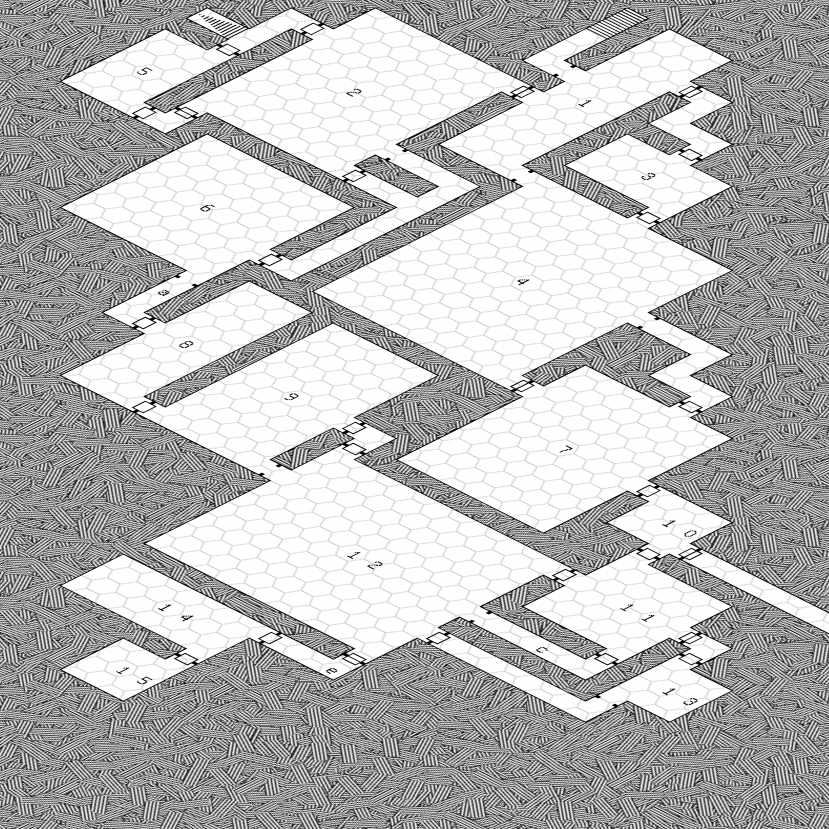
The band’s ‘lair’ is an old and now abandoned mine building. The stairs in the top left lead down into the collapsed mine tunnels. The rest of the rooms were once store rooms, workshops, dormitories, kitchens and all the other supporting services for a working mine.

The GM can dress this place as they see fit.

Much of the complex is still unused.

  1. This hall is used as both kitchen and mess hall. The corridor leading off of here ends in a natural chimney that draws the smoke from cook fires away.
  2. The centre of this room is set up for sparring and martial training. Around the periphery are assorted weapons, shields and armour that the band have accumulated over the years.
  3. These are the private quarters of a warrior.
  4. This is the groups main living area. Along one wall is an odd assortment of stolen furniture that is used for storing non-cash loot.
  5. This is the healers private quarters.
  6. These are the private quarters of a warrior.
  7. This room contains barricades and wall shields the group could use to defend their home should they ever need to. Invaders would be permitted to get this far and no further.
  8. unused
  9. unused
  10. The entrance hall is serving as little more than a tack room for the bands saddles and tack. The actual mounts are kept outside in a corral that is hidden from easy discovery.
  11. This room is piled high with junk. There is a way through but it is difficult to spot. The intention is to make it easy for band members to pass through but create the impression that the way is blocked to the untrained eye. The sort of thing they have done is lean bunks and pallets over the openings so there is no line of sight.
  12. This has been turned from a workshop into a gym for the Thief and Monk to hone their skills.
  13. The private room for a monk.
  14. This is the private chamber for a scout or thief.
  15. The thief’s walk in wardrobe.


The players should meet the brigands outside of their lair. They [the brigands] will attempt to size  up the party before deciding if they are a good target or not. If they decide to rob them then they will wait until the party are a long way from the nearest town or village and then try and steal their horses in the night. If the party look too tough then if they cannot steal them then they will kill them. Once the party are stranded then the brigands will try and pick them off. They never fight to the death. They know that as long as they can get home they will be healed up and can try again. Nothing is worth getting killed for.

The brigands can and will come back night after night and grind the party down if they have to.

This post currently has 2 responses


Channeling, it’s not just for Gods anymore?

Why do I keep coming back to Channeling? Tackling Spell Law deconstruction and rewrite forced me to look at all the underlying assumptions around the magic system—not just RM but other games as well. I think Essence (generic magic) is easy: as long as you allow for the phenomena, then simple rules allow for casting spells. Mentalism is not much different than Essence and often conflated as Psionics. Channeling is a whole other can of worms: God given magic REALLY needs to work in a completely different way. We’ve discussed Channeling in depth in several blogs HEREHERE and HERE.

How might Channeling be different than the other two magic Realms?

Spell Acquisition. Unlike Essence or Mentalism, a PC can’t just go to a library, secure a scroll, learn a spell list and then cast a channeling spell. A “God” must give at least tacit approval for someone to cast a channeling spell. Additionally, you could argue that no learning is really needed—spells could be directly granted by the Diety. This changes the standard process of spell acquisition.

Spell Effects. Common sense would dictate that a caster might not be able to provide magical buffs, benefits or spell effects to targets of an opposing Diety. Unlike Essence which is agnostic, Channeling is driven by an ethos, aspect or belief system. You shouldn’t be able to heal a follower of a mortal foe of your God…right? So the whole group dynamic might be complicated when the Cleric is the primary “buffer” and healer for the group but the other members of the group worship different gods.

Force Majeure. RM Channeling description suggests that PP’s are funneled to the caster and in my BASiL project the spell itself is funneled to the caster (ie like a software download). Either way, the Diety is providing, approving or allowing part of the casting formula. That requires SOMETHING in return on the part of the caster: certain behavior, loyalty, tribute, sacrifice, tithing etc.

Certainly much of this relies on the setting. These may seem like niggling over fine points; and you can certainly hand-wave away any needed explanation—it is religion after all. But RM and RM users take a certain pride in quantifying effects into game mechanics: detailed herbs and spells for healing; complicated Alchemy rules for magic item creation; math driven charts for modelling weapons and armor effects. If Channeling raises some broader questions about its use, than why not establish this in the game rules?

Personally, I’ve come down to two broad options:

Option 1. Disconnect the Channeling mechanism between a caster and a Diety. As Peter argued, Channeling could just be rolled into Essence as “general magic”. That makes sense. Just disconnecting Dieties from spell casting mechanics eliminates all of the awkward questions that Channeling raise in the above examples. If you were you to do that, what then would be the purpose of Dieties?

  1. They can still bestow “beneficence” in answer to prayers for held or assistance.
  2. Lead, create and direct religious organizations.
  3. Control the dissemination of hidden knowledge (spell lists and certain skills).
  4. Interfere in the mortal world

Under this option, Gods are still supreme entities, still have the same powers, play the same role in the world but just don’t act as a conduit for Channeling spells.

Option 2. Go “all in”. Further develop Channeling as a relationship between a powerful being and a follower. If we accept that channeling magic is controlled, allowed, or provided by a Diety than how should that work? More importantly, what prohibits anyone from being having followers and Channeling spells/power to them? I’ve touched upon this with my BASiL Channeling project—spells that only work with designated targets: loyal followers, henchmen, oathbound etc.

The idea goes back to the issues explored earlier—that a Cleric can provide powerful benefits, but only to followers of the same Diety. For Holy Warriors, it becomes even more specific—benefits are only bestowed upon the group, militia or organization of the Holy Warrior. (ie High Templars cast spells to the benefit of his soldiers and/or followers).

The Gods of Shadow World aren’t really gods—just very powerful entities from another dimension. How do they parse out spells/powers? Do they control the entry point of Essaence into Kulthea? Did they devise spells and teach them to their followers? If they are just powerful beings, then can any powerful PC or NPC also grant similar spell ability to their followers? Popular fiction is replete with “Lords” or “Archmages” bestowing their hirelings and henchmen with special abilities—isn’t this Channeling? How about the Dragonlords? Are they powerful enough to act as Minor Gods? Can Minor Gods in Kulthea also provide Channeling to their followers?

At what point can a person bestow spells or power to another? RM already establishes a base mechanism for transferring PP’s or spells  with the Channeling SKILL. I would take it a step further: a formalized process of creating a relationship between “god/lord/being” and “followers”. I played around with an initial spell list concept I uploaded HERE. (RM Forum account needed to access the list). Conceptually, the mechanics of a Channeling process should include:

  1. Bond, link or loyalty or obligations between a god & a follower.
  2. Mutual benefits to both parties. (follower gets spells/benefits, God gets…?)
  3. A substantial downside if the bond is broken, destroyed or a party is killed.

My list needs a lot more work (more specifics on penalties and drains–comments welcome) and is just one possibility of many. (Perhaps the Lords of Orhan use a similar but different spell list). But the framework is there and I like the possibilities for a number of reasons:

  1. It allows a PC/NPC to grow in power outside of the normal experience/level/skill paradigm.
  2. Establishes a known process for Gods to be created/and or a player to ascend to a demi or minor god.
  3. Creates a mechanism for a powerful lord/being/god to influence a local event or encounter.
  4. Provides benefits for a player to pledge to a lord/God.
  5. Balances risk and reward for such a relationship. (need some more work on this)
  6. Acts as an adventure hook.

Is the list too powerful? It certainly wouldn’t be readily available, but let’s review the cost/benefit analysis to a PC using the list:

  1. A follower would have to forgo any other Channeling relationship. (no other god)
  2. The player would need to offer a real benefit to a follower to justify their fealty.
  3. Followers would be a liability. An adversary would target a player’s followers knowing that would weaken or harm the player.
  4. Each follower will require a resource drain on the player.
  5. The benefit would be a growing pool of devoted followers which the player can enact agency through and receive some benefit (HP, PP, stat points?—needs some more thought)

Ultimately Options 1 and 2 aren’t mutually exclusive. I can still disconnect Channeling realm from Dieties and still have the Channeling list and mechanics. Anyway, this went from a thought experiment: “how should Channeling Realm work” to the start of an interesting game mechanic for my SW campaign. Channeling isn’t just for Gods anymore!

This post currently has 5 responses


Get Off My Lawn!!!!! RPG Rant of the Day.

“Fair and Balanced” is not just a Fox News blurb, but a constantly cited principle for RPG game design. But what is balance? An arbitrary viewpoint? Neutral game mechanics? “Fairness”? Often it comes down to personal opinions and long accepted norms established long ago in D&D.

RMU development is a perfect case study in the tension between rethinking a ruleset and an unquestioning loyalty to RPG tropes. The most basic assumptions are often the most discussed: Magic Users can’t wear armor; magic is broken down into 2 or 3 realms; the balanced party (Fighter, Thief, MU, Cleric); Class tropes and the definition of a particular class, etc.

Rolemasterblog has discussed and deconstructed many of these tropes, but it always seems like the fall back argument is “balance”—without ever a real discussion of what balance means. Like most of you, I started playing D&D and AD&D—you know what? That was a broken, unbalanced system. I recall playing a higher level Cleric at a CON and just destroying everything. (Blade Barrier anyone?). It wasn’t fun, it frustrated the DM and while I got all the glory it didn’t feel earned.

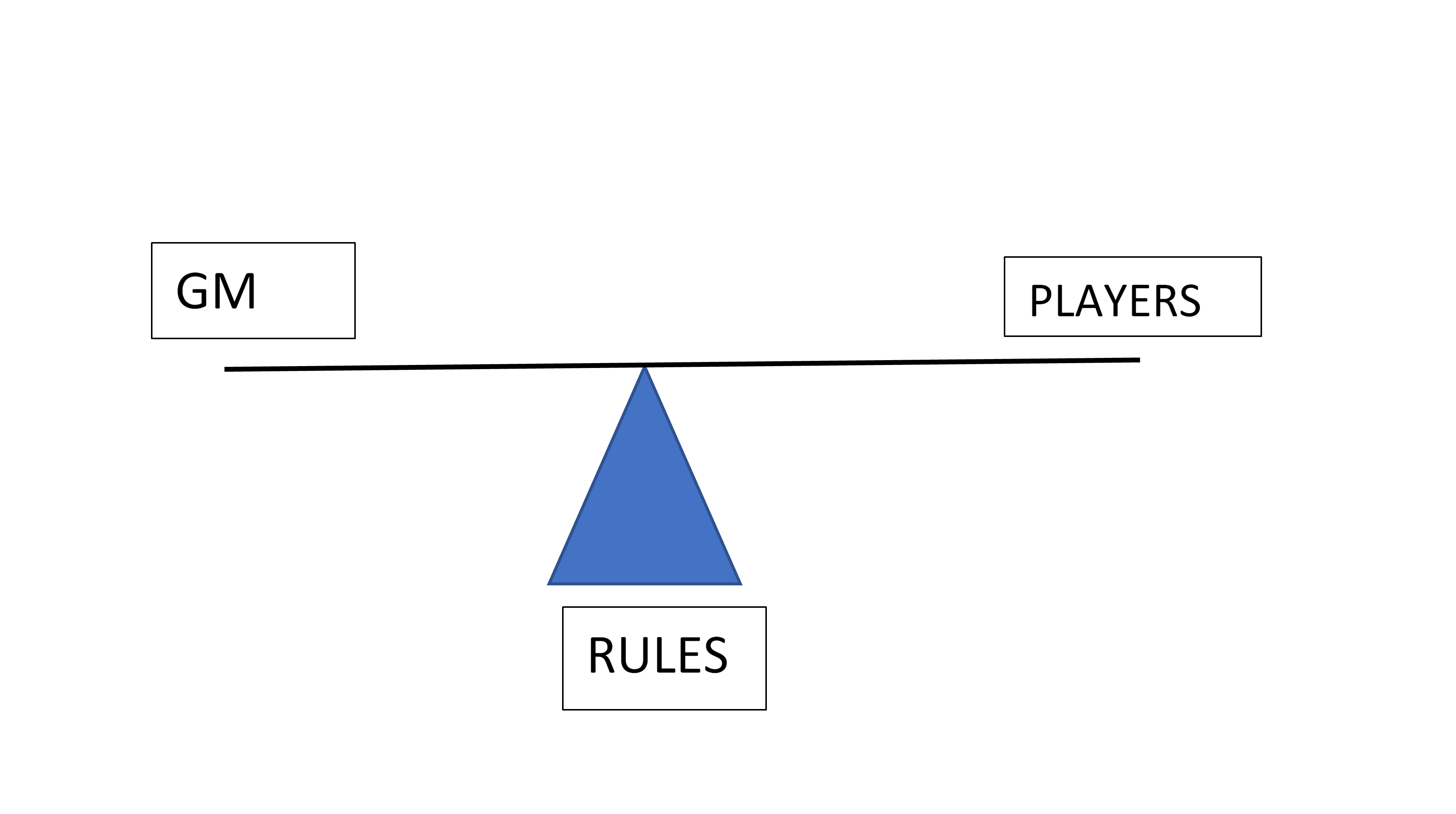
Table top RPG games have too many variables to allow for true balance. Players can make unexpected choices, it’s impossible to create encounter parity and role-playing actions can usurp game mechanics. Also, the adventure or GM can emphasize other aspects that rely less upon game mechanics and more on problems solving or role-playing. The problem with “balance” is that it assumes the following paradigm:


This model positions the GM on opposing end with a ruleset balancing the two. This is a false dichotomy, with the main focus on the impact of rules on the player and PC’s.

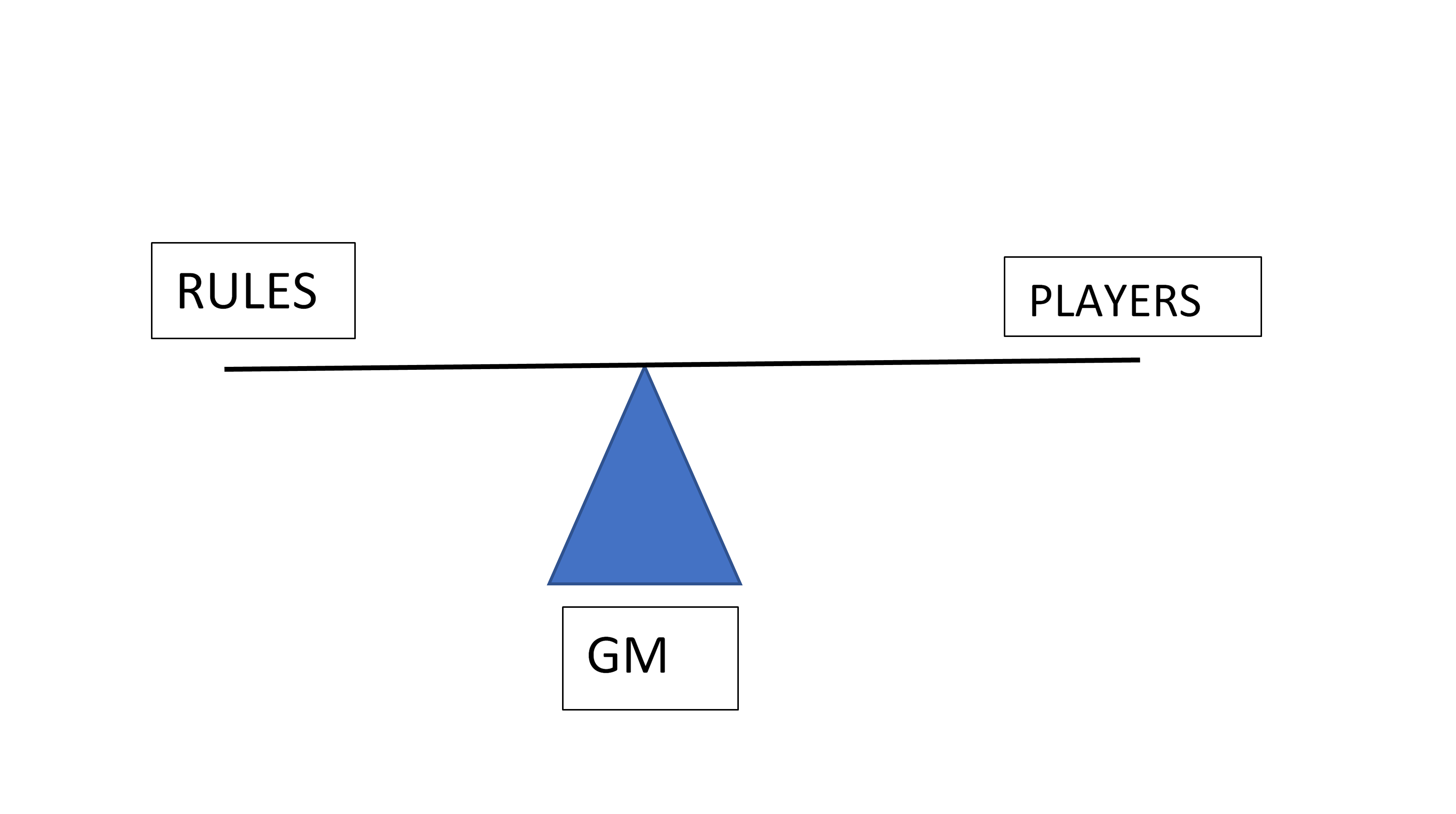
However, if chasing “balance” is a false choice, then a better mental model switches the positions of “Rules” and “GM”.

This model accepts that no open system can ever be truly “balanced” and recognizes that the GM is the final arbiter AND best able to adjust game flow to handle unpredictable outcomes, player behaviors and rule shortcomings.

I’m less concerned with a PC being able to cast spells AND wear armor, than a flexible set of rules that handle in game action resolution. Profession constraints, skill access and player roles within a group are NOT really RM/RMU game mechanics. The game mechanics are maneuver resolution, skill check resolution, spell resolution and combat resolution. Period. Whether a mage can wear armor or what skill costs should be for a Ranger is purely arbitrary or setting specific and not part of game balance.

“Balance” is the last argument of the scoundrel! So GET OFF MY LAWN!!!!

This post currently has 6 responses


Mobile Apps and RPGs

In the real world right now I am studying Android development and Java programming. As a roleplayer I simply cannot do this without thinking about how I could use this to make bespoke roleplaying tools for my phone.

I am also a big fan of open source software and freeware.

The only real problem with creating Rolemaster apps is that RM is such a closed system that ICE would never agree to anything open source that anyone could take, change, expand and share.

Anything I could create would have to be somewhat generic. The most generic of rpg apps has to be the dice roller and there are hundreds of those available.

Somewhere there is a middle ground of more useful than a dice roller but system agnostic enough to avoid the intellectual property rights belonging to ICE but also useful to the RM fan base.

Does anyone have any ideas?

This post currently has 3 responses


This post currently has 11 responses


Random Musings. Immigration and borders & Shadow World Essaence Barriers.

How’s that for topical?

I remember my first exposure to the Loremaster Series (Iron Wind and Cloudlords). One aspect that made an impression on me  was the barrier aspect to the “Essence Flow”–magical currents that also acted as real physical barriers. This was more pronounced in Cloudlords where Tanara was physically isolated from other parts of Jaiman and featured very different and unique cultures. The underground, goth Duranaki, the Viking like Muri, the Inca style Yinka, the rural, gentle Suline and the Roman/heroic cloudlords. Pretty unique and cool!

This Essence Barrier element allowed for niche cultures, isolated civilizations and hidden lands; a major flavor to the SW setting and a reason d’etre for the Navigators.  Many secret and hidden areas were the result of pre-defined, permanet Essaence Flows: Nexus, Karilon, Dream Island, Secrets, etc.

But over time, has this aspect of SW been minimized? Terry has included some parts of this in the Jaimani Crowns and touched upon it with the time barriers/Jinteni…BUT…do you feel it’s still a significant part of the SW story? Does enforcing physical barriers create gaming problems for travel and sandbox issues?

Just curious what everyone thinks. Do you incorporate Essaence Barriers in your campaign? How does that work?


This post currently has no responses


Shadow World Wish List: the definitive Master Atlas.

With every new product Terry Amthor publishes, the world of Kulthea grows larger and more detailed, but it’s been quite a while since an updated version of the SW Master Atlas was produced. In truth, there has been a tremendous amount of world building material generated, but it’s been scattered among the various SW supplements over the last 30 years.

In general, a setting’s “Master Atlas” should contain the overview and broad strokes of the world—the foundation that sets the table for all other material. It should differentiate between “world spanning”, “universal” and “ubiquitous” and material that is regional in nature. Using that very basic definition you could argue that the Loremasters and Navigators are Master Atlas material while the Eight Orders of the Emerian Empire are not. Certainly, some of this is arbitrary, but if a new Master Atlas was planned, what should be included? Part of it is consolidating this “world material” from existing products and the other is filling in the blanks—new material that fleshes out the world, answers important questions or establishes setting specific material that might be different than general Rolemaster rules. (see the blog here)

IIRC, Rolemaster Companion I was generated from the “Red Book”—a notebook filled with optional material used in the early days by key ICE employees and playtesters. The material was cleaned up and made into Companion. We have our own version of the “Red Book”—our own Master Atlas that consolidates all “world material” into the existing MA4 text (converted in editable Word format). We went through each product, starting with the Iron Wind, and added any pertinent material: languages, creatures, Loremasters, artifacts, key persons etc. When a new product comes out, we go through it and do the same thing; our current MA stands at 320 pages without the numbered timeline and without fauna/flora. With fauna/flora our comprehensive MA would be well over 500 pages without artwork and graphics. Is that too large for todays consumers?

Some of that (100+ pages) is our own material—some of it posted up on the Misc SW Files. What is the origin of Elves? What happened to the Earthwardens? Where did the Dragonlords come from? What is the origina and the genesis of the various monsters/creatures? What are the reasons behind “magical” alloys? What is the background behind the lack of chemical processes in SW? We wrote it out of necessity, much of it years ago when it wasn’t clear if SW would continue. I think we came up with some good answers to many of these questions—but ultimately may be modified based on new material Terry produces.

Even with all the material we have, plus the material we’ve written I think there are gaps in the Master Atlas. After 4 versions, it’s probably not a priority for Terry to tackle the Master Atlas yet again even as he updates other past regional products. But…if such a product were to materialize, what would you like to see in it? Here are a few of my own:

1.       Language etymology. Matt did some work on it and I tried some basic classifications but it would be nice to have a basic “language tree” based on the root languages and sub families to build a framework for future products and establish relationships between cultures for language skills/translations etc.

2.       Essence Flow and Foci Map. While I like the idea of not creating permanent Major Flows, they are a key part of the world. Nexus is surrounded by them; Tanara was isolated by them etc. There was a map from an earlier product (Emer in the Atlas Addendum) but I think reintroducing these permanent flows helps fix the Flows as an important physical manifestation of the setting.

3.       Setting specific creatures. Much of the flora/fauna of SW is just a duplication of Creatures & Treasures. This feels like shoe horning a generic fantasy framework into a more unique setting. I would prefer to see a broadening of SW specific bestiary: more fusion and bizarre creatures.

4.       The Pales. Something I’ve been working on is added material on the Pales: environment, more denizens, realm powers etc. It would be great to have them fleshed out as real places that could be visited or used for travelling. My group is currently in the 2nd Pale and pushed me to build the setting out more for the adventure.

5.       Finished SW specific spell lists. Additional spell lists for the Unlife (type specific rather than general) and the other groups detailed in Powers of Light & Darkness.

6.       Finalized and consistent rules about the Unlife. Eliminate the “Anti-Essaence” and create framework for channeling (?) the Unlife and corruption rules.

7.       Notable world wide holidays and religious celebrations.

8.       Simultaneous publication for D20 rulesets.

Just a few of my ideas—anybody have any other ideas for the “definitive” SW Master Atlas?

This post currently has 11 responses


Dyson’s Dodecahedron

I am truly terrible at maps. Thankfully one of the best fantasy cartographers I have ever come across is Dyson Logos. His blog, Dyson’s Dodecahedron, is an immense resource for maps including amazing isometric layouts.

This particular one…

Vault of the Ghost King

…is ideal for those of you of a Shadow World bent. The elevator just smacks of higher technology. To my mind even the spiral stairwell would quite possibly be beyond many cultures.

I am thinking of using one of Dyson’s maps for the session of fruitless searching that I mentioned last time. I guess that many GMs will have already discovered Dyson but I thought I would feature him anyway just in case there are GMs out there who have not discovered him yet.

You should certainly check the blog out.

This post currently has one response


Brief thoughts: masks in your fantasy setting.

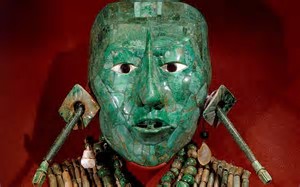
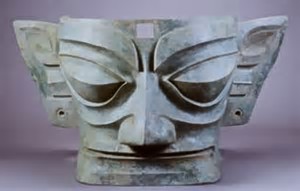
In my recent blog post I referenced the Mayan, Lord Pakal. Pakal was buried wearing a jade funerary mask and it reminded me that masks are very cool! You’ve probably used or encountered a mask in your RPG game—maybe it’s a powerful magic item, a funerary mask found in a crypt /tomb or worn for a festival or celebration. I was reminded of masks worn by cultures or organization in popular fiction and how the mask itself became a defining trait.

Masks can be powerful symbols—they can hide an identity or gender, signify membership, convey emotion, create equality and/or eliminate social barriers. In a fantasy setting, masks can convey tone or atmosphere to the group using a very simple description. One-off masks are great, but what about standardized masks worn by whole groups of people/fighters etc?

Two that immediately come to mind:

1.       The Immortals in the movie 300. Certainly the movie was highly stylistic and not that historically accurate, but the masks make the enemy both anonymous and menacing.

2.       The Seguleh. If you haven’t read the Malazan series—do so! The Seguleh were a militant, hierarchal society of skilled warriors. All wore masks, each one signifying their rank (1st being the best warrior).

I can’t recall any particular group that sports masks as part of their uniform in Shadow World—can you? I’ve included a few cool masks worn by some cultists and like the effect they had on the players.

Anyone have any magical masks they want to share: stats, powers, description etc?

This post currently has 2 responses