On Monday I covered how I intended to use a point buy system for generating characters stats. The point is to enable the player to play exactly the character they want whilst still being balanced.
When it comes to potential stats I was quite taken with the idea of giving the players an additional 100 points with which to buy their potential stats but the temptation to just dump that all on the prime stats for the character would be too great. That makes total sense to do that but in the end every ranger would end up looking pretty much the same as would every fighter and so on.
Turning to RMU again, with the point buy system they advocate every character has a potential of 100 in every stat. The player then has to choose which stat to improve. This would I think lead to exactly the same situation of the players being swayed towards improving the stats the give the greatest gains. What I did like was the generosity of the concept that all characters had the potential to be 100 in every stat.
In my system You will have a 100 potential in every stat but the players do not get to choose which to improve. That decision will be made by the skills they have used or the training they have undergone since they last made a stat gain roll. (There are no levels as you will see later so it is not a case of one stat gain roll per level.)
So if a character has been stalking, disarming traps and picking locks then they will get a chance to improve In, Ag and SD stats as those three stats govern those skills.
Making a stat gain roll will be a case of making a D100 roll and if you roll MORE THAN your current stat then the stat goes up by 1. There are no adjustments to that roll so a character with a 99 Strength would have to roll a straight UM 00 to get the stat gain but it is impossible to go above a 100 stat.
Under the old RM2/RMC rules a stat gain roll could yield up to +15 to a stat if you had a big enough difference between your temp and potential stats. In my version the gain will always only be a +1. This is intentional. The smoothed stat bonuses mean that even going up +1 at a time will bring regular increased in stat bonus. Secondly as all stats have a potential of 100, too rapid a stat gain process would even everyone out to exceptionally high stats too quickly. Because of the point buy system guaranteeing well above average stats anyway there is no need to advance low stats more quickly.
One of the objectives here was to take all the dice rolls out of character creation. The total process should be about the players vision of their character and not dictated by good or bad dice rolls.
These stat gain rolls should be made at the ‘end of each chapter’ of their adventure in the sort of same space that giving out experience occupies. As you will see later skills will also improve at the same time.
While both encumbrance and fatigue are critical elements in our game it’s always added an extra step of record keeping that was onerous. We’ve played around with several mechanisms but found that the new piecemeal armor and fatigue rule in RMU work great but we’ve taken it one step further.
First, we’ve eliminated the Maneuvering in Armor skill. I’ve always had an issue with it in concept and it unnecessarily complicated encumbrance rules by having this “dual path” calculation of min/max armor penalties, encumbrance by weight and the Quickness penalty. Since MnvArm is a skill that basically ties a characters ability to wear better/heavier armor to their level. I’ve heard the argument that it’s “for game balance”—I think that’s absurd. Can you imagine a game system that says a fighter can only use a dagger at 1st level, then moves up to a short sword, than a long sword and finally at higher level can use a 2-handed sword? That’s the same thing.
I’ve always seen armor as a “handicap”—it adds weight and restriction of movement. There are benefits (protection) and negatives (penalties) that a player has to balance out. I don’t think it’s something that’s “trainable” like other RM skills. Getting rid of MnvArm eliminates a skill (good) and eliminates the dual process of armor penalties & encumbrance calculation.
Second we’ve adopted the RMU encumbrance calculation as a % of body weight and applied adjusted %’s to armor pieces. I’ve inserted the table below. For example, a character wearing full plate would have an armor encumbrance penalty of 66% (Plate 40, Plate Sleeves 8, Plate Leggings 12, Full Helm 6). We’ve also added some armor penalties for Perception and Missile weapons. This simplified armor/encumbrance also makes it easy to create new armor types for cultures or materials.
With armor simplified, encumbrance becomes a pretty easy calculation. Tally total weight, convert to % of body weight, add armor encumbrance % and reduce by the weight allowance. I like encumbrance to have a real impact and armor should have appropriate draws backs to reduce the incentive for everyone to wear the heaviest armor. For weight allowance we use a much lower threshold than RMU: 10% + str bonus. So a character with 100str could carry up to 25% (10 + 15 assuming no racial Str mods) of their body weight before incurring penalties. That makes sense to me—a 200lb person could carry 50#s without penalty. If anything that’s still too generous. If that character were wearing Full Plate and carrying nothing else they would have a 41% (66-25) encumbrance penalty. For GM’s that want to lessen the impact of encumbrance just use a higher weight allowance: 10% + Str bonus x2 or even x3.
Finally because we have one simple encumbrance number that represents carried load and armor it can be applied in a variety of ways.
Encumbrance Penalty (Load – weight allowance)
Modifies MMs or any action where weight is a factor.
Modifies fatigue rolls.
Reduces pace/distance. (replaces the encumbrance/pace chart)
Cancels Quickness bonus for DB or optionally reduces DB.
Total encumbrance % is used to modify Essence SCR.
Calban, a 5th lvl fighter with a 100 str weighs 200lbs. His weight allowance is 25% (50lbs). Calban decides he’s going to wear Full Chain/Mail armor and a half helm. His armor encumbrance would be 47%. He’s also carrying 30lbs of gear (15%) for a total load of 62%. His encumbrance penalty is 37% (62-25).
Calban attempts to somersault over an opponent. In addition to difficult modifiers and his acrobatic skill bonus the attempt will be modified by the -37% encumbrance penalty.
Calban is required to make a fatigue roll—it’s modified by -37%.
Calban wants to sprint x5. His base rate is 20’rnd so he’s attempting to move 100’ but the distance moved is reduced by 37% (63’) due to his encumbrance penalty.
Calban has a -10 DB which is cancelled out due to his encumbrance. Optionally, if a GM wants encumbrance to have an even greater impact than his DB would be -27 making him easier to hit due to his lack of maneuverability! (does that sounds harsh? Keep in mind that he’s basically carrying a 134lbs load).
For our game these rules work great.
The reduce skill bloat.
They disconnect the idea that heavier/better armor use is tied to character level.
Creates one encumbrance number that can be applied in a variety of situations.
Eliminates encumbrance pace chart, min/max armor penalties.
Allows us to incorporate strength buff spells and weight reduction spells in our Spell Law which have a real impact.
Creates advantages/disadvantages to armor that fits into our “free market”, “no-profession” game.
Creates a quick way to generate new armors for cultures/tech.
Easy to adjust. A GM can change the armor %’s, the weight allowance calculation or both!
Utilizes RMU piecemeal armor rules which we like!
To aid in record keeping we have a game work sheet for each player that tracks encumbrance, hits, damage etc, In the margin of the worksheet we include a chart to convert total weight to % based on the characters body weight. We usually round off the penalty to simplify even further. Most of the players can separate out their kit so in combat they can drop a pack or sack and immediately have and know their adjusted encumbrance.
After decades of GMing one of my greatest challenges has been to consistently invoke the feeling of surprise, wonder, fear and even caution into gameplay. While they may not be “jaded”, my gaming group have seen it all: there is no plot device, game trope or foe that will truly surprise them. We will probably never replicate the wonder and surprise we felt gaming when we young teenagers but I would still like to instill some caution into my players—they often make decisions based on the assumption that every encounter is perfectly balanced or that they will get bailed out by “greater forces” if they get in over their head.
I think a number of factors have contributed to this:
Simplified combat systems. Starting out on d20 game systems reinforced combat by attrition. Battles were a methodical race to 0 hits with no real impacts. You were either combat capable or unconscious. At mid to higher levels it was easy to keep a running tally of average hit damage; combined with players knowledge of monster stats combat became an exercise in simple math. The introduction of criticals in Rolemaster changed that calculation—combat could be decisive—quickly—and accumulated damage had a real impact on characters performance. Nonetheless there are still a great number of players who never parry, preferring all offense all the time.
Assumption of “Game Balance”. There is a lot of lip service paid to game balance but let’s be clear—as long as there is a human arbiter (the GM) there really is no such thing as pure game mechanics ruled by random number generation. GM’s will often put their influence on the scales of balance. Players know this and rely upon the GM to tip encounters and balance in their favor to maintain the storyline. No GM wants to be considered heartless—this is after all a game, played for enjoyment—and allowing PC’s to die can be a fun killer. As a GM I want adventures to challenge, but I also want my players to act rationally.
The Heroic Journey. Characters/players see themselves as the central characters in a storyline—and main characters don’t get killed. Heroes don’t retreat, don’t surrender and never take prisoners!
Inside Baseball. Most experienced players are well versed in the rules and the monster stats. Combat becomes a quick calculation of abilities, offense, hits etc. Knowing what’s behind the curtain can take some of the fun out of the game and combat choices becomes a calculation of odds rather than true “role-playing” of the character.
Magical Healing. Making most injuries healable, often instantly takes some of the penalty out of reckless behavior.
To counter these player mindset’s I use a number of strategies:
Upend Tropes. I love using my player’s bias’s and assumptions against them. The “mysterious old man in a tattered cloak”: Disguised god? Powerful enchanter? Nope, he’s exactly what he looks like—a low level bum. The “red shirt” city guard: Low level fighter? Throw away nobody? Nope—he’s a retired army commander of considerable skill.
Random Encounters. I use the random encounter table quite a bit without adjusting for the group’s level. They will encounter powerful beings or situations but they’ll have a chance to talk, parley, hide or run. Shadow World is a dangerous place and the players are a “tiny fish on a big hook”.
Ancillary costs of losing. I don’t want my players to die but I’m not rewarding foolishness. There are other potential costs to losing a battle: being captured, losing possession/favorite items, temp stat loss from injuries or even more serious permanent stat loss or loss of a finger/limb/organ. Most damage be fixed with magical healing and items replaced but it’s going to cost the players time and effort.
Personalize opponents. I think players react different when their opponent is personalized a bit more. Fighting “4 mercenaries wearing leather armor and wielding short swords” is antiseptic and anonymous. However, when the players are confronted by “3 men and a women wearing worn and dirty leather armor, all with long unkempt hair, dirty faces and rusty swords approach the party hesitantly but with a desperate look in their eyes…” the players will not only visualize their adversaries but perhaps react differently as well.
Have foes behave rationally. Whether humanoids, animals or monsters, my foes behave to their nature. They don’t fight to the death; they flee when injured, surrender when beaten or call for the PC’s to surrender when triumphant.
Most opponents are NPC characters. Our Shadow World is “monster lite” and we use a “no profession” system so it’s difficult to gauge the powers and abilities of NPC’s. My players have to be cautious when engaging with NPC’s and they can’t assume typical abilities implied by the profession system when a NPC utilizes a distinct skill or spell.
Over time my players have become naturally distrustful—mostly of my craftiness—but that translates to their gameplay. They are cautious engaging and they rely on an initial strategy of defense until they can take the measure of their opponent. They understand the importance of parrying and they know there are worse things than death! How about waking up unclothed, without any of their hard-won treasured items and missing your sword hand? Yikes.
Brih has been posting some of his groups house rules or hacks. This has inspired me to put forward some of my proposed house rules for an up coming game. I have alluded to many of these in the past but I have never listed them explictily. So there is Part I of character creation namely generating some stats.
My favourist game ever for character creation was Champions (or Hero System as it is now). That gave you complete freedom of all of time and space to drw your inspiration from and all the characters were equally balanced. Hero System was a point buy system and so that is where I intend to go with character crreation.
I went through the Rolemaster RM2 companions over the weekend and none of them had a point buy system for RM2 or RMC. If there was one for RMSS/RMFRP I don’t know it as I don’t have any of those books. I have drawn my inspiration from some of the RMU beta rules.
There seem to be three philosophies with RM point buy systems. Firstly you have a big pool of points and all your stats start at 0. Second, you stats all start at 50 and you have a small pool of points and finally all stats start at 50 but you buy stat bonuses not the stats themselves. The first option is the one that my PBP Spacemaster GM has employed. There we rolled 10D10 and added that to a base 700 points to give our point total to spend. The third option is the one used by RMU. You get 10 points to spend on your stat bonuses. you can get more points by taking minuses on other stats.
I am going to use the middle option of all stats start at 50 and you get 250 points to spend on your stats. You can lower a stat to get more points somewhere else if you want.
The flaw in my system would be that in standard RM stats anything between 26 and 75 give you no bonus or penalty there is no reason why not to reduce any stats you do now explicitly need down to 26 and spend those points boosting other more important stats.
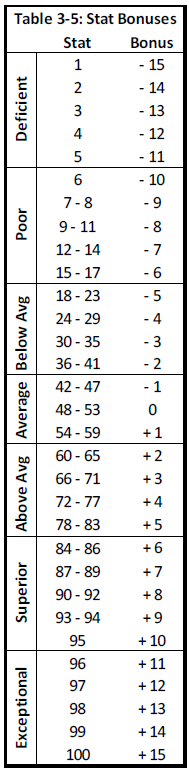
To counter this I am going to use a smoothed stat bonus table. While I am talking about stat bonuses I am also going to adopt the RMU standard of smaller stat bonuses that get added together for skills rather than the averaged method used in RMC/RM2. So what does this stat table look like?
The Stat Bonus Table from RMU Beta 2
This table discourages ‘buying down’ stats as the penalties for low stats start at just 47.
The only complications come from ‘single stat’ rolls. As an example if a player asked “Can my character remember reading anything about this legend as a student?” I would normally ask the player to roll a Memory (OE D100 roll with their Memory stat bonus as a modifier) roll to which I would add or subtract a difficulty factor depending on how well known the legends are. A character with a Me stat of 90 in RMC would have a +10 stat bonus. In this stystem that is just a +8. Your DB is normally equal to your Qu stat bonus but that too is reduced.
To address this all single stat checks will be made with the stat bonus doubled. This now makes DBs slightly higher for lightly or unarmoured characters and stat checks slightly easier. Especially as you will get a small bonus from a stat as low as just 54.
Looking at the bandings in the table here you will see the labels Deficient to Exeptional. These are used for the costings. Each +1 or -1 in the average band costs or gives 1 point. So it costs 9 points to go from the statng 50 up to 59. The Above Average band all cost 2 points so it costs an additional 46 points to get the same stat up to 83. It costs 3 points for the Superior band and 4 points in the exceptional so to get a stat up to 90 costs (9+46+21) 76 points in total.
Reducing stats works the same way.
Stats do not give any development points and I have kept all 10 stats. I was tempted to go with the HARP 8 stat version but that would lock me into the HARP skills system.
The 200 point pool means that a typical character can have two stats up at about 90 and all their other stats at around 54-55 easily within their budget.
Potentials are all 100 right across the board but I will cover potential stats next time as well as stat gains.
Want another reason to adopt Shadow World for you game setting? How about cool creatures to ride! From the early genesis of Shadow World in the “Court of Ardor” and the Loremaster series, fantastic mounts have been an integral part of the setting. Other game settings include the usual cool mounts: Dragons, Pegasus, Hippogriffs etc, but tying unusual creatures with distinct cultures and organizations has been a mainstay of Shadow World. Here are just a few samples from various books:
The Iron Wind. The special militia of the Udahir are the Thyfuriak; young men and women who bond with the Thyfur, a giant bird of prey. These warriors undergo specialized training and lead a monastic life of solitude in defense of their people.
Cloudlords of Tanara: Perhaps one of the best known groups are the Clourdlords. These knights, clad in gleaming armor of gold and silver fly their noble Steardan (winged horses) and wield rods of Sunfire against their enemies.
Jaiman: Land of Twilight. The Dragon Lord Sulthon Ni’shaang forces ride Gartyl: pterodactyl/bat-like creatures.
The Messengers of the Iron Wind. Both Lyak and Athimurl ride special mounts: Great Birds and Large Cats respectively.
The Golden Eye. The riders of the Order of the Golden Eye are formed into four divisions, each with it’s own special mount. Depending on which you encounter the Rider could be mounted on a Climbing Wyvern, Fire Wolf, Land Wyvern or Winged Wyvern.
The Kuluku. The mysterious people of the jungles in SE Emer have domesticated giant Dragonfly’s for pets and steeds!
Heralds of the Night. These fearsome servants of the Unlife are mounted on demonic, black unicorns.
Other cool mounts:
Uthula: Large lizards that can grow up to 20’ in length.
Kith: Who can forget Kith; the 6-legged panthers and famed for being the companion of the Loremaster Vurkanen Tyes!
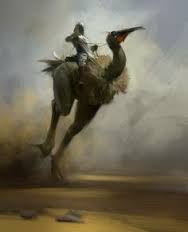
Pfurgh: These ostrich like birds can carry a rider at considerable speeds over open ground.
As a GM I love to introduce mounted foes and SW allows more interesting variants than the usual warhorse. I’m not averse to PC’s with the right background having a unique mount. Most of these mounts are limited in carrying capacity, work only in certain environments and require care and maintenance often not found in towns and villages. Plus the PC will need to expend some effort in riding skill. So while it adds a great character element I haven’t found it to be “unbalancing”.
Cool mounts: just one more great aspect of the Shadow World setting!
For inspiration on interesting mounts from works of fiction I would recommend:
“The Emperor’s Blades” by Brian Staveley. The story features Valyn, an elite soldier of the “Kettral”—gigantic black hawks. Very reminiscent of the Thyfuriak although Kettral actually can carry a whole squad of soldiers. The series also has a unique take on monks.
The Malazan series by Steven Erickson. One of my all time favorite series and a triumph of world-building and fantasy trope subversion. The world includes the culture of the Moranth. While “human” they are always encountered encased in chitinous armor and riding their enormous flying insects the Quorl. The Moranth are famous for developing “munitions” which we incorporated into our SW alchemy rules. The Malazan world is covered by 20 books by 2 authors. There is an extensive Wiki that would be a great model for SW.
The Bard is one of the nicest semi spell user professions in Rolemaster. It has a nice combination of magic, stealth, combat and social skills to make them really useful in all situations. Obviously there is no one profession that can do it all without any restrictions or everyone would choose it and no one would play anything else. The bard profession is not like that, it is nicely balanced whilst at the same time capable.
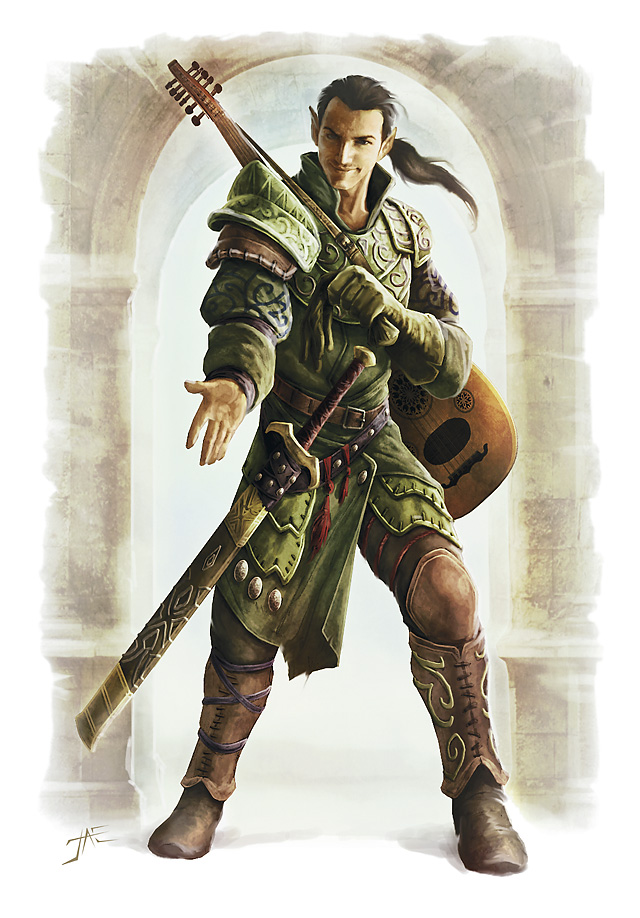
Really cool looking bard although I prefer my bards armed with axes.
The D&D bard is often quoted as the Leader Profession and the Rolemaster bard also fits into that niche quite nicely. In fact leaving all game mechanics and rules aside the cultural role of the bard means that doors open to them at all levels of society and their access to ‘behind closed doors’ information is unparalelled. In fantasy culture bards are the bearers of news as well as entertainers. They are welcome in lordly halls but get to eat with the servants and so on. As a leader the bard has the social skills to inspire and motivate groups and instill morale.
So what makes the (Rolemaster) bard so good? The first element has to be their magic. The Bardic base spells fall into two camps, magic relating to songs and magic relating to knowledge. Their songs give them the equivelant of charms, sleep and fear type spells and as they progress in levels they can effect more targets and at greater ranges. Their knowledge based spells influence how they learn languages by doubling or more the rate that skills are learned for the same points cost. They can also magically assess mundane and magical items. The ability to learn skills more cheaply and to magically emulate ‘lore’ type skills gives the bard the option to devote more development points to other areas of character development.
Bards are not restricted to just their base lists though. They can also learn the 1st to 10th level open Mentalism lists. These include self healing, illusions, detections, invisibility type spells, a variety of defensive spells and even a bolt style attacking magic (shock bolt). The truely great thing about the realm of mentalism is that magic can be cast whilst wearing any armour all baring helmets.
So magically they are really good all rounders. The only thing they cannot really do is movement, no flying or teleporting. This great flexibility is tempered by the fact that spells are expensive to learn for bards so they have to pick what is important to them.
Skills-wise the bard the bard gets professional bonuses in just about everything except directed spells (spells such as shock bolt and lightening bolt) and body development (hitpoints). The bard only has one directed spell in their entire repetoire and that is only if they choose to learn the open list of Brilliance so this no real disadvantage.
The Bard’s primary skill costs are pretty generic with nothing too expensive but nothing being particularly cheap iether. The primary skills are things like weapons skills, spell lists, magical skills, climbing, swimming and so on. the core of what an adenturer would need to do. The Bard has about the most expensive magical skills of all the spell using professions but that is the balancing fact with having the best possible mix of spells and being able to use them in nearly full armour.
It is in the secondary skills that bards really start to shine! All of the social skills from acting and singing to public speaking and seduction are all coming in at just a single development point for the first rank and most secondary skills right across the board are only 2DPs for the first rank each level. Remember that higher level bards can use their magic to learn languages at upto five times the regular rate means that spending a single development point could get you two to five ranks in language.
All RPGs have some element of combat in them. The bard as an all rounder is never going to be a stand out warrior. They are somewhat restricted in that their first weapon skill is affordable but it all gets very expensive after that. If you are restricted to just a single weapon then that generally suggests spear, shortsword or hand axe as your weapons of choice. It really depends on the game and setting as to which one I would go for. In my opinion the spear is the best weapon in the game in terms of flexibility being similar to staff, club, polearms and the lance. It can also be thrown giving a ranged option. They are also a lowest common denminator weapon requiring very little metal manufacture so are widely available. If you are washed up on a beach you can find a big stick and use half your spear skill with it as a big club. If you are a swordsman you are unlikely to find one of them on he beach.
You cannot chop down a tree with a spear in a hurry. If your game is a bit more out in the wilderness then the hand axe comes into its own. It is a practical tool as well as a weapon. It can be thrown to give you a ranged attack and it is similar to short sword for when nothing but a sword will do. I you are in a hack and slash type game then you can learn it left and right handed and two weapon combo to give you two attacks a round. Bards can be pretty good at adrenal moves so combine Adr. Speed with a pair of axes and you are up to four attacks a round or two attacks with axe and shield.
The third option is the shortsword. Again it works well as a two weapon combo, it is throwable and of these weapons it is the most consealable. It is also similar to all the most common longer blades such as broad and long sword and smaller weapons such as daggers, dirks, sais and all the short axes.
All of these options give you a range of weapons you can turn your hand to in a pinch all using just the one weapon skill.
Armour-wise chain is the best option. You do not need much skill to get away with the lighter chain armours, the heavier ones give good protection and cost wise it is certainly affordable. I would probably get fully trained int he first fiew levels and then turn those development points over to more spell lists as soon as you are fully trained.
So there is the bard. They are the smooth talking all rounder and leader of men who can in theory at least do everything from hurling magical bolts, slay dragons and play the wise old sage, all in a single profession. That is not bad going.
For those that feel like table-top RPG’s are a stagnant market or that there is no growth opportunity for ICE, RM or Shadow World I would point out two facts:
There are an average of 27 new forum members per day on the ICE Forums. That’s not a lot but that’s incremental growth. Every new member will be able to see the development of RMU, the large number of resources in terms of thread topics, file uploads and Q&A’s that are available and the active participation of product authors. Being able to get quick and detailed responses from the RMU developers or Terry himself is pretty cool—especially to a new ICE customer!
There are still gamers that haven’t heard of, or are not familiar with Shadow World! Even after almost 30 years. I recently saw this thread where several posters were completely unaware: http://www.thepiazza.uk/bb/viewtopic.php?f=44&t=13960
There are three basic ways to grow sales: acquire new customers (grow the game community), convert competitor’s customers or sell/upsell to your existing customers. Many would argue that growth in new table top players is stagnant, lost to new media and video games. But growth is occurring and RM and SW have a place in that market. Converting gamers to RM and SW is a bit easier—RM started as a modular “bolt on” product to D&D and SW has never really been stat intensive and can and has been used with a variety of gaming systems. Selling more product to current customers is the fall-back approach; what we call “low hanging fruit”. Publish a new product or revision and you’ll get a certain percentage of existing customers that will buy it—baked-in sales.
There is certainly opinions and criticisms of each of these approaches. Some argue that RMU won’t bring in new gamers; that ICE needs a simple introductory rule set. Others feel ICE just needs to push out more products in general. If there was one right answer, or if business strategy was that definitive than everyone would be a millionaire! The truth is that all three channels need to be explored and I think that ICE is doing a fairly good job given its organizational footprint and resources to bear.
There are new tools for small or emerging companies: social media, organic growth strategies, guerilla marketing etc. Putting those aside, there is one essential strategy for growing a customer base: from the ground up: “boots on the ground”. RM and SW need to be introduced locally, whenever possible. Gaming nights at the local library, game store or youth center. Tournament modules at gaming conventions etc. Other industries use “sponsorships”; this might be worth exploring. Having GM starter packs, online private forums and other tools to encourage local GM’s to adopt ICE games and use them locally builds a customer base. Reimbursing GM’s for travel and hotel costs at GENCON might pay itself off quite well.
Let’s look at another industry that has some similarities: rapid adoption, youth client base, local growth. I used to be heavily involved in the paintball industry. The sport grew rapidly in the 2000’s: tournaments were televised nationally, fields opened up everywhere, there were at least 8 glossy magazines dedicated to the sport and equipment companies had robust sponsorships for teams and local retail stores. Over time, the equipment manufacturers started their own retail websites and sold directly to their customer base. Once they captured direct sales and the associated retail margins they became less motivated to spend money on local sponsorship and player development. They became direct competitors of the local stores. While the economic crash was a contributing factor, since the late 2000’s the industry has shrunk by 80%. Yes, part of the issue was the wholesale/retail strategy of the manufacturers, but a larger part was a slower and more insidious feedback loop: there is no place to play paintball. Store retail sales suffered, which reduced player development, field investments and local marketing. Because of this, fewer players participated in paintball and store sales suffered further. Local paintball businesses closed and there were less options to play and thus less players. Overall a self-fulfilling downward spiral.
What are the analogs to the gaming industry? Local development can be an effective strategy to growing a customer base. I don’t think RGP’s will see the same boom that we experienced in the early 80’s BUT…aging gamers are teaching their kids to play and creating a new generation of RPGers. It’s a slower process that requires a broader strategy than a top-down advertising or point of sale effort. Supporting gaming conventions, creating a GM starter pack, reimbursing experienced GM’s to attend every con possible, creating a “game ambassadorships” for targeted cities/regions—these are low cost strategies to build the game base. Growing the local gaming community grows the base, which then grows company sales. A virtuous feed-back loop.
Welcome to my newest blog series where I discuss, rant, and explore common fantasy monsters for use (or not) in Shadow World. Like many RPGers in the early 80’s we started RM using the Middle Earth setting, moved to the Loremaster series and then on to Shadow World. The RM settings were unique in their discarding of most of the usual fantasy monsters packed into ecosystem defying environments. That really appealed to me and our gaming group. Aside from Goblins, Orcs and Dragons and the occasional Kraken, Middle Earth was “monster lite”; that same philosophy carried over to the Loremaster series that used a human-centric approach to antagonists. Opponents such as the Unlife and most villains were humanoids—relatable to the PC’s in a way far different than facing a bizarre and fantastical creature. While the original SW Master Atlas contained most of the monsters found in Creatures & Treasures, Terry’s work continued in the tradition of MERP and Loremaster and ignored most fantasy stereotypical monsters. Shadow World did have a few monster tropes: Unicorns, Dragons and Vampires but the focus instead was on unique fusion creatures that gave SW its particular flavor: Shards, Krylites, Kaeden, etc. I believe that further emphasizing these unique SW specific creatures better differentiates the SW setting from other products on the market. If Shadow World was described as “too kitchen sink” when it first came out I would argue that while many fantasy tropes were presented in the 1st Edition Master Atlas, Terry hasn’t whole-heartedly embraced those elements in subsequent modules.
Giants!!!!!! Look, G1-3 was a great module series in a “cartoony, I’m an eleven year old gamer” way but Giants as a viable game monster in Shadow World just doesn’t hold up. There are a few mentions of Giants in the SW Master Atlas and there are the Titans of Emer but Giants thankfully don’t appear in any SW “canon”. I treat mentions of “Giants” as pure speculation and rumor—the same way Giants are mentioned in fairy tales and stories in our culture. I do have very large humans: 7’, 9’ or a bit larger, but anything much larger than that I start having issues. 20’ or 30’ storm giants with a profession are just plain silly in my opinion!
Looking at it from a combat approach, Giants just don’t work. Go out and pick a fight with a 4 year old child—chances are you’ll win quite handily. A 24’ Giant wielding a 14’ war hammer wearing a massive set of platemail armor and moving and fighting in the same physical manner as a normal 6’ character is ridiculous for all sorts of reasons. A bipedal humanoid over ten feet tall, with excellent motor skills and tool making ability would be an incredibly dangerous opponent. At least a Dragon will have a different fighting style: claws, wings, breath weapon more akin to a reptile, snake or wild animal. Yes, it’s fantasy and doesn’t need to be realistic, but I feel it always take players out of the game. I’ve found a fantasy monster can be more immersive than encountering a 25’ human. RMU’s size scaling rules (Beta2) addressed the size disparity by making Giants and large creatures devastatingly dangerous—as they should, but the combat approach is only one aspect of the problem.
The cultural approach. Does a community of 20’, 2 story humanoids with size appropriate weapons, utensils, pots, clothing, and houses make any sense in your setting? Will adventurers plunder giant tombs only to find they can’t lift the 18’ magic battleaxe they find? Do your adventurers come across a 4’ sock discarded by a teenage giant or plunder a sack of 1’ wide gold coins? Every culture leaves detritus: abandoned objects and buildings that populate the adventure setting—how does a Giant culture work in any setting? Of course the answer is typically a remote Giant “settlement” high in the mountains or tucked into a hidden valley far from humans and other humanoids. And certainly SW’s Essaence Flows could wall off a remote community of Giants but for me it just doesn’t work.
Game Mechanics approach. One of the main reasons I avoid common monster types is because they are tropes and immediately changes the game play into ritualistic, rule-oriented process. Present a Giant to a D&D group and what do you get: Dwarves and Rangers to the front, others use missile weapons and Mages cast from a distance. The bonuses given to certain races and professions force the party’s strategy because they maximize the potency of certain characters. For players who memorize the Monster Manual, encounters became a combat by rote process exploiting known weaknesses. RM includes many of those monster mechanics: Silver vs. Undead, Mummies cause disease, Con drain, can only be hit by magic weapons etc. Alternatively, when your party encounters a menacing party of adventurers they have NO idea their level, power, abilities or weaknesses.
For me, Giants have no place in my fantasy game and no place in Shadow World. But that’s just my opinion and I welcome yours!
There seem to be three philosophies when it comes to level bonuses. I bring this up because I have always used the first method below, I have been seriously considering moving to the second option but following a discussion on the ICE forums and on the RM2 g+ community I think the third option may be the one for me. So let me explain the three options for level bonuses.
Each level characters get a +1 to +3 bonus to all the skills in a selection of categories. So a fighter would get +3 per level in combat skills and +1 per level in outdoor skills. A magician would get +3 in magical skills and directed spells. The bonuses go up to 20th level to give a maximum bonus of +20, +40 or +60 with only one exception.
In this option the bonuses do not apply per level but either per rank but to total bonus has the same cap.
In this version to total bonus is given to the characters at first level but are capped at +10 to +30, half the bonus in the other two options.
The advantages to option two are that the maximum bonus is reached sooner which helps out lower level characters and that it stops a high level character from buying just a single rank in a skill and then adding a huge level bonus to it making the almost a master for just one or two DPs.
The third option has two effects. It makes low level characters very distinctive. Getting all of you level bonus in a single hit means that rangers are really good at rangery things and fighters are really good at fighter type skills and so on. The other effect is when you are leveling up. In option 1 every skill in all the categories that your character has will improve by at least +1 to +3 regardless of whether you spent any points learning those skills. In option 2 only the skills you bought get the professional bonus added to them so that is not a problem. In option 3 you never have to recalculate level bonuses as that done during character creation once and for all. It does make a tiny simplification to the leveling up process and to character creation.
Having spelled all this out I cannot really decide which option out of 2 and 3 I like the most. Option 3 certainly gives the most competent beginning characters and the greatest differentiation between the professions at the lower levels.
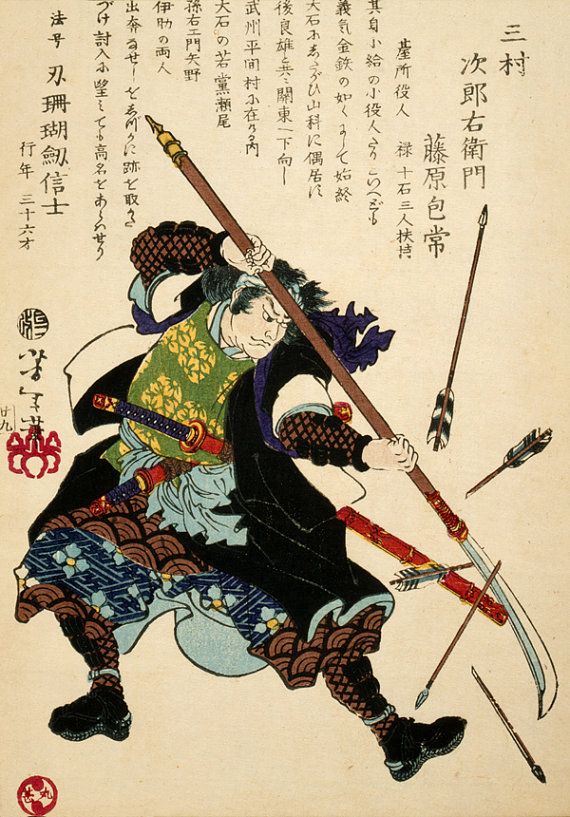
Popular fiction is replete with master swordsmen deflecting arrows with their blades or martial artists knocking aside or even catching thrown weapons. In our efforts to reduce skill bloat and add a “cinematic” quality to game play we’ve allowed the ability to parry missiles along with the standard option of applying OB to DB against melee weapons. For simplicity we prefer to build it into the normal OB/DB mechanic but we have also play-tested it as a combat expertise skill as well.
Parrying a missile attack uses 2 modifiers: the missile parry modifier of the parrying weapon used (which models the utility of the weapon in deflecting a missile object) and the missile parry modifier of the missile itself (which models the size and speed of the missile). Weapon missile parry modifiers can be found on the “Weapon Attack Modifier Chart” posted on the RM Forum (you need to have a forum account to see and download). The download can be found here:
In our current simplified version anyone can parry a missile attack under the following conditions:
They must be aware of the attack.
They must have OB to allocate towards the missile parry attempt.
The allocated OB to DB must exceed the weapon and missile parry modifiers.
Ex. Caylis, the famed Warrior Monk is confronted by a powerful servant of the Unlife, a Messenger of Kulag. Before they can close and engage, the Messenger fires his short bow at Caylis. Caylis decides to full parry the missile attack. His 110 MAStrk OB is modified by +10 (parry weapon modifier) and the arrow is modified by -60 (missile modifier) for a total modifier of -50. Caylis can add +60 to his DB against the arrow.
Note that between the parry weapon modifier and the missile parry modifiers, a character might need a very high OB to offset those penalties and be able to add any DB against the missile attack. This is purposeful and reflects the high level of skill and weapon mastery needed to successfully parry a missile attack.
For those that prefer a skill-based mechanism and a more effective missile parry system we also play-tested “Combat Expertise: Missile Parry”
Missile Parry: This skill reduces the parry weapon and missile penalties associated with blocking or parrying a thrown object or missile. The skill must specify the weapon category to be used. For Unarmed MA, the skill can also be used to catch a thrown object or missile. The character must be aware of the attack and must have available “action” left. The catch attempt is resolved before the attack resolution: Treat as an Absolute Maneuver modified by the attack OB, Missile Parry Mod and Missile Parry skill bonus. Success the object is caught. Failure and the % failed by is added to the missile attack roll.
Ex. Caylis, the famed Warrior Monk is confronted by a powerful servant of the Unlife, a Messenger of Kulag. Before they can close and engage the Messenger fires his short bow at Caylis. Caylis decides to full parry the missile attack. He has +60 in Missile Parry: MAStrk which offsets the +10 (parry weapon modifier) and -60 (missile modifier) for a total modifier of -50. Caylis can add his full +110 OB to his DB against the arrow.
Alternatively, Caylis can elect to catch the incoming arrow in the hopes of impressing and intimidating his opponent. The Messenger fires his arrow. In order to catch the arrow Caylis must roll above 110! (110sb + 60 weapon modifier -60 Missile Parry skill bonus). He rolls an 82, short of success and the Messenger can add an additional +28 to his attack roll since Caylis intentionally put himself in the arrows path during his attempt to catch it!
Additional Options.
We allow unarmed melee the same parrying ability as weapon melee. It’s implied that unarmed combat techniques incorporate defensive block/dodge/parry techniques into their respective combat systems. Additionally, “Parrying” has been defined as not just one specific, physical, blocking of a blow but the general balance between offense and defense.
Because of this allowance we eliminated the skill “Adrenal Defense”. This always felt like a work around: since MA attacks couldn’t parry then there needed to be a mechanism for martial artists to dodge and evade blows.