With so many projects going on, some are just gestating while others I pick away at when I get an inspiration or idea. One small project, an intersection between my BASiL lists and Shadow World material was designing 10 proto/Arcane lists that would have been the underpinnings of the original magic system used by the Ka’ta’viir and later Earthwardens. You can read my previous posts on this HERE and HERE. Well, in fact, I actually did the first run through on these lists under the general guidelines:
As archetype lists, they are less singular and specific as the later spells broken into the 3 Realms. That also means the spells are subject to broader interpretation in the application and effects.
These lists are powered by raw unrefined Essaence. I still used the Spell Law level format, but I wouldn’t say that the spell level is analogous to Essence/Channeling/Mentalism spells or the basic power levels in RM or RMU.
These are powerful spells, and I’ve built in the idea that they are physically demanding to focus and cast. It’s unlikely most contemporary mortal races on Shadow World could cast them unless they had some mix of Ka’ta’viir blood, offspring of a Major or Lesser or local Diety or similar.
These were created by several inputs, creative and specific: some BASiL spell lists (Physics & Time Mastery), Companion I Arcane lists, Loremaster and Navigator lists and others. It’s difficult to credit sources (and impossible to remember) when they are so varied, but let’s just say it’s a group effort and not mine alone!
I arbitrarily chose to make 10 lists. This seemed to cover on the various magical aspects I thought best represented the foundation of magic and it was achievable! Here are the final categories:
Creations – Crafting magical artifacts, constructs, and living statues.
Essaence Mastery – Foci, Power Point flows, travel, and arcane energy control.
Words of Power – Spoken arcane forces, immediate and reality-altering.
Warding – Protective proto-magic, runes, barriers, and mystical safeguards.
I’ll be posting these lists over at the RMForums for download over the next few days and turn the titles above into hyperlinks. Note that you have to have a RMForums account to see and download files there. Then I’ll be returning to Part II and Part III of my Agyra series: Empire of the Black Dragon and Nontataku: City of Sails. On the off chance that Priest-King actually get’s published I’ll have the rest of the trilogy in edit review mode for queueing up.
I’ve finished up my first draft of a game aid I’ve been picking away at for a few years. This is a visual guide and expanded description of the 120+ Shadow World herbs/substances that is found in the Master Atlas.
In my campaign, players learn a new Herb for each skill rank of Herb Lore (they can do additional research of course) and I can just print out the appropriate page so they can add to their own “Lore folder”. There are some rule mechanics and modifiers in some of the text, but I wanted to make it more of a reference book that ideally could be used in RMU or any other setting without a lot of work.
This does not include poisons, but I’ve got notes for an expanded version of poisons, antidotes and nefarious substances from my Alchemy rules that I’ll put in a short primer: Book of Dark Arts. A few of the plants don’t have pictures, and I need to make some changes to those-too many “green leafy” herbs.
Now that I’ve finished this, I want to go back and really expand my “Book of Pales” to include a variety of summoning and protection circles, more creature and Demon pictures and powerful artifacts or cool devices found in the Pales.
There is so much SW material that can be expanded upon–it’s endless! You can download the Book of Herbs over at the Rolemaster Forums, but you need an account to see and access it here:
There has been a lot of discussion around the future of Shadow World since Terry passed away, generally around 2 basic topics:
Finishing up Terry’s projects that were in the works: Emer IV, Loremaster Legacy 2, Wurilis etc.
Creating new SW material. What would that look like and who would do it?
Putting aside #1, I think much of the hesitancy around bringing in new authors is concerns around the quality and consistency of new material. But I also think there is a secondary reason: Shadow World is not just a static setting for roleplaying, it’s an ongoing story that is left partially untold. That story arc is ostensibly the “Grand Campaign” but includes earlier campaigns like the “Legacy of the Seakdrake” found in Jaiman, various adventures in Emer books and the meta plot around the Secret Circle. It felt like this was slowly unfolding in each successive SW book, but the Loremaster Legacy novel basically packaged it up in fiction rather than gaming material. This was Terry’s story to tell and it basically drives a large part of the Kulthean timeline and major events in the Second and Third Era.
It feels like a lot of loose threads, even if we know where the story might eventual go–the destruction of the Shadow Stone and/or the return of the Northern Eye. How can a new writer come in and wrap this all up? It’s hard to imagine–a bit of Brandon Sanderson finishing up the Wheel of Time. At the same time, we know where and how it ends, so does it really need to be mapped out?
But I have an idea to “reset” the Shadow World setting: start the Fourth Era. For those that listened to my podcast with Max, he mentioned that his campaign ventured into the Fourth Era and I’ve spoken to a couple other GMs that also took the group into the future Era. I originally thought that the Fourth Era boundary would be the loss of the Northern Eye, but in hindsight, it now seems obvious that the Fourth Era should start with the return of the Northern Eye.
What would Kulthea look like in the Fourth Era? Several people I’ve talked to have gamed out their version of the Grand Campaign and given me some ideas. For the gaming group, this would be an epic quest, but would also involve notable NPCs, some major battles and probably some type of geographic damage caused by severe Essaence fluctuations and tertiary events (tidal waves, earthquakes etc). Key people would be killed! As a thought experiment, the possibilities are endless:
Tarania emerges again from the sea due to shifts in the planets crust. The island, long submerged, reveals it’s secrets…
Arriving in the nick of time to confront XXX, Andraax helps win the day but is killed or is missing.
With the defeat of the Secret Circle, the Dragonlords being a campaign of conquest over various lands.
Eidolon is destroyed and crashes to the earth. It’s ruins are guarded by the Prince of Sel-Kai, but adventurers sneak in anyway!
Essaence flows are permanently shifted into new locations and pathways. The Navigators obelisk network is disrupted and needs to be recalibrated. In the meantime, Navigator Jump services are unreliable.
The massive Essaence surges that preceded the Eye’s return, opened large portals to the Pales and hordes of Demons poured into Kulthea.
Earthquakes, tidal waves and severe storms destroy coastal cities.
The balance of power shifts and the Alliance grows in influence throughout Kulthea.
I’ve discussed previously about adventuring in Kulthea during the Interregnum but remaking Kulthea and starting the Fourth Era is a clean slate that closes out the plot(s) that Terry established and builds for the a new future. It would be logical to map out massive changes to Kulthea that would occur on a near global cataclysm and give Kulthea a “refresher”. Perhaps one that better incorporates the RMU ruleset.
RMU: Shadow World. Adventures in the 4th Era. “The Age of Woe”.
Kulthea is saved! The return of the Northern Eye rebalanced the erratic Flows of Essaence but at what cost? Gods battled Gods, Heroes fell and catastrophic storms left scars across the planet. New powers are emerging from the ashes of the Great Battle and vying for dominance in the Shadow World. The Unlife is unchecked and Demons run amok among the lands. Will the new world order be for good or evil?
This feels like a clean break from the unfinished past and a start with the new RMU ruleset. What do you think?
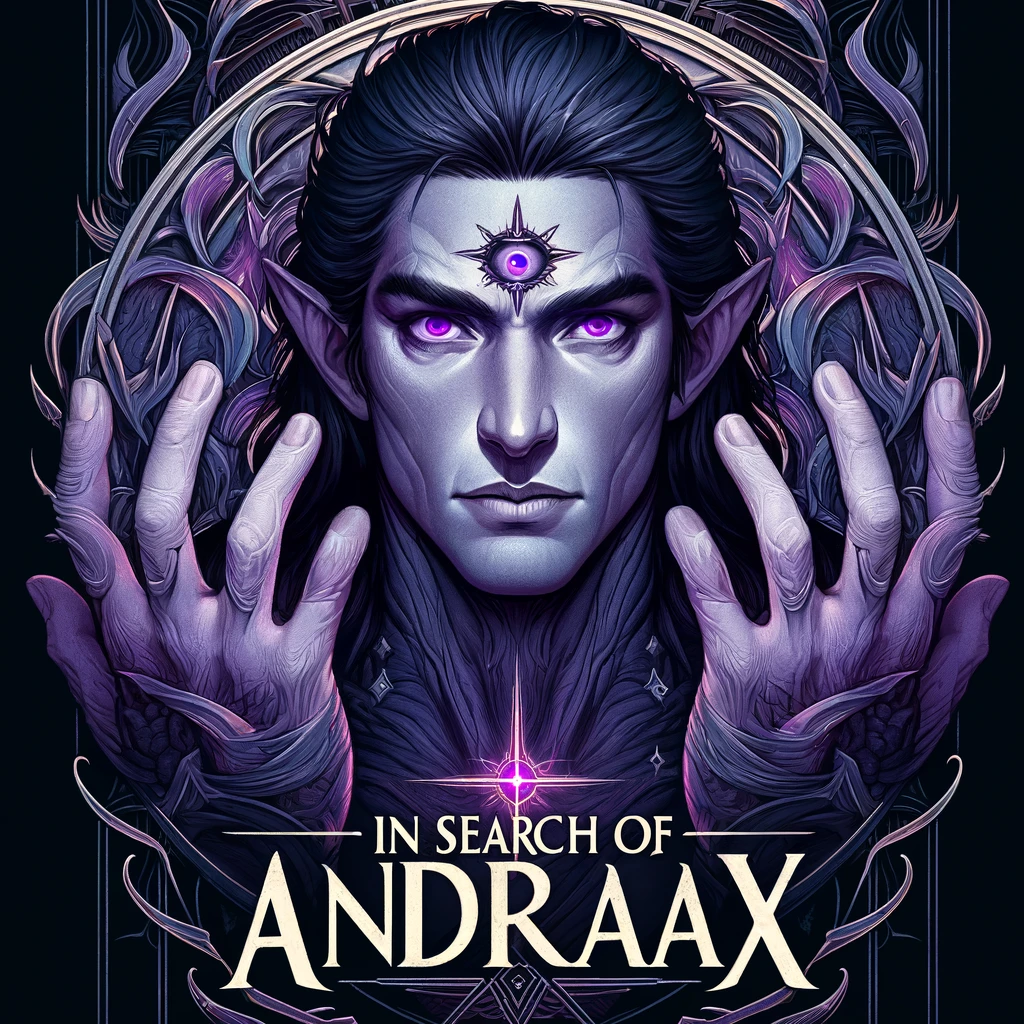
Just a quick note. I’m having great conversations with Rolemaster and Shadow World participants and creators via the Rolemaster Podcast: “In Search of Andraax”.
Do you have a long running Shadow World campaign? Do you have significant house material for Kulthea? Do you have some thoughts on Terry’s setting?
Let’s talk! I really enjoy to hear YOUR experiences, thoughts and directions on this amazing game setting!
In the realm of lands, under the sky so clear, Mountain casts shadows by starlight. Seeing the hidden essence, Through lakes and oceans, journey closely.
The Lord of the old world, Dreams through dwellings, where spirits rest, His heart, full of love, The healer of secrets, his love so true.
Scholars sing, their voices old, Singers of beginnings, songs of stone and sight, Islands whisper of past, of days long eternal, In green havens, where guardians build.
Believing, the mind’s fate, destiny bound, Loving beyond the mist, beneath the hill, Keys to unlock hidden gates, Darken the path where travel once turned.
In shallow waters, where wet meets water, The creator of souls finds his cause, Snow falls, cold to the golden ancients, Finding the lost, believes, the divine.
Through the wild heights, where thirsty dragons soar, To the tall high, where ugly echoes, Believing, forgiving, and finally seeing, The golden secret, destiny—his fate.
For those “Shadow World Scholars”, I think this is a great poem for Kydak Dûm, the Gold Dragon and head of the Dragonlords (if such a title were to exist). You can read my own thoughts on the subject HERE.
This might be too early to announce, but it’s probably given that we have a fairly small, but passionate fanbase so it’s sort of necessary. We are in the process of rolling out a new Rolemaster/Shadow World based podcast: In Search of Andraax. This will be a monthly production sponsored by the Rolemasterblog.com.
We have the first year production mapped out, but I want to solicit YOUR ideas for future podcasts content. Despite it’s current smaller market, Rolemaster was a GIANT of the industry, a pathmaker for other systems (DND 3ed) and for our readers, perhaps the RPG system of choice. It’s history needs to be further explored.
A quick search amongst Youtube and podcasts doesn’t generate a lot of great results: mostly game sessions, product reviews and the rare interview. I’m quite excited about our lineup and approach to the subject matter. If you have an “in” to a key person tied to Rolemaster, or an idea for us to explore, let us know. Is there someone we should interview or is there something you would like to know more about that hasn’t been explored?
This is part 2 of my previous post on Kulthea astronomy and might be my longest post yet–though most of the content will be AI generated. While fleshing out Kulthea’s solar system mechanics further is a goal unto itself, my real purpose is tied into the mechanics of the Essaence flows. I’ve blogged about this before HERE and my opinion has wavered between locating the interdimensional source of the Essaence on Orhan or the lagrange point between Kulthea and Orhan. A few general points from Terry’s work:
The Lords of Orhan arrived from another dimension, opening up a rift that allowed the Essaence into the Kulthean solar system.
The Essaence is a localized effect. We know that it’s found on Kulthea, Charon and Orhan. We can assume it permeates the other 3 moons to some degree, but I’m going to experiment with the orbits to see how that might work. In fact a number of Ka’ta’viir left Kulthea to search for the Essaence in other parts of the galaxy (and returned later to become the Earthwardens)
When the Lords of Orhan arrived, they settled on the near moon of Orhan, implying that they didn’t arrive on the moon itself.
Terry never included material that the Essaence is sourced on Kulthea, or include any mechanism, object or location for such a thing. (my blog posited that the Pillar of the Gods could be that “tuning fork” but the timing seems off.
What we can all agree on is that the interdimensional rift must be located somewhere, it has to be within the Kulthean solar system and the solar system itself is moving through the ether/universe. Therefore, it should be a fixed point that moves with the planetary bodies. I’m settling on my third option, that the rift is in the lagrange point between Kulthea and Orhan and is anchored by some object, although that object could be interdimensional and perhaps non-physical in “Kulthea world”. This allows for some interesting Essance interactions, plays along with some astronomical events like the “Night of the Third Moon”, and partially explains why the Charonic gods are lesser than the Orhanian ones.
For purposes of my simulation I kept the modelling to the interactions and orbits of Kulthea, Orhan and Charon. I plugged in the diameters, orbital distances and orbit lengths into the AI and got this preliminary summary:
To simplify, we’ll assume circular orbits for initial calculations, even though Charon’s orbit is explicitly non-circular (polar orbit with varying distance). For this model, let’s calculate the average orbital speed of each moon and see how they compare.
Key Data
Kulthea
Diameter: 8,600 miles
For simplicity, we’ll assume its mass can be approximated by Earth’s given the similar size, as mass directly influences gravitational pull but was not specified. This is purely for the sake of calculation and the scenario’s understanding.
Charon
Diameter: 850 miles
Average Orbital Radius: 130,000 miles+190,000 miles2=160,000 miles2130,000 miles+190,000 miles=160,000 miles (Given as orbit distance, matches initial input)
Orbital Period: 21 days
Orhan
Diameter: 3,800 miles
Orbital Radius: 210,000 miles
Orbital Period: 70 days
Calculations
For each moon, we can calculate the average orbital speed using the formula:
Orbital Speed=2�×Orbital RadiusOrbital Period in secondsOrbital Speed=Orbital Period in seconds2π×Orbital Radius
Converting orbital periods from days to seconds for this calculation:
1 day=86,400 seconds1 day=86,400 seconds
Let’s proceed with these calculations.
The average orbital speed of Charon around Kulthea is approximately 0.554 miles per second, while Orhan orbits at an average speed of about 0.218 miles per second.
These calculations provide a simplified view of the orbital mechanics of Kulthea and its moons. They help us understand the relative speeds at which Charon and Orhan move through their orbits, given their distances and periods.
But I am interested in how often Charon eclipses Orhan, which should be a significant physical, metaphysical and societal event given the roles that these moons play in Kulthean culture. After a few simple prompts, AI produces this:
The orbital periods of Charon (21 days) and Orhan (70 days) suggest that any alignment cycle would be tied to how these periods relate. Specifically, we can look for the least common multiple (LCM) of the two periods, which would give us a rough cycle in days when their relative positions repeat, offering potential for an eclipse, assuming perfect orbital conditions.
Let’s calculate the LCM of Charon’s and Orhan’s orbital periods to find this cycle.
The least common multiple (LCM) of the orbital periods of Charon and Orhan is 210 days. This means that every 210 days, the relative positions of Charon and Orhan to Kulthea align in a cycle, potentially allowing for an eclipse of Orhan by Charon from Kulthea’s perspective, assuming ideal orbital alignments.
It’s important to note that actual eclipse frequency would depend on the specific orbital paths, inclinations, and the nodes at which Charon’s polar orbit intersects Orhan’s ecliptic orbit. Without more detailed orbital mechanics and alignments, this estimation provides a baseline for the periodicity with which such alignments could theoretically occur.
I’m also curious about how often Charon is in Zenith to Kulthea. In canon, this is a oft referred to event called “Night of the Third Moon” and Terry has established that occurring every 149 days. Terry also establishes that Charon perigee occurs every 24 days:
Charon Perigee This is when Charón swings closest to Kulthea—an event which has no relation to the Darkside Zenith of the ‘Night of the Third Moon’ because of Charón’s strange ‘wobbling’ as it rolls around Kulthea. Charón Perigee occurs every 24 days, a little further in its orbit every time it circles Kulthea. But this distance is significantly closer. At zenith the Third Moon approaches as close as 130,000 miles, swinging near the orbit of Varin. At apogee it arcs out as far as 190,000 miles. It should be noted that every 10.2 years in certain locales near the equator there is a correspondence of perigee and zenith in which Charón hangs huge and red over the night sky. It is a time to fear.
I’m not well versed in astronomy and there is a lot of comingled terms and effects I need to delve into and it’s not clear that Terry’s numbers are accurate given the physical constraints of the planets and orbits. But again, I’m interested in a eclipse of Orhan which, given the location of the Essaence rift in the lagrange point, would imply that Charon would both receive the full flow of Essaence from the rift, and block and reduce Kulthea’s reception of the Essaence. This would truly be a significant and dark event on Kulthea. Per the AI, this would occur every 210 days.
But Terry has defined zenith occuring every 149 days, so I plugged this into the model:
If Charon reaches zenith from Kulthea every 149 days, despite having an orbital period of 21 days, this indicates a more complex orbital interaction or axial rotation of Kulthea than initially simplified.
Here are some possible conclusions or considerations based on this information:
Axial Tilt and Rotation of Kulthea: Kulthea’s rotation or axial tilt might be such that Charon’s polar orbit aligns with zenith over a given point (likely one of the poles) only at certain intervals dictated by how Kulthea rotates. If Charon is directly overhead (at zenith) every 149 days, it suggests that Kulthea’s rotation period and axial tilt cause the alignment with Charon’s orbit to match up less frequently than Charon’s complete orbit around Kulthea.
Orbital Precession: Another possibility is the precession of Charon’s orbit, where the orientation of Charon’s orbital plane gradually shifts over time. However, for precession to result in a zenith occurrence every 149 days, it would require a very specific interaction between the rates of orbital precession, the planet’s rotation, and the moon’s orbital period.
Synchronization Phenomena: This timing could also hint at a unique synchronization between Kulthea’s rotational period and Charon’s orbit, where the specifics of their interaction only align Charon over a zenith point every 149 days. This kind of synchronization might involve resonances between the orbital and rotational periods, though the mechanism would be complex given the data.
Observation Specificity: The 149-day interval for zenith alignment could also depend on the specific location on Kulthea’s surface from which observations are made, influenced by the planet’s rotation and Charon’s orbit. It might not be a global phenomenon but rather specific to certain latitudes.
In summary, a 149-day interval for Charon to reach zenith suggests a complex relationship between Kulthea’s rotation, Charon’s orbit, and possibly the axial tilt of the planet. This relationship goes beyond simple orbital mechanics and delves into the intricacies of planetary and lunar dynamics within this fictional system.
So this is interesting but not very useful to me at this point. My take away at this point is that a significant event occurs every 210 days. In my Shadow World, that will not be the Night of the Third Moon. But I’m also interested in how my placing the interdimensional rift in the lagrange point could impact orbital mechancis, or raise any issues I hadn’t thought about. So I asked:
can we infer anything about the lagrange point between orhan and kulthea?ChatGPT
Lagrange points are positions in space where the gravitational forces of a two-body system, like a planet and a moon, produce enhanced regions of attraction and repulsion. These can be used to balance a smaller object, making it possible to maintain a stable position relative to the two larger bodies. For Orhan and Kulthea, there are five Lagrange points, but the most commonly discussed for stable orbits are L4 and L5, which form an equilateral triangle with the two larger bodies, and L1, which lies directly between them.
Given the data provided:
Kulthea is the primary planet.
Orhan is a significant moon orbiting Kulthea at a distance of 210,000 miles.
What we can infer about the Lagrange points, specifically L1 between Orhan and Kulthea:
Location of L1: The L1 point would lie along the line connecting the centers of Kulthea and Orhan, closer to Orhan due to its lesser mass relative to Kulthea. The exact position can be calculated using the formula that considers the masses of Kulthea and Orhan and their distance apart.
Stability: The L1 point is known for its unstable equilibrium. Objects placed at L1 tend to drift away due to the slightest perturbation and require station-keeping maneuvers to maintain position. For a moon and planet system, this is still true but is more relevant for artificial satellites.
Utility: In science fiction or theoretical space missions within such a system, L1 could serve as a valuable position for observational satellites to study Orhan, Kulthea, or the space between them, possibly monitoring weather, magnetic fields, or other scientific interests.
Calculating the exact position of L1 requires knowing the masses of Kulthea and Orhan, which were not specified. However, the formula for finding the L1 point’s distance �d from the smaller body (Orhan) in a two-body system is given by:
�=�(�23(�1+�2))1/3d=R(3(m1+m2)m2)1/3
where:
�R is the distance between the centers of the two bodies,
�1m1 is the mass of the larger body (Kulthea),
�2m2 is the mass of the smaller body (Orhan).
This formula simplifies the complex gravitational relationships into a more manageable calculation but requires the masses of the two bodies to apply directly. Without the masses, we can’t calculate the precise location but can appreciate the conceptual placement and significance of the L1 point between Kulthea and Orhan.
When does Charon interfere with the lagrance point between orhan and kulthea?
To understand when Charon might interfere with the Lagrange point (specifically the L1 point) between Orhan and Kulthea, we’d consider the orbits of both moons and their spatial relationships to Kulthea.
Given the scenario:
Orhan orbits Kulthea at a distance of 210,000 miles on the ecliptic.
Charon orbits Kulthea at an average distance (considering its polar orbit with varying zenith and apogee) but specifically has a polar orbit that could cross the ecliptic plane.
Interference at the L1 point between Orhan and Kulthea by Charon would occur under these conditions:
Orbital Plane Crossing: Since Charon has a polar orbit, it would only potentially interfere with the L1 point when its orbit crosses the ecliptic plane, where Orhan’s orbit lies. This would happen twice every orbital period of Charon, once when it moves from south to north across the ecliptic and once from north to south.
Alignment with L1: For Charon to specifically interfere with the L1 point, its crossing of the ecliptic plane would need to coincide with the line connecting Kulthea and Orhan where the L1 point is located. Given the orbits and sizes involved, this alignment would be relatively rare.
Timing and Orbital Position: The actual occurrence of such interference would depend on the relative timing of Charon’s orbital plane crossing with Orhan’s position in its orbit. Given Charon’s 21-day orbit and Orhan’s 70-day orbit, predicting exact intersections without detailed simulation and precise orbital mechanics (including the specific orbital inclinations and nodes) is challenging.
Given these considerations, while we can’t provide a precise schedule without further orbital mechanics details, we can infer that:
Charon’s potential to interfere with the L1 point between Kulthea and Orhan is limited to specific instances when it crosses the ecliptic at or near the L1 point.
Such events would be relatively infrequent and predictable with a more detailed analysis of their orbits.
In essence, while Charon could theoretically interfere with the L1 Lagrange point between Orhan and Kulthea, the conditions for such interference would occur at specific, infrequent intervals dictated by the intersection of Charon’s polar orbit with the ecliptic plane at the location of the L1 point.
Can you estimate that frequency within 1 standard deviation?
To estimate the frequency within 1 standard deviation of when Charon might interfere with the Lagrange point L1 between Orhan and Kulthea, we need a basic understanding of the statistical distribution of these events over time. Given the complexity and the non-random nature of orbital mechanics, a true statistical standard deviation isn’t directly applicable without empirical data or detailed simulations. However, we can approach an estimation by considering the orbital periods and the conditions required for interference.
Key Points for Estimation:
Charon’s Polar Orbit Intersection: Charon crosses the ecliptic plane twice per its orbital period (21 days).
Orhan’s Orbital Period: Orhan completes its orbit in 70 days.
Synchronization of Orbits: The key is finding when Charon’s ecliptic plane crossings align with the L1 point between Orhan and Kulthea.
Given these factors, let’s estimate the likelihood of alignment:
Charon’s ecliptic crossing occurs approximately every 10.5 days (half of its 21-day orbit).
The “window” for potential interference at L1 during each of Charon’s crossings would be relatively short, given the vast distances and relative speeds involved.
Simplified Estimation Approach:
We’ll assume that if Charon’s orbit crosses the ecliptic plane near the L1 point when Orhan is also near this point in its orbit, interference could occur.
Given the orbital periods:
Charon crosses the ecliptic plane every 10.5 days.
Orhan’s position relative to Kulthea and the L1 point changes gradually over its 70-day orbit.
The likelihood of both moons’ positions aligning with the L1 point (and thus Charon potentially interfering with it) can be thought of in terms of Charon’s crossings during Orhan’s orbit.
Calculation for Estimation:
Cycle Length: Calculate the time it takes for the alignment cycle to repeat, potentially using the least common multiple (LCM) of Charon’s and Orhan’s orbital periods.
Alignment Opportunities: Divide Orhan’s orbital period by the frequency of Charon’s ecliptic plane crossings to estimate how many opportunities for interference exist per Orhan orbit.
Let’s proceed with a rough calculation based on these assumptions.
The least common multiple (LCM) of the orbital periods of Charon and Orhan is 210 days, indicating that the alignment cycle between their positions repeats every 210 days.
During Orhan’s 70-day orbit, Charon crosses the ecliptic plane approximately 6.67 times (every 10.5 days given its 21-day orbit), presenting several opportunities for potential alignment with the L1 point.
Given these crossings and the LCM, we can estimate that there could be about 3 significant alignments within one 210-day cycle where Charon’s position might align with the L1 point between Orhan and Kulthea, under ideal conditions. This is a simplified approximation and actual alignments would depend on the precise orbital dynamics and spatial positions of Orhan and Charon relative to Kulthea.
This estimation suggests that, within one standard deviation or one complete cycle (210 days), we might expect up to 3 opportunities for Charon to interfere with the Lagrange point L1 between Orhan and Kulthea, assuming each ecliptic crossing by Charon has the potential to align closely with Orhan’s position near L1. This frequency is an averaged estimate, and the actual occurrence could vary based on the specific mechanics of their orbits.
So if we were to average this, Charon would eclipse the lagrange point in relationship to Kulthea every 70 days.
So let’s summarize some basic points:
149 Days. The Night of the Third Moon occurs on the Zenith of Charon. I’m a bit confused on this since Charon has a polar orbit by definition the “highest” it’s in the sky would be when it’s directly over the north pole. Anyone have a better interpretation of this?
24 days. The perigree of Charon (when it’s closest to Kulthea @ 130,000 miles) occurs.
10.5 days. Charon crosses the ecliptic (half of it’s 21 day orbit)
70 days. Charon eclipses the lagrange point between Kulthea and Orhan.
My takeaway:
Zenith. I’m not sure the zenith should have any real impact (physical or metaphysical). The long zenith interval needs to be explained by axial tilt, precession or a combination of factors which I think are too messy and complicated for usable gameplay. Instead, I see the zenith as an dark omen, but given that Charon would be directly overhead of a specific geographic area on Kulthea, there is an increased chance of encountering a creature of Charon. (they would travel the most direct, shortest route from moon to planet)?
Perigee. When Charon is closest to Kulthea there should be an uptick in Charon activity and visits. (ie less effort and power to travel from the moon to the planet).
Lagrange eclipse. The period when Charon intersects the lagrange point between Orhan and Kulthea. This event should drastically modify the Essaence flows bathing Kulthea and dramatically increase the Essaence exposure to Charon.
Moon eclipse. The period when Charon physically and fully eclipses Orhan. This would create the same type of conditions in #3 but also disrupt Channelers of Orhan and reduce or block any interactions between Orhan and Kulthea. This should be a very dangerous and perilous event and in my mind should be the real “Night of the Third Moon”. Charon becomes ascendant and the people of Kulthea are basically blocked from their gods on Orhan. Ouch!
The last piece of my puzzle for game purposes is the impacts on Charon when it’s is eclipsed from the lagrange point by Kulthea. per analysis, such disruption would last minutes or hours and occur once every 21 days. At this point, Charon would be completely cut off from the Essaence, weakening it’s denizens and disrupting the “social order” of the moon. Furthermore, the whole 180 degree arc from the eclipse point would also put Charon further away from the lagrange point. I would consider that 1/2 of it’s orbit Charon is receiving less Essaence exposure. This is a contributing factor to Charons role as a lesser pantheon and why Charon makes for a good “prison planet” for these entities.
So a long post, but to distill it down to the basics. I wanted a simplified model and calendar for celestial events involving Charon and Orhan. I also wanted to tie this into the base mechanics of the source of the Essaence flows. Until now, I’ve just hand waved some answers, but now with AI I can come to a proximity of a scientific solution using orbital mechanics.
As part of my ongoing expansion of Shadow World material using AI, I probably need to spend more time on Iruaric, the language of the Ka’ta’viir. Arguably this is the proto language of Kulthea, (although I created a lesser version called “Alta” to differentiate high and low speak and the eventually evolution into power and magical languages).
Also to keep in mind is that in the Shadow World and Spacemaster, the Althans and/or Ka’ta’viir with “Harbingers” throughout the galaxy–a light inference to “seeding life” theory of sentience. There is a lot to unpack, but Iruaric should not be overlooked despite it being a dead language. Hey, there are quite a few Ka’ta’viir running around (relatively, it’s been 110,000 Years).
So I’ve been running prompt evolutions through the AI machine. To start we have this as a next stage baseline for further development. Some of this feels to derivative of the Kugor language, but in certain theories, Kugor is a sublanguage of Iruaric. I’m not a fan of some of these results, some of it seems over simplistic–pig latin at best by adding a suffix tag, but I’ve done additional iterations, adding in a flavor of science and math to steer results. That makes sense given the advanced nature of the Althans.
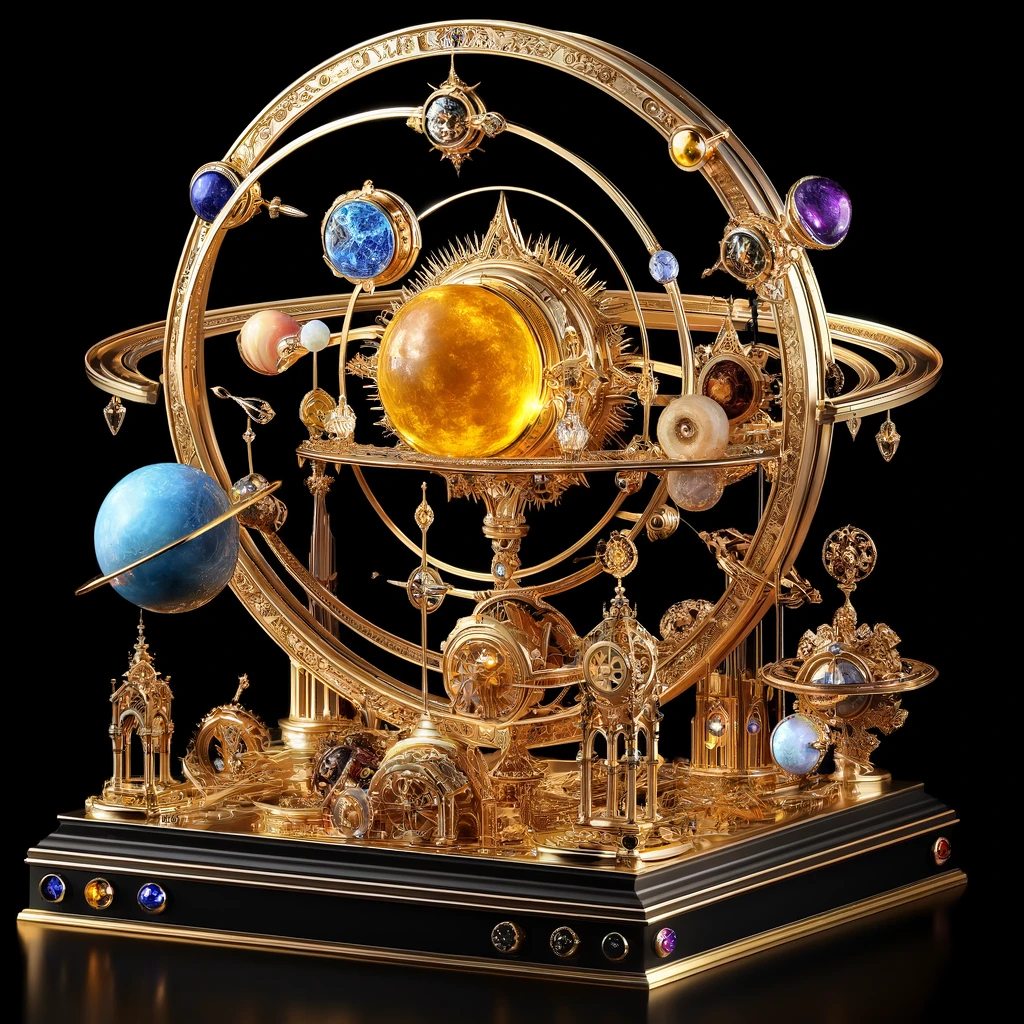
This orrery captures the grandeur of the Kulthean solar system with a central sun made of golden topaz and planets represented by various precious stones, all adorned with gold accents and set upon a base that blends classical and futuristic elements.
We are covering a lot of ground with our Shadow World AI project and with these blog posts I’m just summarizing some of our work or showing our initial results from the last few weeks and months. My hope is to inspire other SW users to generate their own content, provide useful feedback on the work that I’m doing and moving the Overton Window on the discussions around community content. The hard reality is that AI generative material will quickly outpace human creators in both scope and speed and will be able to emulate creative’s style and work product. As much as I try to keep my material “in the lane” with Canon, AI will be able to iterate new material using Terry’s baseline work–which is substantial.
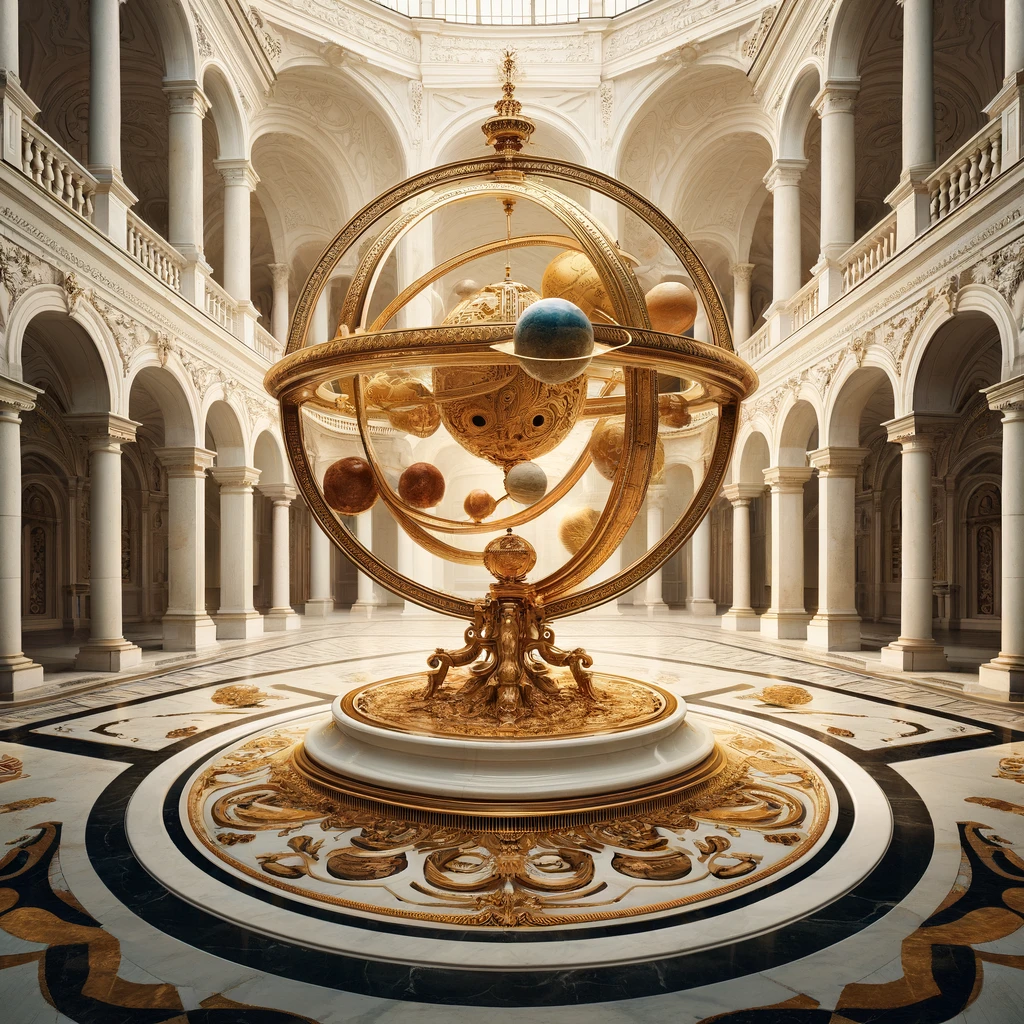
I’ve been working on a simulation of orbital mechanics to understand the interplay of Kulthea, Orhan and Charon (which matters most to gameplay). My first step was to feed the planetary info into the system and model it. Part of that process was to also generate an ornate orrery that is used in the Temples of Phaon. You can see the picture above. Future work will be to create a animated simulation of the solar system but I want to start with a small simulation of Kulthea and it’s moons.
One of the areas that AI like Chatgpt can excel is generating fantasy languages. Not just word emulation, but grammar rules. I’ve been playing around with expanding the vocabularies that have floated around Shadow World books since the original Iron Wind, with a focus on Iruaric and Kugor (the language of Dragonlords). I start with uploading the current available words from the Master Atlas to create a baseline for the AI to work from. Kugor was interesting since it seemed to relate to, or draw, from Norse or Scandanavian influences. I’d be curious if that was intentional on Terry’s part.
The following is a basic first run with a sampling of results:
Kugor
Kugor appears to have a rich tapestry of words, with distinct sounds and themes focused on power, nature, elements, and societal structures. We’ll create new words that reflect and extend these themes, ensuring they’re phonetically aligned with what you’ve shared.
Given the established vocabulary’s emphasis on strong consonant sounds (like “g,” “k,” “r,” and “b”), use of double vowels for emphasis, and thematic focus on elements, creatures, and societal roles, the new words will follow suit.
Nature and Environment
Storm – Raathuon
Volcano – Shaangarn
Iceberg – Raathkarn
River – Biarkael
Valley – Karnbrod
Meadow – Prykachaw
Sun – Utumkodur
Creatures and Beings
Wolf – Drayn
Eagle – Kodry
Serpent – Ssovalg
Giant – Hoerkarn
Witch – Womuulga
Wizard – Womawga
Societal and Conceptual
King – Folmgaak
Queen – Folmgaakur
Hero – Breyaalc
Villain – Gartgaath
Treasure – Utumwomul
Curse – Gaarkchaur
Objects and Artifacts
Sword – Daagutum
Shield – Aalkaed
Book – Cuivagak
Potion – Rúansig
Crown – Aedfolm
Jewel – Eanwomul
Actions and Properties
To Conquer – Druskarn
To Betray – Gartkraaw
To Celebrate – Brechaw
To Enchant – Womuulchort
To Discover – Uscurackarn
To Heal – Prykawomul
Additional Vocabulary Expansion
Natural World and Geography
Thunder – Raathlyyg
Lightning – Piriig
Forest Glade – Chawlocha
Ocean – Aactoskuur
Mountain Pass – Karnny
Volcanic Ash – Shaangdes
Creatures and Beings
Sea Monster – Aactosdrak
Mountain Spirit – Karnorg
Forest Guardian – Horlyalc
Sky Serpent – Awduussoi
Ancestral Ghost – Androskhomul
Societal Roles and Constructs
Chieftain – AWkanga
Sage – Fawshrydrul
Craftsman – Arxduleer
Emissary – Druulkaag
Rebel – Ordir
Concepts and Abstract Ideas
Oath – Kodulryt
Exile – Iirmord
Alliance – Chaaggagur
Ritual – Yhomechooth
Prophecy – Koduldrul
Objects and Artifacts
Rune Stone – Orguscurac
Heirloom Sword – Daagutumleer
Enchanted Cloak – Womuulain
Druidic Staff – Uscuractarmen
Ship’s Figurehead – Progaorg
Actions and States
To Envision – Piriidrul
To Enchant – Uscuracchort
To Forsake – Gartord
To Illuminate – Piriolias
To Reign – Kangaoran
I think this is an encouraging first step! AI tools will actually build rules around verb and adverb usage, conjugation, gender use and perspective. My own usage is around building a word toolkit that is phonetically related to the baseline and generating compound words and short phrasing. However, someone with a deeper understanding of language building could really run with this.
We’ve already been working on a central repository for non-commercial Shadow World artwork, it would also be helpful to create a wiki dictionary with expanded lexicon of the more prominent languages. I’m simultaneously working on Iruaric which I’ll post up next, but the Elven languages might be very interesting given Terry’s initial work in the Tolkien setting.
Again, as a disclaimer, I understand the concern and issues around AI generative material, but I also see powerful tools able to expand on Terry’s work without a disruption of canon.