Play Test Session #2

This actually took place a while ago now but what with Christmas and the #12daysofRolemaster this post got pushed back somewhat.  My playtest player is back from university soon and it suddenly dawned on me that I never posted this write up. It was also useful to me to come back up to speed with where Gao is.

We left Gao out cold after losing a sword fight with a couple of assassins. Unbeknownst to Gao the assassins had left him for dead. The Emperor had used the body of the assassin that Gao had disabled to cover himself with fresh blood and had played dead.  Eventually the assassins had been discovered by the palace guards, the alarm raised and a running battle ensued as the assassins attempted to flee though the Forbidden City.

The Emperor had been recovering in bed when the assassins had attacked having been magically healed by a court healer (lay healer). The Emperor’s wounds and Gao’s had me go over the healing rules in Arms & Character Law. I did really want to use the rules as written but there is no way on earth I am ever going to apply those healing rules. The rules would have had Gao laid up in bed for 10 days given the Injuries and Recovery roll and by chance there would have been a permanent injury because of an even double roll! In my RMC game we use cinematic healing and the same will apply here. The issue is not just with, possibly, realistic healing times but also the plot was supposed to follow this thread. The Emperor has witnessed first hand that Gao saved his life on the night of the first attack and saved it again on the second when someone had obviously arranged for the guards to be elsewhere. When no one can be trusted at court Gao is the shining exception. Thus the Emperor can entrust Gao with the task of finding who the assassins are working for. If Gao is laid up for 10 days then this is ridiculous and any trail would be stone cold by then and even the Emperor would not sit on his hands for nearly two weeks doing nothing when assassins could strike at any time. One option would be to massively up the level of the Lay Healer. The way the spell acquisition works in RMU a 25th level Lay Healer would be more than capable of solving the whole conspiracy anyway without Gao so the whole adventure is moot. Option ‘B’ is to go back to Cinematic healing. This heals Gao’s broken bones in 10 hours rather than 10 days and giving him his #hits back is not a problem.

So on with the adventure!

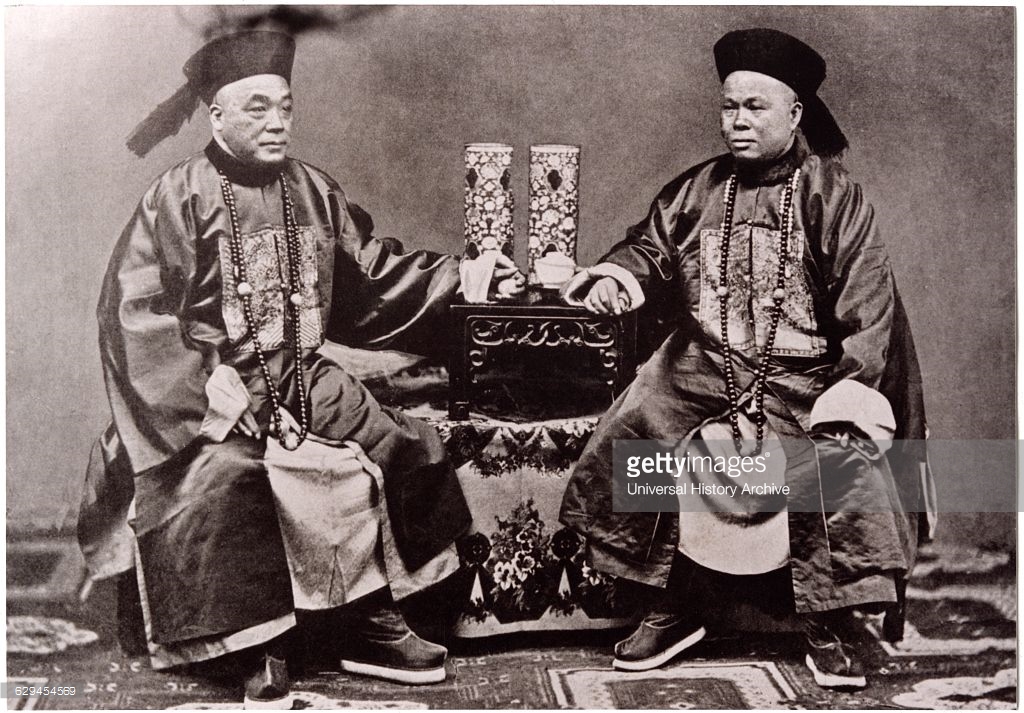
Gao wakes up in a comfortable bed overlooking a tranquil palace garden being attended by many servants. His aches and pains have gone but he has no memory of anything since being in the fight with the assassins. Soon after he is awake an official brings him the Emperors gratitude and a request to attend the Emperor in his chambers. What happens is the Emperor explains that no one can be trusted except just a few of his closest advisors, including the court healer who could easily have declared the Emperors original chest wound fatal and allowed him to die though inaction. Simply by healing the Emperor he has proven his loyalty. As no one else can be trusted it falls on Gao to find the traitor that is plotting against the Emperor. There are some clues to start off with. The assassins’ weapons all bear the makers mark of an honoured sword smith here in the Forbidden City. Furthermore, three of the assassins that were killed have been identified as men sentenced to months in a cangue (punishment cage) for violent crimes. It is possible that these men had bought their freedom in agreeing to slay the Emperor. Gao gets a set of documents that give him freedom of movement around the city and a rank equivalent to an auditor or tax collector that means he had great authority. This comes complete with an over robe bearing a square badge displaying a Peacock known as a Mandarin Square.

The audience ends with Gao being given a fine quality Qi Jian. I am not normally in favour of giving out free bonus items but the combat last time was so disappointing and the fact that with only one PC the chances of him being out numbered is great I think he needs a bit of added fire power.

Gao leaves the palace and decides to investigate the sword smith first. What follows is three failed perception rolls cumulating in an open ended downwards which leaves him completely miss informed. The emperor had sent a couple of trusted guards individually to shadow Gao with two ideas in mind. If they are loyal then should be able to lend him some assistance if he gets into trouble. If one is loyal and the other is not, then chances are the traitorous one will try and kill Gao and the second will still be able to assist him. If both are traitorous then Gao will die but two more traitors have been exposed.

The player had been trying to see if anyone was following him through the narrow streets of the city or looking suspicious. The failed rolls had meant that the guards were not spotted but at this point I made a mistake. I thought that with the open ended roll leaving Gao completely miss informed I would tell him that one of the stall holders was paying a bit too much attention to him. This send the player into a spin of paranoia and and at one point the player was considering doubling back to kill the stall holder. I think in retrospect I should have ignored the OE downwards and just treated it as a normal failure. That cost us a great deal of the game session, we live and learn.

Eventually we arrived at the weapon smiths abode. It is a double storey building with sloping red tiled roof and a central courtyard. Dragon shaped ‘gargoyles’ project from under the roof tiles carry rain water away from the walls and ornate iron gates, again with the dragon motif give access to the courtyard.

Gao has the vocational skill for Oriental Administration so he knows how to act as a tax collector and his plan was to inspect the weapon smith’s order books to see who bought the weapons. Gao decided to go in heavy handed and try an intimidate the weapon smith. Seeing as he is dressed in official mandarin garb and has all the right credentials I gave Gao a +20 to his intimidation attempt but as it happens he didn’t need it, he succeeded with his natural skill. Furthermore, Gao makes a Vocational skill roll to understand the order books and the abbreviations and marks. This is only partially successful but he gets the weapon smith to explain what he doesn’t understand. It turns out that weapons were ordered and paid for by a Magistrate here inside the Forbidden City. The only address is for the palace and the weapons were collected in person so he does not have a delivery address. These blades stuck in the weapon smith’s memory because he made 4 sets of 8 blades. 8 is the luckiest of numbers representing fortune but 4 is the number of death. Most of his orders are for pairs of blades as these are both lucky and bring peace.

Gao decided that he was probably dealing with an innocent here and commanding the weapon smith to report any more orders by the magistrate directly to the palace for approval in future he left the workshop.

Leaving the shop Gao again totally failed to spot anyone following him or acting suspiciously.

Before the session started I had not decided if one, both or neither of the guards following Gao were actually traitors. I try and have one combat per session but with all the faffing about with fake spies earlier I decided to just roll and see if either of these guards had it in for Gao. As it happens the first I rolled for turned out to be a traitor. I also habitually roll the Empathy, Reasoning and Self Discipline of my casual NPCs so I can get an idea of how to play them. This first guard has a 12 Empathy, 92 for Reasoning and 19 for SD. It is not a great leap to guess that he has worked out that Gao is now heading to the guard house and this is not good for the traitors. Gao is heading straight towards him when Guard 1 draws his Qi Jian and attacks. This fight turned into another grind it out, chipping away at #hits. Neither combatant moved much, the first guard caught Gao flat footed etc. but the attack roll was abysmal and after that they stood in the street and parried and counter attacked at each other. Gao slowly increased the percentage of his OB to attack once he realised the person fighting him was not getting through. The worst critical inflicted in 6 rounds was 5AK. Previously I had not read up on the changes to stun so this time rather than having Dazed, staggered and so on we just had the different levels of stun (-25/-50/-75). This didn’t make much difference but the important thing in this fight was the fact that the traitor guard is alive despite being unconscious.

That is where we left this session. Gao is down to 12#hits and is standing over the knocked out guard.

Next time…

I am hoping next week to be able to continue this game using RMU Beta 2. I am using the Beta RAW with the exception of the changes listed in JDales New Tables thread on the forums and next time I will be using double the #hits damage as discussed on the forum.


Big Beasts and Big Hits

There is an ongoing discussion on the RMU beta test forum over weapon sizes. How do you handle a halfling wielding a trolls dagger? Is the dagger a shortsword or a broadsword to the halfling. Does the fact that it was made for different hands make a difference to how you wield the weapon? There were complications where using an under or oversized weapon such as a undersized two handed weapon may be more effective than using a one handed weapon specifically made for you race. So all your human warriors are using halfling two handed swords rather than broadswords.

This is a long rambling debate and you can check the ICE forums if you want to get involved. One of the things I find frustrating is that one never really knows what the devs have taken on board, what their solution is, if any, and is just being ignored because that part of the rules is are already written.

I will say I am not a fan of the RMU size rules. I think they sound fine in principle but they just didn’t work for my play test group so much so that the group didn’t want to play any more.  The play test lasted two sessions!

So how do I handle size variation between different size combatants? I totally agree that all things being equal a giant hitting hitting a halfling should do more damage than the halfling hitting the giant. There is just more kinetic energy in the attack!

The big monster hitting the little character requires no modification. The big monster has its size and mass figured into its OB. So that was easy, just play the RAW.

The smaller combatant hitting a larger one though does need a slight adjustment. It doesn’t need the multiplied hits or stepping up and down for criticals. The very largest creatures have this built in in C&T anyway. So what I do is for every relative size smaller than Medium incurs a -10 OB, every relative step above Medium gives a +10 OB. That results in smaller creatures doing less damage and maybe a lesser crit. Larger combatants tend towards harder hits.

Breaking 150

In another closely related rule is my ‘breaking 150’. For me I use a +1 on your critical roll for every 10 more than 150 rolled. So an attack roll total of +175 would give a +2 to your critical. This also tends to mean that massive attacks tend to do better criticals. My critical tables have an UM66 and a second 66 result. Obviously you cannot shift your critical up to the UM66 result.

Wrong Size Weapons

So how do I handle wrong sized weapons. Well the weapon uses the table for what the weapon actually is. So a halfling using a human broadsword as a two handed sword still uses the broadsword table. But for every one step in size difference gives a -10 OB. This reflects the fact that the weapon was just not designed for that size hand.

It also takes into account that a dagger is a stabbing weapon designed for pushing into the gaps between armoured plates. A broadsword is a swinging weapon designed to use speed and mass to inflict damage. A human picking up a halfling breadsword does not change the shape and design of the weapon and turn it into a dagger.

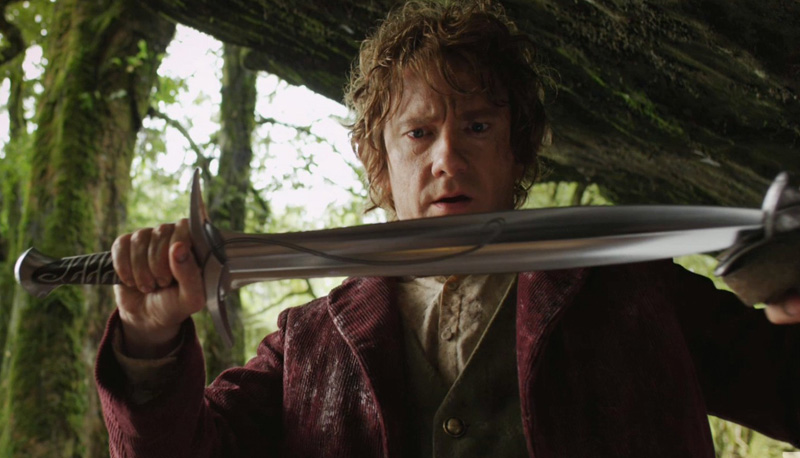
So the example of Sting. Could Bilbo wield Sting? Sting is regarded as a Elven shortsword in RM terms. So Bilbo would be using it as a shortsword but at -10 OB. Chances are that Sting has a greater than +10 magical OB anyway so even with my penalty it is still worth using Sting in combat and its orc sensing powers make it even more useful.

So in conclusion I would say whilst it may not be the idea engineers solution my rules are very quick and easy to use, easy to understand and cope with all the combinations I have ever had to adjudicate on.

By Jove I think I’ve Got It!

<I have a horrible feeling that is a miss-quote from Rex Harrison in My Fair Lady>

I have been thinking a lot about my Rolemaster feeder system rules and I think I can build two systems one for 4yrs to 8yrs and one for 9yrs to 12yrs. It took the example criticals that BriH suggested (“Bam!! Foe hit in face and forced to blink for 1 rnd”, “Kapow!! Foe is disarmed”) and some comments by Edgcltd to give me the inspiration.

I think I can build a game for 4 year olds. I am going to have to examine the National Curriculum in some more detail to see what skills I can expect children to have but that is actually a useful framework to work to.

So down to by game concept.

Imagine rendering skills down to a number of gold stars. You get no stars for having no ranks (-25) and then roughly one star for every +25 or so as we would think of it. So a typical OB would be in a 1 star to 5 or 6 star range. DB would be 1 star for a shield. Magic armour may be 1 star or maybe even 2 star.

You attach roll would normally be in a no star to 4 star range with open ended rolls taking it up to 8 or more stars.

Stat bonuses would typically be no stars or one star.

If any of you have young children or have had them you may be familiar with a number line. It is used for teaching addition and subtraction (check this out if you don’t know what it is https://www.mathsisfun.com/numbers/number-line-using.html)

So I am sticking with cards as they remove the need for dice and being able to self print cards makes the game easily expandable.

Each card will have the attack/skill roll as a number of stars in a top corner. The body of the card will have a number of criticals on a vertical number line. The player when they want to make an attack draws a battle card, sees how many stars on the card and then counts on to add their OB, and counts back to take off the defenders DB and then reads across for the result. That is where the “Thwack! Foe is knocked down and out!” comes in.

Healing would be cinematic and fights last until everyone is either knocked out or runs away. At which point the surviving characters help their friends to the their feet and the adventure continues or the character wakes up in a cell held by the villain.

I think I need three professions; knight, archer and magician.

I think I need 4 stats. Players will be given 9 stars to share between the four stats.

Strength will combine Strength and Con.

Agility will combine Agility and Quickness

Sympathy will combine Empathy and Intuition

Cool will combine Memory and Reasoning (yes, being a geek is cool!)

Presence and Self Discipline are not needed in this simplified version.

The nine into eight means that everyone gets at least one stand out stat.

There will be at least three races Human, Elf and Dwarf. This is not yest fixed in my mind. I think I would like more but not sure which.

There will be battle cards, skill cards, movement cards and spell cards. The battle cards will work as I described above. Skill and moving maneuver cards will work in a similar way but the content of the table will resolve the static action or moving maneuvers. Spell cards will a pack per spell list with half being utility spells such as Light and the other attack spells like Lightning Bolt. So there will be many Lightning Bolt cards each with its own attack roll and unique critical table. The utility spell cards will have the roll for BAR or SCR built into them.

So that is a whirlwind tour of Rolemaster for 4 year olds.

I am thinking of calling it Gamemaster Kids as I have not had any response from ICE when I emailed them and that would mean I am no longer using any of their IP. The version for lightly older players could then be Gamemaster Heroes. That would be the true feeder system into RMU.


4th In my opinion the best bit of RMU is…?

Brian: Hands down it’s the size rules (which may be changed or modified). Such a useful tool for scaling deadliness of a creature, spell, object or trap within the rule frame. I understand that many people didn’t like the math, but it really is fantastic.

Peter: This was a hard choice and I am wavering between two possibles. I love the experience rules. I first saw them in HARP and I am really pleased to see them being used as the default rules in RMU. I was using the HARP rules, house ruled into my RMC game but now I am using the RMU rules in their place. My other love is Spell Law, pretty much all of it from the completed spell lists to the use of the spell aquisition skill as spell mastery.

Interestingly Brian and I are on different sides of the RMU size rules argument. I found the rules cumbersome, awkward and terminally slow. They initally really applied mostly to Arms Law and I though I could just junk all of Arms Law and rewrite my existing combat tables to fit RMU, which I probably will do anyway. That was before I saw Creature Law and the normalised creatures. It is a tribute to RMU and all flavours of Rolemaster that it is so modular that something as central as these rules can be changed without breaking the system.

Meta Skills

Rolemaster Unified Character Law Cover

Brian and I both share the same philosophy when it comes to skills, less is more. Meta skills are a way of having less skills that enable your characters do more.

More is less

The more skills you have in your game the less capable the characters are. If there are only 40 skills and a character can afford to buy 10 plus some body development, weapons and perception then they have 25% of all the skill bases covered.

If you have 100 skills in your game and they can afford to buy 10 skills then the character has only 10% of all the bases covered.

If you have 200 skills then 10 skills covers just 5% of skills.

As you up the total skill count one option is to increase the number of development points each character has. This was introduced with the firs set of secondary skills in Character Law. They added 45 secondary skills and recommended adding 25% more development points. So by the time you get to 200 skills you need to be giving the characters double development points just to stand still.

I can agree that if you have more skills you should give the characters more development points to compensate but this brings with it its own problems. If your character starts off with relatively few DPs because he or she has lowish temp stats (but decent potentials) then your fellow characters are going to be able to do more than you in more situations. This is already a  problem but now the effect has been quadrupled (it was doubled by doubling the demand on the limited DPs and then exacerbated by doubling the difference between a character with high stats and one with low stats). Your fellow characters have more opportunities to earn experience so they level up faster and get more DPs and so the problem gets worse. What you have is a vicious circle.

The other option is Meta Skills. Brian has a Survival skill but does not have Foraging or Region Lore or tracking. If you hae a full set of survival skills for a particular region then that includes where to find food, water, the lie of the land. You can also build a fire and probably tie knots covered by rope mastery.

RMU shows some of its strengths

This is where RMU shows some of its strengths. Firstly you get a fixed number of DPs per level, the default is 50 so having great stats or poor is no handicap but also it has the Vocational Skill.

Vocational is the ultimate meta skill

Vocational is the ultimate meta skill. If you take Vocation:Knight then you gain all the minor day to day skills that a knight would know from recognizing the devices and standard of other noble families to etiquette to handling hunting dogs and birds of prey. A character can have multiple Vocation skills so you could have Vocation:Squire and Vocation:Knight if your character came up through the ranks, so to speak. You can pretty much define your characters back story skills in terms of Vocational Skills. Vocation does not supersede any specific named skills, you cannot use Vocation:Knight in place of Riding:Horse by claiming that riding is a knightly pursuit.

This is how I think all skills should work. I don’t use the Survival skill but I do have Foraging and Tracking. Brian and I have identified the same problem arrived at the same answer but we started from different places. In my gaming group my players love the Tracking skill so it was not on the cards to remove it. It would have been missed too badly to take it away. On the other hand no one bought the survival skill, in those survival moments the players turned to foraging for food or tracking game (animals have to drink so follow the tracks and you will find water).

In both cases, Brian’s Shadow World campaign and my Forgotten Realms game we have both arrived at a total skill count of about 45 skills. The characters are going on similar adventures, facing similar challenges and coming to similar solutions I assume as people the world over are all the same. As long as the game and skill system gives the players the levers they want to pull the players are happy.

The reduced skill count actually makes the players happier as their characters are more capable and more of their ideas are successful ‘on the round’ as the characters are able to put the plans into action. It reduces the need for quite so many NPCs and so on.

As I get older I find I can retain the definition of 40-50 skills easily enough but on the other hand trying to remember 200 skills when about half of them ‘break the rules’ (things like the way that stunned maneuver works, or iai strike that have unique rules for just one skill). I am never going to retain that many skills and rules and I don’t think new players will either.

I kind of hope that RMU resists the urge to bolt on more and more skills a the system matures. There is no need to repeat the mistakes of the past when there are so many new ones we can all make!

Rolemaster and multiclass characters

I am spending the day travelling today. I was up at the crack of dawn to get the train to London and right now I am sat in Caffè Nero at Heathrow terminal 5 waiting for my flight to Switzerland. Initially I thought I may end up missing my Friday article this week. One the Iron Crown forum there is a discussion going on about allowing a character to change professions.

Professions are so ‘loaded’ in Rolemaster that I knew this would turn into one of those rambling threads.

Changing or having multiple character classes is so integral to D&D that I am surprised that this question doesn’t come up more often. D&D, as I remember it, has  two options, you can start out with two or more classes and your experience is split evenly between each or you choose to change from one to another and once your new level catches up with your old one you can start to use features of both classes. For a game with many hundreds of classes the need to create new combinations us a little odd but who am I to criticise, there are millions of D&D players and they all seem happy enough to me.

Rolemaster professions are not character classes. A Rolemaster profession is intended to be an entire way of life and represents the characters entire world view, their education and sets their aptitudes for their entire life. The are not something that you can change at gheeta drop of a hat.

In my Rolemaster Classic (Rules as written) game  the party met and have been adventuring for just 22 days but they are already on the verge of achieving 5th level. In the forum thread the character wanting to change profession is just 4th level. That is a pretty short window in which to shift ones entire world view. Of course the character in the thread may have been adventuring for years, we don’t know.

So in Rolemaster there are few if any hard limits on what a character can learn to do. Fighters can cast spells if they invest the points into spell lists and makes can wear armour if they are prepared to take the rusks of spell failure. These soft caps were meant to remove the need for multi classing to changing profession.

The fact is  that a fighter with a spell list is not a mage. Going against the professional archetype will never be the same as adopting the new archetype and that is what the player wants to do in the forum thread.

HARP does allow multi classes and is balanced to take these into account so it is possible but the RMC/RM2/RMSS/RMFRP development point system of individual skill costs mean that multiple professions will always be over powered. It will much more viable in RMU as the professions are much more like HARP professions, remember that HARP is a much younger system than RM and has the benefit of a lot of hindsight in its design.

The other option is to use the No Profession. This is my preferred solution. You cannot have multiples or change things you don’t have. It gets rid of some much ‘baggage’ that this forum thread has reinforced my view that No Profession is the right way to go for Rolemaster. It is one of the best things about this modular system that No Profession was available as a built in option right from the beginning.

Further musing on the skills system

I really like Brian’s take on skills where the number of ranks has an important role to play as well as the total bonus.

As I see it there are four types of skill roll in Rolemaster.

All or nothing.

This is the classic pass or fail test. You either heard the cocking of the crossbow or you didn’t. In RM2/RMC you need a total of 101+ to succeed in RMSS/RMFRP it is 111+ (which always struck me as a weird number if eleventy-one works for you then who am I to argue.)

Progress towards a goal

So you want to do something that is going to take time, you make your skill roll and depending on the roll and outside factors you get a result. That is how much of the task has been completed. if you get below 100 then you are part way through the task, over 100 and the task took less time than expected.

Opposing Skills

You are trying to hide and I am trying to spot you. Your hiding skill roll result would then be used as a penalty to my perception roll. The GM has to decide which way around to apply the rolls. Does my keen eyesight may your hiding more difficult or does your hiding position may my attempt to see you harder. I always go with the route of least rolls. If there is one hider and five seekers then I would have the hider’s one roll apply to the seekers five individual rolls.

Combat rolls

Here the result is not pass or fail, there is no straight hit or miss, and there is not really an opposing skill although the defender can use skills to make them harder to hit. You make your roll apply all the bonuses and penalties and look up the result on a table.

Now in most RPGs the combat rules take up a huge amount of space in the rule books even if combat doesn’t take up a huge amount of time at the table. Rolemaster in particular takes great pride in its combat system and we all love the critical tables and there blood splattered graphic descriptions. I am perfectly happy with my current version of the combat system and when I migrate to RMU I will junk the rules as written and insert my existing version. I have already rewritten all of the most commonly used critical tables so modifying the numbers of hits delivered and stretching them up to the new 175 cap will not be a massive endeavour.  Some people think that Rolemaster combat can be slow or overly complicated but it doesn’t have to be that way.

I am not so sure about the all or nothing skill roll. In the rules as written (RAW) all or nothing skills have a partial success result which allows a second roll at a penalty. If we were to abandon the whole all or nothing concept and make all rolls as static or moving maneuvers anything else than a 100% success would be a graduation of that partial success. Results at or below 0% would be failures.

In the example of the cocking of a crossbow if you rolled your perception and got less than 100% as a result then you could allow a second roll with whatever the shortfall was as a penalty. If of course there is actually anything there to hear after the event!

The question is would this simplify the game and speed up play?


Is RMU missing an opportunity to fix the rules system?

Rolemaster Unified Character Law Cover

I have been doing a bit of homebrew rules writing this week and I have taken bits and bobs of other games and mashed them all together to get a set of rules that did a particular job. It isn’t rolemaster so doesn’t belong here but bits of rolemaster ended up in what I was doing.

Now if you take bits of different games you get different mechanics and different ways of doing the same thing. In rolemaster particularly RM2 if you look at how skills work you you get different ways of doing things in the same game!

Lets take buying skill ranks.

Some skills you can buy as many ranks as you like each level eg Armour, languages and spell lists.

Normally you can buy one or two ranks but occaisionally some professions can buy more etc Healers and First Aid.

Some skills have ranks that always give a +5 bonus eg Armour.

Most skills have deminishing returns eg +5, +2 +½.

Some skills each rank is only worth +1 eg Ambush and Stunned Maneuover

Some skills have multiple options so Stunned Maneuver could be +1/rank but could be +5, +2 +½.

Some skills can only cancel out penalties but not give a bonus such as Armour and Transcend Armour

Some skills cancel out penalties but can give a bonus on top such as Spacial Location Awareness.

Some skills have the same function or role as other skills but at different costs and use different stats such as tumble defence and adrenal defence, Iai Strike and adrenal quickdraw, spacial location awareness and blind fighting.

Going back to the costs some weapons and musical instruments use the same mechanic of the first you learn is the cheapest, the second the next cheapest and the more you learn the more expensive they get. Languages on the other hand all cost the same regardless of how many you learn. Martial arts has yet another mechanic for its costing with the prices remaining constant but prerequisites on what you can buy.

Some skills come with special rules attached such as iai strike that can have you throwing your own weapon away on a bad roll. Subduing is another

Is all of that really necessary? I can understand that some skills are moving maneuvers and some are static maneuvers and different rules apply but RM2 has reputedly 200 skills all told and apparently 200 rules for how to apply each one. I kid you not! You would have thought that sprinting would be a MM skill to be applied as a bonus to MM rolls when sprinting. Wrong! MM rolls normally give a result that can go over 100% to show greater that expected progress of faster completion times. It would make sense for sprinting to be a bonus and help get those over 100% results but instead sprinting has its own special table that limits the gains you can get.

Now that is only a tiny snapshot of the problems in RM2.

I don’t know RMSS/RMFRP but I do know the real sticking point for players of either RM2/RMC and RMSS/RMFRP is the skills system. RMSS has categories that you have to do something with before you can buy a specialism but it has everyman skills that operate a buy one get a dozen free or something. On top of that you then get training packages that I think give bulk discounts and talents that give bonuses or cancel penalties. I am possibly being unfair to RMSS but as you all know I love minimalism so it was never going to be the system for me. There is nothing wrong with it if it appeals to you.

So where does RMU come into this?

RMU has the opportunity to really sort out the mess of different mechanics for skills. Do skills cancel out penalties, the new Combat Expertise works that way but will any future flying skill or Spacial Location Awareness skill work that way? What will happen if you get an EO downward roll on a quickdraw/iai strike roll? Can you get a downward roll or will it be a fumble roll?

I am really looking forward to the final draft rules. I want to apply my classless levelless house rules to RMU and as such I really want them to sort out a long lasting structure that will prevent the balls up that was the RM2 skill system.

That turned into more of a rant than I intended. It was not supposed to be that way and RMC (derived from RM2) is my weapon of choice. The more I looked the more inconsistencies I found and the more of my own post-it notes I found in my old paper RM2 rule books.

I have only seen the Beta II rules and that does appear to be falling into the different rules for different skills trap with the Control Lycanthropy skill having its own rules as do Piloting, Jumping and Adrenal Focus. There are also different Knowledge tiers for lore skills that do not apply to more physical skills. I repeat though, these are Beta rules and not the final rules. I hope you can see the reason for my concern. if you start off setting a bad example it is very hard to fix it later.

Is Rolemaster Rules Heavy?

Rolemaster Logo

I saw a survey today that listed Rolemaster as an example of a ‘Rules Heavy’ system. If you bought ALL of RMC that would be Character Law, Arms Law, Spell Law, Creatures & Treasures and Companion 1 you would have the entire published system and the entier page count runs to about 800 pages. That is roughly the size of just the three core DnD 5e PHB, DMG and Monster Manual.

Page count is not the best way of measuring the weight of the rules. If we were to look at spells every spell in Rolemaster works in one of just a few ways. Either you roll on an attack table (eg Fireball), the spell effect is dependent on the severity of the targets failed resistance roll (eg Sudden Light) or the spell is not variable and has a baked in effect (eg Projected Light). If we look at DnD you get every spell with its own bespoke rules and formulae such as Magic Missile that fires of a variable number of projectiles depending on the level of the caster but never misses. As a magic system Rolemaster is a lot lighter than DnD 5e. Incidentally DnD 5e was quoted as a medium weight system in the survey above!

Combat in DnD vs Rolemaster is a hard one to compare because I have never known anyone apply the rules correctly in either system. DnD is often protrayed as Roll to hit, roll your damage and move on. That sounds really easy and fast but then you add in initiative rolls, and weapon vs armour modifications and different ‘to hit’ tables for different professions/classes and a few hundred classes and things are not as simple if you apply the rules as written. In rolemaster the big bug bear is exhaustion points. I have never even read the rules in full, I have never played them and do not know anyone who has played them. If you ignore exhaustion then Rolemaster looks more complicated with books of tables, one page for each weapon and books worth of critical tables but it still comes down to roll to hit and roll damage (our beloved criticals). rolemaster has more pages but actually less rules. It does have a hell of a lot more flavour than DnD combat. It is aledgedly more dangerous but that is down to how many first level magic users you have tried to play in DnD I suppose.

The point I am trying to make I suppose is that what makes one system ‘rules light’, I think my RM variant is very rules light, one rules medium and another rules heavy is I think the eye of the beholder. the person who created the survey thinks or has heard that Rolemaster is rules heavy and therefore puts it as an example of a rules heavy system perpetuating the myth.

I think ICE need to address that perception and one way to do that is to adopt the Adventure Path methodology and literally put a ready to play pa together that new players can pick up and start playing in the same evening. Of course with a new generation of RM about to be released this is the perfect opportunity to do so.

RMC House Rules – My Experience System #3 Spell Lists

Rolemaster Logo

There are really three parts to this, improving the spell lists you know, learning entirely new lists and improving your power points. I will take each in turn.

woman-1072572_640

Improving the Spell Lists you know

This is the easiest bit. If you cast a spell off a list in a meaningful situation (not just rattling off a few spells at the end of the day just to tick the box) then you can mark the list as used. When you are in a situation where you can study, reflect and improve then you can roll to improve the spell list. For every rank you have it counts as 5. Roll a D100 OE and if you roll over the current total you gain a rank. So if you know Fire Law to Rank 5 (5th Level) you would need to roll 26+ to learn the 6th level spell. Progress through ranks 1-10 is pretty quick but then slows down. Once you get to rank 19 you need an open ended to improve.

Learning entirely new Spell Lists

You need to study to learn new lists. I use the same rules as are given for researching new spells for studying new lists. Essence lists require books and a teacher, mentalism require meditation and channelling, prayer. Hybrid lists need to meet all the requirements. If there is no first level spell then the time required would be to research the first available spell and at that point yu would have the number of ranks required to cast that spell.

Improving your Power Points

This is based upon improving your Power Point Development Skill. If power points are used in earnest (just as with casting spells that count for experience above) then when you get a chance to rest and improve then you can roll to improve your PPD skill.

This means that starting characters get more power points quite quickly but it then levels off, just like learning spells. That really is the intention of the entire experience system. Everyone should improve quite rapidly in the skills, stats and spells they are really using. Once they are competent then that progress slows but it never stops. Unless you are a real one trick pony each time when experience would have been dished out you will probably improve in something, a little here a little there. Having characters pay for training brings real benefits at that time, not six months later when they finally level up.

Finally, this system works really well with the new RMU spell law. The diference is that every level in RMU has a spell associated with it. RMU kind of expects characters to be higher level when they start so having characters improve quickly fits in well with that expectation. In RMC, my preferred system the gaps in the spell lists does add a bit of extra excitement when a character gets a new spell as often the rank will improve but this does not bring any new abilities. It is rather swings and roundabouts as to which you prefer.