
We love our Giants

Rolemaster Logo

I have spoken about giants and the local legends before in When is a rock not a rock? Now it just so happens that I encountered a couple more giants last weekend then they deserve a bit of an honourable mention, especially as they stood still long enough for me to catch them in a photo.

Giant-Hiligan
It appears out first giant has just woken up and could be in a bit of trouble. I think I read somewhere that the head represents about 1/7th of the entire body so the bit you can see was about 5′ and was half his head making him approximately 70′ tall if he stood up straight.
mud-lady
Out second lady giant is considerably smaller at a meer 35′ tall and somewhat more shapely than her male kin. Obviously both giants have been slumbering sor quite a while which is why nature had almost entirely concealed them.

Giants are cool. They make a complete mockery of most parties battle formations. For most spells if you are close enough to fire a spell at them you are close enough to get hit with a pretty big rock by return post.

In my world I get to choose from a whole host of giants from the Arcane and Cyclops which are fairly distinctive to (and this is a pretty give list) Cloud, Desert, Fire, Fog, Formorian, Frost, Hill, Jungle, Mountian, Reef, Stone, Storm and Wood Giants plus Ettins, Firbolg, and Verbeeg.

In the RMU Creature Law (I know, I just couldn’t keep away!) you get a selection of the most common eg Cyclops, Cloud, Fire, Frost, Hill, Mountain, Stone, Storm, Forestand Water Giant plus three known as Minor, Normal and Major. In RMC you get same cast as RMU.

So who has the toughest giants? The answer has to be RMU giants kick arse! The reason being is magic. In AD&D giants did have inate abilites and there was always a chance that a giat has a low leve cast with them. In RMC wach giant has a couple of spell lists (up to four lists for Cloud Giants) but RMU Giants are incredible spell casters with the king of the heap being the Mountain Giant with 14 spell lists to pick from all to the giants level.

Reading the RMC and RMU giant monster descriptions I am reminded somewhat of the original Greek myth variatons of the giants rather than their Norse brethren but most of all I was really impressed with the reworking they have recieved in RMU.

But what about the missing giants? The Jungle Giant, Firbolg and Verbeeg etc.? These are going to be pretty easy to convert over for my game if and when I need them but now I have refreshed myself with the Rolemaster image of giants I think I may be giving them a bit of a shot in the arm and a general beefing up. Now that has to be a job for a lazy summer afternoon.
Forgotten Realms, Not In the Ghetto

Rolemaster Logo

One of the things I like about the Forgotten Realms setting is that unlike so many other settings the non-human races are not ghettoised.

Take middle earth for example, if you are looking for a dwarf then they are pretty much allowed to live in Erebor or the Iron hills. Need and elf? That will be Lorien or Rivendell. If Hobbits are your problem then head to the shire.

Pretty much the entire planet is human with just these little nature reserves or enclosures for the non humans. Greyhawk was not much better with elves being found in Celene, Highvale, the Lendore Isles, Sunndi, the Duchy of Ulek, the Valley of the Mage, the Vesve Forest.

Faerun is more cosmoplitan and racially integrated than either of these and more than most other settings. Take Waterdeep as an example, the city itself holds almost every inteligent race capable of living in a civilised society and that includes races normally associated with the tag ‘monster’. As long as they are kept in check there is no reason not to employ Orcish bodyguards.

This integration does not only extend along racial lines. Your magic users are not all holed up in their towers. Every spell caster who can manipulate fire or water can find a place in the cities version of the fire brigade. It is one of the ways that spell casters can make their living if they are not the adventuring type.

From an adventuring perspective what this means is that for the starting player every race is available without having to come up with some tenuous reason why they are where they are. If you want to be from foreign lands then great but if you want to be local but still be a dwarven berserker then that is cool too. If you need someone who can read dwarven runes then chances are there is going to be a dwarf in your local tavern at some point. Whether that causes more problems than it solves is one of the day to day hazards of adventuring. (Getting a dwarf to translate the runes of a grave piece from a noble dwarven family can be a bit dicey!)

The whole Dwarves don’t like Elves and Elves being patronising to Dwarves is a bit cliched and totally unnecessary in an integrated society.

This doesn’t mean that you don’t get ‘homelands’ for these races. In fact within Faerun you get elven homelands that have been abandoned (Myth Drannor), those that are in their ascendancy (Evereska) and those timeless lands that have always been and always (to the inhabitants perception) will be elven lands.

The same is true with the Dwarves. There are enough dwarves around that are looking for clues of their lost family halls that they are almost queuing up to repopulate former dwarven halls and strongholds.

So when you are adventuring in the Realms just remember there is no place for ‘human supremacists’.

Broadcryers

Broadcryers are part of the fabric of life in Waterdeep. These are the newspaper hawkers that we know selling the single page ‘broadsheet’ short scrolls that are popular in Waterdeep.

Short scrolls are a single sided scroll maybe 20cm by 30cm (8″ by 12″) that pass for a newspaper. There are several available and each is printed within the city. The most popular are ‘The Vigilant Citizen’, ‘The Blue Unicorn’, ‘Daily Luck’ and ‘Northwind’.

As a rule they carry tabloid style tittle tattle, scandle and rumours as much as any real news. The writers of the short scrolls are a mix of anonymous perveyors of rumour, often in reality scribes who become privy to private affairs through their work or through overhead snippets of information and semi professional reporters of news. The concept of ‘Journalism’ does not exist but chroniclers of events have been around since the dawn of the written word.

As a GM I absolutely love the short scrolls. Based on the premise that with all tabloid journalism 99.9% is made up crap designed to sell newspapers I can use Broadcryers to bawl out headlines which could be ‘rumours’ fit for investigation by the party of PCs, complete fabrication, events spun off from different PCs operating in the same area or a way of introducing colour and flavour into the world, names of important NPCs and what they are up to.

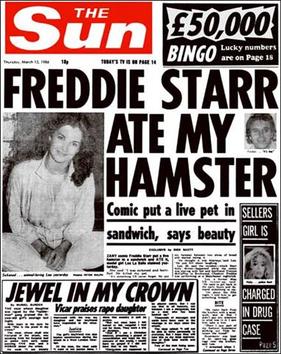
In the same way that Freddie Starr never consumed any hamsters I am in no way constrained by the truth.

Something that is interesting though is that according to all the official Forgotten Realms publications (City of Splendors: Waterdeep, Blackstaff Tower and Downshadow) these are printed not hand written. The printing press revolutionised fifteenth century Europe. As soon as you allow printing presses into the world you open a pandoras box of potential uses for this technology. If you look through Spell Law ways of mass duplication is something that is not are covered by the normal spell lists. Possibly you could use a Prosaic list for this or research a suitable spell but as it stands this is something that technology can do that magic cannot.

The reason Broadcryers and their short scrolls came to mind is that all week I have been making up stories to fill the short scrolls for my PBP game. When rules, reality and even truth are all optional it is really good fun creating little newspaper stories.


I am avoiding RMU! (and the missing subterfuge skills!)

Rolemaster Logo

You may have noticed that I have not mentioned that much about RMU. The truth is that I have had a collegue on annual leave, I have had to go on 6 sessions of full day training, I have been away my self (a paintballing weekend) and various other demands on my time (blame the Greeks). I simply have not had time to read the books in the detail they deserve and conversely there is a really detailed discussion going on on the ICE forums that is far better than anything I could write with the added advantage of feedback from the actual authors.

If you want to know more about RMU then head over here http://www.ironcrown.com/ICEforums/. I will deal with each book in turn when I have the time to do it justice.

RM2 vs My brand of RMC

One of my PBP players today asked me where have all the subterfuge skills gone. RM2 players are used to having dozens of skills detailing the minituae of every aspect of life it seems. For example they have Build Trap, Set Trap, Detect Trap and Disarm Trap in addition you can learn Trap Lore to give you a knowledge base to work from.

In my world I still have Trap Lore but the only skill for traps is Disarm Trap. As I explained to the player if you are looking for traps and it is a trip wire or pressure plate sort of affair then Perception is the skill to use. Just tell me what you are looking for and roll the dice. If it is a complex lock mechanism that you are studying in detail and you want to know if it has an embedded trap then the Disarm Trap skill is suitable.

What about the building and setting of traps? As I see it if you are relying on a trip wire or noose then I would use rope mastery, if it is a snare to all intents and purposes then why not use a foraging roll? If it is none of those but you can explain to me how you want it to work and how to set it up then I am good wth that. Not everything has to have a roll but if there is a chance of failure then we have 10 stats we can use. I am inclined to use a different mix of stat bonuses from case to case depending on the design of the trap. Some will require a more reasoned approach others nimble fingers and a steady hand. Trap Lore would come into this as well. If the principles are well know and obvious then a knowledge of Trap Lore will warn you of some of the common reasons for failure and tips to aid success.

So is this Build Trap, Set Trap or Foraging?

So the most important thing is what are you trying to catch? If the answer is a rabbit then using the trap above is without a doubt foraging. If you want to catch an Orc then under RM2 you would need two completely different skills (Build and Set). Why is that?

Why Remove Skills from the Game?

I am not on a mission to remove skills from the game. What I noticed was that with every companion there were new skills being added. This puts pressure on the GM to give more Development Points each level, makes leveling up slower, makes each RM2 Character incompatible with any other game that didn’t use the same mix of companions and as almost every skills is coloured by how much scope each GM gives it makes playing the game under two different GMs potentially confusing.

Thieves are one of the nicest ‘skills based’ professions there is. They have good combat skills and their skill costs are pretty cheap normaly 1/3 for most subterfuge skills. RM2 then breaks this by adding so many skills that just to build and then set a trap requires two skills (effectively make a cost of 2/6) and two chances of fumbling (a net 10% chance or two attempts at not rolling 1-5 of an OE down roll).

It is not just thieves and subterfuge skills. Spell casters have Spell Mastery but also Spell Trickery. Why? I have rolled both these into one skill. We have different difficulty penalty gradings from Routine to Absurd for a reason. There is no reason as far as I am concerned to constantly break everything down and down into ever more granular skills.

There was a debate on the ICE forums about how many development points (DPs) do GMs give. Up until this current game I have always stuck to the original core rule for development points but I did used to give six free ranks as ‘hobby’ skills. This time I have tried using 25% of the characters normal DPs as hobby skills instead. Chances are I suspect that it will even out as pretty much the same but I would not be surprised if the the characters end up more limited by this method. I am thinking that if a character has just DPs to spend they are more likely to buy skills that are cheap for their profession. With a flat 6 ranks to allocate then you can pick from across the board of secondary skills irrespective of cost.

Rolemaster Lore

Rolemaster has ample scope for individualising a characters knowledge and learning from any possible background or upbringing. You can have as many Lore skills as you like and as many Craft skills as you like. This I do not have a problem with. I think it is one of the great things about rolemaster that every character cn be so unique AND true to the players vision. What I do not see is a cnstant need to add ever more skills or bloat to the a game system that already allowed heroes to be exactly what the players controling them envisioned.

How loud is your campsite?

Rolemaster Logo

I was thinking about your typical party campsite the other day. We assume both as players and as GMs that a lot is happening during those hours camping that we do not normally play through. The fighters are practicing, repairing bits of armour, food is prepared and pots washed and so on.

It is easy for a typical PC to be ‘learning’ 15 to 20 skills each level and all of these will require a certain amount of practice time. I used to work in adult education and we would allocate about 20hrs for a student to grasp a basic skill. It is also generally bandied about that it takes 10,000 hours to master a skill.

I imagine some campsites get quite tense with the characters trying to learn academic skills getting really hacked off with the fighters shouting, grunting and clashing weapons all evening. Combat practice is really hard to do quietly. I was at a fencing competition on Friday and there you have steel weapons but cloth armour or polycarbonate breastplates. The sound of the combat carried maybe 300meters or more. Imagine steel weapons against iron bound shields and steel breast plates. The typical ‘off guard’ or off duty party could probably be heard half a mile away on a still evening and that is without the swearing when the character fumbles a smithing roll whilst hammering out dents in his armour.

If your party, as I often do when playing, says they are going to make camp away from the road so they are not obvious you are in reality talking a very long way if they are going to carry  on the normal business of maintaining their skills and equipment. This doesn’t even take into account particularly keen ears of non-human races.

I think this is one of those things I have just taken for granted ever since I have been roleplaying back when I was 14 or so and that has just always been the way parties camp. In future I think unless other precautions are being taken you will be looking at an active zone nearly a mile in diameter when a full on PC party makes camp. No wonder orcs, trolls and goblins wander into camp so often!

RMU Creature Law First Impressions

Copyright; 2002-2014 by Aurigas Aldbaron LLC. All rights reserved. No reproductions without permission.

RMU-Creature-Law
The new public playtest editions of RMU are monsters. Creature Law weighs in at 898 pages (Spell Law is now 475 pages) and to do them any justice is going to require time to really read them. That said I thought I would share some first impressions and first up is Creature Law.

I am really pleased to see the inclusion of the genric NPC tables. In old versions of Character Law there was always a table that gave you each profession and typical stats and skills at 1st, 3rd, 5th level and so on so if you needed a quick NPC you could just lift one off the page. Well this is now back and it is better than ever before. They are now called Archetypes and they have been developed for every level from 1st to 50th. Rather than having a list of Magicians from 1st to 50th and then Thieves 1st to 50th now you have generic descriptions such as Offensive, Defensive, Skilled, Semi Spell User and so on. The advantage to this method seems to be that however many new professions* the powers that be decide to add to the game these tables should continue to hold true.

Staying with the Archetype tables this gives me something else that is valuable. When you are creating new PCs for the first time with a new ruleset, having a benchmark you can measure your creation against is a useful tool.

You are not going to buy Creature Law just for a list of generic NPCs. You want monsters and lots of them. This leads me on to a negative point. Creature Law does not look or feel like a second beta version. What if feel like is something any one of us would cobble together in word if you were making a load of new monsters for a particular game. The tables of stats are all over the place. It just feels like a mess. Worst of all the terrible terse enviornmental codes still exist. I do not know anyone who likes these and these days they serve no purpose except to make the book hard to read, understand and use.

All in all I would say I am disappointed at first glance. This book simply is not of the same quality as the other RMU works to date and feels like someone was ruhing to get their homework in on time.

To sum up, great ideas but terrible execution.

* I get the impression that the intention is after the initial release of RMU core rules is to release companion after companion. I understand that the percieved wisdom is that every company has a need to continue to generate new sales but the main criticisms of Rolemaster has been that it is too complicated, has too many optional rules and too many charts and tables. Following the same route again that taking a new set of rules and then adding in more and more options, complications and charts just seems to be repeating the mistakes of the past.

Spears, The Ultimate Weapon

There are often discussions on which is the best or most powerful profession, bsst or most powerful spell or spell list and so on. I am going to share my thoughts on Spears.

art1[1]

A great many professions can only realistically expected to develop one weapon skill. This is especially true of the pure and hybrid spell casters whose points cost are normally along the lines of 9, 20, 20 , 20 and so on. If your concept of the spell caster was layed down in your formative years playing D&D then it is almost instictive to think dagger or staff for your weapon. The lord of the rings movies atleast give Gandalf a sword. I think spears should be the ‘go to’ weapon of choice.

Here is my reasoning.

  1. Most spears are wooden and contain very little metal. This is a good thing for all spell casters excepting the Mentalists for whom it is a non-issue.
  2. As a spell caster you are unlikely to be in the front line during combat but the reach of the spear allows you to take part but at a safe distance, preferable from behind a big burly fighter. (or evenmore prefferably behind a Amazonian warrior princess in little more than a chain mail bikini, or is that just me?)
  3. Talking of the reach of a spear, they get a nice healthy initiative bonus on the first round of combat. If you really need all the bonuses going your way then going first in a fight is no bad thing.
  4. Still talking about the reach of a spear, no one seems to carry 10′ poles any more but a spear is the next best thing.
  5. At least once you will give in to the urge to use your pole vault skill using your spear. I know this isn’t just me as there is an illusionist in Heroes and Rogues (Ryssa Tyrpal) who does exactly that!
  6. If your version of Arms Law allows it then you can use your spear with your shield (-10OB for one handed in the RMC Arms Law).
  7. The spear is a sort of cross over weapon. If you look at the similar weapons table  assuming your GM allows you to throw your spear at half skill then it is worth carrying some javelins (or Pilum) as these are similar. Your one weapon skill now allows you both a melee and ranged weapon.
  8. Spears are similar to quarter staff or the wizards friend as I like to call it. Everyone knows that the most powerful daily items seem to be either rings or staves so if you are lucky enough to get a magic staff at least you can fight with it! If you are dumped in the middle of nowhere with no kit then you can probably find a big stick you can use as a staff (or failing that as a club as a spear is also similar to cudgel)
  9. Spears are similar to lances! Oh yes, if the party is going in a mounted charge against that knot of orcs then you can join in the fun. You can take this even further, a bit of displacement here, blade turn there, a shield spell and an illusionary (for the non-mentalists) set of plate and you can even go jousting.
  10. In total a spear is ‘similar’ to 10 different weapons from pilums to pole arms but importantly none of them are swords. Every Tom, Dick and Harry carrys a sword so when it comes to dividing up the treasure they all fight over the swords and bows but your spear skill gives you a massive selection most of which no one else can use.
  11. For Mentalists, of all sorts, spear, shield plus chain or plate armour and you can go carousing with the fighters and no one bats and eyelid. Try that in wizards robes and it is a real conversation killer. The wizard failing to chat up the barmaid is frankly embarrassing, a fighter failing to chat up the barmaid is par for the course and no one will give it a second thought.

This was going to be ten good reasons for carrying a spear but as you can see the spear gets 11 or 10. What more can I say?

You’re far too keen on where and how, but not so hot on why

Spell Law has an advice section on how to handle different spells and their effects such as invisibility, illusions and how spell effects can interfere with each other such as Aura and Blur counteracting each other. What it doesn’t handle is the future.

There are two ways of seeing into your characters future, divination and magic. The first is a mundane skill, anyone can learn it and it involves using tarot cards, runes, tea leaves and crystal balls etc. to get a glimpse of the future. The skill is a RM2 skill and appears in Companion II along with a neat little table of modifiers and difficulties. It is great for predicting the very near future in vague terms with limited accuracy. I have a Seer in my world who keeps telling party members that ‘there will be a death in the next two minutes’. As a GM I can be fairly certain that if the party is about to sneak around the corner into a Drow partrol then that prediction is likely to come true but also dividination is vague. Yes the death card comes up but you never know whos death. The seer casts rune stones for her divining and that is not something that you can do in the pitch black while everyone is trying to be quiet. Divination I think works well. The other option is harder to handle.

There is the sort of thing I mean. this is the first level spell from the Seer base lists.

FUTURE VISIONS
1. Intuitions I – Caster gets a vision of what will happen in the next minute if they take a specified action.

So the party are about to burst through the door and confront the bad guys body guard. Does the vision include the death of one of the party? What if it doesn’t but as it turns out it should have done?

As a GM you should have a reasonable idea of relative difficulty of each encounter but there is always the chance of a freak accident or the dice gremlins prevent the main fighter in the group from rolling anything about a 06.

You could argue that the simple act of knowing the future changes the future and what the seer saw was one possible and the most probable future at that moment if the seer had not cast the spell and the party forewarned. The spell above is the first level spell but at fifth level the Seer can see five minutes into the future and at 15th they can see one minute for every level so that could easily extend into the half hours.

Imagine the Seer casts Intuitions I while the party are preparing to kick in the door. He or she sees that the guards are caught entirely by surprise and a fight ensues with the party winning at the time the vision ends. The Seer does not tell anyone what he saw. The door flies open, the magic user casts fireball, fumbles and the attack goes off at ground zero blowing up the party. Surely the Seer would have seen that? The arguemets over the Seer changing the future do not really hold up as the plan was formulated before the spell was cast and not changed as a result, it is not even a case of the plan being delayed even by 10 seconds. Everything should have been as the vision showed.

I don’t know the right solution to this but this is what I am doing currently.

For the duration of the spell if there is a game changing dice roll I pick a number from a random number chart and use that instead. So if the player fumbles his fireball I change the dice roll. The players all know that once magic has been invoked then their fate is already ‘written’. As soon as the sixth round is over then all dice rolls stand.


The table above is an axample of a random number table. You just start at row one column one and if it is a d100 you want just take two columns. There is even a nice 00 at row 14 column 7/8!

This has worked well so far as the players know I am not ‘fudging’ dice rolls or fixing things. It is literally just the few rounds and the few critical freak rolls that get changed.

I also use this table for subtle perception rolls. If the party all walk past a secret door but no one is explicitly looking for it I will just pick their dice roll from the table. I think my players are paranoid, as soon as the GM picks up his dice the pary draw their swords.

It is easy enough to create something like this is a spreadsheet but I find I barely use a single row in a weekend and at three weekends gaming a year a single page will last me 10 years.

does anyone else have any ideas on how to handle a player knowing the future?

p.s. I am on holiday/vacation next week. I will still see, read and approve all your comments but there may be a bit of delay. I don’t spend my entire holiday glued to my phone.

Roleplaying Games Do Not Exist

Rolemaster Logo

Roleplayers as people exist and roleplayers as gamers exist but roleplaying games do not really exist. What is in the rule books is a framework from which the Game Master can create a vision of his world, or bring another world to life.

There was a thread onthe ICE Forums this week about how many development points you as a GM give your players. Some gave more, some gave less and it really sort of stacked up along ruleset lines. RMSS/RMFRP generally gave more as that game has many more skills that the characters are expected to have. RM2 has many skills and so the GMs generally gave more and RMC GMs seemed to give the least but the game has the least skills. No shocks there really but what was interesting was that nearly every GM clearly had a difference of opinion of that was requird or what was the ‘norm’ and even what was possible but we were all broadly meant to be playing the same game and even if you split us into ruleset camps we still did not generally agree.

Another reason only see the rules as a framework is that I have spent nearly 6 months now working with another GM in trying to decide exactly what rules we want to apply from all the rulebooks and companions. We mostly agree but there are red lines that we have drawn because to cross them would break our personal world view(s). We are nearly half a year in to this and less than half way through the companions. We have been playing together since about 1984, you would not think that two people playing the same game would be so far apart.

All versions of Rolemaster that I have seen (I have never played or even read the rulebooks for RMSS/RMFRP or Rolemaster Express) have been very modular and very consistent in their approach to describing the characters world. This means that it is very easy to slot in an optional rule and have it work seamlessly with all the other rules. The companions have optional rules and options for the optional rules. Some options have four or more solutions to the proposed problem, all of them viable but some impact on complexity others on the power level of the game.

This modular approach lends itself to house rules because you know that the rules will work if you follow the style of the rules as written. I am not a fan of house rules and generally do not use them, I don’t see the need and in my opinion most cause more problems that they solve because they are normally one persons opinion and completely or relatively untested.

When I played DnD I can remember discounting great swathes of the rules (the table of all the different weapons vs armour classes and all the plusses and minuses never got used) and almost every month when we bought White Dwarf or Dragon magazine we would add in more spells, character classes or alternative rules. House ruling is not a Rolemaster problem is a natural occurance when you have highly creative and imaginative people trying to create worlds.

I would say there are as many versions of every roleplaying game as there are GMs running those games. All variations are valid and of equal worth and all are unique. DnD does not exist but there are a great many DnD derived games just as there are a great many Rolemaster variations out there.

Ironically I would have said that there are as many versions of the Fearun as there are GMs/DMs running that setting too. As GMs I don’t really think we can leave anything alone can we?