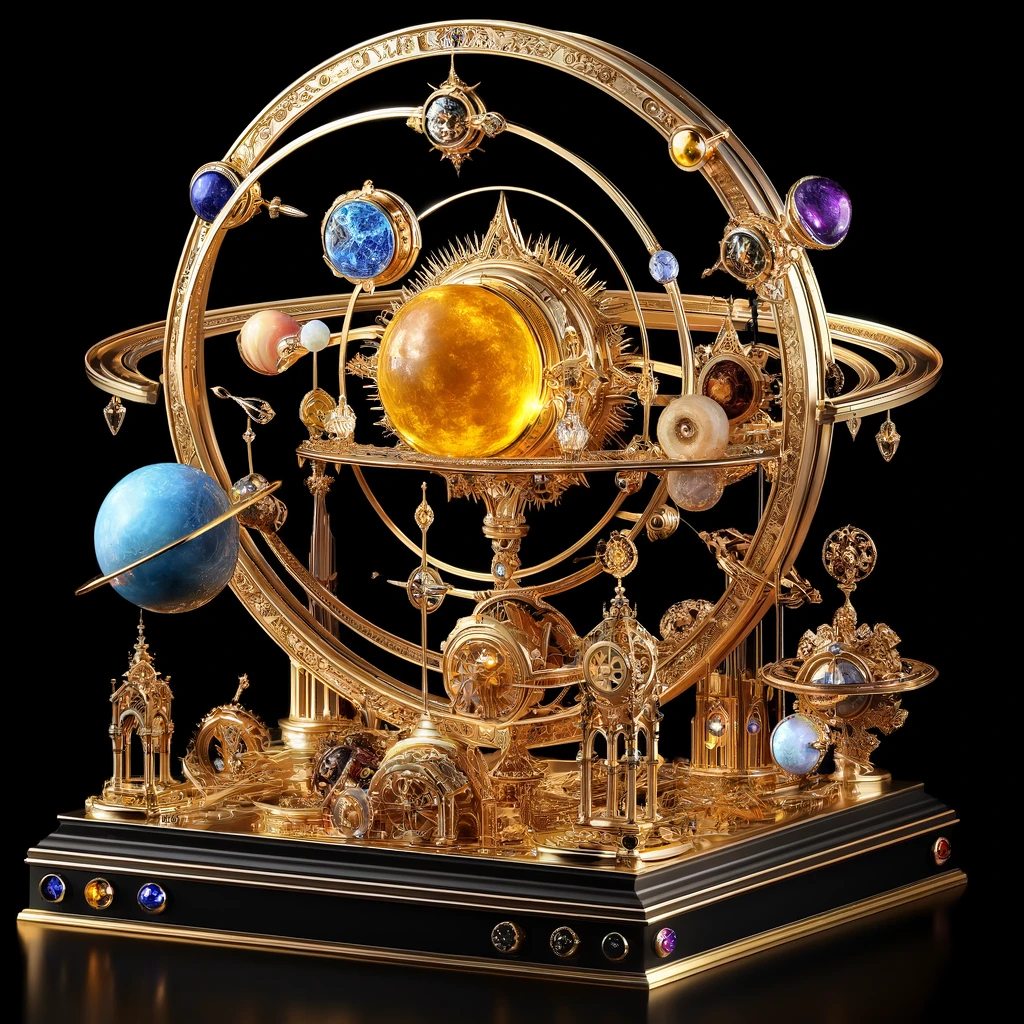
This orrery captures the grandeur of the Kulthean solar system with a central sun made of golden topaz and planets represented by various precious stones, all adorned with gold accents and set upon a base that blends classical and futuristic elements.
We are covering a lot of ground with our Shadow World AI project and with these blog posts I’m just summarizing some of our work or showing our initial results from the last few weeks and months. My hope is to inspire other SW users to generate their own content, provide useful feedback on the work that I’m doing and moving the Overton Window on the discussions around community content. The hard reality is that AI generative material will quickly outpace human creators in both scope and speed and will be able to emulate creative’s style and work product. As much as I try to keep my material “in the lane” with Canon, AI will be able to iterate new material using Terry’s baseline work–which is substantial.
I’ve been working on a simulation of orbital mechanics to understand the interplay of Kulthea, Orhan and Charon (which matters most to gameplay). My first step was to feed the planetary info into the system and model it. Part of that process was to also generate an ornate orrery that is used in the Temples of Phaon. You can see the picture above. Future work will be to create a animated simulation of the solar system but I want to start with a small simulation of Kulthea and it’s moons.
One of the areas that AI like Chatgpt can excel is generating fantasy languages. Not just word emulation, but grammar rules. I’ve been playing around with expanding the vocabularies that have floated around Shadow World books since the original Iron Wind, with a focus on Iruaric and Kugor (the language of Dragonlords). I start with uploading the current available words from the Master Atlas to create a baseline for the AI to work from. Kugor was interesting since it seemed to relate to, or draw, from Norse or Scandanavian influences. I’d be curious if that was intentional on Terry’s part.
The following is a basic first run with a sampling of results:
Kugor
Kugor appears to have a rich tapestry of words, with distinct sounds and themes focused on power, nature, elements, and societal structures. We’ll create new words that reflect and extend these themes, ensuring they’re phonetically aligned with what you’ve shared.
Given the established vocabulary’s emphasis on strong consonant sounds (like “g,” “k,” “r,” and “b”), use of double vowels for emphasis, and thematic focus on elements, creatures, and societal roles, the new words will follow suit.
Nature and Environment
Storm – Raathuon
Volcano – Shaangarn
Iceberg – Raathkarn
River – Biarkael
Valley – Karnbrod
Meadow – Prykachaw
Sun – Utumkodur
Creatures and Beings
Wolf – Drayn
Eagle – Kodry
Serpent – Ssovalg
Giant – Hoerkarn
Witch – Womuulga
Wizard – Womawga
Societal and Conceptual
King – Folmgaak
Queen – Folmgaakur
Hero – Breyaalc
Villain – Gartgaath
Treasure – Utumwomul
Curse – Gaarkchaur
Objects and Artifacts
Sword – Daagutum
Shield – Aalkaed
Book – Cuivagak
Potion – Rúansig
Crown – Aedfolm
Jewel – Eanwomul
Actions and Properties
To Conquer – Druskarn
To Betray – Gartkraaw
To Celebrate – Brechaw
To Enchant – Womuulchort
To Discover – Uscurackarn
To Heal – Prykawomul
Additional Vocabulary Expansion
Natural World and Geography
Thunder – Raathlyyg
Lightning – Piriig
Forest Glade – Chawlocha
Ocean – Aactoskuur
Mountain Pass – Karnny
Volcanic Ash – Shaangdes
Creatures and Beings
Sea Monster – Aactosdrak
Mountain Spirit – Karnorg
Forest Guardian – Horlyalc
Sky Serpent – Awduussoi
Ancestral Ghost – Androskhomul
Societal Roles and Constructs
Chieftain – AWkanga
Sage – Fawshrydrul
Craftsman – Arxduleer
Emissary – Druulkaag
Rebel – Ordir
Concepts and Abstract Ideas
Oath – Kodulryt
Exile – Iirmord
Alliance – Chaaggagur
Ritual – Yhomechooth
Prophecy – Koduldrul
Objects and Artifacts
Rune Stone – Orguscurac
Heirloom Sword – Daagutumleer
Enchanted Cloak – Womuulain
Druidic Staff – Uscuractarmen
Ship’s Figurehead – Progaorg
Actions and States
To Envision – Piriidrul
To Enchant – Uscuracchort
To Forsake – Gartord
To Illuminate – Piriolias
To Reign – Kangaoran
I think this is an encouraging first step! AI tools will actually build rules around verb and adverb usage, conjugation, gender use and perspective. My own usage is around building a word toolkit that is phonetically related to the baseline and generating compound words and short phrasing. However, someone with a deeper understanding of language building could really run with this.
We’ve already been working on a central repository for non-commercial Shadow World artwork, it would also be helpful to create a wiki dictionary with expanded lexicon of the more prominent languages. I’m simultaneously working on Iruaric which I’ll post up next, but the Elven languages might be very interesting given Terry’s initial work in the Tolkien setting.
Again, as a disclaimer, I understand the concern and issues around AI generative material, but I also see powerful tools able to expand on Terry’s work without a disruption of canon.
We’ve started a sub-thread over on the Discord server to upload AI generated Shadow World art. You can find it HERE. If you have any illustrations, maps or art for Shadow World, please post it up for everyone!
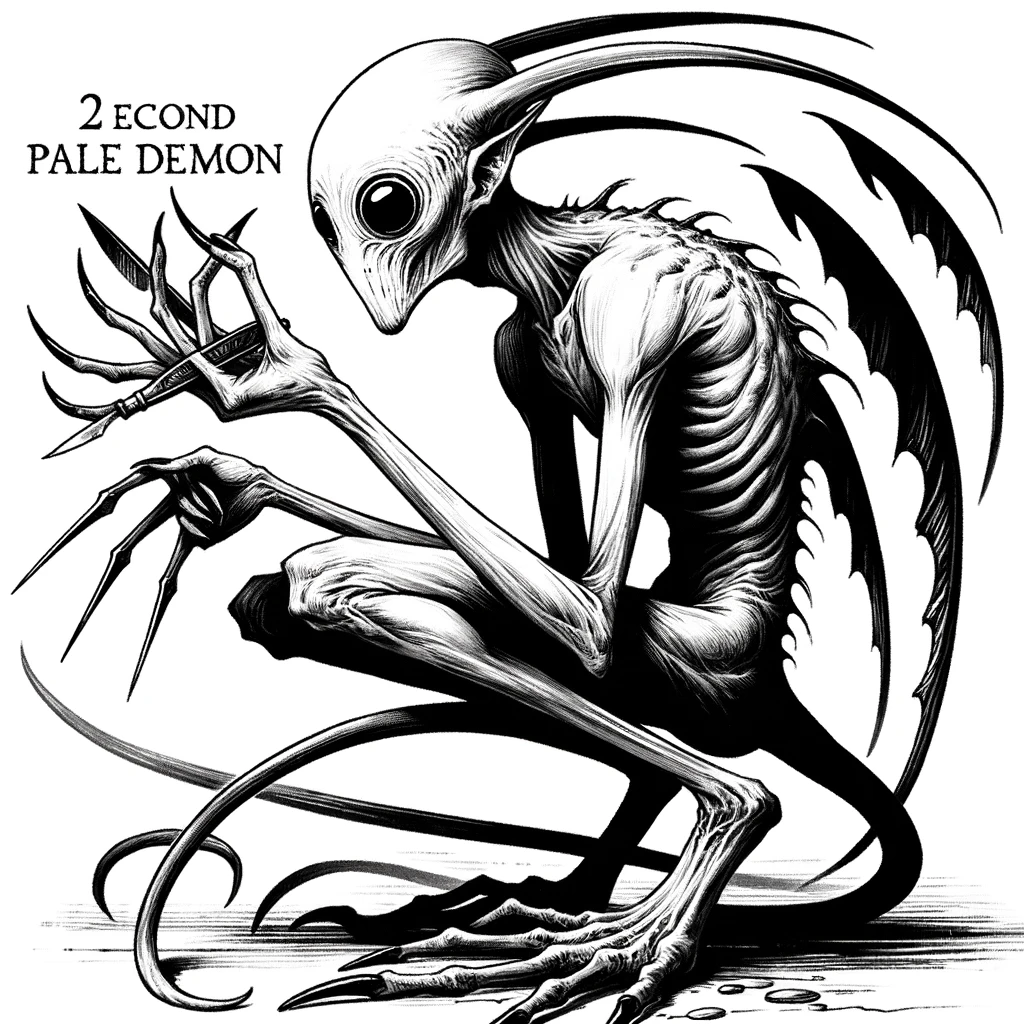
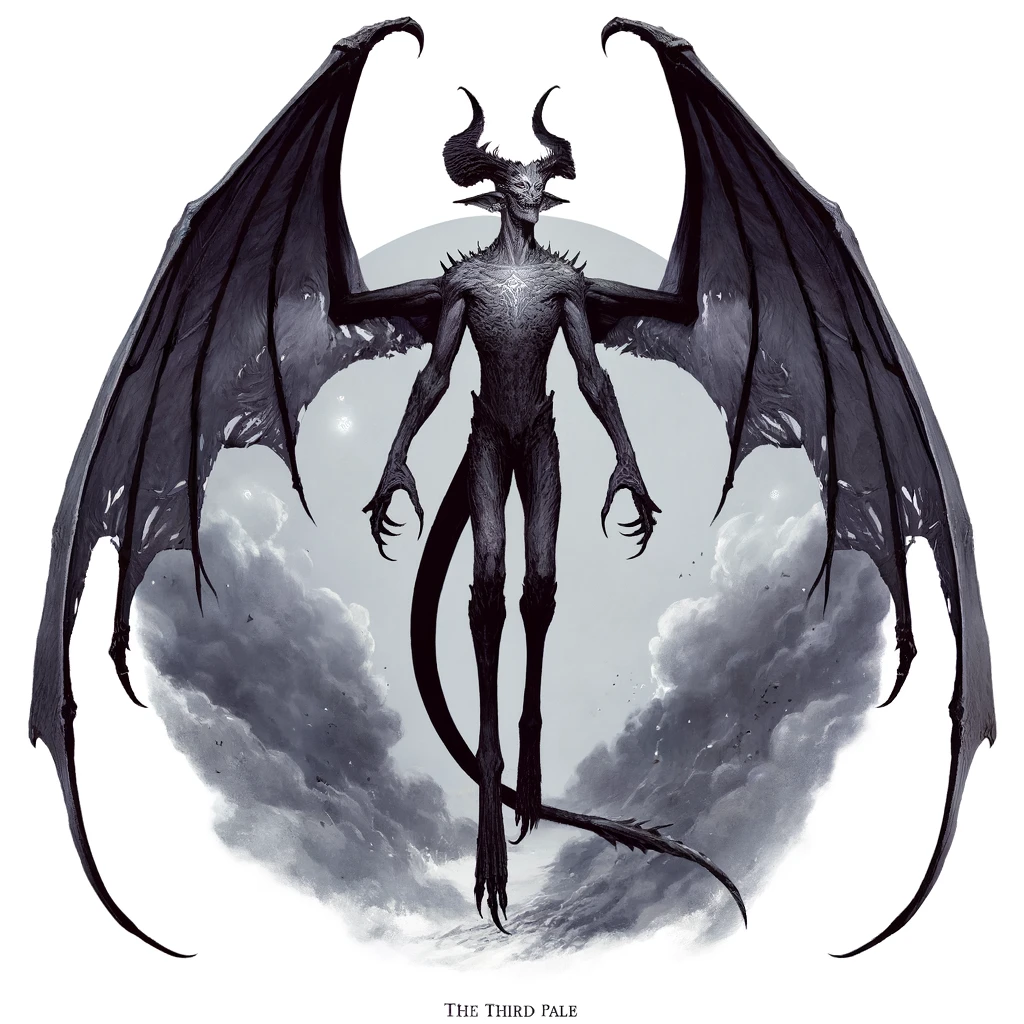
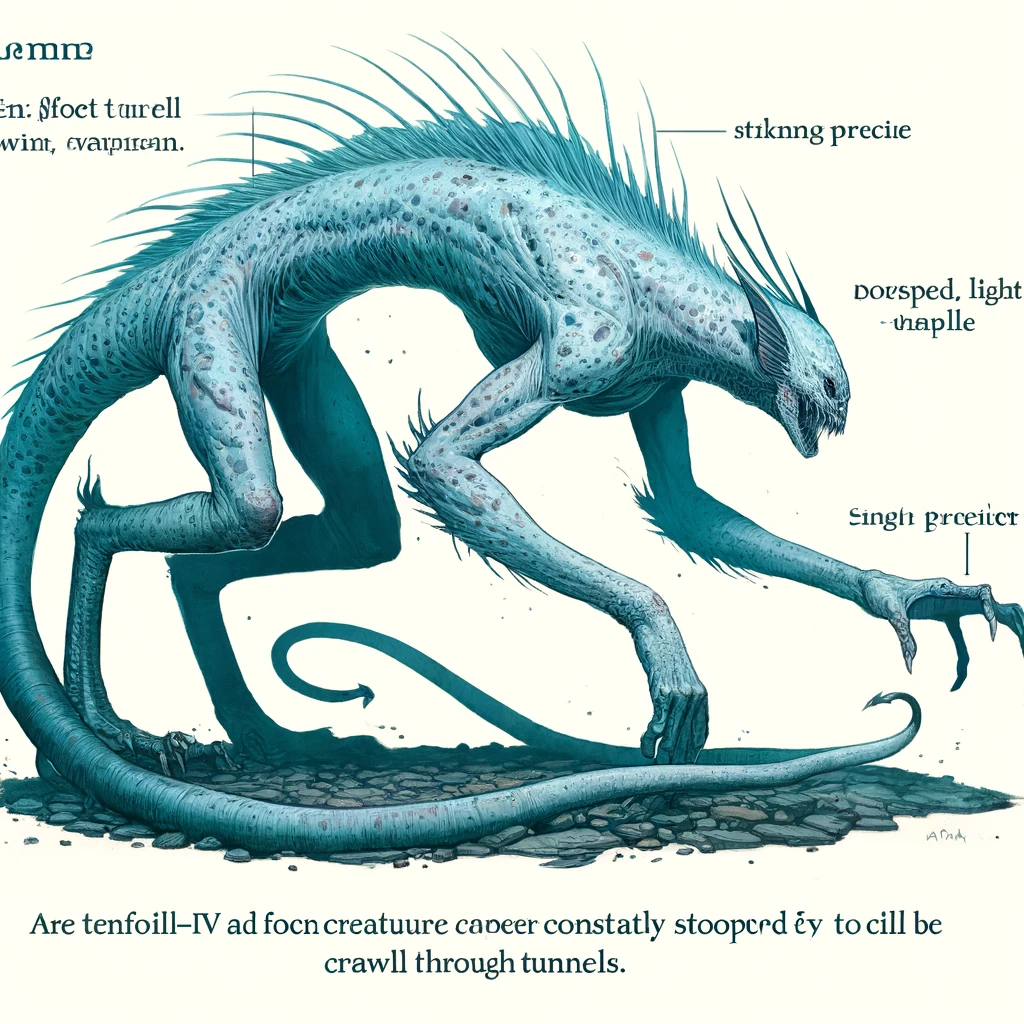
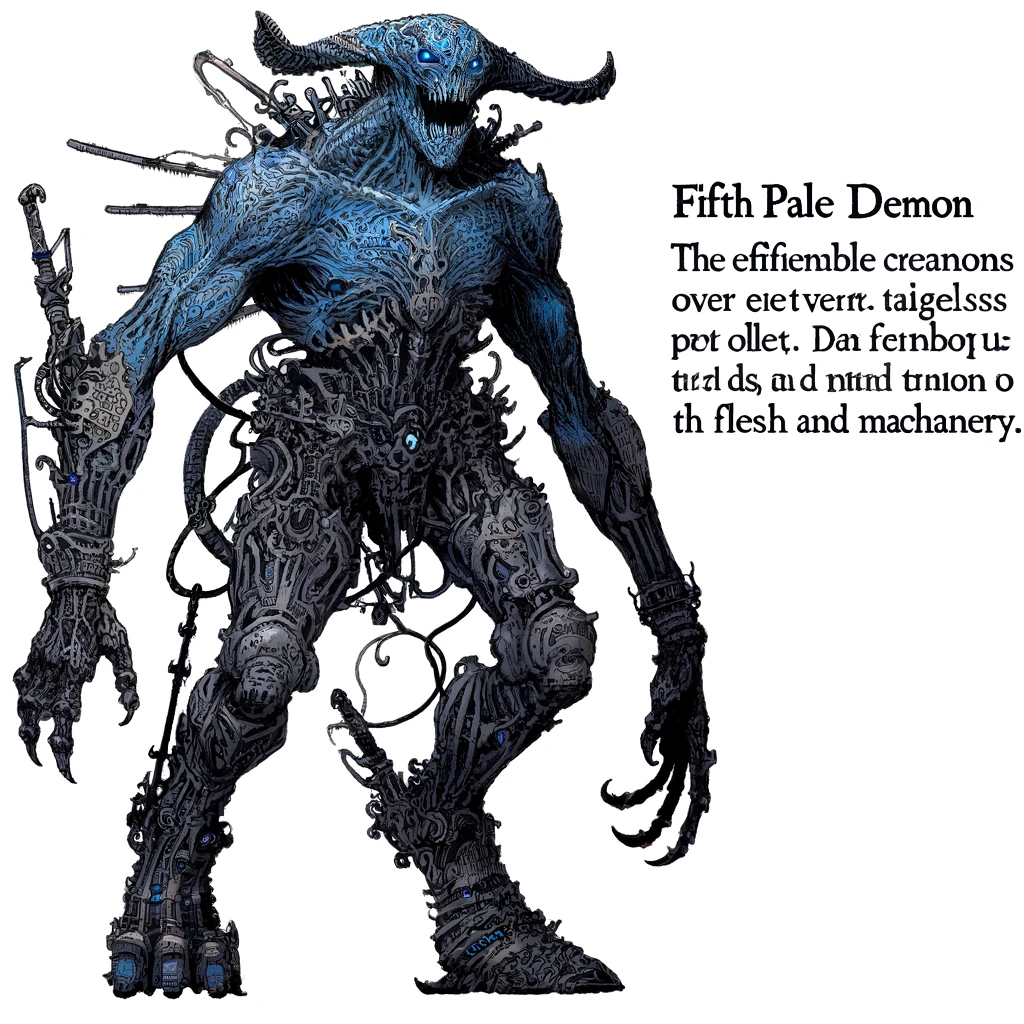
I’ve been going through my various projects and generating and inserting quick artwork to capture the flavor and essence of persons, places and things. I’m a novice at AI generated art, and I completely understand the issues around using AI in commercial projects. This isn’t that. One of my major roadblocks for content creation is my limited art and floor plan skills–abilities that Terry had in spades (given his architectural/design background) and really drove the Shadow World aesthetic and narrative. I was tinkering with my “Book of the Pales”. I had excluded the descriptions of the main Demon types for copyright and IP issues, but I wanted to create include more accurate artwork. I’ve literally put 30 minutes of effort into these generations, but I think they work great!
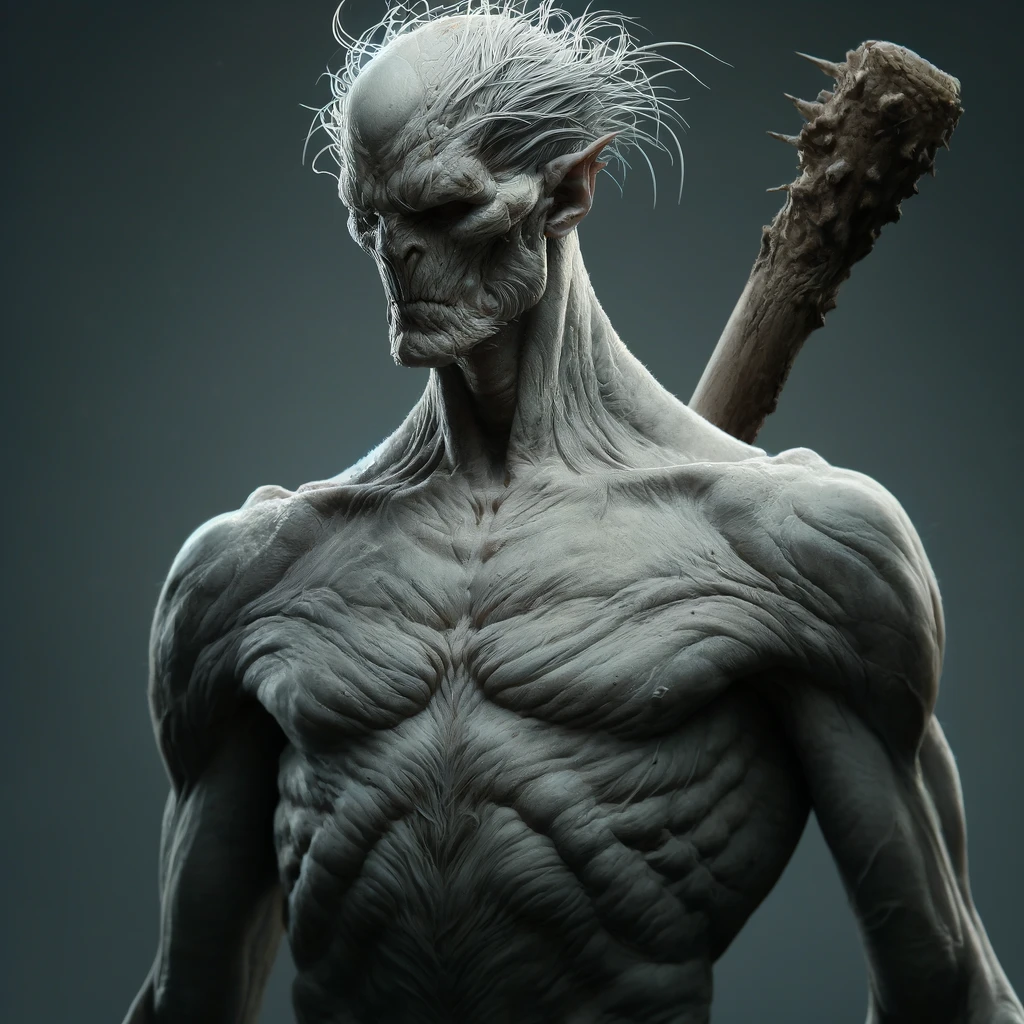
A Pale I Demon with pale grey skin and the clump of wiry hair atop its large skull, wielding a club.
A Second Pale Demon in traditional line drawing. Needs some more work and the hands and feet need webbing!
The Demon of the Third Pale, capturing its towering, lithe form with dark grey coloring and huge, bat-like wings extending from its long arms.
A Fourth Pale Demon. I really like this–a very catlike and serpentine feel. One of my modules takes place on Charon and I utilize these Demons there in the tunnels…
Fifth Pale Demon. I like this–especially the technology touches with hints of the fusion of flesh and metal.
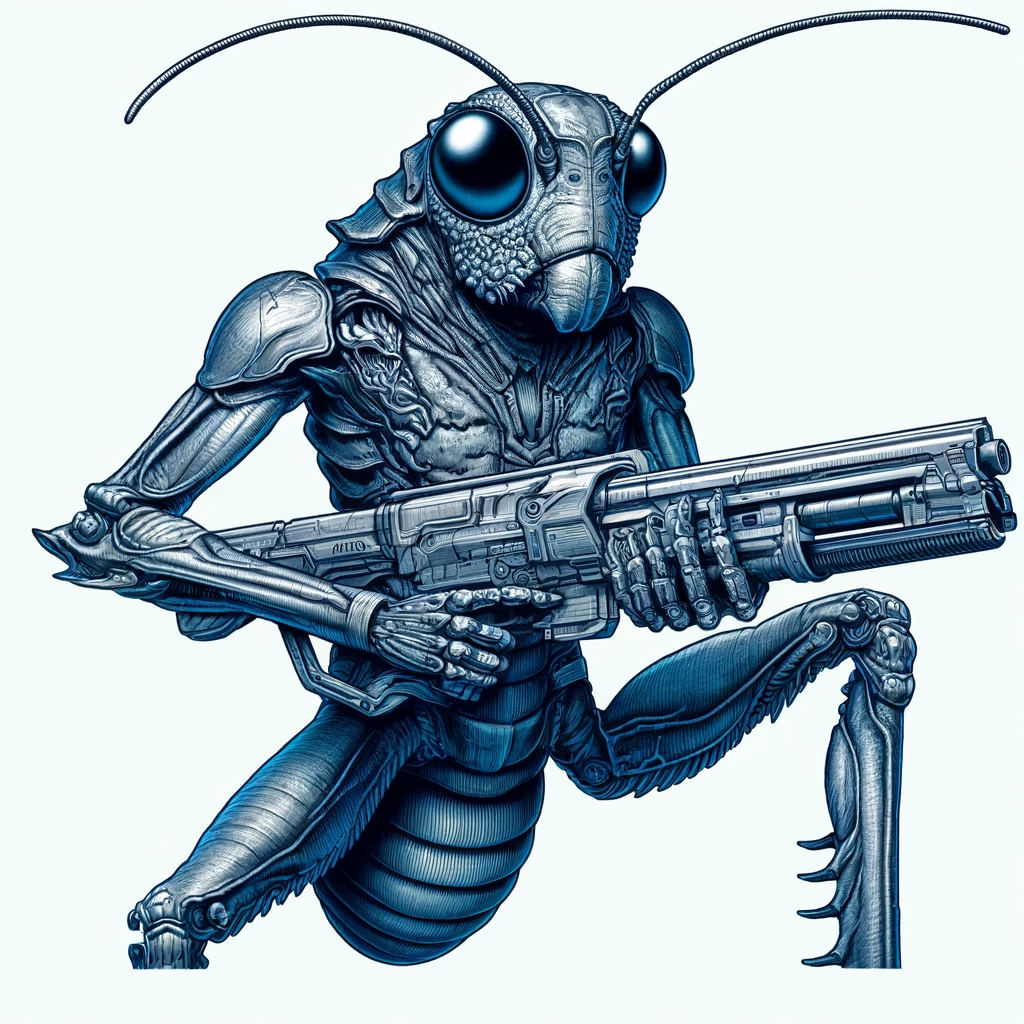
This illustration is showcasing its unique features like the giant grasshopper stance, powerful rear legs, blue-grey exoskeleton, and the distinctive head with insectile mandibles. The Krylite features the creature holding a lightning gun, further enhancing its alien warrior appearance.
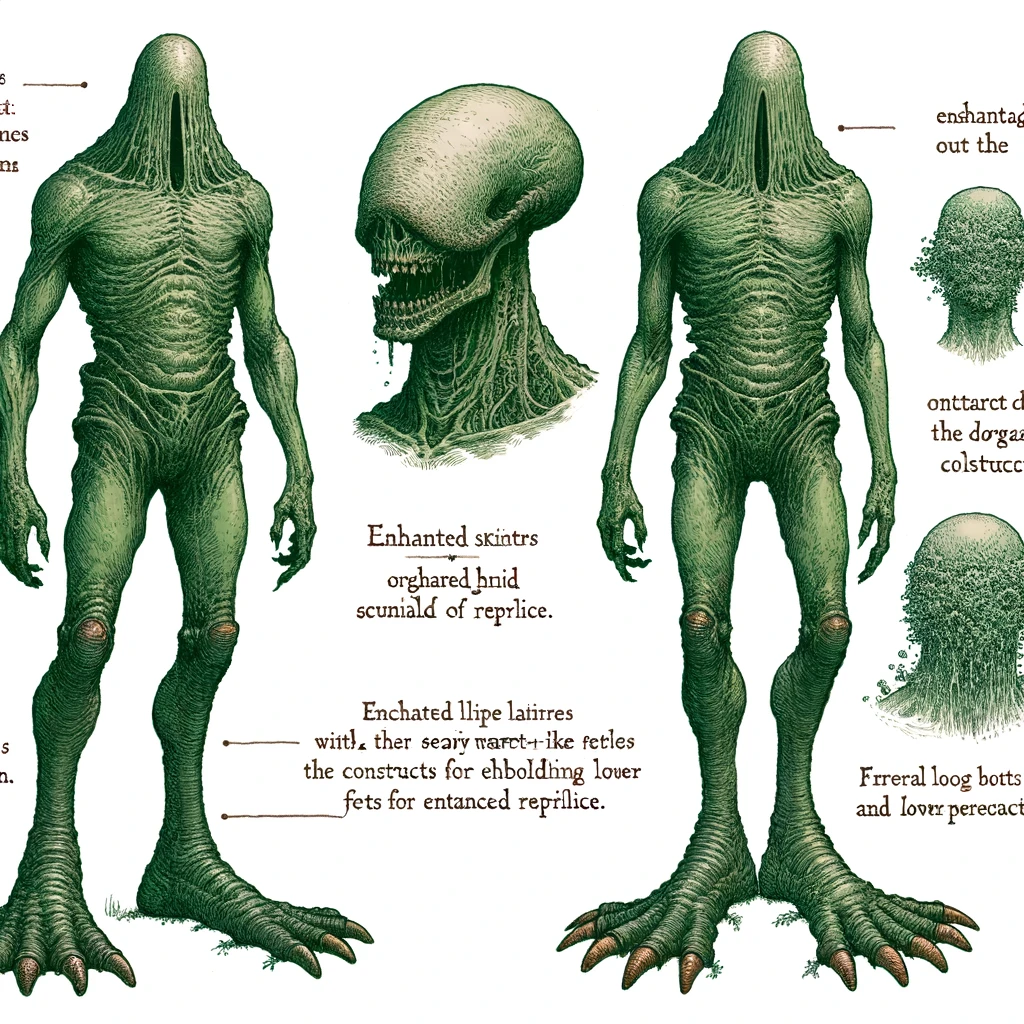
Per ChatGTP. Here’s the illustration of the Shard, an artificial creature with enchanted organic features. This drawing captures its unique characteristics, including the greenish hide covering its body, the wart-like protrusions on its feet, and the semitransparent layer that obscures its facial features, giving it a haunting appearance.
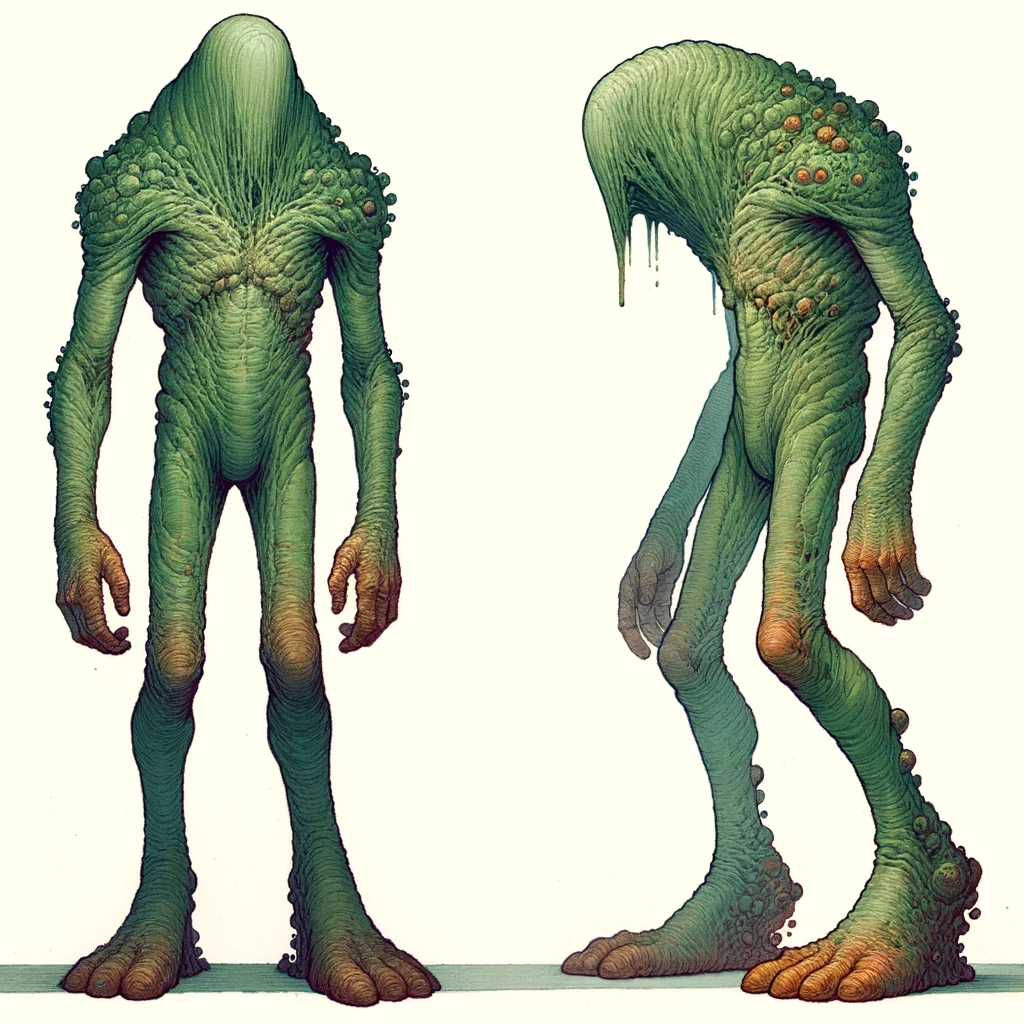
I’m going to be writing a lot about our AI Shadow World project in the coming months, but thought I would showcase a quick image generation of a Shard. Here is another version with a small iteration on the prompt:
Obviously they can be fine tuned, but for about 2 minutes of work that’s exceptional. For me, there is not just an opportunity to create art work for unique creatures found in Shadow World, but the ability to create new creatures with basic descriptions. Stat blocks are easy to create from an illustration, and having the artwork really enhances the gameplay and immersion.
I was reading James recent blog over at Grognardia, and it made me think about the current state of this blog and what topics to write about in the future. While James has written more posts (orders of magnitude more), I’m currently sitting at 426 posts over the last 10 years. That’s not bad considering I’ve had lots of downtime and gaps in my output.
Also like James, it’s harder for me to find new material to discuss and/or I realize I’ve already written on the topic years ago. I always thought it was odd when someone would tell me they couldn’t remember how old they were (it tracks now that I’m in my 50’s), and it can also be difficult to remember what I blogged about five, eight or even ten years ago! I think I’ve mined some interesting angles with Rolemaster and Shadow World, but I’m not sure where else I can go with this. Inspiration will occur, but I suspect at a much slower rate.
So where does that leave us? RMU is finally out (mostly), Terry has passed leaving Shadow World indeterminate, TTRPG’s are as popular as they have ever been, and there are numerous channels to explore gaming topics. What conclusions can we draw from these basic observations:
The environment is right to promote Rolemaster/RMU. The system is still one of the few “complex” systems for gamers looking for more verisimilitude. Just like in the early 80’s, players converted to Rolemaster for greater realism or grittiness. Those conditions still exist today–most games embrace simplicity and “rule lite’ structures; there will always be a need for complexity for maturing gamers. It’s a cycle. We need a blogger to cover RMU rules and issues.
Shadow World is still a viable setting for Rolemaster and with a bit of tweeking, RMU. I’ll continue to focus on SW as my main blogging topic, and continue to produce material for that setting. I’m currently focusing on using AI tools to leverage that effort.
In general we need more writers with other viewpoints, ideas and material to contribute to this blog. If you prefer long form over short tweets or discord give blogging a try. There isn’t much RM blogging out there, so it might be better to consolidate output into the Rolemasterblog?
Overall we need to keep the Rolemaster flame lit. RMU has drawn new users and brought old users back. When they search the web they need to find a home, content or a community to engage. Basically there are 3 choices: Rolemaster Forums, Rolemasterblog and RM discord servers.
Sometimes it’s hard to gauge engagement when there is a lack of comments–so let me ask directly. What do you like to read about? Is there material or topics that we haven’t touched upon? Is there something we should focus on more? What material would you find more engaging or comfortable commenting or participating in?
I recently finished my first pass through on the new RMU Treasure Law and was pleased to see the inclusion and continued concept of “Charms” in the book (Charm Creation p.182). I’ve written a bit about “Single Use” magic items, and I think they are a underappreciated and perhaps under developed type of magic in Rolemaster. I’m not sure if “Minor Enchantments” is the best name for this category of magic items because it implies these are relatively minor or weak spell effects. But on the contrary, powerful magics can be imbued into “minor” objects (thus the name): a feather, a semi-precious stone, a talon or something similar. There are a number of lists I would categorize as Minor Enchantments: Charms, Weapon or Armor Runes, etc, but they can be defined as the following:
Easy embedding or creation process. These items don’t require multiple day/week/month investiture to create.
1 use. While you could have multiple charges in some, generally these charms are consumables–the item is destroyed when activated, or the effect is dispelled from the object.
They are either “pro-active” or “re-active” items. Pro-active items could be candles that once lit activate whatever store magical potential exists. Re-active items are triggered when a certain condition is met: a certain spell is cast upon a wearer of a charm, a crit result during combat with a weapon rune etc.
I purposefully try to stay within Terry’s wheelhouse when creating spells or magic items for Shadow World, and Terry was guided by the original Spell Law. Early edition Rolemaster didn’t have weapon runes, simple imbedding or charm creation spell lists so they don’t exist in SW canon. (However, Terry never really used potions either). But I feel that Minor Enchanting is a great addition to Shadow World:
It provides temporary magic items at low level that don’t unbalance the game.
Minor Enchantments are flexible and can be created specifically for a challenge, rather than a permanent ability in a magic item that isn’t needed or less appropriate for the moment.
Protective Charms can mitigate some of the deadlier aspects of Rolemaster combat and crits without an arbitrary “reroll token” or similar.
In conclusion, Minor Enchantments can be a much more usable and functional magic than some of the cool but cumbersome spells that players will never really use. How many of you regular use this type of magic in your game?
I was reading this blog yesterday and it got me to thinking about the topic. Do I try and write adventures with “memorable situations” (cool setting, unique creatures or plot twists), or do great gaming memories derive from something else?
It wouldn’t surprise me if pop culture subtly influences GM when writing material. Shouldn’t an adventure or campaign be framed properly in narrative form, much like a movie script? With so many system specific and generic adventures, isn’t there a motivation to come up with a clever new take on an old idea? Do we try and wow our players with a new obstacle, trap, monster or puzzle?
We all play RPG’s for a variety of reasons, but one unifying experience we all share is a great memory of gameplay. Every player has a favorite memory and every GM can probably relate an equally memorable game incident. But when discussing this with my players and other Rolemaster games, those great memories weren’t necessarily derived from something unique introduced by the GM, or a specific challenge written into the adventure.
For me the one differentiator that Rolemaster enjoys compared to other systems, that comes up often, is the Open-Ended Roll and to a lesser extent Unmodified 66 and 100 results on critical tables. If you think about it, OE rolls are a baked in mechanic that guarantees amazing, some might say miraculous, results during gameplay. Rolling a “20” in D&D is nothing like rolling high open-ended. Over and over, I heard stories of the “Hail Mary” roll, the multiple OE and resulting critical that saved the party, defeated the baddie or allowed for a unusual success.
As a long time GM, I’ll occasionally put my “thumb on the scale” to assist the party, but nothing compares to a player rolling and hitting the “00” when the chips are down. That’s a serendipitous result I can’t write into the adventure and I enjoy it just as much as my players.
During the development of RMU there was a steady stream of suggestions and ideas to improve and streamline the ruleset, but one item that was considered sacrosanct was the crit charts. Despite the negative connotation of “chartmaster”, the majority of the RM community wanted to keep the crit charts! But if you were to dig down, I don’t think it was the charts themselves, but what they represented. Part of the random magic of Rolemaster. That’s what creates great gaming moments that are remembered fondly.
What’s your Rolemaster memory?
As a player did you beat the odds with a once in a lifetime dice roll?
As a GM did a once in a lifetime roll change the game situation radically or take the game in a completely new direction?
I feel like the recent publishing of RMU Treasure Law is a good time to delve into an issue I’ve touched upon slightly in past blog posts. How many alchemists are required in Shadow World to create all of the magic items and work the various enchanted materials and alloys found in the various supplements?
Terry was always adept at creating cool, and powerful, items for his various NPCs and key persona but a quick examination of the various Master Military Charts will show that most militaries, groups and organizations also had their “standard kit”, much of it superior or magical in nature.
A few examples:
There are 500 Duranaki Warriors, each with +10 Kynacs (ignore the fact that Keron has an intrinsic +20)
There are 42 Duranaki Captains Aids, each with +30db Bracers, +10 Shurikens, AT8 Cloak and headbands that protect as a full helm!
Sulini has 500 Warriors, each with a +5 Broadsword and +10 bow.
There are 1600 Sentinels in the Elven Forest in Jaiman. Each has Cloak +40 to hiding, +5 Long Knife and +10 Longbow.
This are just general militia members. If you look at specialized groups like the Eight Orders, the Messengers, Navigators or other secret or powerful groups then the number of magic items really piles up. The Loari are currently making A LOT of specialized magic weapons for the Kuluku–this is on top of their “normal” alchemical/enchanting work that they do. Then, dig into the NPCs, many loaded with powerful magical items, you get the sense that magic items may not be that rare in Shadow World.
But there are really two issues at play: who is making the more powerful items that, based on Rolemaster item creation requires very high level Alchemists and perhaps more importantly, how can they produce the volume of magic items no matter what their potency? One could argue that militias, armies and guards draw upon an armory for their kit and are required to hand those items back at the end of their service. So once a certain inventory of magical gear is generated it remains stable after that.
One thing that Rolemaster players love is digging into the realism/verisimilitude/data used in the game! One would imagine that with all of these magic items there are many mass production facilities found throughout Kulthea, or at the least, each powerful organization has their own specialized Alchemist factory to generate the unique items for their members. But that really doesn’t seem to be the case. Looking through the various city books, Alchemists are about as common (or rare depending on how you see it) as other specialized casters like Astrologers.
Magic items are cool, and Terry came up with a lot of neat and interesting items. But he didn’t seem that concerned with the the underlying economics that were needed for his world building. This is more noticeable because Rolemaster was one of the first systems that created a workable system for making magic items: the Alchemist lists. One of the principals of Rolemaster Alchemy is the binary process of Crafting and Enchanting. Magic items must first be manufactured using “Work” spells found on the Alchemist Base lists, and then spells or abilities are imbedded in the object.
I have a lot of issues with this approach, so I’ve done away with those “Work Materials” spell lists. Work spells are really “spells as skills” and removes any incentive for tradecrafts. Furthermore, there is no requirement for a caster to learn the appropriate craft skill; they just learn the applicable spell and somehow gain knowledge of the crafting process that would take years or decades to master? Should a skinny 20th level Alchemist be able to Work Laen just because he can cast a spell? Where does the knowledge of forge work, hammering, smithing or any other applicable subskill come into play? It doesn’t under the Alchemist spell lists.
A better solution, one already provided by Terry solves a lot of the issues around bonus item creation. Materials that have an natural bonus can simply be crafted into suitable items: swords, armors, cloaks, shields etc. through tradecrafts; spellcasting is not necessary. Per the Master Atlas:
SPECIAL WEAPON ALLOYS These correspond (roughly) to alloys described in Rolemaster. The number in brackets is the intrinsic bonus given to a blade fashioned of this material because of its hardness and ability to hold an edge.
So Laen has a natural +25 bonus. If one wanted to stick to corresponding “levels” of such material–in this case 20th level to correspond with the Spell Law “Work Laen” spell then crafting Laen would require 20 ranks of smithing or laenworking or whatever skill the GM indicated. Standard skill acquisition of 2 ranks/lvl means that a competent craftsperson can work Laen by 10th level. It doesn’t require a 20th Level Alchemist Spellcaster. This fits well with many of the cultures that utilize Laen but don’t seem to have expansive Alchemist populations. The Udahir in The Iron Wind being one example.
Separating the Crafting process from the Enchanting process supports the need for tradesmen or acquiring tradeskills. It allows for large production of bonus items by regular craftsmen using superior/enchanted materials like Tethium, Keron or Quevite. So Alchemists can utilize workshops of skilled craftsmen and they can spend their time on Embedding unique abilities or spells into those items.
Do your players utilize Alchemists to make them special magic items? Are Alchemists common in your Shadow World campaign? Should Alchemists need to be 15, 20th or even high level to create magic items from superior materials like Laen, Eog or Star Iron?