Rolemaster Profession Review: Taking a Look at Witches.

In a previous blog, I offered up some suggestions on a obvious core profession that should have been included in Rolemaster: The Shaman.  Today I thought I would dive deeper into another profession that could also be core to the system: The Witch.

For that follow other blogs and specifically The Other Side, Tim is an avid “witch guy”. (I think he actually designed the witch for some version of D&D). Anyway, Tim wrote about witches in early D&D and referenced some work by Tom Moldvay. You can read that blog HERE. The first take away is Tom’s summary of core witch abilities:

According to Moldvay a witch class should include the following:
1. The ability to use herbs for healing and magic.  

2. The power of fascination, like a super-charm ability.  

3. A combination of both Clerical and Magic-User abilities.

4. The ability to practice sympathetic magic.  

5. Be worshipers, in secret, of a religion otherwise forbidden in a particular era.

6. Powers based on nature and the cycle of seasons, similar to Druidic* powers.

To me, those abilities draw from standard western tropes, and at the time helped form the basis of an alternate D&D profession. But let’s look at these in the context of Rolemaster.

#1 Healing & Magic Herbs. That one is a bulls-eye for Rolemaster that has a much more detailed and integrated system for magical and natural herbs. Additionally, this doesn’t even need to be a basis of magical spells, just herb lore and/or various similar skills. Or, a Witch could use Herb Mastery as a Base list.

#2 “Super-charm”. This touches on the witch trope of casting glamours, using love potions and charming unsuspecting targets. It would be easy to use Spirit Mastery as a Base list for the Witch profession.

#3 A combination of Clerical and M-U. Again, Rolemaster can easily define a witch as a Hybrid profession using Channeling and Essence.

#4 Sympathetic Magic. Tom is probably referring to curses, hexes, talismans that are common in Witch folklore. Here we could give the Witch a “Curses” or “Disease” list.

#5 Secret society. As a Channeler, a Witch should have a patron god. It doesn’t have to be a secret god, just that the witch doesn’t practice within an organized religion. Or, the witch could worship an ancient “dead” god or a minor god of indeterminate morality. That doesn’t suggest that witches must be evil or suspect! Why can’t you have “good” witches?

#6 Nature Magic. Giving a witch nature based spells could make sense. One or two Druid or Cleric Open/closed would round out the witches base lists and their witch-like abilities.

So for those wanting a traditional witch, it’s fairly easy to bolt together the profession using existing skills and spell lists. Of course, RM Companion offered up a variant with “Candle Magic”, “Familiars” and other tropey spells. But we can’t discuss professions in my blogs without deconstructing the topic!!!

While Tom Moldvay offers a traditional package for a witch, does that work in non-westerncentric fantasy settings? What is a witch really, using the broadest sense of the concept. A few thoughts that use Moldvay’s foundation, but might be more flexible for various types of settings.

  1. The ability to use “natural magic”. Whether that’s herbs, nature, familiars or something else, a Witch accesses fundamental powers rooted in the natural world. You could argue these are Arcane Powers.
  2. Well-rounded. A witch is mostly solitary or lacks a open organized society or group to work within. Therefore they have a broad skill set for both offense and defense. This does not just need to be subtle charms or passive aggressive curses. A witch could easily utilize fire magic or other elemental powers in certain settings.
  3. Power flexibility. Whether a hybrid or just has access to a variety of power types, a witch should be versatile but not formally trained.
  4. Secret Worship. A witch should have a patron god, but worships secretly and protects the god’s identity. A witch will be secretive and elusive about their powers. This provides them with a sense of mystery and solitary nature, even if they operate within an organized society. (see the 50 in 50 blog HERE). Witches don’t have to be hermit crones living deep in a swamp.

Once you dismiss the specific powers of potions, charms, cackling and glamours you have a versatile, unique and powerful professional template. Using these 4 basic criteria, a witch could be very adaptable to many settings without regressing back to fantasy norms.


All is quiet in Rolemaster world.

I have literally 5 minutes to spare so I thought I would get in a quick blog! As RMBlogs reader have seen, activity is WAY DOWN on the blog and even the RM Forums are pretty slow moving. Let’s chalk it up to the dog days of summer, real life commitments and a temporary lull in the conversation. I have 5-6 posts stewing on the dashboard that I hope to get to, some polishing up on the 50in50’s and then of course the rest of my projects.

So what have I gleaned from quick and random perusals around RM land?

  1. It feels like RMU is close. There was a flurry of activity on the development forums on several topics and it looks like some tightening of the rules. Generally though it feels like most everything is now set and close to publication. That is just my sense–no inside info.
  2. GenCon. I was sad to see Terry had to cancel  his GenCon game. I think his presence would have been a big hit and brought some exposure to Rolemaster and Shadow World. On the other hand, it’s time for newer younger players to take up the banner and run with it via RMU and new products.
  3. Real life news. No not politics! There has been a ton of cool archaeology news lately. I should do a weekend round up soon!
  4. According to Terry, my SW submission and Lethys are on the shelf! He has asked Nicholas to find a new editor since he is busy with his own projects. That’s discouraging… I’m leading towards just publishing it for free so I can have closure and move on to the next one.
  5. When things free up we are going to put together a super edition of the Fanzine with a compilation of updated SW material. I promise Peter!

ok, back to the grindstone. If anyone wants to put their big toe into the land of RM or RPG blogging now would be the time! And it would be a great help.

Rolemaster Deconstruction: Is it a Skill or an Ability?

As part of our Rolemaster deconstruction I’ve followed two processes: consolidating small “skills” into larger meta-skills and changed traditional skills into inherent abilities. (Perception and Body Development being the two foremost).

Obviously, one of Rolemasters differentials with D&D was shifting almost all abilities into trainable skills. The contrast was clear: D&D imparted abilities through racial mechanics, classes and levels and was on one end of a game  spectrum while RM’s skill focus sat at the other end. The problem (in my mind) of course is that under RM’s approach, EVERYTHING became a trainable skill. Skills became parsed further and further into niche secondary skills, skill bloat became rampant and a more complicated similar skill mechanic was necessary to manage the interrelationship between overlapping skills. Lost in all of the Rolemaster Companions, RMSS and RM bolt-on’s was questioning the very premise of “what is a skill?”

There were a few early exceptions: DB and RR’s. Those kept to their D&D roots and RM never allowed a trainable skill to offset poison, disease or the realms of magic. Adrenal Defense was a skill, but had lots of restrictions and has now been mostly nerfed  in RMU.

As discussed in my various blogs, I’ve reverted some core skills into inherent abilities using stats or other approaches. Just a few examples:

  1. Body Development. I’ve mostly embraced Peter’s approach and set HP’s by race and constitution. However, we also add +1 HP/# of skill ranks in Endurance.
  2. Perception. I’ve moved the skill into a 12th stat. This measures the characters PHYSICAL perceptual abilities: eye sight, sense of smell, alertness, hearing etc. This also is easier to use with a racial modifier.
  3. Feats of Strength/Lifting. Purely based on strength.
  4. Maneuvering in Armor. It’s been discussed in previous blogs and now is being talked about at the Forums, but I just don’t see maneuvering in armor as primarily a trainable skill. Instead I see it as a “handicap” (like adding weight to a race horse). Plus, making MnA a trainable skill, armor becomes a video game like level ability: players progress up in armor type as the gain in levels. As I have argued before, thats akin to players proggressing up in weaponry: start with a dagger and eventually getting to a 2hand sword at 10th lvl.

There are arguments for aspects of a established skill as a being trainable. For me, it’s weighted the other way: if the argument is less than 50/50 for it being trainable I want to work it into an inherent or stat based ability. I know many people want to stick to the core of RM and it’s skill system; but think outside the box…what RM skill should really be an ability?

50 in 50 adventure hooks. What works, what doesn’t, what can improve?

I’m in the final stretch of a hectic professional life, so I barely have time to write, post or respond. However, the Rolemasterblog must go on so I’m going to do a quickie for today. Hopefully this will spark some feedback.

We are nearing the end of our “50 Adventures in 50 Weeks” challenge we set for ourselves last year. It’s been a great experience in creativity, deadlines, limitations on using IP, and testing the limits of publishing. The last of my adventures start getting larger and more in depth and I’ll be putting in usable “stats” whenever possible using an abbreviated stat block that can be used with d100 and Rolemaster w/o any IP infringements.

Peter blogged previously about his views on the 50in50 and I wanted to toss out some thoughts and observations of my own:

  1. I’ve made a little money. Nothing significant, but I did buy hardcovers of Xa’ar, Emer III and Cloudlords the other day using my earnings.
  2. In hindsight, I wish my adventures were a bit “meatier”. That wasn’t the original goal of the challenge–it was supposed to be simple hooks and concepts–but looking over the published ones sparked new ideas.
  3. Reviews. No one wants to be criticized but it would have been nice to get some reviews from people. Even “I can believe I paid .50 for that” would have provided some insight.
  4. For my contribution, it seems like the “City of Spiders” and “Haunted Forest” were the two most popular. Some of my other products were encounters or people related so I wonder if the appeal was that they were both physical places that are easy to drop into a adventure or campaign?

Since we are going to continue to publish adventures past the 50 adventure limit I’m going to set a few more goals:

  1. Each of mine will be at least 3 pages of content.
  2. Include Rolemaster compatible stats
  3. Focus on places. Interesting NPC’s or encounters will be rolled into a “place”.
  4. Layouts. Everyone likes the battle maps so each adventure will have one.

I’m open to any suggestions as we move forward! What should we change or improve?

Deconstruction: Rolemaster Arms Law. How often should you fumble?


Have you ever fought in a melee? With weapons? Every played around with nunchakus, flails, morning stars or just goofed off with chains, ropes, whips or similar objects? Ever chopped wood? Ever been in a fight? Have you been in a stressful dangerous situation where your heart raced, adrenaline kicked in and your palms started sweating?

If so, chances are you have also fumbled an object: it slipped out of your hands, bounced dangerously off a hard object, it was over-swung and you actually hit yourself or you missed a target completely and lost balance, tripped or even fell. That’s completely normal and expected. Wielding weapons in battle should be more difficult than playing around with mock combat.

Rolemaster has a system for fumbles: each weapon has a fumble range, generally between 1-10 with an optional rule that the # of skill ranks can reduce the fumble range (but never below 1). In practical terms, that means that by level 3-5 most fighter types will  have reduced their fumble to 1 in their chosen weapon(s).

Many people probably feel that fiddling with fumble ranges is like encumbrance and exhaustion: too much realism and/or record keeping for not a lot of benefit. I get that. However, swinging around a sharp object, as HARD AS YOU CAN, in a confusing and disorienting environment is incredibly dangerous!

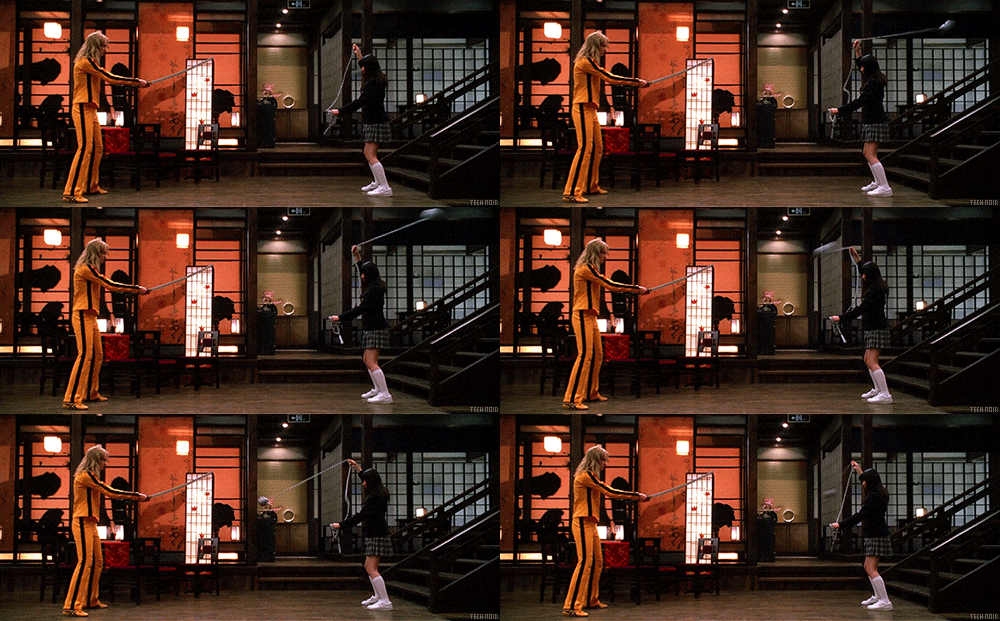
kill bill GIF

Now imagine weapons even more unwieldy than a basic sword, club, mace or dagger. How about a 8′ glaive? A whip? A chained morning star? Should 2, 3 or  5 skill ranks in these weapons impart enough competency to reduce fumbles to a natural “1”?

As part of our expansion of weapon individualization, I’ve been tweaking weapon fumble ranges–some ranges as high as 20, 30 and even 50. This does several things: it models the actual ergonomics of a particular weapon, it adds a counterbalance to some exotic, dangerous weapons that should be difficult to wield correctly (kynac, chakram) and it ties expertise (not total bonus) into the proper handling of a weapon.

Let’s consider the Urumi. This weapon looks particular dangerous to wield doesn’t it! I give this a fumble range of “50”! Basically only a true master can wield it effectively–in normal progression that’s around 20-25th lvl. (But it also imparts a fairly low combat penalty against multiple opponents so there are benefits to using it as well). But even at 10th lvl and 2 ranks/lvl, it will still have a fumble range of 30! It’s one thing to twirl around and show off, but imagine using that in actual combat. Whipping it up to speed, recovering from a missed hit or withdrawing defensively.

Most common weapons have a fumble range of 10-20 so my players can reduce that to “1” by 5-10 level. That seems right to me. And if they want to use a “special” Shadow World weapon (Irgaak) to benefit from bonuses to AT or extra crits, they’ll probably have to deal with a much higher fumble range. Increased fumble ranges and weapon specific modifiers add a whole new dimension to weapon selection–more than just max damage, critical thresh hold and efficacy vs armor.

Rolemaster Ambush Skill: How Could it work?

In the original Rolemaster, Ambush was one of the skills that worked differently than others. I’m sure at the time, they were just trying to fit a square peg in a round hole to get the desired result, but actually it was quit brilliant and should have been pursued in greater detail for other skills.

What do I mean? That the # of skill ranks can serve as a rule mechanic just like total skill bonus. RM made Ambush a skill rank only skill where the other skills were purely total skill bonus. But why not have both for all skills?

What does Ambush skill really entail? The skill description requires that the skill be developed with a specific weapon, but does that really make sense? Ambush is not about the weapon, it’s about surprise and the ability to target kill points on a body. A competent assassin can kill with a knife, a stapler or a pen by targeting soft spots or vulnerabilities. The type of weapon is irrelevant as long as it can physically carry out such an attack.

So what might be a way to handle Ambush using both # of skill ranks and skill bonus? Here is how we do it. The ambush skill bonus is used for the Offensive Bonus-no matter what the weapon or object. The GM chooses the attack chart/size based on the weapon and type of damage it might inflict (a flail would not be great in close quarters, while a wooden splinter would be great but do very little damage w/o a great attack roll). Obviously this is a close quarter attack, ambush shouldn’t work for missile, or thrown weapons (that’s a called shot with surprise bonus). The skill bonus reflects the versatility of training using any weapon or object to kill. Also, it recognizes that the ambush weapon is being used to kill with a direct strike and perhaps not how the weapon is normally used. If the attack is successful, then the # of Skill Ranks is used to adjust the critical roll. A bit different than the original rules: some would argue that this allows the assassin to use any weapon or object to kill a target. Correct.

In any event, that’s how we play it. does it seem overpowered? The Assassin would need to get into striking range without being detected (a different skill/ability), have some type of damage inflicting weapon, and generate a critical result attack.

Just my take, using my own hybrid system (S.W.A.R.M.). What’s yours?

Inherent ability or skill: another look at Perception.

Back in December I wrote a post about Perception and whether is was even a trainable skill. I think a lot goes into “perception” ( alertness, visual acuity, intuition, reasoning) and the way it’s used by Rolemaster makes it an incredible skill that covers a huge expanse of ability.

But even if you could make an argument (and many did) that perception is a trainable skill, it’s vast multi-disciplinary scope is harder to argue. For instance, while a fighter may be able to perceive an opponents sword skill, the apparent movement of troops or even a carefully laid ambush it’s harder to accept they might be able to detect a trap or secret door if they have no relevant experience in such.

Doesn’t that make sense? No matter how alert or perceptive you are, you can’t perceive small details or glean information on a subject with which you have no skill, training or education. I consider myself a perceptive person, but I can’t look at a horse and draw any conclusions the way Peter could. In other words, perception should be tied to subject matter fluency.

Of course one solution is to add a ton of perceptual sub-skills: perception: reality distortion, perception: traps, perception ambush etc. The list is virtually limitless and would add dozens of new skills to an already bloated system.

With that in mind, I’ve been trying something new and it’s working quite well: I’m using the SKILL RANKS of the appropriate skill/lore as a bonus or modifier to the perception check. If there are no ranks then it’s -25 (along with any difficulty modifiers). So the Thief with 18 ranks in locks/traps gets a +18 bonus to their perception roll related to locks/traps. It’s simple, makes sense and once again creates a use for skill ranks as a measure of proficiency.

Thrown Weapons in Arms Law. A critical component of combat.

A recent thread over at the RMU Arms Law Beta Forums discussed the viability of thrown weapons. The general impression is that thrown weapons aren’t used regularly by most players; according to the poll over 60% of player use thrown weapons 0-20% of the time. There are a number of reasons stated or implied for the low use of thrown weapons:

  1. Limited damage.
  2. Limited range.
  3. Limited “ammo”; once you throw it, it’s gone for the remainder of combat usually.

But there might be a systemic problem within Rolemaster combat that minimizes the use of thrown weapons–I’ll get to that in a bit.

First, let’s distinguish between larger thrown weapons like spears and war hammers and smaller less potent weapons like daggers, darts, shurikens, needles or even ball bearings. All of these smaller weapons are cool, add personality to players and NPC’s and are portrayed as being quite deadly in popular fiction. But in many RPG’s, small thrown weapons aren’t that potent; or as seen in the forum thread, rarely used.

Terry includes a lot of thrown weapons in his NPC’s. Wrist dart guns, axes and  shurikens are frequently used, but they are often magical (return via long door) or have other bonus properties (exploding flame cartridges or sleep powder). These “add-ons” overcome some of the real or perceived  limitations of thrown weapons, but also reinforce the idea that mundane small thrown weapons aren’t that usable.

So solution 1 is to enhance thrown weapons with Weapon Runes, poisons, or powders/pastes. I like this solution as it adds even more utility to the Herb/Poison skill and can be a accessible solution for lower level players.

Where and when does one throw a weapon? The base 50′ movement rate/rnd allows players to shift from long distance ranged weapon use to melee in a single round. 50′ is usually too far for effective thrown weapon use, and within 10′ it’s basically melee engagement. Throwing while moving incurs fairly high penalties and basically removes the ability of the player to use a more effective melee attack at the end of the movement phase. It feels like a small window of opportunity and combined with low damage, makes thrown skill less important when allocating scarce development points. Certainly everyone modifies or house rules their combat rounds, so ask yourself how your methodology encourages or discourages thrown weapons.

Therefore, Solution 2 addresses issues that might be arising from the RM combat rules itself by allowing for thrown weapon use in melee. If we consider normal melee engagement distance to be between 5′ to 10′ then allowing small thrown weapons at the outer limits of that range, as an extra attack, to be advantageous. We’ve worked this into our system with the “combat sphere” in our initiative rules and our individual weapon modifiers. With this system, if the “thrower” wins the initiative they’ve created a small space/distance to effectively throw (similar to the combat sphere of a polearm wielder). That means an opponent with a shorter weapon will be at a disadvantage against the thrower.

However, you don’t need to add those extra rules –just permit  thrown small size weapon use in melee with the understanding that the small give and take positioning of combat allows for gaps needed to throw. Allowing more flexibility with thrown weapons and adding some enhancements can make these small, even innocuous, weapons quite deadly!


Revenge is inevitable. The blowback of a murder hobo party.


Today I wanted to talk about unintended consequences of game play and connect two previous blog posts about “Newman Groups” and “Murder Hobos“.

Let’s be honest, PC’s in Rolemaster and other RPG’s kill a lot of people and creatures! Even if you focus on role-playing and noncombat situations, most game mechanics support adversarial and violent action. In our last session alone, the group killed (or incapacitated, maimed or left for dead) over 20 creatures–and that wasn’t a particular violent session. Not all of their opponents were purely evil or non-sentient; in fact, most were sentient humanoids or thinking creatures–they just happened to oppose the players or obstructed their goals. These opponents may have had family, friends or compatriots that would feel anger or loss, and probably want some sort of justice or revenge on the PC’s.

Now multiply that ten-fold or more. By the time a player is 20th level, they’ve probably killed THOUSANDS of people, creatures, monsters and animals.  In reality, the adventuring party is constantly creating new groups of enemies that might want to hunt them down.

I’m not making a moral point; Rolemaster is predicated on a detailed combat system with sometimes brutal or gruesome criticals. Killing is normal and common. But should there be consequences for years of endless murder and mayhem?


Dividing loot. An early RPG mechanic.

For those taking note, my blog volume has decreased substantially over the last month or two. Luckily, we have new bloggers that can help fill the gaps as well as bring different perspectives to all things Rolemaster and RPG’s. Unfortunately, my schedule doesn’t free up for another month or two and I’m going to limit myself to shorter posts that are geared towards generating discussion rather than me presenting my own solutions.

Let’s talk about dividing loot. I was meandering through some old D&D material and realized that they actually developed some rules on how players should divide up treasure. I had never given it much thought and in all the years of playing, dividing treasure always seemed fairly simple and intuitive.

Here is the original text from the Players Handbook.

APPENDIX V
SUGGESTED AGREEMENTS FOR DIVISION OF TREASURE

Agreements:
1. Equal shares (share and share alike) is a simple division by the total
number of characters involved.
2. Shares by level is a division whereby all* character levels of
experience are added and the total treasure divided by this sum.
One share of treasure is given for each experience level.
3. Equal shares plus bonus is a method to reward excellence and
leadership. Treasure is divided by the sum of all characters, plus
two or three. The outstanding character or characters, as
determined by vote, each gain one extra share.
*For multi-classed characters add one-half of the lesser class(es)
levels to the greater class levels to determine total experience
levels for the division of treasure. Characters with two classes
receive shares for the class levels they are permitted to employ (cf.
THE CHARACTER WITH TWO CLASSES).

Modifiers:
1. Non-player characters who are henchmen of a player character
count as one-half character or for one half of their levels and
cannot gain bonus shares.
2. A character incapacitated or killed (but subsequently brought back
to life) is eligible to share only in treasure gained prior to such
incapacity or death.
3. Characters who are uncooperative, who obstruct the party, attack
party members, or are the proximate cause of the incapacitation or
death of a party member shall forfeit from one-quarter to all of
their share(s) as penalty for their actions.

Magical Treasure:
While it is a simple matter to total coins and precious items which can be
sold for an established amount of money, the division of magic items is far
more difficult. It is therefore necessary for party members to determine
how magic will be divided. As the number of items which will be gained is
unknown, selection of a system of division is not possible until after the
adventure is concluded.
1. If but one or two items of magic are gained these can be grouped
singly or paired to equal  share of treasure. If one is of relatively
small worth, it can be grouped with money to equal one share.
2. Three or more magic items:
a) best item
b) next best item
c) third + fourth items
d) “x” amount of money as compensation for not getting any
magic items
3. Three or more magic items, alternate method:
a) best item
b) second item + “x” amount of money
c) fourth item + “3x” amount of money

Magic items thus parceled are then diced for, the character with the
highest roll selecting first, and then the second highest scoring character
choosing next, etc. It is suggested that each character be given a number
of rolls equal to his or her level of experience, the highest of these rolls
being the one retained. Non-player character henchmen are typically
allowed but a single roll.
Variations on the above systems are, of course, possible. Systems should
always be established prior to the inception of the adventure whenever
possible.

To me, these rules are a curiosity- a remnant of D&D’s wargaming roots. I wonder if any game since has actually created or quantified a similar system of loot division? A few thoughts I had:

  1. It seems impersonal in a game generally played by a group of friends in a cooperative group. For a convention game or playing in a group of strangers it might make sense?
  2. While it may seem impartial rules would reduce group conflict, shares by level or equal shares with a bonus are begging for player disagreement. The modifiers seem a bit qualitative as well.
  3. I like the fact that it’s mentioned that henchmen get a share as well. That reinforces the importance of henchmen and retainers in D&D that isn’t really found in Rolemaster.
  4. The “shares” reminds me of loot and spoil agreements used by pirates, freebooters and privateers.

I suppose in a game system that quantifies everything and uses 1gp = 1xp, having hard rules about dividing treasure makes sense. Is this a legacy of a simpler time in RPG’s or a needless complexity that has been ignored by most other game systems since? Did you ever use official loot splitting rules for your group? Do these rules foster teamwork and collaboration or create problems? In a game that is based on group problem solving, is it strange to lay out these rules? Maybe it’s just quaint but unnecessary now–like wearing hats in the old timey days.

What other original D&D rules are “outliers” or seem obsolete now?