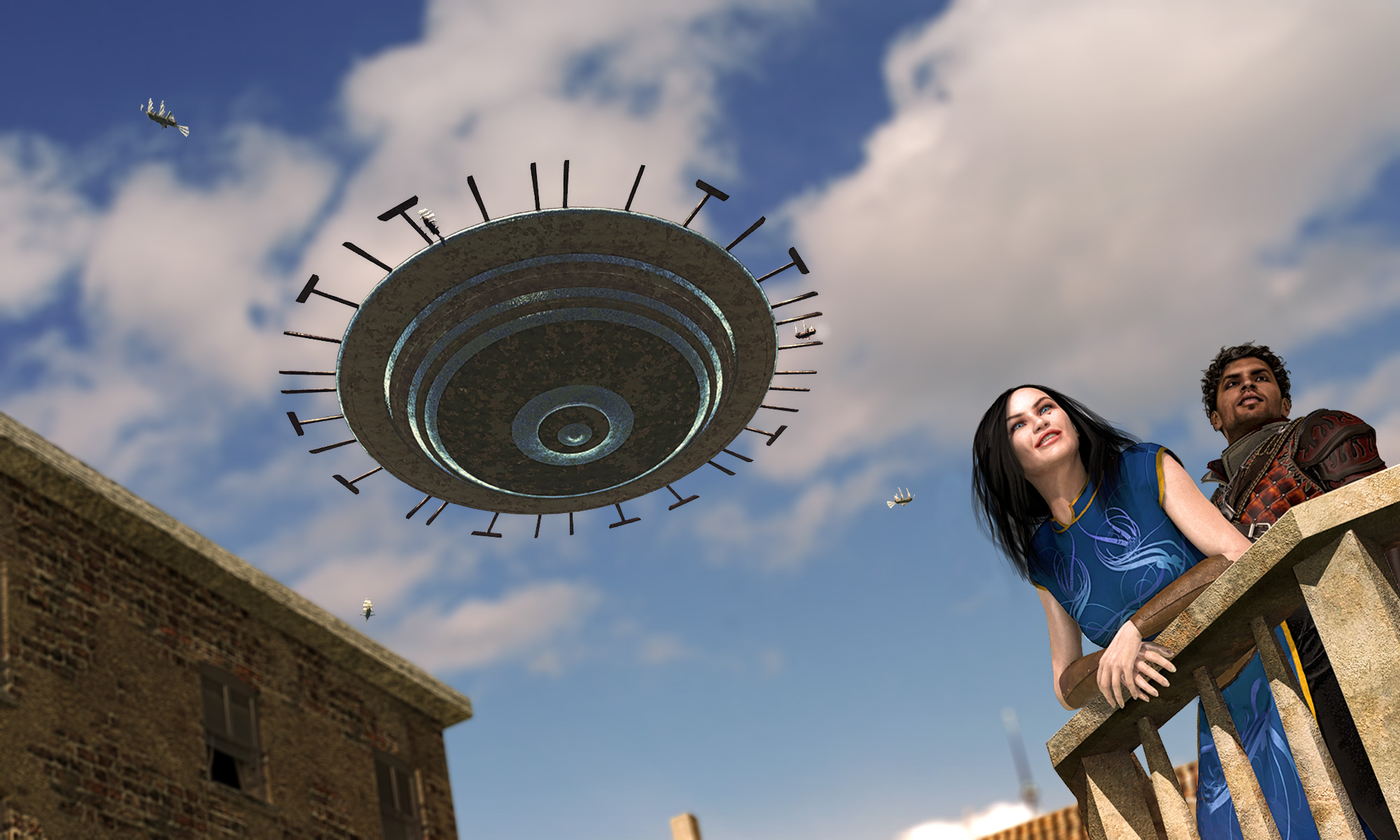
City of Forgotten Heroes

This is not one of our 50in50 adventures, no, rather this is a sort of crowd sourced adventure. So if it is crowd sourced then technically I am not saying that there will be this monster at this location, no, you will suggest that monster goes there and this one here and so on. The end result should be an adventure with monsters and villains for which I am entirely not to blame.

Or so the theory goes…

So, the inspiration for this was a quote I heard on the radio today. I wasn’t paying attention so I have no idea of the original context but I thought “That sounds like one of Brian’s adventures”. I googled that title and there is a piece of fan fiction of that name and this has absolutely nothing to do with that but I have linked to it just out of courtesy as Lady of the lake came up with the title before me.

My initial thought was for a originally coastal city or large town that over the years flood defences had crumbled or drainage ditches had become choked so that the surrounding land had returned to a wet march. The city itself is approached by a raised causeway. Part way along the causeway are the remains of a gatehouse. One tower has completely collapsed into the march, the arch over the causeway has also crumbled but one tower remains mostly whole.

I am thinking that the city is inhabited primarily by the incorporeal undead, so no zombies and skeletons but more shadows, wraiths and spectres. These marshes could be home to corpse candles and corpse lanterns. For a lower level party the marshes could be haunted by phantoms, being only 2nd level.

So this is a real gatehouse. If we wipe out one side due to collapse we have six remaining chambers over three levels if the party decide to approach our city along the causeway.

That is not a given of course. There are parties that will stubbornly insist on slogging though the marsh to avoid it, those that will fly over it or longdoor past it.

To address some of these I propose that the last vestige of the gate captain be a Spectre.

There are three levels of Spectre in Creature; Law Minor, Lesser and Major at 5th level, 10th and 15th respectively. These attack using Shockbolts, Lightning Bolts or more so they can control an area hundreds of feet across the road. Yet they are easily within the capabilities of even a low level party to take on.

The rest of the gatehouse guard can be Ghosts which start at just 3rd level (Minor Ghost).

So that is the first set piece encounter, can the party get past the gatehouse?

What about those pesky players that refuse point blank to go anywhere near the obvious adventure site of a gatehouse on a causeway?

I would happily let them trudge their way through the swamp. To make things interesting we can weave a bit of back story into this. Imagine this city was being defended for a reason. I can imagine a city under siege being protected by the heroes in the title when along comes an evil necromancer (That’s a stupid phrases isn’t it? How often we we have good necromancers saving the day?) and brings down the city from within. That explains the undead and why the city was left abandoned. Bound forever to defend the city are the ghostly remains of the heroes. Any party that want to try and approach the city via the marches can face random encounters with ghosts, phantoms and for those at a higher level Revenants and Shadows.

I am sure we could produce a scaling table of random encounters for parties of varying levels. If anyone tries to rest in the swamps then we can toss in an encounter with a Mara.

So what about in the city?

I don’t want to detail that in this post. Have a think about it between now and next Tuesday. I will put forward some ideas. I have an awesome idea for a BBEG at the end of it all but we also need a good reason for the party to need to journey to the city in the first place.

So your mission should you choose to accept it is this:

  • Can you add to or embellish what I have suggested so far?
  • Why do the party need to enter a city of the undead?
  • Do we need more set piece encounters for the opening chapter?

The Tree of Sighing Blades

This is a very late post for our latest 50in50 adventure.

The Tree of Sighing Blades is an unusual and special tree, and its sap has special properties that are greatly desired. Harvesting the sap is not easy, though, as the leaves of the tree are very sharp and constantly fall and swirl in the air, apparently seeking out any who try and making it a dangerous proposition.

This is another of our battle map issues. We are still using the squared map but the hex map is in the pipeline!

Tomorrow my first priority gaming-wise is to put together the Issue 14 of the fanzine which is all built around BASiL and Mentalism.

HârnWorld

As I mentioned last week in my settings post  I have been given a selection of HârnWorld materials to look at by Columbia Games Inc.

As always I am a bit late to the party as it appears that most of you are already familiar to some extent with Hârn whereas I am rather new to it as a setting.

So Hârn is a long established, system neutral game setting that attempts to be realistically medieval in its approach. There is a lot of fantasy here as there is an ancient disappeared race of Ancients or Earthmasters. You get orcs, Gargun on Hârn, and 12′, two ton lizards where the female is definitely more deadlier than the male.

The gods of Hârn are presented but it is left to each GM to decide if the actual gods exist or not. There are definitely hints at wizards and magic but this is rarely mentioned. I think it was mentioned in that previous post how Hârn is a low magic setting.

From a physical point of view each Hârn book I have looked at has been 60 to 70 pages. So each is tightly focused on a specific region or place and there are a great many books. I think this is a great plus. The Shadow World master atlas  I have looked at is 358 pages and then you need the regional books and they run into another 200 to 300 pages each. I simply cannot assimilate a thousand pages of material before I even start play.  65 page booklet I can read in an evening.

Rather neatly when any Hârn book references another work it puts the reference in the margin. In the sample below there are references to the Kindom or Kaldor region book and individual cities. These add on modules can are priced from as little as $3.99 to up to $20 depending on how substantial a city it is. The biggest module I have seen so far is the City of Tashal at 70 pages including a lot of floor plans for $36.

The second big plus is the way that Columbia Games Inc. respects the GM. Every book is based on play starting at the beginning of the year 720. At no time will they publish beyond that date. Your adventures start here and the publisher will never contradict you. Bearing in mind that I play a lot in the Forgotten Realms; not having your campaign setting ripped to pieces just so they can sell a new version is a major plus to my mind!

So what are the negatives?

The one thing that really stands out is the quality of the art. Hârn was first published in 1983 and it looks like the art has not progressed much since that time. I fully accept that you do not buy a setting for its artwork, it is the content that counts but when you compare the presentation of the Hârn  materials to other system neutral settings and Hârn feels ‘old’ or should that be ‘old fashioned’.

Great art can make you go ‘Wow! I want to play in that world.’ The first impression created by the Hârn books I have seen do not have that wow factor.

Hârn Freebies!

You do not have to take my word for it. Columbia Games Inc have a section on RPGnow of promotional materials. These you can download for free to get a first hand experience of what the materials are like. You can get them here.

So how about Rolemaster in Hârn?

As someone pointed out, Rolemaster is not a low magic system. That is the only modification that would challenge a GM in my opinion. Someone last week said that some of the professions would need tweaking but you all know I am an advocate of the no profession set up anyway. If you are one of those people that imported all the companions pretty much wholesale then you could have a problem. I never saw the companions that way. The companions to me were books of suggestions to be considered and then used or put aside.

So could you run a high magic game in Hârn? Certainly! There is rumoured to be an entire Earthmaster city buried somewhere and who knows what mysteries it holds.

I like low magic so I don’t have a problem with this. I have more of a problem with the Rolemaster Monty Haul approach to spell lists and the deluge of spells available to each caster, but that is just me!


Rebel Without a Chance

In Rebel Without a Chance, the characters come across a halfling village where many of the residents have been mentally dominated by a half-orc that they rescued. The remainder are trying to free themselves. The dominated residents will try to get the characters to leave the village; if they stay, the characters will not know for certain which halflings are affected, and therefore potential enemies.

This was one of the earliest adventures I wrote for this series.

The villain in this one is quite clearly an evil mentalist, if not by profession then by deed. You can set the level to create a suitable challenge for your players.

Referring back to the recent post on Murder Hobo PCs this adventure hook has the nice twist in that almost everyone thrown against the party is a completely innocent halfling controlled against their will.


For whom the setting tolls

One topic that we keep coming back to is RM’s setting. There is nothing inherently wrong with a generic fantasy set of rules but it does set any single game at a disadvantage in the gaming market place.

The reasons why generic is a disadvantage is twofold. Firstly, settings get people excited. Middle Earth = exciting and evocative, Game of Thrones = exciting and evocative, Generic = bland and boring.

Generic also equals work. If you have a setting you know and love, Middle Earth, Shadow World or the Forgotten Realms as examples you have to immediately do work to make the game rules fit the setting. I must have spent months recreating significant NPCs from D&D to RMC before starting my game. That is easy for me as I know RMC inside out but for a GM that has just bought a new game then it is a lot to ask.

Something that Terry does well is use vignettes at the head of a chapter to bring his setting material to life. Game mechanics on their own are actually pretty boring. The setting on the other hand can be compelling and surprising. In separating the rules from the setting you are not really helping anyone.

The counter argument is that RM is an advanced system that experienced GMs upgrade to and these are most likely to have their own home brew setting. So why spend all that time and effort creating a setting that no one is going to use?

I can sort of see the logic. Most of us are in our 40s and 50s and came to RM by upgrading from D&D. So if we all upgraded to RM then others are likely to as well.

The problem with that is, in my opinion, that the gaming world has changed a lot since the 1980s. You are no longer restricted to the games that your FLGS stocks. Sites like RPGnow and Drivethru have so many games that no one can every hope to play them all. The result of all that choice is that there is a game or set of rules out there that model whatever it is that you want to play almost perfectly, off the shelf and without the burden of bending a generic set of rules to fit.

Also, over the past 40 years all those traditional systems that we upgraded from have themselves updated and evolved. AD&D 1st edition was far from perfect, as Hurin said recently ‘Once you have seen 1d8 damage you have seen them all.’ but now critical systems are plentiful if you like your damage covered in blood.

Those systems we upgraded from have also mostly flourished and grown over the years and as a result every possible taste is catered for. Just look at the number of genre books available for GURPs as an example. GURPS is an example of a generic system that really identified the lack of setting as a weakness. To address that weakness they put the time and effort into fitting GURPS to each and every genre so the GM didn’t have to.

I am lucky enough to have been given some of the core Harn World books by the publisher. It is my task in the coming weeks to read through them. I will be blogging about them as well. Here we have a setting ready for any system. I know that Shadow World can be an acquired taste, the mix of fantasy and tech are not to everyone’s taste.

As we are not allowed to publish for Shadow World (thinking about our 50in50 adventure hooks) we could easily publish these and add in Harnic locations. These could be ‘box outs’ so the GM can use it or not at their discretion.

So how many of you have played RM or HARP in Harn? What did you think of the setting?

The Knitting Circle of Whispering Valley

I did NOT write this one!

As a ‘drop in’ bit of added texture to a campaign the knitting circle are a great addition. Brian is certainly stronger in the locations and campaign centric 50in50 ideas.

The Knitting Circle is an organised group of women who operate behind the scenes in the communities of Whispering Valley. They are the true power in the region and have various magical powers, providing healing and defence of the locals. These are normal women, not a secretive coven of witches, but ones with magic who subtly affect the area.

SL: One Mechanic To Rule Them All?

I was going to blog about something completely different today but as we seem to still be in dissecting rolemaster mode and Brian has the hood off of Spell Law I thought I would stick my oar in as well.

So as you all know I have been reading the 7th Sea rules. Looking at 7c2e magic at first glance you could so easily turn it into a spell list based system.

7c2e has different types of magic.

Porté allows the sorcerer to mark items, people and places with their own blood and then by creating a portal to either draw the item to them or travel to the person or place. As your skill in Porté increases you can maintain a bond with more items, people and places and take more people with you when traveling via these portals. So you could have a series of spells for Mark I, Mark II and so on that build up the number of marked items, Mark Person, Mark Place and so on that go up in stages and Create Portal spells. Between those you could easily build a list.

Sanderis is a form of magic where the character has a contract with a demon (to all intents and purposes). The spells on a Sanderis list would be in the form of ‘deals’ where the demon could be coerced into performing actions. Low level spells would do minor deals in exchange for minor gains and high level spells would force the demon to significant errands for the character.

Hexenwerk is a cross between alchemy and necromancy to create unguents.  Unguents are thick pastes or salves and come in minor and major variations. Here is an example, Ghost Eyes. Eyes carved from the recent dead, mixed with holy water and mandrake, and then smeared across the eyelids. Ghost Eyes allows you to see—for a single Scene—spirits, ghosts, and other such Monsters that would typically be invisible. One could easily build a list of unguent creation spells going from minor to major effects.

Those are just three of the six types of magic in 7c2e. Each is woven into the culture of the land where it originated and each has very distinct usage, effects and mechanics.

So, I could easily convert all of these to Rolemaster spell lists but in doing so something would be lost. With Sanderis the ‘caster’ can do any deal with their personal demon if they are prepared to pay the price. You do not need to be a particular skill level to get a particular effect. With Hexenwerk you can build a recipe book of different unguents as you learn the recipes. You do not need to work through them in a linear way.

So why do we need Channeling, Essence and Mentalism to work in exactly the same way? If a priest is getting his or her power directly from their deity why are they limited in what they can prey for? Rangers and Clerics are both channelers but their power source (nature vs gods directly?) are potentially very different yet treated as being one and the same.

Potentially you could easily abandon the realms model completely and built truly distinctive spell casters that are closely tied into their setting and characters culture as they are into their magical tradition. The only thing that makes one pure spell caster different from the next are their base lists. If a style of magic does not fit into a linear list style structure why not abandon the list and create a structure that does work?

Call That A Knife

Of all the 50 in 50 adventure hooks I wrote my two favourites were Mating Season and Call That A Knife.

This week’s offering is Call That A Knife.

Call That a Knife? sees a strange woman pulled out of the sea at a port. The woman is wearing tight-fitting armour and has unusual weapons, which she immediately attacks her rescuers with, killing several. The characters hear about this attack and may pursue the woman, who is travelling across the town’s roofs, as she tries to escape. The woman speaks no known language; it isn’t known who or what she is or why she is attacking everyone who approaches her.

Believe me when I say it is much better than it sounds. This is Ninjas meets Bourne Identity meets Kill Bill.

If you only buy one of my hooks then this is the one to buy. If you want to buy two of mine then get Mating Season as well!

Chargen Part 2 Questions

I used to have a GM that would start the first game session with dishing out about 5 pages of questions about your  character. The format was sort of question followed by about 10 lines of space then next question and so on. I cannot remember the actual questions except the very last one which was “What would your character sell his soul for?

I used to detest these questions. For a start I rarely know my characters personality when I sit down to play. I tend to have an idea of what I want to play but I am heavily influenced by the other players characters and the first adventure.

It is not the actual questioning I objected to but the timing of it. During that first session there is so much to take in, you could be getting to grasp with an entirely new setting, your new character, new party members, a new mission and possibly new rules or variations on the rules you thought you knew.

What brings this all to mind are twofold.

  1. Spectre771 mentioned in a comment to my last post about the differentiation between experienced players and newer less experienced players.
  2. My reading of the 7th Sea rules.

One of the things that my Rolemaster house rules always share is that character generation is always diceless. In RMC I use fixed #hits and point buy stats. In RMU hits are skill based, not rolled, and there is a core rule for point buying stats. Spell acquisition is skill based in both games although using different methods but the net effect is the same. If you know my house rules then you can create your character well in advance. For me it means that I can then devote my time and effort to any new players who cannot be left to create a character without some support.

7th Sea is also a diceless character generation system, you just pick options at each stage to create your hero. It is exceptionally quick and easy but lacks much of the detail and granularity of RM.

The stand out difference is that 7th Sea starts with 20 questions. These start with objective things like What Nation is your Hero from? and progress through things like What are your Hero’s highest ambitions? and What is your Hero’s opinion of his country? to eventually end up with What does your Hero think of Sorcery?

The fundamental difference between these questions and my old GM’s questions is that of timing. I can give out the 7th Sea questions along with a primer on my setting, nations and game world long before the game starts. That way you get to think about the sort of character you want to play in your own time. You can answer the questions then go back and change your mind. The answers you come up with then turn into a blue print to use in creating your character.

Adopting the same technique for Rolemaster, particularly with new players, has massive advantages. For really new players coming to RPGs for the first time the difference between Roll play and Role play are not always clear in their minds, particularly if they are coming from a wargaming background where the use of dice for combat resolution is an idea they are comfortable with.

I don’t see this just as a structure for new players either. It doesn’t hurt to give it to experienced players. My group have a tendency to slip into the same old personalities again and again. I get my players to create a post-it sized personality description which is stuck on the front of their character sheets. At the start of every session I ask them to read it to themselves as a reminder. If they tell me they do something that I think would be seriously out of character then I will ask them to read their post-it and then reconsider. Sometimes they read it and then insist that they are happy with their original choice, others they retract the action and do things differently because the character simply would not rip the innocent bartenders fingernails out just to get the address of an informant.

The 20 7th Sea questions do not take up any game time as they happen before the first game session but they make creating that personality prompt post-it much easier. It also makes creating a character with a new player easier too. As a guiding GM with a new player if you know what the player wants to play it is easier to help them achieve that. This is doubly true with a fully expanded RM2 I would say.

If you want I will list the 20 questions but I would also suggest that you create your own and make them setting specific. For modern espionage settings (I’m looking at you Intothatdarkness) you could style it like a psych evaluation. For shadow world if you have already decided on your characters starting location then you can add in cultural influences or drop in questions to hint at the Unlife or if everyone is going to be Gryphon College trained then twist things to reflect their world view.

Any thoughts? Do you want to see the questions?

The Red Stone Circle & May Fanzine

This week we have a two goodies for you. The May edition of the fanzine, issue 13 or Year 2 issue 1 depending on how you want to think of it. We also have our latest 50in50, The Red Stone Circle.

The Red Stone Circle

The Red Stone Circle is an unusual location, a stone circle formed of concentric rings of monoliths with a dolmen at the very centre. The circle acts as a magical dampener, suppressing the magic of anything that goes into the rings; the further in, the greater the effect.


This month brings 25 new Channeling Spell lists from Dark Woundings to Herb Mastery, here is the first part of the BASiL Channeling book by Brian Hanson. You can get the PDF from RPGnow or the print and kindle versions on Amazon.

I love the covers by Craig John, this time Sel Kai!