Assassins as PCs.

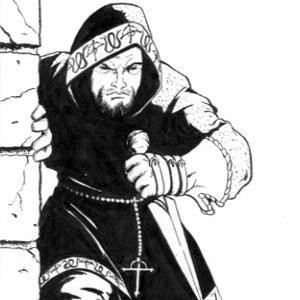
Image result for d&d assassin players handbook 1ed artwork

Based on the recent discussions about Mystics here on the Rolemasterblog and the RM Forums, I think one interpretation is that the Mystic could serve as a proto-type “Assassin” profession in lieu of companion classes like the Nightblade.

That got me to thinking about Assassins as a rpg profession in general–and perhaps the first iteration in the 1975 Blackmoor supplement by Dave Arneson. Most of the Assassin material was wholly transplanted to the 1st Ed. Players Handbook (p.27). The Assassin is a subclass of the Thief, and generally gains the same abilities with a few Assassin specific skills:

  1. Assassination. With a successful backstab attack the Assassin can use the Assassination table to determine if their is a kill strike.
  2. Language. Assassins can learn other alignment tongues. (recently discussed HERE.)
  3. Disguise.

Of course, all three are cool abilities, but how does an Assassin fit into an adventure group? It’s implied that Assassins can pose as a Thief or perhaps another class or person (using another alignment tongue and disguise) but would that last long in a cohesive group?

I’ve read a bit about Gygax and the early development of D&D and an Assassin class just seems incongruous to the core idea of a “balanced group” and spirit of play. Rolemaster has Professions similar to an Assassin; the Nightblade could be seen more as a Ninja style character, but nothing like the D&D version which is described thusly: “The primary function of assassins is killing.”. That’s pretty straight forward, but how does “assassinations” fit into a traditional fantasy game? What about poisons? I’ve seen quite a bit of comments/feedback from people who dislike the idea of poisons in gameplay.

Has anyone played an Assassin in D&D or similar in Rolemaster? If you GM, would you allow an assassin in your group?

This post currently has 2 responses


Novel Weapons in Shadow World & Rolemaster

The Katar…is that a lizard man motif?

Every now and then I stumble upon another blog or reference to odd or unusual real life weapons. Some seem very impractical, but they still fuel the imagination. (Beside, impracticality is of little importance in a fantasy setting!)

Rolemaster has some “fantasy weapons” that are really Shadow World specific available HERE, and I’ve posted a couple of blogs about some alternate and odd weapons:

Helmet in the shape of a conch shell
Conch Helmet

I’ve also had the opportunity to see some fantastic collections of armor and weapons at the Army Museum in Paris, and the Higgins Armory Museum that was relocated to the Met in New York.

Since I had already written about the Urumi, I was delighted to stumble across THIS BLOG‘s post on eastern blades. Of particular interest, besides the Urumi, is this:

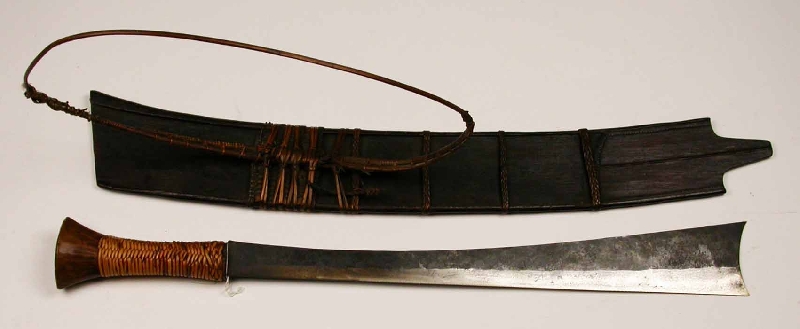
Assamese Dao

Like the Adya Katti, the Assamese Dao lacks a guard and gets broader towards the tip, but there the resemblances end. This is a straight sword rather than the curved one, and though it seems somewhat simple, the unusual shape of the blade adds enough character.

In my Priest-King module, I have a similar weapon that is basically a battle machete. These weapons were designed to be used by the Kinn Rangers to hunt Quarnaks–thus the lack of a hilt that is necessary against other bladed weapons. the Assamese Dao provides a good model for that weapon.

The blog post describes several other cool looking weapons that would add flavor to a fantasy setting. Do you have any unique or strange weapons in your game?

This post currently has 5 responses


Rethinking Inherently “Evil” Races. (Updated 2/14/21)

Image result for evil fantasy races

Synchronicity, being what it is, has brought together one of my blog topics and some current discussions floating around the web. In particular the racist nature of dark-skinned fantasy races that also are inherently “evil”.

Over on the RM Forums there is discussion about the dark-skin – evil duality. However I am more interested in the broader issue of evil races and if they even make sense. As a primer this is an interesting take:

Certainly a lot of progression has occurred in fantasy over the last 40 years: simplistic tropes have developed into more mature themes, the founding player base has aged and “awoken” and world building has expanded into more realistic modeling of societies.

Putting Tolkien aside, perhaps the most stark examples of monolithic races that I can remember was in David Eddings Belgariad series. Even as a young reader, the stark rigid depiction of racial characteristics was distracting. But this was pretty standard for Golden Age fantasy gaming and driven by the ideas on literature.

There are probably many driving forces for the standardization of evil races in fantasy gaming:

  1. Alignment. The introduction of alignments, and the assignment of alignments to races, monsters and creatures created a blanket behavioral type that was hard to overcome. I remember one early game where we first introduced a half-orc PC–the rest of the group was suspicious that the PC was secretly an assassin and was never trusted.
  2. Physical characteristics. Again, there is enough written about skin color, but there is also the physical attractiveness equation: ugly = bad, beautiful = good (although beautiful is also depicted as evil, but in a remote dispassionate cruelty).
  3. Story element. Every hero needs a foe, so races of inherently evil humanoids are a great standard foil. Fighting, attacking and killing any member of a evil race is just and righteous.
  4. Societal traits. Civilizations that are ambitious, colonialist, capitalist or warlike could be described as “Evil” or just immoral. Does that mean that every member of the society also holds those traits? A majority of them? Or just the leaders and powerful members of society?

Personally, I like moral ambiguity in my campaigns. It provides a more complicated ethical framework and consequences for actions. However, I realize that one of the appeals of RPG’s is it’s relief from a morally complicated reality and the escape to a good vs evil paradigm.

But even if you like a simpler framework, does it make sense to apply a blanket label like “evil” to an entire race? Is that corruption embedded in their DNA? Is it nature vs nurture? Can a societal structure create so much influence as to pre-ordain a person’s ethical nature? This is a philosophical debate, but still worth considering when using races like Dark Elves and Orcs in your setting.

One hand-wave approach to rationalizing a racial alignment is to have it driven by the race/society’s god; ie they worship an evil god therefore the people are “evil” too. Simple. In my own Shadow World campaign, the only truly evil entity is the Unlife. Dyari (Dark Elves) are simply a label for Elves that have forsaken the Lords of Orhan, and are not a distinct separate race.

There are a lot of arguments against a intrinsic evil as a racial trait. What are the argument for it? What do you do in your game?

{Update} In a related note, James over at Grognardia had an interesting post on alignment languages. It’s been decades since I’ve dealt with alignments, but the more I ponder the concept of alignment languages the less it makes sense. Based on the comments to James’ post, a lot of people struggle to define or rationalize them.

This post currently has 2 responses


Shadow World “Krylite”: Race or Monster?

Image result for fantasy insect creature with gun

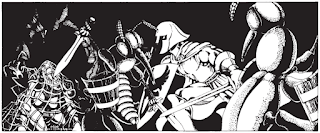
It’s been 4 years since I’ve blogged on “Race vs Monster”, the last time we discussed “Neng“. So today I wanted to review Krylites, an insectoid race that is classified at an “alien race” in the SW Master Atlas (page 131). Described as non-native to Kulthea and non-humanoid. They have professional limitations of no Essence or Channeling, but that makes common sense for a non-native race.

Krylites are grouped in 3 classes: Workers, Defenders and Minds. Apparently there are total Minds that direct and lead the collective through a hive mind. The most interesting aspect of the Krylites is their knowledge of advanced technology-specifically electricity. One group of Krylites works in cooperation with the Itanian Warlocks and trade resources for some of their technology.

The Apsis from Slave Pits of the Undercity.

So clearly, Krylites have quite a few limitations and perhaps don’t make the best PC race, but is it possible? Certainly there would be limitations when interacting in normal societies and settings, but a Krylite would definitely be a cool PC to play for a one-shot. Perhaps the “Hive Minds” need help against the Trogli and have sent a Krylite warrior on a mission with the PCs? Or a Krylite might be a good race for my “Monster Squad” idea. Maybe just fleshing out the Krylites and their society would allow them to be PCs in a more Mieville inspired Shadow World setting.

What are your thoughts? It would be great to do an adventure hook or one-shot with a Krylite or Krylites.

This post currently has 3 responses


An Ear for an Ear

We are now regularly playing using Fantasy Grounds and I don’t think I have ever played so much Rolemaster. I am running one game, playing in a Shadow World game, and there is a another game just about to start using a much more historically accurate Viking setting, and Rolemaster rules.

There was a fourth RM game, but the GM has decided to ditch it, in preference to running a 5e game instead.

I ran a couple of training sessions, for me to get used to running a game in FG, and for the players. I have now launched into a campaign.

Before starting the campaign proper, I ask the players how they felt about character death. The consensus was that they were happy with letting the dice fall as they may. That is fine by me, but the players were also happy that creating characters in Fantasy Grounds is very quick and easy, as is leveling them up.

Everyone can keep a back up character on hand should they suddenly need it.

That was all well and good.

We have played three sessions so far in this campaign, they survived the first but were defeated and taken captive. They then did a task in exchange for their freedom. Along the way, the [NPC] ranger lost a leg and then died from blood loss.

In the second session a critical facially disfigured the fighter. He was saved by his helm, but scarred as a result.

Last night the thief lost an ear to a wolf attack, winged wolves, not your common land-based ones.

I wonder if I am just getting a run of criticals that are leaving permanent marks or did I just not notice before?

Another possibility is that normally, this group of players plough everything into getting a high an OB as possible, which means that they are are often doing E criticals or nothing.

Now they are back to first level, we are seeing a lot of A-C criticals. It is possible that what would kill as an E critical is marking them as an A to C critical.

I am finding it quite amusing. It is almost as if they are being dismantled piece by piece.

Where they are going next week is full of fire hazards, lava, fiery monsters, and the like. I was browsing through the low level criticals, and they destroy a lot of armour and clothing, as well as burning off body hair. I am looking forward to see what state they emerge on the other side of that!

This post currently has one response


Shadow World Religions Supplement

I finally finished a better version of my various SW channeling and religion files done and packaged it into a “SW Religions & Channeling Handbook”. You can find it HERE. (you need a Rolemaster forum account to see it and download it. You can register HERE.).

I already have some new material for it and some updates, but it might give GMs and players a few ideas on how to structure a Cleric/Priest in Shadow World.

I’ve also updated my Shadow World master file list here on the blog.

This post currently has one response


Rise of the Old Guard.

GROGNARDIA

For those that follow various RPG blogs, you are probably familiar with Grognardia, written and curated by James Maliszewski. James ended the blog back in 2012 and it looked like he was done with the project. Perhaps he ran out of creative energy, or there was no topic left unturned.

Many of his older posts are worth perusing, but as it turns out, James is back and restarted the blog after an 8 year hiatus! Since the restart he has been prolific with 309 posts in 2020 alone! We managed 1 or 2 months of almost hitting 1 post a day here at the Rolemasterblog, and that was with 3 or more contributors!

James brings a true OSR viewpoint to his writing and he has in depth knowledge of the early Golden Age of roleplaying. He’s posted several articles on MERP and has some familiarity with Rolemaster even though he’s not a fan of the system. Welcome back James!

This post currently has no responses


New Year, New Projects

I think this is the longest I have ever gone without posting on the blog, excepting when I was plugged into hospital machines but I try to forget that bit. Every time I have thought about writing a post, there has been some new article from either Hurin or Brian.

I am also in a period where I haven’t played so much Rolemaster since I left home in 1985. After years of resisting online play my group has gone Fantasy Grounds crazy with two games a week now, Tuesdays and Fridays.

I used to have months to prep sessions, and that is cut down to days, and FG combats are so fast to adjudicate that where I would allot an hour for a battle previously, they now take twenty minutes at most. A fight last week ran to twelve rounds, three characters against a sea serpent. The beast was hard to kill because it was ignoring many criticals and effects. Twelve rounds with four combatants, including area of effect attacks was done and dusted in twenty minutes.

New Project #1 Sabre Lake

I saw a map recently by Dyson Logos.

It appeared so rich in adventure locations that I wanted to detail it all and run exploring the region for my players. They are on route there at the moment, but as they are first level, and only on their second adventure, they will have a few side quests along the way.

What I am doing is chopping this map into smaller blocks, the first is a rectangle that covers The Fool’s Rush Inn to Hebrek’s Tower. I am then detailing the adventure locations, both for my own players, but also in the fanzine.

I detailed both the inn and the tower, this month (Issue #45) but left some areas undetailed to give other GMs places to put their own ideas.

In February I will detail the Violet Obelisk and the Dench Estate.

Over the rest of the year I am going to try and cover the entire river valley.

All the adventures will only use the monsters from Creatures & Treasures I and Creatures & Monsters. This means that they adventures will be playable in all versions of RM, including RMu.

Project #2 Pilot RPG

I did start this in December, but then stalled. It is my definite intention to get this written and published as a public beta in the first half of 2021.

I am also tempted to try my hand at a Kickstarter. So I will write the first draft, then use KS funds to add a level of professional polish to the finished game.

As with Navigator RPG the game will be in print and as PDF. Putting the two together will give the community a community content/OGL rulebase for both Sci-Fi and fantasy that is broadly RM compatible.

I will then talk to OneBookShelf/DriveThruRPG about setting up a Community Content Programme.

This project will in all likelihood take up most of 2021, but it will also be a really interesting learning experience.

This post currently has 3 responses


Three Tales of the Tarot Deck.

Tale 1. One of the more curious aspects of The Court of Ardor is the “Deck of Ardan”, a tarot-like magical set of cards. At first glance, the deck simply acts as an “org chart” for the mysterious Court and assigns members to various roles based on a playing deck. Additionally, the deck holds other powers, two of which are detailed. The first is the ability to communicate with other members of the Court featured in the deck. This can be through voice, or if chosen a visual window akin to modern “Facetime”. The second detailed power was enhanced “Channeling”–per the channeling skill in Rolemaster. Since no one I know has ever used the Channeling skill (as described in RM2), it was interesting but ultimately unhelpful. (I recently asked Terry about the origins of the Channeling skill, but that’s another blog!)

Tale 2. The Court of Ardor was not the first appearance of a Tarot style deck in fantasy that replaced the cards with characters in the particular story. It has been decades since I had read Roger Zelazny’s “Nine Princes in Amber” but I vaguely recalled the same style device being used. The book was published in 1970, so it clearly predated Rolemaster and I’m not the first that noted the similarity. Age of Ravens blog noted the similarity in 2011.

http://ageofravens.blogspot.com/2011/02/rpg-supplements-i-like-court-of-ardor.html

So was this just a coincidence or an example of convergent creativity in early fantasy? When I asked Terry, he provided this short explanation:

“Yes the Ardan Tarot was inspired by Zelazny’s books. More details I am afraid I don’t recall after all these years!”

So there we have an answer, but answers to questions I had about additional powers of the deck or further ideas on their use were lost in the mists of time!

Tale 3. 29 years after Zelazny’s book and 16 years after The Court of Ardor, a Tarot plot device appeared in another fantasy series. One that had it’s birth in fantasy gaming. Gardens of the Moon is the first Book of the Malazan and featured the Deck of Dragons. This deck of cards was both a divination tool and depicted the various members of a pantheons court. The Deck of Dragons plays a major role in the early Malazan books, but less so as the books go on and other systems replace the deck. I’d enjoy asking Steven or Cameron (the authors) if they too were inspired by Zelazny’s book; the Malazan series was driven primarily by their early roleplaying games.

Perhaps I’ll read Nine Princes in Amber again, but I’m still intrigued by the use of Tarot cards in Court of Ardor and Malazan. Zelazny might have been the progenitor of an idea that is now shared DNA in two other fantasy settings.

This post currently has 3 responses


(Updated 1/17/21) Rolemaster Profession Review: The Astrologer

While the Astrologer has not been included in RMu, it does hold an interesting place in the minds of Rolemaster players. What was the point of the Astrologer? Is the profession even a useful PC? Why are the base lists so sparse? I decided to ask Terry if he could remember anything about the origins of the Astrologer from the early gaming days in Charlottesville. It’s been 40 years, but he did have this to say:

It was included partly for the spell-user realm symmetry (we needed a hybrid mentalist/Channeling?) I never played one; I think they are better suited as NPCs.

That’s interesting and re-affirms my thinking that some of the original RM professions were probably never gamed extensively. (Not dis-similar to the new RMu Delver). Nonetheless, the Astrologer is a profession in RM and I’ve had a few thoughts about it recently:

  1. Astrology implies a game setting that supports the concept. Sure, the Astrology spells are mostly replicated in other spell lists, but the conceit itself relies upon some systems around the sun, moon, stars or “heavenly” bodies. Does that work in all settings? Probably not. Does it work in Shadow World. Yes!
  2. Many of the Astrology spells are divination based. That can create challenges for the GM in terms of predicting future events. The more vague the information (for instance through “Dreams”) the easier, but specific info about the future may require the GM to funnel the gameplay to meet a desired, predicted outcome.
  3. The Astrology base lists need work. I addressed some of that in my blog below.

Conceptually what is an Astrologer? For me, the Profession invokes ancient magic, star-cults, sun based worship or Zoroastrian magic rather than “horoscopic” mumbo jumbo. The Zorastrians were seen as a priesthood and called Magus or Magi, so it was a combination of religion and magic. In Rolemaster, Astrologers are Channeling/Mentalism hybrids, but you could make the argument for Channeling/Essence given their “star-fire” powers.

The Astrologer was a prominent feature in early MERP products and shown in color coded city maps using red fill with a question mark for Seer/Astrologer. Clearly, Peter & Co. saw a need for Diviners in their early campaigns even if those professions were left out of the MERP ruleset. As an NPC, the Profession adds an air of mystery and exoticism and would be a useful resource on occasion. As PC, it’s not clear that the Astrologer would be that effective.

In other “Profession Review” blogs I offer up more specific spell lists and remedies that I think would fix or focus a profession. With the Astrologer, I have some ideas but the verdict is still out. Here are a few thoughts:

  1. Combine the Seer & Astrologer Profession. They both have a divination aspect and consolidating the base spells lists would tighten up the spell abilities.
  2. Tie the spell lists into some type of astrological mechanism. For instance, why not have some spell lists tied to the Sun that can only be used from Dawn to Dusk, others that can only be used at night under starlight and a list that can only be used when the Moon is full. (see next item).
  3. I haven’t reviewed the Moon Mage in a while, but Astrology includes the “Sun, Moon and Stars”. Why not roll the useful and usable MM spell lists into a fleshed out Astrologer. Moon Mage is a goofy name anyway.
  4. In conjunction with #2 & #3, an Astrologer could be an interesting Profession using Shadow World. With 2 prominent moons (Orhan and Charon) that are the home of the Gods, and other planets in the Solar System, there is a basis for building the Profession around orbital mechanics. I’ve already experimented with Essaence cycles and lunar orbits in Chapter 3. It might be cool to develop unique spell lists for different moons, planets and the sun that only work during portions of their orbit in relation to Kulthea.
  5. Currently, I use Astrologers as a subset of the Phaon clergy. They act as Priest-Astronomers and justified their use of Sun-Fire spells. I think using Astrologers as Priests of Phaon in Shadow World, or Priests of a “Sun God” in other settings makes sense.

So just a few thoughts on the Astrologer. Has anybody played one as a PC?

This post currently has 7 responses