Adding “dark things” to your Rolemaster and Shadow World games.

Poisons, diseases, curses. Oh my. In the earliest days of D&D, adventurers not only had to avoid traps, navigate mazes and defeat monsters, they had to contend with other insidious agents like poisons, level drains, curses or cursed objects, petrification and the diseased touch of the Mummy.  Not really a safe vocation when you really think about it! While much of the Saving Throw/Resistance Roll mechanic was built around these attack types, how often do GM’s really use these “dark things”? How often do you introduce poisons & diseases in your campaign?

D&D made many challenges fairly simple. Curses could be countered with a particular spell, poisons could be Saved or cured etc. They were designed to be yet another discrete challenge that has to be overcome. A binary mechanic: effect vs. cure. D&D didn’t bother with specific poison antidotes (unless part of the narrative) or even causation (what is a curse and why so prevalent in D&D). You Saved and you were good, you failed and you had to seek out a singular solution.

Rolemaster introduced a more realistic system for many of these challenges; and poisons were definitely more detailed! Not only were there many poisons, they were defined into 5 types, had specific antidotes, and had varying levels of effects. A similar approach was taken with diseases and whole spell lists were devoted to varying curses whose effects spanned the realm of imagination.

A few years ago I took a critical look at my own campaign and GMing proclivities. I realized that I rarely used diseases, never used curses (or at least hadn’t for many years) and was reluctant to delve into poisons.  Now I see these interesting affects as not just a quick add-on but great additions to my narrative toolkit. Let’s take a look:

  1. Poisons. Many GM’s are reluctant to use poisons due to their variety, unpredictable effects AND some sort of ethical standard (maybe established by D&D class restrictions). I think that’s just wrong and leaves a whole layer of complexity to gaming. Putting our own social norms aside, the widespread use of herbs in the RM/SW world clearly lays a path for the common use of harmful herbs and agents as well. I just finished then newest Mark Lawrence book that prominently featured the use of herbs and poisons–it really inspired me to add more depth to poisons and an added value to the skill. Luckily, RM and SW already has a comprehensive list of substances that I collated into a MASTER LIST. I also left Poison as a meta-skill that covers identification (by taste, smell, symptoms etc) preparation, application and use, and as part of our system that provides a benefit for ranks, the # of ranks in Poison is also added to any RR vs poisons.  (This models the idea of a poisoner taking low doses over time to build up their resistance). So now poisons are like spells, with varying effects, methods of delivery and counter-antidotes. To facilitate poison (and similar substances) it helps to use a variety of mediums: paste, liquids, powders, oils that have varying effect times and for pre-prepared antidotes to the most commonly known agents. And poisons don’t just have to kill, they can paralyze, knock a person out, make them dizzy etc, so they aren’t just a deadly, unethical or cowardly attack only favored by assassins and “low men”. Poison preparation also shoehorns into our alchemy rules and can be combined with various substrate delivery systems. I’ll be expanding on this in an upcoming blog or RMBlog fanzine edition in the near future.
  2. Diseases. I think my reluctance to use diseases is multi-fold. First, diseases are generally slow acting so they don’t create a sense of urgency. Second, Elves and even half-Elves are basically immune to diseases so in SW much of the population doesn’t eve worry about it. Finally, Spell Law healing makes curing diseases fairly simple and implies most societies are not going to have problems with disease in general. Besides having a disease as a core plot point to an adventure, I think diseases only work well if they have affects measured in days or weeks and not months or years. That may only be magical diseases. Like poisons, I avoided using diseases for many years, but now I like them a lot–especially the slow, sapping type. Perhaps it’s reduces Str & Co 1 pt a day or week, or there is a slowly increasing fatigue penalty. That hits home with the affected player as it directly impacts the game play–they’ll want to deal with it!
  3. Curses. I still can’t remember when I last used a curse. I specifically reduced “Curses” down to a single spell list in BASiL (and even then it was difficult to rank them by level) and I don’t think I’ve used a cursed object in RM or my SW campaign. I feel that curses are very setting driven and probably generated from Channeling/Diety. In Rolemaster, Curses are more “ill effect” than the common idea of curses that tend towards future effects and augury.  Traditional curses are too open ended and hard to fit into the gameplay. I’m open to ideas, so happy to hear other peoples experience with them.

But “dark things” are not just limited to poisons, disease and curses. Beyond these traditional agents, Shadow World may provide a bevy of interesting taints, attacks and complications that can add to your campaign. Here are a few thoughts and ideas:

Demonic Possessions. I’ve blogged about the problems with summoning and demonic possessions should be based on the particular setting. But Shadow World does have Demons, so it’s possible to have Demonic possessions beyond the thematic demons introduced by Terry. Having a player possessed could make for interesting sessions: Demons may not have any particular agenda beyond being a chaos agent and maybe they even impart some Demonic powers (like Frenzy).

Mental Illness. Introducing a mental illness to a player really relies on their roleplaying skills, but can add a interesting twist to group dynamics. Traditional Mentalism spells can cause mental illnesses, but how should they work and manifest in game play. Serious illness beyond phobias and violent tendencies are going to be metagamed by the player, but a players that really commits to it can be a lot of fun even if it gets the group into trouble.

Unlife Taint. There has been several attempts to mechanize Unlife taint in past GC’s and some other thoughts on the Forums. Obviously there needs to be corruption rules for SW. Should this work as a player accesses “Dark” spell lists? In my own campaign I differentiate between “dark” lists (that are the result of the Gods of Charon) and “Unlife” spell lists which tap into an alien, malevolent power. These lists are the various Priest Arnak lists I posted up on the RM Forums, and the lists Terry made for the Steel Rain and other Unlife organizations. Ideally, the Unlife lists should be really different from standard SL lists and more powerfully to justify and entice spell users to explore and experiment with them–and start down a slippery slope. Unlife corruption should be a core rule mechanic for SW. The concept of players “flirting” with learning and casting powerful Unlife spells and risking being corrupted or subsumed by the Unlife is a great fantasy theme.

Channeling Block. A priest who defies their god, behaves in a inappropriate way or similar should be punished. The quickest and most obvious is to sever them from their spell casting ability until they make atonement for their actions. This atonement process is a natural trigger for an adventure or quest!

God Cursed. Similar to the disfavor in a channeling block, a character could get a “mark” that shows they are cursed, outcast or disfavored by a god. This could be in the form of a birthmark, shaped scar, change in eye color, or symbol that can be seen in the person’s skin (excommunication). This would be an ill omen in most cultures, and make it difficult for the player to interact with society.

Just a few ideas that I need to explore in more detail or finalize as rule mechanics. RMSS and RMU have introduced Flaws that are similar to these, but I like for fluidity to these more than CharGen mechanics to offset talents. What has been your experience with “Dark Things“?


This post currently has 7 responses


Interview with Jonathan Dale RMU Dev

Today I have for you an interview with Jonathan Dale about the current state of RMU and I did my best to get the release date out of him but he was having none of it.

Peter: For those people who are not part of the RMU Beta test on the ICE Forum could you tell us how you came to join the RMU Dev Team?

JDale: The glib answer is that I posted too much in the playtest forums, and now here I am. That’s sort of true. ICE is currently made up of freelancers and people’s available time changes, and an open playtest is an exhausting process, especially at the beginning when the rules are still rough. Some of the team were not going to stay closely involved and that meant some new people had to be brought on board. Some of the team had told me they appreciated how, in my comments, I was looking at other people’s views, explaining my reasoning, and suggesting alternatives rather than just criticizing. I also had met with Matt Hanson at an RPG event at Jetpack Comics. Initially I was brought in to help Matt, and we did a sit-down session as well as conversing by email, but as his free time ran out, I ended up the lead on A&CL. I also did some work on Creature Law, mainly on the talents and updating the giant spreadsheet used to create the creatures, and Vlad is plugging away on updating the creatures themselves. Nicholas also brought in Graham Bott to do some work on Spell Law (which did not get changed very much) and Treasure Law (which got more changes, unsurprisingly since it had only been through one beta cycle).

Peter: It has always struck me that you come across as the voice of moderation, on the forums as least, especially when there are some very strongly held views. How much of Arms & Character Law would you say is ready to sign off and how much is still open to change given that most people are praying every day for the RMU Singularity?

JDale: A&CL is basically done. I could have signed off on it a while ago. It’s Creature Law that is taking time. That said, because of that delay, I’ve continued to make minor tweaks and adjustments to A&CL based on feedback, mostly improving wording for clarity. The current discussion of tactical movement is an extreme case of that, I actually have two versions of the manuscript, one each way.

Peter: The problem I have had with play testing was getting the players. I took me over a year to get my RM2 stalwarts to accept RMC. Going to RMU was rejected out of hand. I did find one new player but he comes and goes and we didn’t get to play much. You on the other hand seem to have several games on the go. Did you hit many problems at the game table with the new rules?

My player’s biggest complaint is that…

JDale: I still don’t get to play nearly as often as I’d like. I’ve been forced to fall back on playing a D&D game although the current plan is I will take over and launch another RMU game when that campaign ends later this year. In any case, I started my current (still-running) RMU game before joining the development team. I think my player’s biggest complaint is that I keep changing the rules on them as we go from update to update; I started that even before joining the dev team. We did run into many of the same issues others have mentioned on the forums, for example injury penalties were too high and too frequent (these have since been reduced), and damage was too low (this is being raised). We also converted our long-running (but not frequently meeting) RMSS game, in which I am a player not GM, and conversion is different from starting a new game. Some things go up, some things go down, there were some complaints about the latter but nobody complained about the reduced need for spell prep or their skills that went up. The biggest issue there was with the very different number of starting language ranks between the two editions, which we mostly dealt with by giving everyone 20 extra ranks.

Peter: I would like to ask about monsters. I know you are mainly working on A&CL but the foes we fight are an integral part of combat. When the Beta of Creature Law hit it was dramatically behind in its level of development in terms of presentation and it stirred up a hornets over the normalised creature stats. Is there a secret ‘new and improved’ creature law that the dev team are using that we haven’t had a chance to look at?

“…to a mere 286”

JDale: The core of Creature Law is in the talents and archetypes. The archetypes are basically a streamlined way of handling normal level progression, so the GM does not have to pick individual skills and stat gains when creating a creature. And the talents cover everything else. The archetypes have been slightly updated to take into account other changes but we did a lot of work to clarify the talents, remove redundancy, and make the costs more consistent. That reduced the number of talents and flaws to a mere 286. All of the talents now have full descriptions in the same style as those in A&CL. That required us to update the creature-building spreadsheet to take into account the changes. We also made changes to how movement rates were calculated, how hits are presented (e.g. larger creatures now have more hits rather than taking reduced damage), etc. So, the framework is definitely improved. And I have used it to create creatures for my campaign. But ultimately the books (it will be two volumes, not one) will also present more than 800 creatures that are ready to go; the creature stats all need to be updated based on those changes, and that’s what’s still in progress.

Peter: That is really good to hear, I was one of those people who moaned mightily about the normalised #hits for monsters.

So the thing I like the most about RMU is the skill system. RM2 skills by comparison are a nightmare of inconsistency with some skills giving different bonuses per rank depending on the skill, the costs had no continuity and even really important game mechanics being given buried in the skills descriptions; such as all flying manoeuvres being at -75 only  being mentioned in the Flying skill but not under the manoeuvring rules. RMU by comparison is really neat, skills give bonuses and expertise reduce penalties.

If you had to point to one thing in RMU that really stands out as an improvement or a problem solved what would it be?

JDale: That’s tough. I’m mostly coming from RMFRP, so the streamlined skill list and similar skills rules are a nice improvement from the skills and categories of the previous system. I can definitely see the improved organization and clarity being a big step from RM2, that’s why we switched to RMFRP in our group after all, and there was still room for improvement. The improvements to the attack tables are big in my opinion too. But as someone who enjoys worldbuilding, I was really excited to get tools for creating and customizing professions, races, cultures, and monsters. Those are super useful for me and I think will also be useful keeping everything working when the system expands with future Companion books.

Peter: OK, this will be a bit of a curved ball but I actually did a bit of research before asking to talk to you. So without looking in Creature Law, what OB would you give a starfish?

JDale:  Maybe I gotta keep clam about that. 🙂 I’m sure they’re awesome grapplers with a secondary acid critical… if you just sit there and wait for them.

The answer is 25T(3)gr ;25D(2)be (grapple and beak) but to my horror I discovered that the number encountered is 2d8(!) I play Rolemaster, I don’t own 2d8!

Peter: OK, one last question, and this one I know you cannot really answer, but you have seen more of the books in their present state, the working spreadsheets and so on. You have seen how they have been progressing over the past six months. If I had to press you, when do you think the singularity will happen, at least to the nearest month or season? Should I be putting RMU on my Christmas list?

JDale: Even after the singularity, there will be a round of proofreading, probably a round of fixes to the issues it reveals, and then art and layout. I have no idea how long that will take. I would love to have a copy in my hands this year, but no idea whether it will happen.

My thanks to Jonathan for spending the time to answer my questions and what I think was the coolest bit was that he signed off saying “I am off to go run our LARP for the weekend so thanks for the chat!” In my experience there are not many conversations you can drop the word LARP into and get away without some fairly long explanations. 🙂
This post currently has 7 responses


Capricorn One

Yes, you guessed it, the stupid title means it is one of my 50 in 50 adventure hooks.

Capricorn One is a “Can the heroes save the village?” adventure. For added fun as least some of the adventure is going to take place on water so it is a chance to prize your tanked up warriors out of their plate mail.

There are sea monsters, magic and deep water which probably makes it a warriors worst nightmare but jolly good fun to GM.

This post currently has no responses


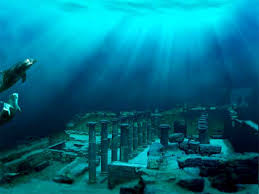
Thoughts on ancient structures in fantasy RPG’s and Shadow World.

We dropped anchor in the deep bay west of the Sullen Mountains. A solitary volcanic cone, trickling a faint plume of smoke from its summit loomed above us. The swells chopped but the water was relatively calm compared to the weather we had faced the past few weeks. To the north we beheld the Sunken City, the natives call it the City of Giants, but a cursory inspection of nearby structures indicated the occupants were most certainly mortal in size. The tops of huge blocks, broken towers and chipped obelisks worn down by the millennia spread as far as the eye could see. There must have been leagues of crumbling ruins above the water, but I could only imagine what secrets lay beneath the dark waves.

Travel Journals of Malco Teves, Merchant Captain of the Storm Sea Free Traders

Ancient castles, dark crypts, lost cities. Exploring ruins and structures is a key component in fantasy roleplaying, and if your games are similar most of these “ancient structures” are in fact really not that “ruined”.  I recently visited the Yucatan Peninsula and 4 different Mayan sites: Chitzen Itza, Coba, Tulum and a small complex on Cozumel. In some ways, Coba was the most interesting as much of the huge site (home to 55,000 people) is still buried under the jungle.  As I walked through the jungles, I definitely had my GM hat on, and thought about the experience through a roleplaying session. Peering into the jungle you can see numerous, huge, mounds covered in scattered stones, undergrowth and trees.  These are all buildings that not only haven’t been excavated, they are probably just piles of rubble. Most of the iconic buildings we see at these sites or in pictures are the result of complete rebuilding–often times done multiple times to either repair shoddy work or to correct architectural mistakes as archaeologists gather new information.

In other words, many untouched ancient ruins in real life wouldn’t make good adventure settings! Over time ancient structures degrade: they are buried under strata, collapsed in cataclysms or earthquakes, looted, stripped of cut stone for new buildings or leveled by conquering forces. In jungles, foliage quickly cover buildings and root systems crush and grind the buildings to dust. This reality is in sharp contract to our expectations as adventurers. Rarely do parties have to dig for days or weeks to uncover a tomb entrance or hire a work force to lift and move thousands of cut stones of a collapsed building. Many structures might not even resemble buildings as much as mounds of rubble or small hills which doesn’t work well for a cinematic approach to your game. I think we all tend towards “ruins lite” in our games: basically recognizable and functional structures with some crumbling around the edges.

But what if the buildings are much, much older than Earth comparables?  Right now the oldest constructions on Earth are 10,000 to 12,000 years old (Gobleki Tepi and Jericho) and GT was purposefully buried in 8000 BC to protect it! The 3 Eras in Shadow World span more than 100,000 years with many distinct high tech cultures and of course immortal Elves. These cultures left behind remnants of their civilizations across the planet.

Priest King of Shade (the opening vignette was taken from that) includes the ruins of a 1st Era Althan city. Over 100,000 years old, partially submerged and continuously explored and looted by subsequent cultures I had to think about how it would have survived or what it’s present state should be. Since we don’t have anything to compare to here and it was a city of advanced tech I had to guess at it. And what about other ancient lost ruins that may not date to the 1st Era but are still TENS of thousands of years old. Should we expect them to be intact, structurally sound and playable? Maybe hand wave their condition away due to “magic”?

I’m curious if anyone else has thought about this, introduced standard archaeology or excavation in any of their adventures or have thoughts on this topic?

This post currently has 9 responses


What a rip off!

On Tuesday I came across a game called A Slight Mistake. It is a Pay What You Want game on RPGnow but do not pay anything to the author! When I say author what I really mean is thieving scum bag.

A Slight Mistake is, in the ‘authors’ own words…

For a few years now, I’ve been writing a series of novels set on a Dyson Sphere.

Then the opportunity arose for me to run a game based upon them. I created a beespoke set of rules, based upon my own preferences and so I decided to put it out there and see if anyone else would like to play it.

I’ve broken the rules into two books, the GM’s guide and the Player’s guide. Hopefully someone out there might find this useful.

I’ve set it to ‘pay what you like’ as I know this won’t be everybody’s preferences.

You see the bit where is tries to say “I created a bespoke set of rules” what he actually meant was “I ripped off Rolemaster or HARP and try to pass it off as my own.”

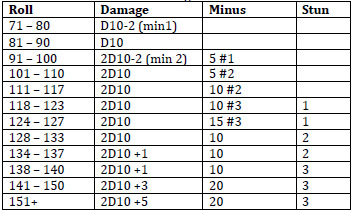
The only bit that is ‘his’ is that he turned the individual combat tables into something that looks like this.


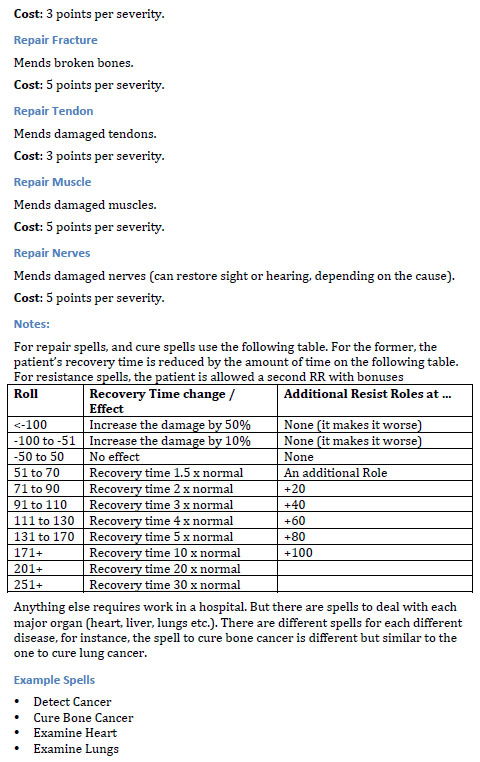
He had the amazing thought of grouping spells like this


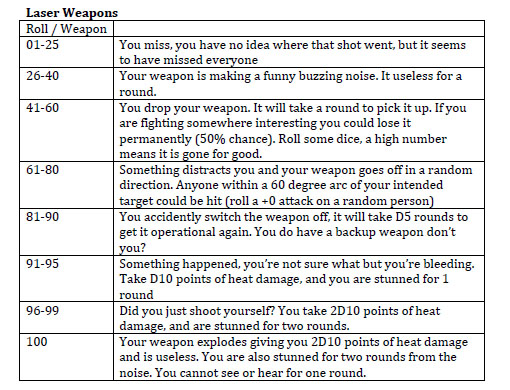
And that weapons could have their own fumble charts like this.

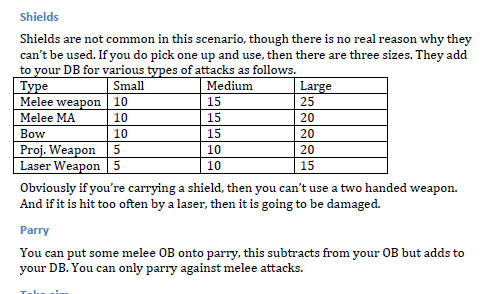
The combat system seems oddly familiar, lets look at shields and parrying.

I guess you get the picture?

Isn’t it amazing that half the time we agonise about how we can share playable adventures or NPCs without violating ICE’s intellectual property while someone else will happily rip off the entire game system.

I did vainly try to see if there was a mention of Rolemaster/HARP anywhere, any sort of acknowledgement or word of gratitude but nothing. The only kind of introductory preamble is a push to get you to buy his book on Amazon and a reference to Star Trek TNG. I won’t be buying his book.

I am not entirely sure if ICE can do anything about this either. You cannot copyright game mechanics and he has not used any of their logos or trademarks. It is just a wholesale plundering of ideas and presenting them as his own.

It wouldn’t surprise me if his next book was about a sea captain that builds a submarine and sails around under the ocean. He could call it “69046.767miles under the sea”. That is unique after all.

This post currently has 10 responses


Culture of Spiders

We have released a few adventure hooks that could easily be expanded into full adventure modules with a bit of effort. One of the prime candidates is The City of Spiders.

As this hook introduced a whole city for the characters to explore along with factions to interact with it is easy to imaging creating several adventures within this one location.

So there seem to be two types of threat in this adventure. People from the various factions and spiders, large and small.

What I would like to do is gather some ideas of what ‘monsters’ you think complement the classic giant spider? I do not want to end up with a D&D menagerie in every room but I worry that a mono culture could get a bit same old same old fairly quickly.

So my four initial ideas are Drider style half human-half spiders possibly related to the inner circles of the church, Gemsting (giant scorpions) living in the surrounding landscape and giant wasps, the original ecological reason why the giant spiders both evolved and why they are tolerated in the city. Finally, there could be golem or or automata in spider form.

So can any of you come up with really good monsters that could naturally sit in a city dedicated to spiders?

This post currently has 3 responses


Feldaryn’s Flying Ship

This week is Fanzine week and our latest 50 in 50 adventure.

Fanzine issue 12

This issue is the finishes the Essence part of BASiL with five new spell lists and as a preview of the Channelling lists there is one new featured channeling list ‘Minor Curses’. In addition you also get the Mummy and Mummy Lord as new monsters converted from 5e to Rolemaster. To round our the issue there are a few more articles on NPCs and player skills.

As this is Issue 12 it means we have completed our first year of the printed fanzine. It is also in some way fitting that this is the first issue to feature Craggle’s Shadow World art.

The fanzine is available on RPGnow and on Amazon in print and kindle editions.


In Feldaryn’s Flying Ship the characters come across a ship that is stuck – in a tree. The ship is actually a flying vessel and the sole individual on it – by all appearances a powerful mage – needs help getting the rigging untangled from the tree. The mage, Feldaryn, is not what he seems and can be a source of problems to the characters. Having access to flying transport may prove useful, though.

There is a three deck plan of the flying ship included.


This post currently has no responses


Current Affairs: Thoughts on Magical Languages in Rolemaster and Shadow World.

Warning: this might be a whisky rant as well.

A recent THREAD at the Rolemaster Forums is discussing Magical Languages. Since I have some opinions on this subject I thought I would write a quick post. For those following my discussion on BASiL or have downloaded the spells probably know that I use a “no profession” system for my own Shadow World campaign.

After reading lots of comments I realize that most people only understand my reference to “no profession” as a direct reference to the RM system “no profession”. That’s not it at all! My players have profession names–but those are descriptors driven by the sum of skills and abilities of the character. With BASiL I allow access to all the realms (but  I have no hybrid realms which break logical mechanics). Professions and classes do reinforce group roles, but again, Rolemaster mostly broke that a long time ago…AND…that’s why players liked it! So having broad access to all realms has the appearance of unbalance but it’s really just the case of applying “free market” principles to control player skill selection. Early on, I decided to use pre-requisite lore skills to gain access or use certain spell lists. This would be similar to requiring advanced math to do astronomical calculations or basic anatomy for healing skills (spells or otherwise). So BASE lists might require more lore ranks to learn while OPEN lists only need a few ranks. To me that made sense. But BASiL is a work in progress and participation in the Rolemasterblog and RMForums has introduced me to new ideas.

So lately I have backed off on the Lore skill pre-req approach. It added too much to my skill offering and was not tight enough. Instead I have changed my approach to the use of Magical Languages. It’s such a simple, elegant mechanic and solves a lot of problems.

In the past, Magical Languages have been a “bolt-on” mechanic; introduced in Companions and referenced in SW for added casting bonuses etc. Spell casting requires certain mechanics: verbal, gestures, focus, components whatever. But what is that verbal and gesture component? Should it have an underlying science behind it? Is the verbal component linguistically diverse? Can a French person speaking french or a German speaking German recite the same words in their own particular language to cast? That makes NO sense! Immediately, it would be argued that they aren’t speaking French or German but reciting “arcane sounds”. Exactly!!–casting requires a power language of some time that is divested of speaking languages. Once that is accepted the conclusion follows the logic: spells need be cast using a magic vernacular, a magical language. This doesn’t have to be just verbal recitation but gestures, body motions, chants or katas.

If you accept that, than building a number of magical “languages” becomes a powerful tool to limiting spell list access rather than arbitrary “professions”. An Elemental Language might allow casting element spells, while another may allow for Illusions, Arcane or other.

From a mechanics standpoint, I use the Magical Language skill bonus for the SCR. How can anyone cast a high level spell if they have a kindergarten mastery of a language needed to cast the spell? Mastery of magical language is mastery of casting. Creating numbers of “Power Languages”  that are needed for certain types of magic limits a casters ability to learn a wide range of spells and therefore reinforces “class tropes”. (on a side note, to me, the very people that argue for professions LOVE the Arch-mage, Warrior-Mage, and other unbalanced classes).

This post currently has 9 responses


Smells Like Stream Spirit and Fanzine #11

So this week we have one 50 in 50 adventure and the latest fanzine on both RPGnow (pdf) and Amazon (print).

First up is Smells Like Stream Spirit…

You can tell from the stupid title that this is one of mine. It was actually one of the first I wrote for the 50 in 50.

In Smells Like Stream Spirit, the characters will encounter some naiads. There are two families of naiads in the area who are generally hostile towards each other, but the hostility has not turned into outright war – yet. Naturally, a couple, one from each group, has fallen in love with other. Depending on how the characters interact with the naiads, they may incite a conflict – possibly by accident – or cause the two sides to reconcile.

Fanzine Time!

This months issue is all about BASiL and contains 33 new spell lists. I am the first to admit that all the content in this issue is also available as a free download on this site but if you buy the print editions you get real physical books that you can read easily off line, share with your players at the gaming table. For me that is the real added value, real books for a hobby that cries out for pen and paper.

You can buy the pdf on RPGnow and the print edition on Amazon. The kindle edition should be along any time this coming week. If you have kindle Unlimited then you can read it for free!

Edit: The kindle version went live on Sunday. You can find it here.

This post currently has no responses


I.C.E. Deep Dive. Loremaster Series Review pt.4: The Shade of the Sinking Plain.

We are at the last chapter of my reviews of the original Loremaster module series. I wish I could say I saved the best for last; but that’s not really the case. While Shade of the Sinking Plain has occupied a place of curiosity, appeal and mystery for decades, it’s not that great. Basically a D&D module re-purposed for Rolemaster.

Despite it’s arguable quality, it’s generally seen as a “rare” book, at times on par or even more than the price of The Court of Ardor. SotSP can fetch hundreds of dollars or more in excellent condition. But has anyone read it or even used it in an adventure? A quick but not exhaustive search via google and I couldn’t find a single review of the Shade of the Sinking Plain!

First off, SotSP is a “Loremaster Adventure from North Pole Publications, Inc.” and prominently says so on the cover and ToC.  Interestingly, North Pole Publications did at least two other products: The Serpent Islands and Tome of Mighty Magic and there may be MORE. I don’t have time to hunt them down, but it would be interesting to find out more on the company. The credits can be found in the back. Apparently the author was Roger Walker with development credits to Terry, Douglas Bohlman and Rober Walker.  The remainder of the credits for art, production, editing and play testing seems a mix of North Pole and ICE.

The Cover.

The cover art quality is average but the scene itself is compelling.  A robed figure sits on his throne while slaves or pirates present treasure and booty. Skulking behind the throne is a Demon of some sort. The art appears to be done by Victoria Wheeler in 1983. The back side of the 1 piece cover is a large hex map of the “Northern Kingdoms” (which is Trademarked apparently). It’s a fairly simple map with only major geographic features, the location of the Shade’s keep, a few cities and that’s about it. Pretty sparse and in no way the quality of the Iron Wind or Cloudlords. (or Vog Mur for that matter). Again, we get the sense that this is an outlier. More Judges Guild for D&D than a curated ICE/RM product from Terry, Pete and crew.

Table of Contents.

The ToC looks like an attempt to bend the modules material into the standard Loremaster organization: section 1 is on the world of Loremaster, 2 is a general overview, 3 is Politics and Power, 4 is a physical overview, 5 is people of note, 6 is layouts, 7 is a gamemaster guide and 8 is scenarios/adventures. I’ll get more into the actual content, but it feels like there was a half-hearted attempt to “Loremasterize” some of the material by North Pole.

Material starts at page 2 and the font type immediately feels like Judges Guild or Midkemia Press than an ICE product with a smaller more distinct font. There is 1 page of the standard “world of loremaster” copy and then some definitions/glossary with RPG terms and historical people and items. Page 5 has a short general overview: basically the land of the Sinking Plain is an enormous marsh. That’s it in a nutshelf. A paragraph on inhabitants: the only humanoids are Trolls. The cities are mostly Common Man. The woods have Elves. The foothills have Goblins, Orcs and Dwarves. This is all very generic.

Politics and Power.

This section is an overview of the three cities: Zetta, Garrothold and Oriz, but the majority of the section focuses on Oriz. Why it’s called “Politics and Power” is beyond me. Zetta and Garrothold only have the briefest of material so the GM will have to fill in a lot of information for the cities to be useful in the game. Oriz gets a small hand drawn map (see above), lengthier material on different city districts, a rumor chart and some notes on the monetary system.  Strangely, each of the 8 districts are covered twice, first as descriptions and then again under a sub-category “Economy”.  Overall there is 5-6 pages covering the 3 cities and it’s sparse. The last section is a Vignette–a short first person narrative used to introduce the Shade. I’m curious whether this was written by Terry or an ICE staff member as the quality of the writing is much better than the rest of the module.

Physical Overview.

This section is short and a bit puzzling. First there is the crappy map you see above–my drawings are pretty bad, but that one looks like it took all of  minutes to draw. Unlike the other Loremaster/MERP and SW books which feature excellent maps, Shade just doesn’t keep up. Then there is a short section that describes the Shade’s keep and his Bronze Barge.  The barge is very cool, but this material should have just been inserted in the later “Layout” section. Finally there are some encounter tables that don’t work well inserted into the page layout–they should have been structured as actual tables in the back. Again, the organization of this module is poor and really breaks up the flow of information.

Peoples of Note.

This is really the “Politics and Power” section as it covers the key NPC’s and there history. This is the core of most ICE modules as it provides an overview of the dynamics and backgrounds of the key people. This section is a bit more comprehensive (punched up by Terry or ICE?), and covers the “Shade”, Aaron the pirate captain, Prince Arndre W’ricke ruler of Zetta, Danel Silens an advisor, King Y’rage, Smiley a war lord, and finally Lito Extempler prelate of the truth. Most of the section is spent on the Shade, as it’s the key NPC opponent for the players.

Layouts.

Section 6 covers the layouts of the key locations. First is the Shade’s keep:

It’s basic but serviceable. Then there are some detailed drawings of the portcullis winch system and piping used to disperse a variety of fluids: oil, acid, paralysis and “moron oil”. These oils are keps in cauldrons that run along ceiling tracks. Compared to the rest of the module, this is very specific and detailed and feels like Terry or Pete had a hand in this.

The next layout is the Shade’s tower:

This is a great layout and the layout key was definitely written by Terry or ICE. There are great traps, descriptive text and there are 14 levels in the tower. The Shade’s tower layout is really the best part of the module and a great drop-in to any campaign. In fact, it would be a great fortress for Roth Naku, the Lich that resides in the Thanor Stand (p. 68 Emer II).

The next layout is the Shade’s bronze battle barge.

The barge is huge, with multi story battle towers, rams, catapults and driven by an Elemental Engine. Very cool so far, but here is the kicker for me: the 380′ barge can be reduced to toy size and put in a storage bottle due to a spell “Boat in a Bottle”. I was never a fan of shrinking castles and ships and it doesn’t feel very Rolemaster.

Game Master’s Guide.

Section 7.0 is a mixture of material. The first part covers the “adventure phases”–basically the writer sees this module as a linear adventure rather than a sandbox setting like the other Loremaster books. It’s a short story in 4 parts: gather info, travel to the keep, the battle, return and collect reward. The next part introduced new magic items. There are a few good ones included but one in particular is like the barge: it’s a marble cube that transform into a 13 level fortress including forming a hill as it’s base.  Again, I’m not keen on the concept; it seems more whimsical magic than the more grounded magic found in Rolemaster. After the magic items, we have a number of new creatures: some Demonic creatures, some hybrids, snakes and giant spiders. Nothing to revolutionary or creative. Next are new spells. This IS interesting as North Pole Publications also did a Tome of Mighty Magic. Listed are individual spells that name lists and level so they can be incorporated into existing Spell Law lists. Many of the spells are more suited to d20 games but there are few goods ones:

Tangle Weed. Basically allows plants to attack using Large envelope. Plant attacks weren’t found in the first iterations of Spell Law (either Animist or Ranger) and seem pretty obvious in hindsight.

Alaup’s Zufferooma. I’m not a fan of “named” spells, but this one is pretty funny. It creates an almost indestructible, horrid, camel that is constantly surrounded by a sand whirlwind.

Healing Sleep. This is a good one. It basically sends the target into a deep sleep but also provides accelerated healing.

Hey Bartender. Yes, this spell summons a magical bar and bartender.

Elemental Summons. RM didn’t have any elemental summons for quite a while. The module has 6 summon and control spells that can be inserted into Gate Mastery. That’s a good add if you are using 1st edition RM.

The next few pages are the master charts: Personalities, NPC’s of Note, suggested player characters (thief, rogue, ranger, bard, magician, cleric), Master military, creatures, movement/travel rate chart, and several price charts.

Scenarios.

The final section breaks down the adventure path with very specific If/When conditions.  Again, the intent here is a standard linear adventure, the the GM is coached here to keep the train on the tracks. But in this section is something interesting: a simple large scale combat system. Basically this is used for a infantry or siege battle with 30 minute phases, morale checks, archery mechanics, fortifications and charts  for Attack Conditions, Heavy Weapons, Ship Capabilities and troop training. I’m not familiar with War Law, but someone should check these rules out and see if they make sense. They only take up about a page or two and it might be a nice little mechanic for troop actions in RM.

Overall impressions and thoughts. At it’s core, Shade of the Sinking Plain is a short, basic adventure. The efforts to expand it’s scope with cities and regional maps just fall short in quality and there is so little there it’s basically meaningless anyway. However, the Shade’s keep and battle barge are cool and interesting and the NPCs can be easily fleshed out. There are some good spell ideas and that battle mechanic may be useful for a quick and dirty mechanic. Ultimately, the most useful and well done section is the Shade’s tower and that definitely has a RM/SW feel to it.

Finally, for clarification, my module The Priest King of Shade WAS meant to be a re-imagining of Shade of the Sinking Plain. I kept the best “kernels” of Shade and expanded it into a more traditional Shadow World regional module located in SW Argyra.

Thus ends my 4 part blog on the original Loremaster series! Thanks for reading.


This post currently has 3 responses