Seeing the Light—Religious conversions for Channelers in Rolemaster.

I write a lot about Clerics. One interesting phenomena, often featured in popular fantasy literature is the reluctant conversion or initiation of a character into an avatar or priest of a God. Perhaps the PC encounters the God during gameplay and creates an opportunity to pledge fealty. Maybe the God directly recruits the PC as his agent and follower or changes in the pantheons require the PC to choose a new God.

One of the limitations of RM is the inability to switch professions at later levels—precluding a PC from “converting” or choosing to enter a life of a Priest. Certainly a bit of hand-waving and rewarding the player with the appropriate Base List could work, but the PC would still have skill costs assigned by their original Profession choice. To me this is just another limitation of the Profession system; a system that was once advertised as having “no limitations”.

This also speaks to the awkwardness of emulating the Open/Closed/Base paradigm for the Channeling realm. Conceptually it doesn’t work well; was the reason I started my own re-write for Spell Law; and I suspect the need for the Channeling Companion. By its definition, Channeling ability must be given or granted by a God or God-like being. Rather than define Open/Closed/Base from an access viewpoint (a PC must spend DP’s to gain a spell list), it must be defined by a bestowed viewpoint (the God chooses which spell lists are granted–though the PC would still spend DP’s). In other words a God would likely provide Channeling spells to followers based on their need and their position in the church. So even low level admin or devout follower might have some lower level “Open” utility lists. This will just depend on the setting and as Peter pointed out, you could simplify all of this by just merging Channeling into Essence and Mentalism. My game allows for characters to access any or all of the “realms” so I end up with the same result using a different solution.

I like the idea and I like the dramatic potential of the ability to change religious loyalty and in the last few years have really embraced active gods in my Shadow World setting. As a Deux a Machina, I have more flexibility with a Lord of Orhan than a nosy Loremaster, and from a narrative standpoint I can provide unambiguous direction for the group when needed. Again, In my setting there is not difficulty in granting Channeling lists to a new convert—but how should that work in standard RM RAW?

Converting from one God to another is fairly straightforward: just replace current base lists with the lists of the new god. In regular RM this might not require any changes, as Clerics all receive the same Base spells. For people using Channeling Companion or have embraced the concept of God-aspected spell lists this would create a significant change in PC abilities. Can a PC willingly switch Gods—perhaps motivated by the powers/spells they might receive by changing allegiances? Fiction is ripe with stories about characters worshipping dark Gods for additional powers, but what about switching Gods within the same pantheon or “alignment”? Would the discarded God feel betrayed? Punish the PC? Would the new God require a Quest or some other token of loyalty before granting Aspected spells or even Power Points? I think this raises great adventure possibilities!

In the end, the narrative should drive the rules—right? But I would rather create flexibility rather than “one-off” rules to explain away system conflicts. Whether you use Professions or not, the Channeling Realm may benefit from some fluidity or tinkering in your game.

This post currently has 3 responses


Strengths and Weaknesses of Rolemaster – My View

Rolemaster in its various versions has a wide range of strengths (real and perceived) and weaknesses (again, real and perceived). Although people like to talk about the wide range of skills, attack tables, and various formulas that go into the game (in both positive and negative terms), for me those discussions miss the greatest strength of Rolemaster: flexibility. Looking at all the Companions published for RM2, it’s easy to overlook one point: all those rules (Professions, skill changes, new spell lists, and so on) are possible because Rolemaster is such a flexible system.
Although I’m not a fan of “levelless” gaming, the fact that RM can be modified to this style is a testament to its flexibility. I do a fair amount of modern setting gaming (espionage, Old West, and so on), and have modified the basic Rolemaster systems to work with those settings without missing a beat. Of course, you have to redo the weapon tables for firearms (most of the published Rolemaster modifications for firearms, in my opinion, don’t do the job) and make some modifications to ATs to bring them up to more modern armors, but it’s still possible. In fact, taking magic out of the game entirely helps you see how flexible and simple core Rolemaster really is.
Of course, there are weaknesses, too. For the type of gaming I often do, the RAW combat system is a major weakness. The round seems to be calibrated for spell casting, and taking spells out and adding in firearms means you have to cut the round down to about two or three seconds (at most) in order to model firearms correctly and maintain fun and balance. And I’ve never been a fan of the combination of abstract melee and specific missile combat in the same round. The flexibility of the skill system can lead to skill bloat if GMs aren’t careful about limiting them ahead of time (I play RM2, and we actually redid the skill lists to fit my campaign setting, shifting some skills from primary to secondary or secondary to primary and cutting out quite a few), but planning before playing makes this less of an issue.
I’ve always considered the magic system one of Rolemaster’s strengths, but I also modified most of the Channeling Professions to reflect the fact that a deity has direct control over a character’s access to spells. If you enforce the casting limitations in RAW RM2 you have a check to balance some of the more powerful spells and casters.
All this flexibility leads to (in my opinion) Rolemaster’s greatest weakness: you need a competent GM to run a proper campaign. With all the options and variables in the system, a GM needs to understand what she and her players want from a game, and be willing to say “no” almost as often as she says “yes” when it comes to rules. Just because a Profession is in a Companion doesn’t mean you have to allow it. The same goes for skills and spells. A rookie GM has a steep learning curve when it comes to any version of Rolemaster. That can make it difficult for newcomers to pick up the game, and it’s also not helpful when a veteran GM modifies Rolemaster beyond recognition and introduces concepts that may make perfect sense to veteran gamers but make no sense to someone new to the hobby.
Something to consider, at least. What do you readers think?

This post currently has 5 responses


Rolemaster Spell Law: Revisiting and rethinking Project BASiL.

Our rewrite of Spell Law was always going to be a work in progress: every new idea, every game session of playtesting or a random thought makes us rethink our basic assumptions. So a recent comment on the Rolemaster Forums  and various blogs on the RolemasterBlog has me thinking about “Realms” again.

Peter makes the argument against the Channeling Realm and his solution rolls various Channeling spells into either the Essence or Mentalism realms. I think my discussions of BASiL realms can be misleading—I don’t see “Realms” as separate properties of power; instead we see “Realms” as the separation of magical powers by casting mechanisms. In RMU this is the same distinction between generating magic effects via spells versus magical effects via rituals. We just take it one step further and further divide spell casting into more distinct mechanisms. This just happens to mirror the original Essence, Channeling, Mentalism to some degree, but we added 4-5 other “Realms” so the comparison starts to lessen. (I just haven’t gotten around to put up these other Realms yet). Peter refers to this as Schools of Magic which I think is a pretty good model to view it.

I think RMU and RM in general has it wrong to use the same spellcasting mechanism for all three realms (SCR, 1-3 round casting time .etc). Furthermore it’s clear that some spell lists just don’t fit the assigned realm or that casting process. We attempted to correct that in BASiL and just took the process where it led us. That meant that “Imbedding/Alchemist” magic needed a better casting and process methodology; “performance magic” (bard, dance, sing etc) needed a more unique process and “written” magic (runes/sigils/glyphs/symbols/circles) didn’t really fit into a 1-3 round casting time.

I’ve blogged about increasing distinctions between Realm powers, but in my thinking over these latest posts and blogs I think I made a mistake—one that I write about often. It’s difficult to completely remove all the tropes/memes and biases built up over a lifetime of gaming and I question my thinking all the time when writing new material, but I stuck to a trope I should have reconsidered. Why shouldn’t the Essence realm have healing spells?

In BASiL I made a clear distinction between Essence (manipulation of the physical world) and Channeling (miraculous and affecting spiritual issues): sort of Science versus Faith paradigm. So while it was clear to me that Spirit Mastery, Souls, etc were solidly in the realm of the metaphysical, I kept healing in the Channeling realm (and self-healing in the mentalism). I do remember questioning this during the Spell Law redesign but I kept healing in Channeling for “balance” purposes!!! My hypocrisy.

Spells that heal tissue, stop bleeding or knit tissue and muscle are very much a physical process and should be included in Essence. At the same time the healing spells in Channeling should be less technical and more miraculous—or just more effective—given their source to divinity. So it looks like I’m moving the Healing Law lists to Essence and writing new and improved healing spells for Channeling.

For more thoughts on the Spell Law rewrite:

Part 1

Part 2

Part 3

Part 4


This post currently has one response


Advanced Technology in Shadow World

For those that want to utilize it, ancient advanced technology is a narrative aspect to the Shadow World setting. Advanced technology was not just achieved by the Althan/Ka’ta’viir civilization in the 1st Era, but also utilized by several other notable cultures during the Interregnum: Taranian, Jinteni & Worim.

When we think of technology in fantasy role playing we often visualize laser pistols, laser swords, shield devices, power armor—objects that are just more powerful version of standard fantasy weapons (crowsbows, swords, armor etc). I posted up an older file on using technology in SW here, but the convenient fact is that although it’s tech, it can be handled easily within the RM fantasy magic rules. Laser Guns cast “Firebolts”; Lightsabers inflict Electricity, Fire or Plasma Crits; Anti-grav belts cast “Levitation”, etc.

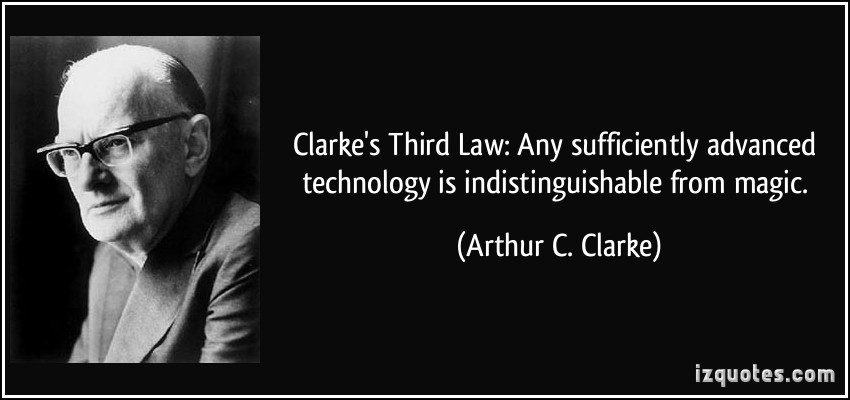
While there have been numerous ancient high-tech civilizations and contemporary cultures that use “science” (Krylites), none of them reached the advancements of the Althans or Ka’Ta’viir.(Tech Level 13+). Truly advanced technology can transcend common form factors and seem inscrutable to normal understanding. In other words, they will seem magical.

Here are a few advanced technologies that might be a good fit in your Shadow World game:

Post Physical Entities: This is a term often used to describe an “upload society” where consciousness can be transferred to a computer network, object or virtual emulator. Shadow World modules already features stored Ka’ta’viir intelligences (Cloudlords) and the Thalan are a good example of a post-physical entities (PPE’s). From a game standpoint, introducing an ancient Althan/Ka’ta’viir consciousness could be interesting. The entity would probably have their own agenda, limit information flow and perhaps “guide” the players to their own purpose. This could provide a useful guide for the GM to direct the PC’s through the adventure or tie multiple adventures into a greater campaign. Mechanically, PPE’s should be treated as an NPC, only limited by the ability to interact with the physical world. Additionally the PC’s may not even realize the “entity” is an uploaded consciousness or ancient being.

A.I.: Similar to Post Physical entities, A.I.’s are already featured in SW. Two prominent ones are the A.I. in Andraax’s tomb and Morik in Eidolan. Unlike PPE’s, A.I.’s are a technical/software artifact and may be limited by their learning ability, programming and information resources. Like PPE’s, A.I.’s should be treated as NPC’s.

Time Control: Ka’Ta’viir use a “Chronagenic” process to hibernate. Not to be confused with a cryogenic process; rather than freezing or preserving a person through physical or biological means the capsule seals the entity into a time singularity. It’s not clear whether the Althans had additional control over time (barring localized events). Jinteni also had some time dilation abilities (Emer III and Inn of the Green Gryphon). Time travel and control have always been tricky in RPG’s: a GM needs to decide the long term effects of causality and impact on the game narrative. There are three basic mechanisms for time manipulation: devices (machines & portals), spells (I’ve uploaded a Time Mastery spell list on the RM Forums  ) or Essaence effects (Essaence Storms and Foci). Time Travel introduces an introducing plot device to allow PC’s to explore other parts of the immense SW timeline. In fact, you could probably roll randomly for page, paragraph and line or 1-100,000 years to pick a date in the timeline to send the players. At the least, they could be spectators to interesting historical events and experience some of the intriguing past of Kulthea!

Matter/Energy Conversion: A truly advanced society will have mastered matter – energy conversion. This is more than simple fusion, it’s a two way process to generate power from any matter OR the ability to produce objects or material from energy. This probably has less game-world impact than other technologies but it does allow for devices to be powered indefinitely (by harvesting small amounts of matter for energy), self-repair of devices and vehicles or for generating objects “out of thin air” like a Wish spell.

Molecular Assembly: Before they have the ability of creating matter from energy, a post scarcity society will have obtained the ability to create any object from scratch using “feedstock” raw material. These Replicators or “Cornucopia Machines” are just highly advanced 3D printers. In Sci-fi and economic theory, such a machine would be a major societal disruptor allowing for the easy creation and accessibility of wealth. This technology was the basis for the post-scarcity society presented in Star Trek. In your SW game, this technology could be useful but not unbalancing on a limited basis—perhaps program/design access is prohibited except to authorized users (i.e. weapon mfg)

Mal-Metal: Malleable, changeable or programmable materials would be common in an advanced society. This allows for amorphous forms—wings that can change shape, weapons that can morph into others with a thought, adjustable cloaks, armor that can distribute impacts or force etc. This type of technology would be very useful to a PC and would be indistinguishable from common magic item tropes. Obvious examples would be morphing weapons (retain weight/mass but changes shape), fluid bracers that cover the arms as greaves at a thought etc. In SW, “Malloys” (malleable alloys) could combine advanced tech with materials like Keron, Eog or Ithloss.

Bionomics: A step past cyborg implants, Bionomics are organic based technological capabilities built into a person at the molecular and cellular level. These could be energy projections (disruptors, beams), shields (force fields or environmental shields), wetware computing power for advanced mental and calculative abilities. Unless they were born from a very specific parentage, installation of Bionomics would require substantial surgical procedures and DNA manipulation.  Bionomic abilities could be treated as innate spell abilities powered by a reservoir of cell energy (use CO. stat?).  In our campaign, Bionomic technology was a significant part of the Xiosian heritage.

Von Neumann Self Replicators: These machines combine the technologies of molecular assembly and matter/energy conversion to build copies of themselves. This is a powerful concept but might not have too much relevance in a gaming environment. However these could also work on a nano scale—“Nannite” clouds that replicate and perform programmed tasks (healing, buffs, metamorphis etc). Examples of “Nannites” might be found in upcoming SW material!

Solid State Technology: When we think of machines we often conflate it to devices with moving parts and collections of components. An advanced society will utilize microtization, exotic meta-materials and atomic level functionality to produce devices that work as machines but won’t have moving parts. To PC’s this will give machine or software functionality to solid objects–just like magic items.

Neural Control/Interface: The Ka’ta’viir were not only advanced technologically, they were able to utilize the Essaence AND access Psionic/Mind powers. At the height of their powers (Late Imperial Era) many devices were controlled through mere thought. In the game, neural interfaces should be treated as quasi-mentalism or accessed via “Attunement” skill (treat as Absurd or -150 due to the complexity of this technology or allow a PC to have some Althan heritage and reduce the penalty).

While primarily a fantasy setting, Shadow World also has elements of a post-apocalypse setting and a sci-fi setting. Maybe the PC’s will initially be unaware they are encountering technology and not magic but these elements could add flavor to your campaign!

This post currently has 9 responses


This post currently has 3 responses


Don’t It Make My Brown Eyes Blue

Rolemaster Logo

Imagine for a minute a player asks the perfectly reasonable question of “Can I remember what colour her eyes were?”

What I have always done in the past was ask for a skill check using the characters Memory stat bonus as the skill bonus.

When I moved from RM2 to RMC and the threshold for success went from 101+ to 111+ for most casual stat based tests success required an open ended roll. If that was reasonable 19 out of 20 trips to the shops for me would probably end in chaos and that could not be right. For me 1 in 10 trips to the shop ends up with me bringing home the right thing.

So I started thinking about these non-skill rolls. Not everything has a governing skill. Simple tests of memory, trying to catch a plate before it hits the floor or trying to lift a portcullis.

I have often thought that Stats in Rolemaster are largely irrelevant. Once you have rolled them you only ever use the Stat Bonus and never the stat. The exception is body development that uses 1/10th of the Con stat for base hits.

In eliminating the body development skill I have previously suggested using Con + 1/2 SD to find the Total Hits. That would give a starting character a typical 75 hits. That is more than the default starting hits under the RAW but that is not a bad thing. It gives starting characters a bit more longevity and is slightly more realistic than a starting character can take 18hits and a 10th level character can take 150hits. Why is the more experienced character so much more damage resistant?

I don’t use level so there will be no levelling up. I do use a RuneQuest style skill improvement. You roll higher than your current skill total and upon success you gain a skill rank.

I use a similar scheme for stat gains. During periods of rest & recovery you can roll against your stats. If you roll higher than your current stat then your stat increases by 1. You can only roll against stats that have been used. What that means in practice is if you used the Trickery skill you would put a small tick against the skill itself and against Pr and Qu. When it came to doing the tests for improvement then you could roll against those two stats and the one skill. This means that the skills you use tend to improve and the stats you are using tend to improve.

So going back to my simple memory test, to get a result of 111+ just to remember if your girlfriends eyes are Brown or Blue seems a bit of a tough call. That is a open ended roll for most people. If as a GM you wanted to put in a difficulty factor for recalling facts that character saw or heard weeks or months ago then the test becomes almost guaranteed failure pretty quickly.

What if we didn’t use the stat bonus but the actual stat? So Joe average has a memory of 50. What colour are his girlfriend’s eyes? Roll 111+  on 1d% OE +50. That pretty much gives a 60/40 chance of failure which in my experience seems pretty realistic, or is that just me?

So what about lifting a portcullis? Now with an average stat of 50 you, as GM, have scope to put a difficulty factor in there. Sheer Folly is a -50 so trying to lift a portcullis on your own would still require an open ended roll. That also seems realistic. If the character had the Athletic skill then by all means let him or her use it but you cannot make simple tests of strength dependent on such a skill. You cannot tell me that someone with a strength of 90 cannot lift something heavy without learning to play football first?

The final missing part of the puzzle is the racial differences. High Men are about the strongest commonly played race and they get a +10 strength bonus. Elves get a bonus to Memory. If you were to roll these Stat based tests as Stat + Racial Bonus then you would retain the flavour of the races.

Using this method what you get is more competent PCs, greater flexibility as a GM to challenge the characters and Stats gain greater importance beyond just a measure for finding the stat bonus.


This post currently has 8 responses


Nature vs. Nurture. The emphasis between Stats or Professions.

I really can’t get off my soap box regarding adopting a “No Profession” system. One of the arguments I often hear for professions and profession assigned skill costs is that early character development locks in affinities that define the characters learning patterns for life.

For me, this is a perfect example of the Nature vs Nurture paradigm. “Nature” being defined as a characters stats and stat bonuses (natural aptitudes) and “Nurture” being defined as early influential training. Rolemaster assumes the primacy of “Nurture”: early choice of a Profession sets skill costs that influence the characters progression and development. However the rules themselves allow that paradigm to be easily broken. For instance a player can choose “Fighter” as a profession but spend all his developments points on thieving skills. At what point or level does continuous training of thieving skills outweigh the early choice of the Fighter profession? Should that character even call themselves a fighter?

I am firmly in the camp of “Nature”—that learning is driven more by innate, natural abilities, but that intensive, immersive training can eventual overcome natural talent. Even a weak, clumsy person can become a competent fighter with enough training and dedication. So if innate ability (Nature) is more important, it argues for the elimination of profession based skill costs and thus professions in general.

Ideally, the best solution might be skill costs set by stats or stat bonuses. I.e. a character with high physical stats would have lower costs for physical skills etc. While this makes intuitive sense it would be cumbersome in practical application. However, if you like the “Nurture” argument, RM and RMU rules are already poised to model this reality with just a few tweaks.

We achieved this via the following:

  1. First there needs to be an increase in the influence of stat bonuses. In RM2, stat bonuses are really only influential at the first few levels and then begin to diminish quickly as the skill rank bonus increases. We adopted the RMU stat bonuses and 3 stat per skill calculation to increase the benefit of stats.
  2. We set all skills costs to 5*. That doesn’t mean that skills cost the same for everyone: the increase in stat bonuses means that the real measure is the acquisition cost/skill bonus ratio.
  3. We adjusted the skill rank bonus progression to 1, 2, 3, 4, 5….up to 10 and then it drops 1/rank back down to 1 again. This accomplishes several things—it increases the importance and influence of stat bonuses (by lowering skill bonuses) and reduces the benefit of picking up a handful of ranks in a skill to “max out” the rank bonus vs. acquisition cost. Plus, in general, this progression better models a natural learning curve.
  4. We introduced unlimited rank development. This allows a character to singularly focus on a skill to overcome innate limitations. But this comes at a high opportunity cost—each additional rank taken costs an additional 1DP/rank (this resets each level) so focusing on one or a handful of skills will allow a player to truly excel but at the cost of other skill development.

For our gaming group the application of three elements allows for fast character creation, flexible characters and a more intuitive modeling of character development in the Nature v. Nurture framework.


  1. Cultural Skill packages (Nurture) to reflect early development and culturally appropriate knowledge.  This is non-stat influenced as it is skill transmission driven by society and culture.
  2. Vocational Skill Package (Nurture) to reflect young adult vocation, job or trade. This is non-stat influenced as it represents an early “career” decision, availability of vocations in a specific culture or the imperative of cultural norms (ie everyone must join the military).
  3. (Nature) Uniform skill costs, influential stat bonuses and unlimited rank development to give players maximum flexibility and cost/benefit decision making. This is stat dependent as detailed above.

For those that like Professions, this still allows the creation of creative, emulative or societal driven Cultural or Vocational training packages. Our Shadow World campaign has over 40 Cultural Packages and 50 Vocational Packages that can be combined to make thousands of interesting characters without the arbitrary dictums of Professional names or concepts.

Just my two cents—what’s yours?

This post currently has 9 responses


More thoughts on “Level-less” Rolemaster.

Rolemaster is inherently a skill-based system but it has clung to some of the established level mechanisms of D&D by reverting them into skills. Peter had a great blog on making hit points independent of skill. I’m really embracing this idea now–and it gets rid of Body Development skill which is a plus in my endless efforts to reduce skill bloat. (We’ve shifted the other aspects of Body Development  into our meta-skill “Athletics”).

So I’m still struggling with disconnecting RR’s from character level. We use “Spell attack level = PP’s” which makes a lot of sense to me, but could be unbalancing if characters didn’t have a better chance of saving as they progress. Or is it unbalancing? Here are some scattered thoughts in no real order:

  1. Set all RR’s to a base of 50/50 success. The threshold is adjusted by the “attack level” of the spell/poison/disease/effect etc. So a PC resisting a 50th lvl spell would need to roll above 100—but would still have their stat bonus and any other spell buffs. A RR vs a 10th lvl poison would need to roll above a 60 etc.
  2. Magic is powerful and should be difficult to resist. However, using this system, a lower level caster who dedicates enough PP’s could affect a 50th lvl character. Is this unbalancing? Higher level characters should have substantially better protection in both items and spells.
  3. While this may increase the potency of spell casting, our own character law system results in casters having fewer, more individualized spells. Under normal RM rules this system might greatly enhance spell-casters.
  4. More buffs. I’ve always felt that the protection spells in RM were fairly weak, something we have tried to correct in our Spell Law re-write. If protection spells were increased in than this might offset the bump in potency in spell casting?
  5. I’m trying hard to get almost every action resolution into the standard RM 1-100 resolution process. The idea proposed in #1 above doesn’t quite work within that frame. RMU tries this with spellcasting by incorporating +100 into the SCR which I find cumbersome. Perhaps, like weapon attacks, I’ll have to let this be just slightly different.
  6. I’ve seen some proposals to get rid of levels to determine RR and to introduce “resistance skills”: skills that give bonuses against Essence, Channeling, Mentalism. That leads down a whole complicated path on spell mechanics, training etc–anybody try this?

Resistance Rolls seem like the last vestiges of a level based system; one that I would like to eliminate. Open to any ideas.

This post currently has 3 responses


Weekend Library

Greetings all and welcome to my new column: Weekend Library.  I read quite a bit so I thought I would offer up a list of books that might be a little obscure but worth checking out for great game or campaign ideas for your Rolemaster, Shadow World or fantasy setting.

The Mechanical (3 book series). Interesting take on Clockwork men and alchemy. I got some ideas to update my adventure “The Lair of Ozymandias”.

Six of Crows. A grittier version of “Lies of Locke Lamora”. Good characters and ideas for a urban “Sting/Heist” campaign.

The Face Fakers Game. The writing is a bit inconsistent, but an interesting system of magic that gave me a few ideas.

The Copper Promise. A throwback to the early D&D style adventures. Fun but a straight forward translation of game to store.

The Dungeonneers. Witty and fun quick read. However, it’s interesting because it acknowledges all the traditional dungeon tropes and tackles them head on via a group of Dwarven adventurers.

Free the Darkness. What type of game would you have with a character that was good at EVERYTHING?

Mountain of Daggers. Very old school (Howard or Leiber). Short stories of a famed thief.

Low Town. Great urban low-magic fantasy.


This post currently has no responses


Solo Roleplay Part III

So this time I am going to show you how you actually do ‘solo roleplay’. I am going to use the Mythic GM Emulator although it is not my favourite. There is an online version here.

So here is an opening scene for you. Take you favourite character, in your favourite setting and right now they are in a copse of trees over looking a ruined and abandoned manor house. It is dark, the moon has risen but is hidden by a thick layer of cloud. An owl hoots near by. Somewhere in that house is rumoured to be the blood stone. An artefact in the form of a worn and rounded granite rock the size of your fist that bears the thumbprint of one of the gods. If the legends are true placing the blood stone on the chest of a deceased person will return them to life for seven days.

So that is our plot, opening scene and character. One a piece of note paper jot down any NPCs from the characters past that may have a bearing, past villains that are still around, other adventurers they know if in the region or anyone else that could possibly crop up. Also make a short list of any ongoing story arcs that could come up again. These are the start of your thread list. The top of that list should of course be trying to find this blood stone.

So if you were playing this in a conventional game you would probably ask about lay of the land, maybe available cover, approaches and so on. There is no need to ask any of those, just make it up. It is a ruined manor so chances are it does have a drive way or road in some disrepair leading up to it. It probably has out buildings. Your setting will give you most of these answers. If this is Pern then there could be a ruins of the dragon culture. If nobility travel by carriage then there is probably going to be stables and a carriage shed. You decide. The first question we are really interested in is what can you see and what can you hear. Asking the question “Can I see any light down there?” is the perfect Yes/No format question for this style of play. First of all you make your perception roll. Use all the regular Rolemaster modifiers. Looking for lights on such a dark night is pretty easy as they stand out. If you fail the skill check then it is irrelevant if there is light to be seen or not as you didn’t see it. If you made the check then if there was a light then you saw it. So we need to know the answer. Turning to the mythic engine we need to decide how likely the answer is to be yes. I think the answer is unlikely. The stone is not being held by something as simple as a local bandit or such. If it was that simple it would have been recovered centuries ago. Of course your answer could be different, it is down to the sort of game you want and the world you are in. So my question looks like this in the GME (GM Emulator).

You can ignore Chaos for now. Click the Ask a Question button and you will get an answer. So in this case even if you made your perception roll there was no light to be seen.

Our adventure continues with the here doing any other investigations he or she thinks of and slowly approaching the house. Maybe you have been making stalking rolls to approach quietly, maybe you rode up the drive on your mount. That is entirely up to you. My character has circled to the rear of the ruins quietly and is looking in through a gaping window opening trying to see if there are any signs of recent habitation. This time the perception roll was made and I got this answer.

An extreme no means not only no there is no sign of recent habitation but as definite as you can be that there was no recent habitation. I would say that even the floor in this room has collapsed down into the cellar below, the ceilings have gone and the beams that held it up lying scattered across the yawning hole in the floor.

My character out of interest in this example is Silas a 5th level Illusionist.

Maybe you want to check in more of the ground floor rooms first? So we sneak around a bit, making a few more skill checks, perception rolls and so on. Eventually you make your want into the ruins and a successful perception check about hearing any movement in the house forces the question and gets this response.

So the answer is no, you cannot here any movement but we have an event. The focus ‘move away from a thread’ means things just got more difficult for the character. If this adventure is the only one on your threads list then the result applies to this adventure. If there are several threads on the list then roll randomly to see which thread it applies to. The meaning  is often cryptic. I am going to assume that this is the only plot on the thread list so this applies to this thread. Things are about to get more difficult. Recruit wounds could mean that Silas is about to get hurt. My first thought is that the floor may give way, it is an old house and we have already seen one collapsed floor. As the floorboards crumble and disintegrate under his feet Silas attempts and fails and acrobatics roll and ends up on his back in the cellar looking up at the clouds as leaves, broken bits of rotting wood and dust rain down on him. I roll the normal falling damage and luckily he takes just a couple of hits and no critical.

I am going to end the first scene there and start a new scene. The reason is that the first approach and investigation was all about stealth and caution. After the fall, stealth has somewhat gone out of the window. Think of it in cinematic terms. We would certainly had the director shout “Cut!” immediately after the fall and the next shot would be down in the cellar. I like to start and end my scenes when the director would shout “Action!” and “Cut!”.

At the end of each scene ask your self is the character in control of the situation? If the answer is yes then reduce the Chaos by 1. If the answer is no then increase it by 1. Silas is not in control so from the starting point of 5 the Chaos is now 6 for future questions. We can also use the GME to evaluate this new scene.

You can see the new Chaos level of 6. The Scene resolution says that the scene has be altered. This means that what you may have been expecting is not what actually happened. I was expecting a store room or wine cellar but that is not what we now have. The GME also says NPC action. Someone else has caused this altered scene and finally we Adversity dispute. The first thing that comes into my head here is that someone caused that floor to give way and it plies that someone else is also trying to get this stone. From Silas’s prone vantage point, looking up he can actually see that the joists of the floor above have been sawn through. Some one did this on purpose. Looking around he can see that the cellar has been cleared somewhat and there are signs that this has been used as a resting place. There is a bed roll over their and some cooking pots in the corner. We also add the unknown NPC to the NPC list.

Starting at the bottom of the manor house and working up is just as good as starting at the top and working down. There is a doorway out of here into a second cellar chamber. It is extremely dark so that question comes up again about can we see any light, torches, lanterns, that sort of thing. A successful perception roll is made and the GME is asked the question. This time the answer came up as a Yes. Logically if there was an NPC or monster in the next room then they would have already reacted to Silas coming though the ceiling so the light has to be reflected light from somewhere. I decide that in that next chamber are is the surface evidence of an excavation. Someone is digging some sort of tunnel or shaft. There is light playing on the ceiling from a torch or lantern down below the ground.

I am going to stop here. I hope you can see how you can build the story up. If you go with your first instinct when you see these cryptic hints from the GM Emulator and what they could mean. The setting and surroundings are what you would expect from the scene you are setting. The results of the Emulator, the altered or interrupted scenes can force you to add twists to the story. If Silas were to hear the NPC talking to themselves down the shaft that could beg the questions are they male? Are they human? Can I understand the language? A yes or no there will relate back tot he character and the languages they know. It could add a political twist to this adventure. If Silas were to cast Long Ear I (Essence’s Perceptions 5th level) what can he learn about the NPC from their mutterings?

Solo roleplay like this can be great for creating adventures, you play it solo, let the GME take you through all sorts of twists and turns. Keep notes and then put your players through it. It is great for creating interesting back stories for your PCs. How they earned that first 10,000 exp.

Imagine your GM wants to run a political campaign set in an Arabian setting. You will be starting at 3rd level. You want to play a mystic. Do some solo plays at first, second and third level in this setting with typical Arabian nights type plots and see what spells/lists you actually want or end up using.

There is of course one more use for solo play. My wife likes to watch shows like Strictly, The Voice and this new Let it Shine which I cannot bear. With solo play and an online GM emulator I can pick up a solo adventure as and when I want to. Over time you pick up a rich list of NPCs and interweaving threads. You can play game systems that your normal group cannot all agree on and otherwise sit idle on your shelf. I bought myself HARP at Christmas 2015 and it is never been played  as our group are die hard RM players but with Solo play I have been on several adventures and got to know the rules.

Solo play cannot replace proper face to face play amongst friends but then PBP doesn’t replace that either. Solo play is just another aspect of our hobby that can be used by any player or GM. It is hard at first to know what you can just decide and what you should ask the GME. You don’t want to turn the game into 20 questions and you don’t want to ask world breaking questions either. ‘Does my God strike down the infidels?’ is a perfectly valid question but it is highly unlikely and the chances of an exceptional NO answer are quite high. What is the worst possible thing that can happen if you are hoping for a divine intervention to save you? There is a fair chance it involves a gate and a couple of Pale Vs.

If you have any questions about Solo play then ask below in the comments.

This post currently has no responses