What would my perfect Spell Law look like? Pt I – A Non Channeling Druid

I am still thinking aboutChenneling magic. As far as I am concerned it is just the channeling realm that causes the problems in Rolemaster. It simply has too many D&D hangups. The idea that healing is the domain of clerics, platemailed paladins and dependence of gods or deities are just things we all grew up with if you started playing in the D&D world. So as a start I thought about the Druid. This is a typical channeling profession. Where would a non channeling Druid fit?

Essence of Mentalism?

Looking at the spell lists in Companion 1 about 80% of all the Druids base spells fall into two schools of magic, Force and Mental. The remained are Healing, Information and a few Phantasms & Illusion. So at first glance Mentalism seems the way to go.

Force Magic

Let us have a look at what the Druid is doing with Force magic and see if that could swing the balance into the Essence realm. The only Force spell on the Animal Mastery list is Animal Summons and that requires concentration. I think that still implies mentalism.

The second Druid Base List is Druids Peace and every single spell on it is a Mental spell until you get to 30th level when you get EARTH CALM (F) Within the radius, caster may “calm” a natural phenomena (quakes, storms, winds, etc) or he may cancel a magically created natural phenomena. Now that does sound a bit elemental but then by the time you get to 30th level you should expect all spell casters to be throwing around some powerful magic.

The third list is Druid Staff. This is one of those enchant your own weapon type lists and the weapon is bound to the caster. Every spell on this list is a Force spell except for three (one utility spell and 2 defensive). In these cases the magic is self only and and requires concentration. I think this still leans towards mentalism.

Natures Forms is the fourth Druid list and just like nearly all mentalism spells the area of effect is self only. All the spells on the list are Force spells bar two that are Phantasms as the druid can mask his own thoughts. This again feels like a mentalsm list.

The fifth list is Stone Mastery and this at first glance looks the most Essence like. There are three Elemental spells in the form of Stone Wall, Curved Stone Wall and Stone Spike. The rest are Force Spells. So what is going on in this list. Well the Druid can speak to animate stones (not particularly useful!). Can throw stones in a similar way to the mentalism Hurling and telekinesis. The rest of the spells involve shaping and animating stone. This list could sit in either realm equally naturally I think.

The final base list for Druids is Plant Mastery and is another Force spell list. The ranges are most touch or self and enable the cast to communicate with plants, heal plants and control their growth. He or she can also create paths though vagetation and animate or activate plants and sentient trees. This is in my opinion another list that sort of sits on the fence between menalism and essence.

The overal balance though is that Druids should be in the mentalism realm rather than essence and there is nothing in here that implies there is any need for a deities involvement. There is no communing, no divination and no cross planes summoning going on here.

Anyone could easily play a non channeling Druid using the no profession and mentalism spell lists and casting restrictions as they now stand.


This post currently has no responses


Weekend Roundup: October 8th, 2016

imgres

Cool treasure at Sutton Hoo. A helm worthy of an RPG.

IT’s spreading and being TALKED ABOUT

So call the FBI and ask for the “Clown Division”.

Art imitating life?

Lord of the Rings?

F#@%ing Elves!

I never turn away from a story regarding GNOSTICISM.

Have you ever cleaned out some old storage and found the “Blast From the Past” RGP adventure?

My go to resource for RPG ships.

Mapping resource. Any good?

RPG Brand Management. How about I.C.E.?

Tombs, traps, creatures and temples! The Lost Shrine of Tamaochan!

Spell list for a Cleric of the God of Needlework!


This post currently has 11 responses


What would my perfect Spell Law look like? Pt I Channeling

I am rather jealous of Brian’s reworked Spell Law. He and his group have obviously but hundreds of hours into that rebuild project. That is time I do not have at present but I am giving this more and more thought. So what would my perfect spell law look like?

Essaence as the motive force

This is one of Brian’s ideas and sums up the concept that all magic is Essence and that what changes is the way that the character taps into the essaence. Essence users manipulate the essaence around them, mentalists control their own essaence and channelers recieve essaence from some outside entity. I like this idea and want to go with it. I do have a problem with Channeling magic though. That is the realm that doesn’t work for me.

Channeling doesn’t work

The problem with channeling is that it seems to be tied into the natural world. This is where you find animists, druids and shamen as well as your clerics. If your nature magic casters are getting their essaence from nature around them are they really not essence casters? Can you have channeling without the gods?

Brian pointed out an issue with Shadow World’s gods in that if there is only one god relating to spirits, souls and the dead can any other clerics cast life giving spells?

Channeling and Armour

Mechanically Rolemaster had an issue with channelers not being able to cast magic in metal armour but the fantasy roleplaying commmunity all want their Paladins in platemail. The Rolemaster solution is to add more rules to bend the existing rules, in this case Transcend Armour as a skill.

Channeling Healers are a bit crap

Channeling Healers are a bit crap. The problem is that there is at least one open channeling list relating to healing (concussion ways), most of the closed channeling lists are related to healing and all their base lists are related to healing. They really are the stereotypical one trick pony. If you want to do anything else with your character you are pretty limited. You cannot afford to get stuck into the action as the party need you  alive at the end of the fight to put them back together so fighting is out and your other magic is rather limited. So what do you do?

So what purpose does channeling serve?

Channeling is the preserve of most of the healing magic and nature magic and bizarely necromancy. Does that need an entire realm of its own? If you bumped the healing into Mentalism and the necromancy into Essence (most people think of Necormancers as mages not dodgy clerics I think) all you are left with is the nature magic. Using the definitions above of Essence using the magic from around the caster and Mentalism using the casters own Essaence then it feels like the nature magic should be in the Essence realm. The rest of the channeling open and closed lists are just duplicates of the essence and mentalism open and closed lists so they could be dumped.

So my perfect Spell Law would have no Channeling realm at all.

What about traditionally channeling professions? Well I would make Paladins mentism users. That is where the healing spells mostly live and ever realm has the basic detection spells for detecting evil. It is a 7th level Essence spell but a 6th level Mentalism spell so even the existing lists suggest that mentalism should be the Paladin’s natural home. I would put clerics in the same pot as the paladins.  Animists and Shamen should be essence users. They can still get their nature magic but their open lists would actually be a bit more powerful. The channeling healer you can simply drop in favour of the Lay Healer.

This post currently has 8 responses


“NO PROFESSIONS” = All Professions

Jordan Tate: You’re not a cook.
Casey Ryback: Yeah, well… I also cook

I have had a handful of email conversations going on with other RM players about our “No Profession” ruleset and one of the first assumptions that people make is that our PC’s (or NPC’s) are just called “No Profession” or “Layman” or really nothing at all.

As I have discussed in other Rolemaster Forum postings, Professions/Classes do act as a short-hand to summarize a characters skill-sets, aptitudes and general abilities. In that regard, eliminating Professions does create some problems or more work when creating NPC’s. Since we’ve thrown away Professions, we’ve generally thrown away the working template for quickly creating NPC’s and assigning skill abilities.

However, while we’ve thrown away the profession mechanism, we haven’t discarded the professional names. In our rule-set “Professions” are more tags—driven by 2 factors: the skill sets developed by the player and/or the social conventions of the setting. For instance, a player that develops the majority of their skills in armor & weapons will still call themselves fighters. As a counter-example, in RM a PC that chooses the Fighter profession but chooses to dedicate all of their DP’s into thieving/subterfuge is still called a “Fighter”. From a societal/setting standpoint a Fighter may be called a “Warrior”, “knight”, “Barbarian”, “Janissary”, “Armsman” etc. This is no different than a lawyer in our world; some societies call them barristers, counselors or consults. Players can build their character and apply any name/descriptor they want, or based on their background/training or organization ties might be assigned a professional name/tag.

In Shadow World there is already some gray areas around professions using the RM2 rule-set. Navigators and Loremasters could be considered stand-alone Professions, each with their own Base Lists, but in actuality are assigned standard professions giving them 2 sets of Base Lists. Issues around the Unlife, access to evil spells, hybrid magic, power point sources/pools, further complicate things. (this topic was discussed in my blog post about the “gap” between rule sets and dedicated settings).

Our transition to “No Profession” was gradual. First, like many others, we kept designing new professions (with associated spell lists) to meet player wants and needs or to fit into a particular setting. Basically the “RM Companion” approach. At a certain point we realized that small skill cost differentiators meant very, very little past the first few levels and became meaningless at higher levels when skill rank bonuses were minimized. In an effort to maintain “balance” we moved to a archetype template: Non, Pure, Semi but still keeping Realm assignments. (A Pure Essence archetype could pick between elemental spells, illusion spells etc and label themselves a “Mage”, “Illusionist” or whatever fit their character image or setting. After we tried that we realized we had one foot in the old ways and one foot into a better, flexible approach. I realized that using skill costs and other “free market” approaches, character generation would be a process of choices and opportunity costs that would enforce character balance without the need for lots of rules or arbitrary skill cost assignments. (Rules for Rules) Characters can’t be great fighters and great magic users—the fall somewhere in the middle (ie Semi).

So, in short, our campaign and rules have ALL the professions, not NONE of them. A character that focuses on farming skills is a farmer. A character that focuses on the Fire Law magic is a FireMage, Wizard, Mage, Elementalist etc. A character that develops subterfuge and poison might call themselves an assassin or a nightblade. A member of the Loremasters is a Loremaster. A cleric of Z’taar is a Battle-Priest. A character with certain mentalism spells in Itanis is called a Warlock.

It’s not for everyone, but it works for us.


This post currently has 3 responses


Does Low Fantasy Gaming work with Rolemaster?

I have stolen this idea from Brian’s weekend round up. I think the answer is an emphatic yes to Low Fantasy; especially RM2/RMC when played with the core rules and no options.

Why core only? The first one is magic. The actual base ruling on spell list acquisition is in RM2 and RMC is D100 + ranks in the list. Roll 101+and you learn the list. You can learn only one list at a time unless you buy 20 ranks in the first list and then start to learn a second. If you fail to learn a list you can carry those ranks over to the next level and continue learning that list or you can lose all those ranks and try and learn a different list. You will note that there are no bonuses to that spell list acquisition roll, no level bonuses, no stat bonuses.

Building a character that way you tend to end up with maybe 4 spell lists every 5 levels, sometimes slightly less. As most essence spell casters want to be able to fly and go invisible and cast sleep this means that a magician may have just one of their base lists by 5th level, maybe two by 10th level.

The problem with learning lots of Magician base lists is that you need to learn lots of Directed Spells skills to make use of the bolts and the natural development point economy means that you simply cannot afford to diversify like that.

If Low Fantasy is meant to be scarce then making spell lists hard to learn makes spell casters less attractive to the players. If there is a very real chance that your first level character is going to start the game with just 1 first level spell you are going to make the average RM player uncomfortable.

With just the core rules there is no undercasting and no overcasting so they are really stuck with just that one spell.

So pure Rolemaster played RAW (rules as written) fits the magic specification for Low Fantasy.

Fast and Engaging Combat

There is no more engaging combat system than Rolemaster with its descriptive criticals and deadly edge. I personally prefer the Combat Companion version but I have said this is core RM only. Without all the bells and whistles bolted on to combat by many of the companion books rolemaster combat is pretty fast. When I used to use Arms Law I would print the page from the PDF of the weapon used by an NPC and of the PCs and put them in a folder with the most common critical chart facing it. In essence what I had was just the pages of Arms Law I needed for that session. It cut down the rules look ups and page turning.

Rules Light

Without all the companions Rolemaster is not that rules heavy. It has a reputation for being a mammoth but it is really undeserved.

Once you simply know that a skill roll total of 101+ (plus any difficulty mod) equals success you can play for hours without having to look at a single rulebook. Without the companions there are are only something like 50 secondary skills. That is enough to differentiate the characters without bogging the game down.

I have condensed the entire rules down to just 12 pages for running a weekend of gaming.

A Realistic World

Rolemaster does realistic mediaval worlds very well. If anything it is less monster driven than many RPGs including D&D and Pathfinder. If you want to poison someone in RM you do get to choose what type of poison and that describes the effect. This is not a game of make your saving throw or take x points of damage. Poisons are very realistically handled for a game.

Falls are not 1d6 per 10′ fallen. We have an attack table that takes into account velocity and criticals that are in tune with having fallen. This does not add to complexity as it is still jsut roll a d100 + the distance fallen in feet and look up the result but it is a lot more realistic than 1d6 per 10′.

The list can go on. Almost every natural hazard has been given a realistic work over in Rolemaster. So this is another tick in the RM box regarding Low Fantasy.

Rolemaster is also setting neutral

The Low Fantasy that the article points to says it is setting independent. Rolemaster is also setting neutral. Shadow World is the offical world setting but there are no setting specific rules in the rulebooks tying it that setting. It actually works the other way around with the Shadow World books referring to Rolemaster materials not the Rolemaster books referring to Shadow World.

So yes RM is most definitely capable of Low Fantasy judging by the definition above. Just leave all your companions and add on Laws at home.

This post currently has 18 responses


Weekend Roundup: October 1, 2016

imgres

Science behind the “Bardic Tradition”.

Science or Magic?

Nietzsche’s “Beyond Good and Evil”?

Gods of Old, Gods of New.

Any spell list ideas here? You betcha!

How about ordering some effects for the game table or Peter’s haunted mansion adventure?

Not all loot glitters like gold!

Sweet jesus—that’s a clown photo!

…but clowns aren’t a laughing matter!

Does Low Fantasy Gaming work with Rolemaster?

Anybody watch this on Netflix?


This post currently has one response


Rolemaster Ghosts

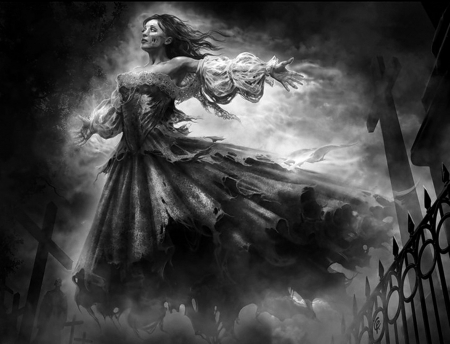
In the next session I will be throwing 5 3rd level PCs at a few 3rd level Rolemaster ghosts. The undead do not drain levels like they did in D&D back in my day. Rolemaster Ghosts drain constitution from your Temp stat which you need to rest to recover at a rate of a point a day of light activity or more for complete bed rest. This is a lot less devastating than losing entire levels

The objective of the confrontation is to try and bring the characters low by using a massively underpowered foe. It is sort of my chance to play something to the maximum of its ability and not have to hold back and just see how they all cope.

Rolemaster Ghosts look like living beings at first glance

The ghosts earthly remains.

Using the ghost also means that I can justify all the bump in the night style of scary stuff without having to ‘break the rules’. Also in the Sinister Secret module there are a number of NPCs who are placed there to try and dupe the PCs and try and steer them away from discovering the smugglers. I don’t have the smugglers but I can replace the NPCs with ghosts and now they want to steer the PCs away from disturbing the ghosts earthly remains.

To my knowledge the players have never met a ghost before so it is one of those monsters that the rules lawyer in the party will not know exactly how to handle once they have even identified them as a ghost. You must remember that Rolemaster Ghosts appear like living beings at first glance.

Lack of skills

In the past I have mentioned that one of my players has focused all hist development points into Perception, Body Dev, Weapons and Magic and nothing else. This adventure is the one where he will need a wide range of skills. I want to emphasise his lack of skills beyond combat. Looking back at Brian’s Consolidating Skills post this character is a warrior mage but lacks any of the magical skills that would allow him to identify the ghostly apparition. The ghost being incorpreal can walk through walls and doors but the character cannot pick locks.

The ghost can definitely effect the physical world as its primary attack is a medium claw attack so it can leave a room by walking through the door and then lock it from the outside without trouble. If can unlock a door and let the zombie hordes in from the outside if the characters take refuge inside the house. If can of course slam doors and throw open windows in best hammer horror style.

Not a hack and slash event

Going by the NPC roster in Sinister Secret I have 6 figures I can turn into ghosts if I wanted. In addition I am surrrounding the house with a graveyard that I can raise as zombies. I don’t want this to turn into a hack and slash event but I can use the zombies to push the characters into the house if need be.

I am quite looking forward to using a monster I have never used before and one that lets me achieve everything I want from a session.


This post currently has 3 responses


Prepping for The Sinister Secret of Saltmarsh

Following Brian’s suggestion I have taken the haunted house from The Sinister Secret of Saltmarsh as the basis of my haunted house. We are going to play this on the 16th so it is time to finalise my prep.

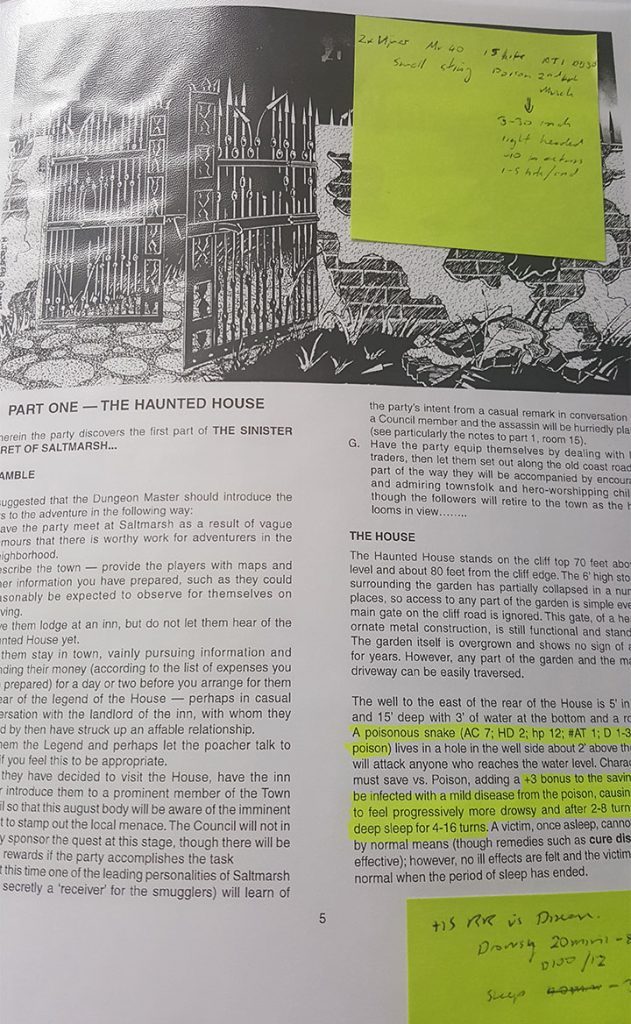
You can see, but probably not read my hand writing, that I am doing my usual sprinkling of post-it notes.

The Sinister Secret of Saltmarsh
A highlighted page from the module

Noting the Encounters

The top post-it has just enough details for me to run an encounter with the snake(s). The original module had just a single poisonous snake at this point but I have swapped that out and made it a pair of vipers.  The note reads 2x Vipers and then just enough details from Creatures and Treasures, the level, Mv, hits, AT, DB and OB etc. The block handing down below are the details of the poison taken from Character Law about the type and effect of the poison.

In this way I have saved myself two book look ups just by copying the core details onto the page. From a prepping point of view it takes very little time to write out just a single note so I can do a page or two each time I take a tea break.

Keeping track of Experience

The other thing that is popular is the game journal. We play so infrequently that the chances of remembering every step or clue in the game from one session to the next is almost nil. By taking my post-its off the page when they are finished with, the combat done or the NPC encountered. I can move them to where I keep my journal notes. I also use that for experience; so the details of the fight or however the vipers in this case were circumvented goes with the note into the journal.

As I am converting from one system to another there are a lot of changes to make to a bought module such as this but no more than if I was writing an adventure myself. The point is that I cam looking up the rules that will be called into play now rather than at the gaming table.

What to convert?

The sort of things I have noting are:

  • Converting D&D Potions into Rolemaster Herbs where possible.
  • Converting Monsters over to Rolemaster creatures if they exist, if not I am doing a manual conversion.
  • Creating NPCs as RM characters.
  • Checking and inserting the rules for poisons, diseases and traps.
  • Setting difficulty factors for traps, locks and manoeuvres.
  • Converting money from D&D to the Rolemaster decimal system.

Funnily enough it is the conversion of the magical items into RM herbs or into RM spell effects that makes the biggest difference to the feel of the game. D&D just does not have the herb culture and being able to smoothly integrate the herbs into the setting where they did not exist before works well. Conversely Rolemaster does not have a potion culture like D&D so by toning the use of poisons down helps.

In the current adventure there is a ring of protection +1 to be had fairly easily. We all know these from our D&D backgrounds but again they are not a Rolemaster ‘thing’. In the game as it will be played it will be a Ring (Daily III item casting Blur). They are not exactly the same but the trade off is that the ring of protection is a constant effect item that would give +5DB but I am giving away a +10DB but can only be used three times a day for short periods.

It is little tweaks like this that make the module feel like it is native Rolemaster rather than converted D&D.

It is the potted rule lookups on the page where they are needed that save time at the table.

The monster stats on the page with any special rules to run them that helps speed up combat. As I have said before for NPCs I note down the general plan for the first three rounds of combat and if or not they would try to escape and how.

Keeping it Sinister

Finally I have one other type of post-it on these pages. I am using them to remind me to lay on the atmosphere. This is meant to be a haunted house. With all the ideas I have to use from the 100 Creepy things books (http://www.rolemasterblog.com/azukail-games-100-creepy-things-events-encounter-outdoors/ ) I want to lay on the spooky effects. This is not intended to be a dungeon crawl and these little reminders are there to reinforce that point.

This post currently has 4 responses


Weekend Roundup: September 25 2016

images

I stand corrected on a previous news item.

Are these the Yinka/Y’kin?

Changramai Warrioress? Followers of Inis? Female Warrior Monks Kick Ass.

Iuraic has no words for empathy.

20 ranks in Rolemaster Herb Lore?

What are the Kulthean Dark Gods up to?

Now that’s an Essaence Storm!

Nature, nurture, skill bonus, stat bonus, talents, professions…the DEBATE is endless.

Shadow World Chegains are now the new Cool.

Real life cool treasure. Ancient craftsmanship. Here, here and here and last…here.


This post currently has no responses


Demons and Devils – 5ex5

Asmodius the Demon Prince

I have had an incredibly busy week, so much so that I missed blogging on Monday completely! What I should have been doing is working on the D&D 5th Edition conversion to a D100 system. I am doing this conversion very much with a Rolemaster hat on and it is interesting to see what D&D has that Rolemaster doesn’t and what it does very differently.  One of those are the Demons and Devils.

Demon Princes

You can tell I am working on the Monster Manual right now can’t you. Demons are a classic fantasy monster and we have our own rolemaster demons with our type 1 to 5 pales and so on. When you compare that to the D&D world you get an entire ecology of abominations to play with from relatively weak monsters to named demon princes. I had forgotten just how many of these there actually were in the core D&D books.

Asmodius the Demon Prince

Crusading Knights

I think that D&D had its origins in a fairly real world concept. You can almost see the fighter class being cast as a crusading knight. As soon as you take a step in that Christian direction then demons and devils are nature enemies to be defeated.

Rolemaster has a strong Tolkien heritage

Rolemaster on the other hand has a strong Tolkien heritage and in that setting there are certainly no devils but the Balrog certainly seems demonic even if they are of the maiar. Once you step away from middle earth then that demonic niche needs filling. I think the developers gave us elven demons and human demons to fill the gap. Seeing as Middle Earth had no devils then Rolemaster has no devils.

I think it is interesting that in 30+ years I have never felt the need to reintroduce devils back into the monsterous ecology of my game world which is in fact their natural environment of Faerun.

This post currently has 7 responses