Essaence Barriers in Shadow World

I’ve written a few blogs referencing Essaence Flows and Barriers over the years, but my current writing has me circling back to the subject. I’m not sure what our readership is here now, but I thought I would throw it out.

The issue. Excluding the inception of the Great Barrier, when did Essaence Flows begin to manifest into physical barriers on Kulthea?

While I still suspect that many SW groups don’t use Essaence Flow barriers as originally devised and envisioned by Terry, they are part of the setting and would necessarily direct societal interaction, commerce and trade. So when did they become “a thing”?

Essaence was detected on Kulthea during the 1st Era and was present during the technological evolution of the Althans and the rise of the Essaence Users, the Ka’ta’viir. So while the Essaence permeated Kulthea, it couldn’t have to the extent that it does in the current Era. We know the Essaence interferes with standard tech and the presence of invisible energy walls and even Flow Storms would have had an impact on the Althans. There is no indication of Essaence working like that in the 1st Era. That leaves us with a few basic conclusions:

  1. Essaence energy became more ubiquitous and powerful after the end of the 1st Era.
  2. While this coincides with the placement of the Northern and Southern Eyes, it could also be the result of time. The Interregnum lasted 100,000 years, so perhaps the Essaence was always growing and expanding on Kulthea.
  3. Alternatively, something about the installation of the Eyes and the creation of the Great Barrier created offshoots: smaller, less powerful, and perhaps temporary versions of the Great Barrier that ebb and flow around the hemisphere.
  4. Counter intuitively, weren’t the Eyes meant to stabilize the Essaence? You would think that Essaence would be more consistent and less volatile with the Eyes, but for a many reasons that seems the opposite.
  5. Another theory might be that the wars and cataclysms at the end of the 1st Era, damaged the Essaence permeation into the universe. The Essaence was out of control and the Eyes calmed it down, but not to the degree of pre-interregnum. So all of these could be partially true.

Is this academic? Perhaps not. While I’m working out the ontology of magic using, it’s equally important to define the what/how of the Essaence over time. Simply put, if the Essaence ebbs and flows, so to perhaps the power and scope of spells. That would dictate spell design for early primal magic, arcane magic and the contemporary magic realms.

Anyone have any thoughts?
Winter Thoughts, Random Musings and Updates

First off, Happy New Year to all! Last year was fairly active for ICE and the finalization of the RMU product line. This blog has been fairly slow the last few years as the conversations have shifted to new platforms like Discord, but I still prefer the more deliberative blog format to memorialize work or organize my thoughts.

In that spirit I thought I would post up some random musings!

  1. Where have I been? With all he noise around RMU I decided to step back and let that process run it’s course. Instead I focused on writing AND I’ve been able to reconstitute a playing group to start testing new ideas, adventures and Shadow World in general. Having a semi-regular game creates a fantastic feedback loop that also drives my writing and new content. My players know and understand that their might be significant changes to the game rules, spells and even the adventure path from session to session so I can “move fast and break things” for faster game testing.
  2. Nomikos Library. A longstanding goal was to get Matt’s “Nomikos Library” back up and running. Not only has Matt got it back up and running, it’s now AI enabled to add functionality with more features forthcoming. I think this is a fantastic tool for the setting.
  3. Terms of Art. I’ve written about this before, but I’m constantly thinking about our word usage in Rolemaster. Specifically, whether it makes sense to mechanistically define words for the ruleset or to use them interchangeably. An example would be “illusions”, “glamours” “mirage”, “visions” “phantasm” or “summoning” vs “calling”. FRPG’s will often use these terms loosely, or as just spell name differentiators among casters. To some extent this has been done, and perhaps it’s moved further along with RMU, but it’s not quite there. By defining these terms we also create established guidelines around their use that fits into the setting, the ruleset or as coherent short hand for communicating ideas. This topic requires a lengthier treatment, but it’s been on my mind, especially in terms of written magic: runes, glyphs, sigils, marks, symbols etc.
  4. Re-writing. From a review of my work product so far, everything needs a re-write! I’ve always relied on the 80% rule, with the understanding that no work is every finished and/or that the final polishing could be done if ICE decided to move ahead with an official publication. But final edits are time-consuming and I’d rather push out 100 new pages than final edit an existing work with 10% new material for the same amount of time.
  5. 2026 Goals. My goals for this year are…ambitious. Of course I’m cheating a bit since some of my 2026 product is the result of work I did last year. My goal is 600 pages of material.
    • Chronicles Chapter 1: Kuor. I put out the first section of this a few years back but now I’ve been able to expand upon it with the new gaming group. For me, the Gods are the entry point into Shadow World. Religions create impetus, reasons and conflicts for adventure. That is not to say that I would lean on religions and gods if I were to create my own setting, but I use Shadow World and that’s that! I have a few other Chapters outlined so there is lots of material to plumb!
    • Shadow World: Book of Things. Tech, magic items, materials, trade goods, alchemical stuff, drugs, equipment etc.
    • Nontataku. I’ve been picking away at this for years. Barring maps, it’s almost there.
    • Empire of the Black Dragon. This has always been 80% complete and was expected to go into editing for official publication. Since that’s unlikely to occur it’s time to put it out there to finish off the Agyra Series.
    • Shadow World: Book of Essence. This has been my primary project for the last year. History and chronology of Shadow World magic: arcane, realms, languages, sources and history of lists, and re-writes of the BASiL lists for Shadow World (my version of it anyway). Lots of side info including expanded info on Ka’ta’viir families and merchant houses, Dragon lineages, Orhan/Charon cycles and influences etc.
    • Book of Channeling Addendum. I’ve added some inferred powers to the various Priests based on their aspects. I’ve shied away from level based powers–very D&D but I’ve warmed to it as my views have changed on Channeling.

Final thoughts. I’ve toyed with putting out my SWARM ruleset (Shadow World Alternate RoleMaster). I pullled a 30 page summary together for my players so they could make characters–and yes, they did character creation in 15-20 minutes! But after monitoring the endless rule debates online I’m going to stay away from it. Matt and I want to focus on narrative and setting, regardless of rules. Shadow World needs a d20 version!

High Level Rolemaster

Another Discord discussion caught my attention and I wanted to provide a few additional thoughts on high level Rolemaster. I’ve blogged about this a few times and the following posts might be worth reviewing:

I’ve now run my “Legends of Shadow World” roughly 11 times. That’s the average of all 5 chapters but I’ve run Chapter 1 twice that and the last chapter only half a dozen times. (although that’s my favorite).

MY overall impression is that Rolemaster holds up VERY well at high levels and its FUN! At the risk of repeating a few notes from previous blogs I’d offer the following:

  1. Melee. Offense v Defense Player Mindset. 1st Edition Rolemaster explicitly built in the OB/DB mechanism as a core mechanic that modelled a combatants defensive posture and added some tactical complexity to simple “roll for results” of D&D. However, my experience is that few players want to dedicate much, if any, OB to parrying and that does lead to a disconnect in the remaining game mechanics: criticals, damage types etc. Simply put, players are looking to maximize their changes of hitting and getting a critical. Every swing is an attempt at a home run. But RM’s famed lethality is meant to temper player aggression and utilize the parrying mechanic. Unlike lower leves with low OB’s, every attack roll result is random with unknown results. However, when using high level characters with OB of 150 to 200, you basically need to roll over the defendants DB to automatically hit and max out the attack table and critical result. The first attack becomes essential to disable, stun or incapacitate the foe. My experience is that players behaviors don’t change, and they still rarely use significant OB allocation to parrying even though at higher levels it’s even more essential to parry to avoid a killing blow directed at them.
  2. Magic. Spell Types. A quick perusal of spells show a considerable bias towards attack and damage spells. I did a deep analysis for BASiL year ago, but I think it was a 6 to 1 ratio of attack vs defense/protection spells. From a player engagement attack spells were more varied, more fun and more engaging than the handful of protection spells. Furthermore, while attack spells allowed for significant damage (tactical importance to gameplay) while defensive spells were generally weak, 1 dimensional, boring or to specific to use effectively in gameplay.

It’s my belief that the weighting of attack importance to defense contributes to problems encountered or perceived in high level play. While player behaviors towards OB/DB split can be trained into players, ell Law has structural issues that can’t be addressed through player choice. That was one of the mandates of BASiL–nuance and complexity in spell use and choice. That’s not to say that I solved all problems, or my solutions are better than anyone else; I constantly tinker with BASiL based on player feedback, game results and playtesting. But I stongly believe that Spell Law design should be weighted towards defensive/protection spells and not the other way around. It might be a subtle difference, but it would impact gameplay and could avoid the Fireball/Fly/Invisible Mage that outperforms Fighters fairly early on the level curve.

Earthwarden Spell Lists

With so many projects going on, some are just gestating while others I pick away at when I get an inspiration or idea. One small project, an intersection between my BASiL lists and Shadow World material was designing 10 proto/Arcane lists that would have been the underpinnings of the original magic system used by the Ka’ta’viir and later Earthwardens. You can read my previous posts on this HERE and HERE. Well, in fact, I actually did the first run through on these lists under the general guidelines:

  1. As archetype lists, they are less singular and specific as the later spells broken into the 3 Realms. That also means the spells are subject to broader interpretation in the application and effects.
  2. These lists are powered by raw unrefined Essaence. I still used the Spell Law level format, but I wouldn’t say that the spell level is analogous to Essence/Channeling/Mentalism spells or the basic power levels in RM or RMU.
  3. These are powerful spells, and I’ve built in the idea that they are physically demanding to focus and cast. It’s unlikely most contemporary mortal races on Shadow World could cast them unless they had some mix of Ka’ta’viir blood, offspring of a Major or Lesser or local Diety or similar.
  4. These were created by several inputs, creative and specific: some BASiL spell lists (Physics & Time Mastery), Companion I Arcane lists, Loremaster and Navigator lists and others. It’s difficult to credit sources (and impossible to remember) when they are so varied, but let’s just say it’s a group effort and not mine alone!

I arbitrarily chose to make 10 lists. This seemed to cover on the various magical aspects I thought best represented the foundation of magic and it was achievable! Here are the final categories:

Creations – Crafting magical artifacts, constructs, and living statues.

Essaence Mastery – Foci, Power Point flows, travel, and arcane energy control.

Dimension Mastery – Gates, teleportation, interdimensional travel.

Shapechanging & Life Mastery – Polymorphing, biological manipulation, and ascension.

Time Mastery – Mastery over time, including dilation, stasis, and time travel.

Mana-Fires – Plasma-based energy manipulation, precursor to Elemental Essence.

Earthworks – Megalithic construction, geoglyphs, stonework, and tectonic forces.

Sound Mastery – Vibration-based effects, levitation, disintegration.

Words of Power – Spoken arcane forces, immediate and reality-altering.

Warding – Protective proto-magic, runes, barriers, and mystical safeguards.

I’ll be posting these lists over at the RMForums for download over the next few days and turn the titles above into hyperlinks. Note that you have to have a RMForums account to see and download files there. Then I’ll be returning to Part II and Part III of my Agyra series: Empire of the Black Dragon and Nontataku: City of Sails. On the off chance that Priest-King actually get’s published I’ll have the rest of the trilogy in edit review mode for queueing up.

Experimenting with Level less Resistance Rolls

At this risk of opening the door to more blogs about rules (which I try to avoid) I wanted to post about my current experiments with level less resistance rolls. It’s important to understand that my current gaming group has accepted the fact that I frequently change rules from session to session. Sometimes dramatically. They take it in stride and certainly provide an instant feedback loop. They are also pretty good distinguishing between what might be a good system rule and what may benefit or hard their character and note their own biases.

For a primer on previous blogs and VERY good comments I would suggest the following:

Generally we’ve been testing Resistance Rolls in our repeated playing of Legends of Shadow World, so the gameplay is very high level. So where are we right now?

  1. We use “Stats as Skills”. So the actual Stat(or a average of several) is used as the modifier. This works best when stats are actually the product of random generation or has a normal variation. Not every stat for a PC should be 75+.
  2. Resistance falls into 4 categories: Fear, Poison/Disease, Mental Attacks, Essaence/Magic.
  3. RR’s use a Success 100+ so it works the same way as all other skills.
  4. Fear. There were good arguments as to why Fear should have a factor of level since it reflects experience and maturity so I keep playing around with it. Natural Fear effects (ie from a Dragon, Undead or Demon) is given a Difficulty modifier like an MM/SM. I generally use a Difficulty modifier range of +100 to -150 rather than Difficulty labels like “Routine”, “Hard”, “Absurd” etc. For cast spells that create a Fear effect I use the resolution for Essaence/Magic below in #7.
  5. Poison/Disease. Same as Fear. Poisons and Disease are given a Difficulty level/modifier. For example, Jeggarukh (level 6 circulatory) has a -40 severity modifier. A target with a 80 Constitution would need to roll over a 60 to resist. The level of failure determines the effects of the poison.
  6. Mental Attacks. We use the SD stat as the primary modifier PLUS the # of skill ranks in Mental Focus (a developable skill).
  7. Essaence/Magic. We use the average of Re/In/Em stat to resist Essaence/Magic. We don’t distinguish between “Realms”–it’s all just Essaence. In our game, Realms are just the way magic is manipulated and shaped. There aren’t three types of power (plus the 3 mixed hybrid). I always thought that silly.

So for #6 and #7 what is the target resisting in a level less system? Again, we use a Success 100+ for a spell casting roll. The amount over 100 is applied against the target. So let’s say Barry the Mage casts Fear at Selma the Simperer. Barry rolls a 55 on his spellcasting roll, adds his skill bonus and modifiers of 75 for a total of 130. The excess of 30 is used against Selma in her RR. Selma has a SD of 70. She needs to roll at at least a 60 to resist the spell.

One option that I use with the above system is using the # of Power Points in both the spellcasting roll (a negative to the caster to represent the dangers of using power) and the # of Power Points as a negative to the target as a proxy for the potency of the spell. So more dangerous for the caster to cast, but more potent for the target to resist. This is similar to using the PP’s as the level of attack versus just the level of the spell.

Finally I’m still playing around with a RR versus Stun/Surprise. I like it, but don’t want to add more RR rolls to combat. That’s the gist of it, and it has worked. I play around with bonuses, modifiers and various options but always try to keep to the 100+ success so almost all resolutions are unified.

“Punching Up”: Warrior Monks in Shadow World

It’s been a long time since I’ve played a character in Rolemaster. Early on I became the GM and have filled that role to this day. But when I did play it was usually as the Warrior Monk “Caylis” (who later became a regular NPC in my Shadow World campaign). In general Monks have been problematic in RPG’s–with some cool abilities but lot’s of weaknesses and shortcomings. Like many of RMs professions, the Warrior Monk was drawn from the templates D&D provided.

Some memorable special abilities in D&D include “Feign Death” and “Quivering Palm”, neither of which made the translation to RM. Due to RM’s lack of inherent professional abilities, RM’s Warrior Monks were just unarmed fighters with a few low cost skills like Adrenal Defense and Adrenal Moves. So unless you play a spell-casting Monk, you didn’t have much for special abilities and had some limitations:

  1. Inability to wear armor or be encumbered to utilize Adrenal Defense
  2. Martial Arts were arguably not effective against animals and much larger creatures.
  3. No parrying.
  4. Martial Arts have to be developed in Ranks, so the most effective Rank 4 will lag in development (and skill bonus).

Early rules did include some options for quick strike, multiple attacks and engaging multiple opponents and also had rules for Weapon Kata so Warrior Monks had some increased combat abilities, but were basically slightly less effective fighters. While I still am a fan of Warrior Monks they definitely had their limits. So where do Warrior Monks fit into Shadow World?

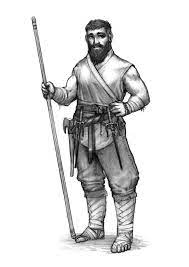
Fortunately, Terry incorporated both the Warrior Monk and the Monk into a famous monastic institution: The Changramai Monastery. As Terry notes in Emer I, the Monastery is more of a school and training center than a true monastic or religious organization. Nonetheless, the Changramai were renowned for their fighting ability and the school hires out skilled Changramai to serve as bodyguards throughout Kulthea. To be hired out, Changramail need to have achieved at least the “Third Veil” which is around 10th lvl.

There are a number of references to the Changramai in Canon with which we can construct a better picture of the Changramai. Some mentions in the books include:

  1. The Nomikos Library used Changramai extensively as guards throughout the facility. Nomikos Changramai are 6th lvl.
  2. The Nameless One is protected by 4 Changramai.
  3. The “Black Velvet” Brothel also uses Changramai as guards.
  4. Kyan Kim is a named NPC and trained in the Changramai school, living in Eidolon. He is 8th lvl.
  5. The Monastary was established in 2500 Second Era. “It is believed that the Changramai are disenchanted Xiosians who left the service of the Titans”
  6. Terry introduces a new special weapon: the Jata. This is a thrown, circular, 3 bladed weapon that has virtually magical properties to attack multiple targets AND return to the thrower.

There are a number of other references of powerful figures in both Eidolon and Haalkitaine that use Changramai for guards. The implication is that they are either very competent, or so feared that they are never tested. But how does the realities of the Warrior Monk profession stack up to this reputation? Throughout the books, Changramai are described as “imposing”, “intimidating” and:

  • Changramai monks can catch arrows, run on walls, leap incredible heights, punch through stone walls, and defeat half a dozen well-armed foes simultaneously with their bare hands.
  • Are fearsome experts at unarmed combat. It is said that they can see things invisible and know a liar by his voice.

Certainly Monks, with their spellcasting ability can perform some of those feats, but are Warrior Monks truly that adept? If you look at Changramai stat block, the typical Nomikos Changramai is 6th lvl, has 90 hits, AT1 with a 90DB and has a 90OB using MA Strikes R4. Depending on your liberal use of Adrenal Moves, Warrior Monks would be hard pressed to “punch through stone”, “leap incredible heights” or “catch arrows”. As an added comparison, using Jaiman stat blocks, a Erlini Sentinel is 5th lvl, has 85 hits, AT1 50DB and a 90OB is Short Sword. Really not much of a difference. Changramai are basically comparable to many of the rank and file warriors in the Master Military Tables found throughout Shadow World books.

Of course those are rank & file. We would assume that the Nameless One, or Haalkitaine Royalty would engage higher level Changramai as befits their position, status and wealth. But even higher level Warrior Monks are just going to comparably scale up by level in comparison to Fighters. They still won’t have those legendary abilities ascribed to them, or attainable by Monks via their spell lists.

But if you want to “Punch Up” the abilities of Warrior Monks, or just the Changramai Warrior Monks, I would offer up a few of my own solutions:

  1. I eliminated the development Ranks for Martial Arts and instead use the Ranks as the effectiveness of the combat style. This is similar to the size limitations found on in the various Claw Law attack charts. The Changramai and Kortri Ta Shiin styles are Rank 4; lesser unarmed combat might be limited at Rank 1, 2 or 3. This represents the superiority of these fighting styles and reflects the deadliness of the Changramai combat system. Removing the Rank skill development also frees up a TON of DP’s for Warrior Monks to expand in other skills.
  2. I allow for parrying with martial arts–no bracers needed. If parrying is really a proxy for an offense or defense posture, than even an unarmed combatant can emphasize active dodging/defense over a full attack.
  3. I use specific weapon modifiers, unarmed combat has very low modifiers for initiative, engaging multiple opponents and attacking and engaging targets in 360 degrees. This gives martial artists a implicit advantage over weapon wielders for a variety of combat situations and allows them to engage multiple opponents with the least amount of penalties. This chart also includes penalties for parrying missile weapons–allowing Changramai to swat arrows away!
  4. I’ve modified Adrenal Defense and rolled in the “Yado” secondary skill. This allows Changramai to not only parry missiles but to catch them.
  5. I use a modified Adrenal Strength and Speed that further benefit martial artists.
  6. I have unlimited skill rank development and a modified rank bonus progression that allows for characters to accelerate a few skills through focused development. The creates a tradeoff between average development of a broad array of skills or fast development of a smaller, focused set of skills. This seems appropriate to a unique combat school like the Changramai Monastarey.
  7. Finally, I use a “no profession” system to my Shadow World campaign. Changramai Monks are neither “Warrior Monks” or “Monks” and have access to the BASiL Mentalism “Self” Spells. With these lists and the changes above, the Changramai skills are complete, indeed they are powerful as depicted in the Shadow World books.

Have you utilized the Changramai in your game? Have your players ever faced off against them or perhaps have Changramai training?

Cool Things in Shadow World

I’ve blogged about the various, unique aspects of Shadow World as a setting, but today I thought I would note some very specific things that differentiate Shadow World and are great additions to the game.

Favorite Familiar:

Tameki. Introducted in the Cloudlords of Tanara, Tameki are small animals resembling black Terran housecats. Tameki have short, silky blue-black fur, large blue or violet eyes, and upstanding
triangular ears. They differ from cats in that their paws have longer, dexterous ‘fingers’ and their torsos are slightly shorter. Very acrobatic, these small creatures are able to leap amazing distances.

Obviously cats are featured a lot as Wizards and Witches pets, but Tameki are just enough that they feel familiar and different enough to add flavor.

Favorite Material:

Keron. A black, very shiny alloy. The substance is strong but flexible and holds a keen edge. When polished it has such a high luster that it looks wet or oiled. It does not corrode, and should be treated as
enchanted.

I don’t use alchemy spells in Shadow World to enchant item bonuses. Instead I rely on Kulthea’s naturally occurring metals and alloys that can be forged by smiths. (Thus, I don’t need to have groups of 30th level Alchemists working in sweat shops batching out Laen or Eog items). Keron is Shadow World’s “Mithril”–a cool material that is intrinsically tied to the setting.

Stone/Mineral/Gem:

Bloodstone. A soft, sandy stone dark red in color, this material can stop a would bleeding up to 5 hits per round! In seconds. This is often overlooked, but what an incredibly valuable stone. Better than a herb or a spell, portably and rugged.

Baddie Critter:

Gogor. Not unlike gargoyles or huge bats in form, Gogor are black as
midnight, with tough hides and leathery wings. They stand about
7 feet tall. Their heads are elongated with a certain reptilian appearance.
Huge, protruding green glowing eyes see in complete darkness.

I’m a fan of all the artificial and specific “monsters” in Shadow World, but Gogor are a good foe for a capable group. My players have some remorse from opening stone jars found in an ancient facility. What they hoped was treasure….

Special Weapon:

Kalta. A Loari Dart Pistol with a 10rnd clip. Very cool, practical, and not game changing. I’m a fan of small projectile weapons and thrown weapons. They add a coolness factor to combat, are a unique skill for players and they don’t impact game balance.

Riding Animal:

Kith. A giant six legged panther? Sign me up for that!!!

Cool Item:

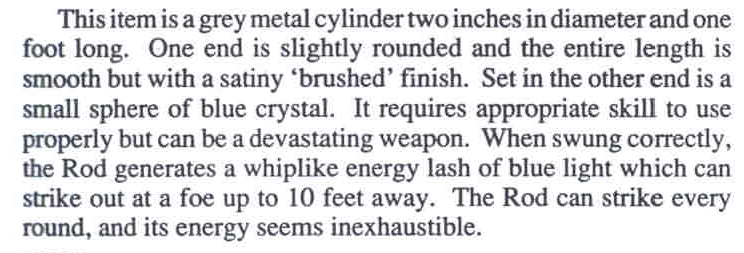
Rod of Tanys. Not magic, but a tech remnant, this grey metal cylinder is 2″ diameter and 1 foot long. No it’s not a light saber, it’s a “power whip”!!! There A LOT of cool magic items that Terry has created, but I like the cinematic nature of this weapon.

Favorite Practical Spell:

Warning Portal. Found on the Warding Power list in EMER and SWMA, this simple spells allows the caster to set a magical trip wire across a portal. If someone crossed the barrier, the caster is alerted. This is a 1st level spell. It’s practical, reliable and needed in an adventuring group. I’ve been working on BASiL warding spell lists, and this good spell design.

Those are just a few of my favorite things. I found that on each re-read of the SW books I found something new, something I forgot or a new idea is sparked. Are there any particular things in Shadow World that appeal to you?

Spell Law Deconstruction: Spell Attacks, Resolutions and Resistance Rolls

One consequence of my BASiL project is a critical, and hopefully objective, review of the spell mechanics found in Spell Law. I’ve blogged on “deconstructing spell law” under a number of topics here on the Rolemasterblog; perhaps too many times to provide relevant links. But today’s blog is related to my previous posts on Resistance Rolls (HERE and HERE) and might be helpful to review when reading this entry.

Spell Law establishes some basic classes of spells: Healing, Informational, Elemental, Force etc. It feels like the foundation of a consistent set of principles that covers various spell effects, but unfortunately falls short. I dropped this entirely in BASiL for now, but I’m in a review process and may reinsert spell types again. {I haven’t reviewed RMU enough to see how they might have address this issue}. At issue is the varying classifications of spells compared to the spell resolution.

Three Types of Fire Attacks.

As an example let’s review the differences between Firebolt, Wall of Fire and Call Flame. All are classified as “Elemental” spells. Firebolt has it’s own attack table and Directed spell skill to resolve attacks like a traditional weapon. A target’s defense is determined by AC and defensive bonus. Wall of Fire is a fixed effect that delivers a Heat Critical and specifically states that there is no RR. Call Flame doesn’t specify a resolution, but based on RAW, I believe a BAR is rolled and the initial target is given a RR. One could argue that the missile style of the Firebolt lends itself to a weapon attack resolution, the Wall of Fire is in a fixed position and thus has a unavoidable effect if walked through or touched. Call Flame is a bit of a hybrid. It could be considered a targeted spell (like the Firebolt) when manifesting (takes 1 rnd to form) and then a fixed unmoving effect (like Wall of Flame) for it’s duration of 1 rnd/lvl.

I’ve got no problem with Firebolt and Wall of Flame resolution, but does Call of Flame require more thought? Perhaps a better resolution is to treat the manifestation as a Fireball for attack purposes and then a Wall of Flame for the spells duration. Why am I parsing this?

I don’t think a physical attack, whether Elemental or Force, should be resolved using a magic realm resistance roll. Essence RR’s are modified by the Empathy stat. If Call Fire was imaginary or a nerve attack then ok, I might buy that argument. But Call Fire is actual flames–any defense against that should be physically based: quickness, a “dodge” or maybe even an intuitive reflexive flinch.

Let’s use a more apt comparison: Fireball vs Vacuum. Both are aimed, area spells but neither have a directed spell skill. Fireball is an explosive burst of fire and is resolved on a attack table using physical parameters: range, area of effect, defenders DB etc. Vacuum is a “Force” spell, but still an implosive burst of air. It’s a real, physical manifestation and yet, a target makes a v. Essence resistance roll.

There are numerous examples of similar spells that are physical attacks, don’t have their own attack table but are treated like intangible magical effects that can be mitigated by a magical resistance. It just doesn’t work for me. So what are some options?

  1. Generate individual attack tables for any applicable spells. That sounds like a lot of work, and more tables.
  2. Have the spells use existing established attack tables to save the extra work, but to model physical attacks and physical defenses.
  3. Establish a Resistance Roll that is based on physical stats. Qu/Qu/Int for example? This is the metaphorical Dodge; a slight twist of the body, a ducking of the head or similar that avoids the spell damage.
  4. Allow a targeting process that if successful, inflicts a mandatory result. Basically a Wall of Fire but with a accuracy roll.
  5. Use the “Dodge” skill with these types of spells (physical attacks that don’t have it’s own attack table).

If you’ve followed my BASiL project you know that I generally opted for #2. Plant attacks use the Grappling Attack Table, Wave Attacks utilize the Ram/Butt/Bash Table etc. Since these have attack tables I do allow for directed spell that models a casters mastery and increasing efficiency of the spell.

However, I’ve also experimented with a physical resistance roll that is used for reaction times: ambushes, physical spells etc. Like many of you, I will continually tinker with my house rules, but one thing is certain: I don’t believe that using magical resistance against a physical attack (magic or otherwise) is a good resolution rule.

What do you think?

Follow Up: Magical Languages in Shadow World

Now that I have had a few years of playtesting on my magical languages I thought I would blog a quick update. This is a follow up to my 2018 blog post on the subject and the added comment I posted in response to others.

For a quick summary here, I have made magical languages a skill rather than just a assumed ability that is gained when learning spells. In fact, it’s odd that Rolemaster doesn’t embrace magical languages as skills given the need to codify virtual anything as a skill. (I’m looking at you RMSS!) My goal is to create barriers to learning spell lists within my “free market” approach without arbitrary rules about Open/Close/Base or learning lists via “A”, “B”, “C” et al spell picks. (Base list restrictions is just another “Rules for Rules” example).

I originally had 20 or so magical languages I was trying out, but over time I’ve reduced them to just over a dozen. This is due entirely to my thoughts on mapping the development of magic use from the Ka’Ta’Viir (arguably Arcane or possibly Mentalism) to the multiple “realms” that I use in BASiL. So while I created a few of my own, I started with the base magical languages that Terry helpfully provided! I generally classify them as “High” or “Low” which corresponds to Base/Closed and Open classifications in Spell Law.

Aludos:* The “alphabet” of Enruning. Aludos is the language of “short hand” magic used in inscriptions, runes, glyphs, sigils, hieroglyphics and other codified, written magic. This is not a spoken language, but Aludos allows a caster to execute inscribed magic as well as interpret other’s work. (This magical language replaces the function of the Rune skill)

Elemos. High language of Elements. This language is used for casting the high spell lists of Elemental Magic.

Enruth:† Language of Imbedding Magic. Used for alchemy and enchanting objects. Glottogonic analysis suggests the Enruth evolved from a mingling of Elemos and Aludos.

Krônyt:* The High language of physics magic. Used for spatial, physical and time manipulation spells.

Kugor: The High Language of Dragons. It is virtually impossible for other races to use due to limitations of the vocal chords.

Kuskarûk: An arcane language utilized in “Dark” spellcasting. It is believed to be a corrupted form of Orhan power and was introduced to Kulthea through the Charon pantheons.

Logos:† (‘The Word’) The discipline of word-thoughts: mnemonics, method of loci, meditation, transcendence and schema that allows a caster to utilize Mentalism magic.

Meanas: The high language of Illusions, Shadow and Misdirection.

Morgradoth. Language of the Pales and Void. Used for Demonic summoning and controlling spells.

Nomos: “Common” Language of the Essence, used for most lesser Essence spells lists.

Sylmaria: High Speech of the Flows. Almost musical in nature, it is required for spell lists involving the Flows of Essaence. This language is very difficult to learn. Its teaching is closely guarded by Loremasters and Navigators.

Shurak: Language of Fire

Uscurac: The ancient magical language of the Ka’Ta’Viir and “Arcane” magic.

Var Arnak: Language of the spells of the Unlife.

Xytos:† Language of Power-words (Essaence). This language is a limited vocabulary of single word spells and closely related to Uscurac.

With BASiL spell lists are assigned a language. So a caster that wants to learn a diversified selection of lists will probably need to expend additional DP’s learning multiple lists. In addition, the caster can’t cast a list above the level of their Magical Language skill rank AND the Magical Language skill bonus is the bonus used for the SCR. All and all it’s worked great and mimics the original arbitrary spell list acquisition rules using the core Rolemaster premise: skill acquisition.

Rolemaster Spell Design: Thematic or Mechanistic?

Since I’ve been spending quite a bit of my writing time on BASiL: Mentalism I’ve also been engaging with a few other writers about spell design concepts. As my blog title suggests, there are two approaches to Rolemaster Spell Lists.

Thematic. The spells within the list are unified by a concept, theme or purpose.

Mechanistic. The spells are unified by an underlying process, mechanism, or metaphysical force.

While I am firmly in the “Mechanistic” camp, there is compelling evidence that some spell lists in Rolemaster were driven by the “Thematic” approach. Why might that have occurred? I think Professions development is a top down process: you start with a professional concept, you define the skills and abilities that reinforce that concept and then you assign skill costs and spell abilities last. For instance if we want to model a Paladin profession we might then create broad spell list categories like this: “vs Undead/Evil”, “Healing”, “Buffs” and “Combat”. Then we would design and fill in spells under those thematic categories. That makes sense.

The problem is that you can end up creating spells that work on different operational principles. Good examples of this can be found in the expansion Professions in RMCI, specifically the Nightblade and Paladin lists:

Nightblade/Distractions. This list contains a number of spells that fit under the umbrella of “subterfuge” it’s a hodge podge of styles. Nightvision (a personal augmentation, Confusion (a mental effect), Smokeflash (a teleport with a elemental angle),Extinquish (cancel elemental). So the list is a bit of Magician powers and Mentalist powers all jumbled up.

Paladin/Holy Warrior. This spell list really covers three areas: self healing, buffs (Strength & Courage), and “holy auras”.

A quick review of almost any list will find at least half a dozen “outlier” spells that don’t really fit into the mechanistic’s of the spell list. I’m not suggesting that a thematic approach is wrong, and ultimately, you probably need a mix of both to create full spell lists.

When I try to create a new list (or clean up a messy Spell Law List) I start from the bottom and build the list mechanically. What is the underlying “power” of these spells? Are they similar that they support the fundamental idea of a Spell List? (Similar spells that increase in power). Sometimes I can build enough spells to form a new list to 50th level. Other times I need to include a spell that doesn’t fit well but is needed to support the list functionality. Other times I have 1 cool spell but it’s a dead end to building a full list around the idea.

While I mostly use a Mechanistic approach, it can also lead to less diverse spell lists, or ones that might be better served with a HARP scaling approach. That’s a valid criticism. For limited spell lists, like the Shadow World Messenger Lists, I used a more Thematic approach. I feel comfortable using Thematics for Channeling spell lists, given that they are arguably structured for use by a Diety/Being.

The Thematic approach appeals to my gut- it’s intuitive, it reinforces professional tropes and provides wide latitude to populating a spell list. But my mind finds the mechanistic approach a more orderly process to spell list creation. In the end, much of this will depend on your concept of a spell list.

What are your thoughts?