RM Optional Rules: Skill Atrophy

14

While RM and it’s various iterations focus on obtaining and learning skills much less attention has been paid to the slow erosion of skills due to lack of use: “Skill Atrophy”. Many RM skills should require continuous practice to maintain that ability or sustain the peak level of performance. Taking a handful of ranks over a few levels and then ignoring the skill shouldn’t guarantee performance in perpetuity.  Skill atrophy also addresses several issues with the RM skill system:

  1. “Min/Max skill rank bonuses”. Many players will run a skill just up to the +5/+3 rank bonus inflection point. This gives them the most bang for the buck and when tied to stat bonuses can give them a solid bonus for most skill checks.
  2. Higher level skill bloat. Once most core skills are maxed out (skill rank +20), PC’s will turn to obtaining ancillary or non-core skills. While they may cost more DP’s, the +5 bonus gets them a better return than adding a + ½ to a fully developed skill. Thus higher level characters tend to homogenize into a jack of all trades.

Skill atrophy incrementally reduces skill ranks IF the character doesn’t take at least 1 new skill rank in that skill when they level up. So even high level characters with 20+ ranks in a skill and who gain very little in taking an additional rank will need to continue spending DP’s to maintain the skill.

Skills are assigned a skill atrophy percentage of 5%, 10%, 20%, or 25% that sets the amount of atrophy and the minimum threshold the skill can’t be reduced below. If, at level advancement, a current skill doesn’t gain a new rank than the skill atrophy modifier is applied. The result is always rounded down and the skill ranks can never be reduced below a level that the atrophy percentage is less than 1. So an atrophy mod of 5% means that the skill won’t reduce below 19 skill ranks while a 25% atrophy mod means the skill could slowly be reduced to 3. For example, a skill with 15 ranks and an atrophy level of 10% will lose 1 rank at each level advancement that the skill is not increased until 9th lvl, where it won’t atrophy any further.

Skill types and atrophy. In general learned knowledge (lore skills) have little or no atrophy while skills that require top physical performance or specialized training (athletics) will atrophy faster. While individual skills in categories may have differing atrophy rates, general suggestions are as follows:

Lore Skills: No atrophy or 5%.

Trade skills: 10%

Crafting: 10%

Social: No

Performance: 10%

Physical or athletic: 10% or 20%

Endurance: 20% or 25%

Combat skills: 10% or 20%

Mental skills: 20%

Magical Skills: 5% or 10%

Spells: No

Directed Spells: 10% or 20%

Special Skills: 5% or 10%

Option 1. Atrophy still applies but instead of requiring an additional skill rank, allow a character to expend 1 DP to “maintain” the skill IF they don’t take a new skill rank in that skill.

Using RM’s professions, skill atrophy reduces skill bloat at higher levels by requiring characters to continually invest in their critical skills. When using a “No Profession” system, this further enforces the need for characters to focus on core, “defining” skills that in effect creates professions without the need for arbitrary pre-defined classes.

The NPCs of Daggerdale

Rolemaster Logo

My players have been working their way through the Doom of Daggerdale module. This was one of the things I have converted over to Rolemaster. Not only did I have to convert Hook Horrors and the Nightshade/Wood Wose creatures but there are three significant NPCs in Daggerdale. These are Randle Morn, Caldoran The Razor and Tren Hoemfor.

The first that the Players meet is Randle Morn the displaced Constable of Daggerfalls, the traditional ruler of the town and Dagerdale. According to the module Randle is a 7th level fighters/6th level thief. In my conversion I have made him a 10th level Rogue. This gives him the strength in combat as well as the breadth of skills. You can use the standard generic NPCs for him and just give him +5 Chain mail (AT14), +10 full shield (+35/+25), a +5 long sword and a +10 long bow. In my world these are all superior quality non-magical weapons. I chose to give him the leadership and public speaking skills required to inspire a band of 200 men to continue to fight a partisan war against the Black Network.

Tren Hoemfor is a D&D 7th level fighter. This translates into a Rolemaster 10th level fighter with Chain (AT13), a +10 broad sword and two interesting magic items.

The first is a Cloak of Displacement. I have made this a Daily Item that casts Displacement I once per day (5th level Guises, Illusionist Base). I made this decision because I did not want to introduce a magical item into the game that I would regret if it fell into the players hands!

The second item is a Ring of the Ram. This ring in D&D does 1, 2 or 3d6 damage in the form of a ramming attack depending on how many charges are used. My version is again a daily item embedded with Vacuum I (3rd level Gas Destruction, Sorcerer Base) three times a day this  delivers a single impact critical severity B. I thnk the damage it delivers is slightly less than the D&D version but it does not have a limited number of charges so on balance I think it is on a par.

The third and final NPC is Caldoran the Razor. I am not going to give you his complete stats but a general outline. In D&D he is a 6th level Mage. I have made him a 10th level human Archmage. The interesting thing about archmages is that they can pick their ten base lists from any profession and any realm. I this case I chose the Alchemist list Liquid Gas Skills that enables him to create potions. The eaty of this list is that it allows him to create potions. I have then given him a substantial stock of potions from his own spells (1st to 3rd level and those of his allies. What I have aimed for is to massively extend his pool of powerpoints and therefore how dangerous a foe he is without having to resort to giving him powerful magic items. Potions are inherently single use and in someways force players into making choices. If they use the potion now then it is gone or save it until they really need it. As it is they have no way of telling what any of these potions do without testing them the most basic way of holding your nose and swallowing it down.

I am a big fan of low level spells. I think there are some really cool powers in there that often get over looked by bigger and more powerful spells. Another option is of course you can give potions to somebody else and there is no skill involved in use it. In Rolemaster you need a certain skill to invoke a rune or scroll. Potions are just glug it down and hope for the best!

As it is Calderan is still alive and kicking and a danger to the PCs so I cannot go into much more detail. Once he is done for I will share what his stock of potions was and how he used them.

RM Combat Hacks: Enhanced Riposte

Welcome to my 1st RM Combat Hacks post! While RMU is developing cool new combat expertise options, I thought I would introduce a few rule tweaks that we’ve used over the years. Our options don’t require adding new skills and can be used with every version of RM. I thought I’d start with a simple one that has worked well in years of playing.

Enhanced Ripostemelee7

While riposte was added as a secondary skill in RM2 the rules allowed for a combatant to Full Parry and still be allowed to make a +0 attack. Enhanced Riposte allows the combatant to Full Parry and make an attack, but if the attacker misses, the defender is allowed to make an attack with a bonus equal to the attackers result and the minimum number needed for a critical result. The attacker cannot use any allocated parrying DB against the Riposte.

Ex. Taor a 3rd lvl Bard is in combat with a 5th lvl Evil Paladin. Feeling that he is over-matched, he elects to Full Parry in the hopes that his friends will show up and save his bacon. He allocates all +28 of his OB to Full Parry along with his +10 DB. The Evil Paladin attacks with +75 Longsword. He rolls a 14 for a total of 89 less Taor’s 38 Parry/DB for a final result of 51. The Paladin needed an 87 to generate a crit result on Taor. Taor does take 4 pts of damage but can now make an attack at +36!

Note that if the Paladin had generated a critical result, Taor would still be able to make the normal +0 attack per the Full Parry rules.

As this example shows, it’s possible to generate a Riposte attack bonus HIGHER than the combatant’s actual OB. This reflects the mechanism of the riposte—drawing the attacker in and even taking slight damage to create an attack opening from an over-extended opponent. Obviously, a GM can limit the Riposte bonus to the combatants OB.

For lower level players this gives them an additional tool against a superior opponent and if the attacker rolls very poorly, could give the PC a considerable Riposte bonus.


New Topics and Blog Contributors Needed!

I’m a bit behind on posting up new blogs but I’ve come up with 4  basic titles/topics for my  upcoming contributions. So even with a continual stream of new ideas or inspiration I’m going to try and stay within my own topic guidelines! The four I’m focusing on:

  1. Shadow World Spin Cycle: Re-purposing other gaming material to fill in content in SW.
  2. RM Combat Hacks: Optional rules and ideas for adding additional depth to RM combat.
  3. SW Adventure Hooks: Adventure “hooks”, ideas and starting points for SW adventures using the SW Master Timeline and other threads “dangling” in Canon material.
  4.  SWARM. “Shadow World Alternate RoleMaster”. My own rule set for No Profession Character Law for use in the Shadow World setting.

With that in mind Peter is looking for new Blog writers & contributors. Do you want to write short posts on RM or RM related topics? Let Peter know!

It is Game Recovery Week!

I am back from my weekend of gaming and these long weekends take their toll on this poor old GM. I feel this is game recovery week when I try and get over the effects of too little sleep and the diet of a 18 year old student. Gone are the days when I could game until 3am night after night!

The game went well, the evil magician escaped but following the antics of the players he is going to have to do some serious remodeling at home! The party are all spell casters and when faced by their third locked door resorted to using a pair of lump hammers and entering rooms like some kind of police raid. What was interesting was how often some of the situations turned on a single lucky dice roll.

The first instance of this was a situation where the party were bottled up in a small chamber, arrowslits and murder holes pointed into the room and before them were some heavy stone doors. Out side the room firing in were skeletal warriors under the control of our villain.

The priest tries casting repulsions and on a roll of 97 (base spells roll) destroys every single skeleton at the first invocation of his gods name (Torm, if you are famiiar with the Forgotten Realms panthion). That gave the lump hammer wielding front row the break they needed to get at the doors. I had expected that killing zone to pose a real problem for the players. Their first attempt was them getting as close as they could and then casting Sleep and waiting for the sounds of falling bodies. Two spell casters wasted sleep spells before they spotted the archers were undead.

The second dice roll was a perception roll. The bad guy was on the run and trying to make his escape with his more precious posessions. In the romm next door the party were searching for any sign of him, believing they had killed everything in this part of the underground chambers. At the first attempt one of the players made an open-ended perception roll of over 320! So much for the quiet get away.

It was not the slickest ‘dungeon’ clear out I have ever seen but I am beginning to see the start of the party gelling together. Several times they failed to communicate and we had people either casting completely contradictory spells. The Warrior Mage cast sleep on one foe just as the Sorceress cast Vacuum on the same target. In the next fight the same two clashed again by both preparing can casting Sleep VII and a Sleep VI on the same target. These at least started the conversation about working together.

It also highlighted the weakness in that the party have no real healer, the cleric doesn’t have any serious healing spells, just concussion ways, and the seer who has been playing the role of healer only has first aid and some herb lore. The party also lack a scout or thief. This time they got away with using lump hammers and they had left locked doors alone until they had probably killed all the other minions. Their approach is not so good if you are worried about maybe trying stealth for once!

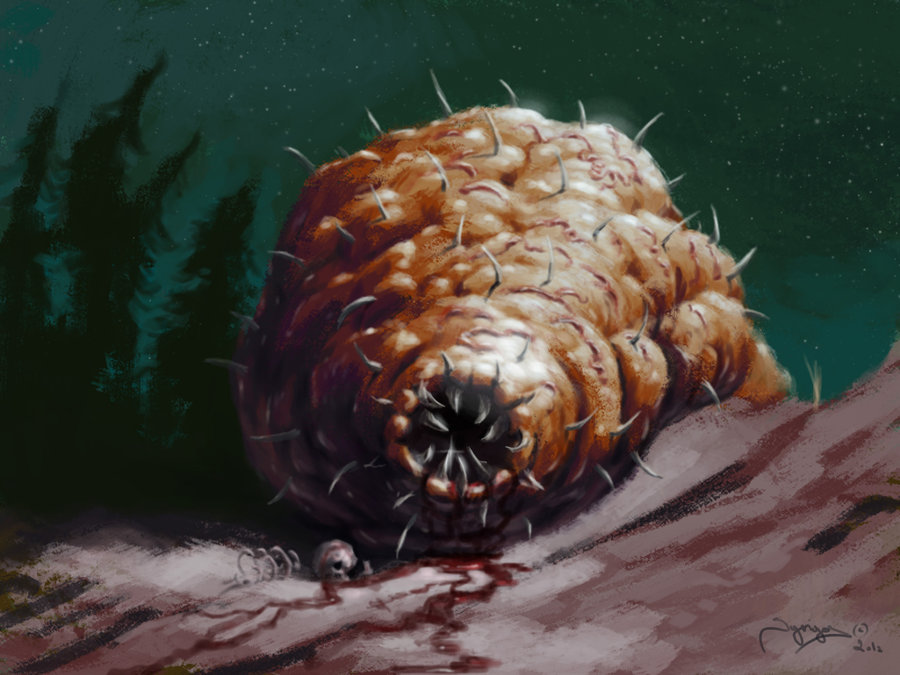
The only creature left alive as far as the players know was a huge worm type creature trapped at the bottom of a pit. It looked somewhat like this…

A Giant Bloodworm

The party managed to gather up all the evil magician’s healing herbs, that comprised most of the ‘treasure’ in the adventure, and throw it down the pit. They knew the magician was performing dark rituals to create animated wooden effigies to do his dirty work. When they found his ritual chamber they gathered everything including the herbs, threw it in the cauldron and tossed the lot down the pit.

I suspect the party could do with a better herbalist as well!

It is Game Day! (The Post-It Revolution)

Rolemaster Logo

I have packed up all my game notes and rules and I will soon be on the train to Faerün (so to speak).

The biggest difference in the game this time will be that I have adopted some advice I was given last week. For each major NPC I have given them a post-it note with a mini-flowchart of their tactics and or favoured spells. The idea is that as soon as I pick up a character sheet I can see at a glance what they are most likely to do in the first combat round without having to delve any deeper into the paperwork to look at skills or spell lists.

All it needs is what and the applicable skill total eg “Adr.Spd +70, Sp.Sudden Light” tells me that the NPC will attempt to prepare Adrenal Move Speed and their total skill is +70 whilst also casting the spell Sudden Light. (That is a spell that can stun everyone within its radius if they are not prepared). It is a 5th level spell and in this casters case can be cast in a single round without preparation.

The NPCs objective is obviously to try and create some confusion amongst their opponents whilst also giving themselves options (the adrenal move speed is a like Haste) for the following round.

The next section is split into two, being fight or flight. So having cast that spell I hav enow noted down two options depending on whether the NPC is going to fight on or try and get away. SO in this case it is either “Sp.Invis, Stalk+30” (cast invisibility and then creap silently away) or “Sp.Blur, att.Shuriken +35” (cast a spell that make them harder to hit and then attack with a thrown shuriken with a total attack bonus of +35). So there are two definite different strategies here. I have only sketched out two rounds because if the fight lasts longer than that then any pre-made plan will probably fall to pieces and any NPC that does not react to what the players are doing probably will not live very long.

At the bottom of the post-it is a note of the most significant items then NPC has such as weapons, wands, staves and potions etc.

The point is that from the moment the two parties meet I can tell at a glance what is likely to happen immediately. If the NPC is  a criminal mastermind then chances are he or she will know what their best tactics are. By spending a new minutes before the game session to look at what their best options are then you will do them more justice in the game as well as make the opening sequence fast paced and exciting.

There are additional benefits to this I have noticed. If I am under pressure to decided the NPCs attack I am more inclined to reach for the lightning bolt. Given more time I find that there are some much more interesting and varied spells to use on the same lists. This makes the NPCs power points go further if you are casting a 5th level spell instead of a 12th level spell and they are tossing it off in a single round.

I ran a fight not long ago and after the fight was over I discovered that the, now dead, villain was carrying couple of powerful healing potions. He didn’t use them and it would have changed the nature of the fight if he had and to make it worse he did have an opportunity to do so. In the actual fight he tried to flee but was brought down by the PCs. I removed the potions from the inventory but if I had known immediately that he had them then the nature of the fight would have changed as would the rewards.

So now with the NPCs covered in green personality post-its and orange fight or flight post-its it is time to get my train. I will let you know how it goes.

If anyone can think of a good (roleplaying) use for my blue post-its then please let me know!

Five Days until next Game Session plus traps and puzzles

Next weekend I will be running my next face to face game session. I have read over the game notes and the adventure module. I have just decided that the main trap/puzzle that the players have to solve I don’t like.

Lots of these old D&D modules have magical traps and puzzles in them which seemed fine when I was 14years old but now when I look at them I just don’t like them. Dare I say they are a bit silly? So I need to come up with my own replacement puzzle (in this case it performs as a lock to get deeper into a magicians tomb) that I feel comfortable with and gives a more serious tone to the adventure.

For this I think I want to construct something based around an astrolabe. I thought I was on a winner and being original until I did a Google images search and the top results were all for the Game of Thrones astrolabe. I read the books a few years ago and the idea must have stuck. What I did discover was that an astrolabe was not actually what I was looking for. What I was imagining was actually an Orrery.

An Orrery

Now, an Orrery is a great basis for a puzzle and seeing as the dead dude in the story was actually an alchemist the creation of a magical orrery is entirely consistant with the story and the world.

I am intentionally not giving my players any permenant magical items at the moment just scrolls, potions and single use items. One reason being that in a previous campaign I played in the game became completely overshadowed by the magic items the characters carried. To some extent it became that we were playing the equipment list not the characters. The other reason is that single use items force the characters to make choices. The item is used now or later but it cannot be used both ways. The only items that have are healing, the most powerful of which is a scroll of life giving, a single use bring a dead character back option. I like that one because it gives me the option of killing a character and knowing that it wil not be final.

Anyway back to the Alchemist’s tomb. I cannot tell you the actually trap/puzzle I intend to use as I am sure my players read the blog. What I have said here is not a spoiler for them as they have already know to expect something and its size and positioning will tell them exctly what it is when they see it.

Going right back to the beginning I have noticed now that in every D&D module I have converted over to Rolemaster I have removed either traps I think are immature or monsters that I simply cannot believe could have evolved or anyone would have created. The very first of which was the Gelatinous Cube. In the first game I ran for my players when they came upon a trap their first reaction was that “Oh this is a D&D adventure it wil be filled with silly traps.” It also brought out anecdotes about dungeons that had been ‘abandoned for centuries’ with corridors filled with locked doors behind which were two hobgoblins. How did they get there? Who fed them for the past 200 years? What were they waiting for? Needless to say I very quickly scanned through the adventure for any such room or other silly traps and I didn’t find any, thankfully.

Assuming we all started roleplaying with D&D back in the 70s and 80s we must have been much more accepting then or is it that I am now much more intolerant?

Spin Cycle for Shadow World: CoA pt. 2

5The Citadel of Ardor.

What is it? A 9 level tower of black “marble” stone. Interior features with familiar SW elements including iron/steel/laen tracked doors, glowing glass panels. There is even a lower level cavern hall.

How and where to use it in Shadow World? The tower feels A LOT like the Loremaster’s Tower of the Winds with its High Council Chamber and the lower cavern could be the repository for the Master Orb. (MA p.72). But the elements, materials and craftsmanship certainly evoke LoE or 2nd Era style.

General Ideas:

A tower for a powerful Priest of the Unlife, a Mage or local Lord/ruler. If you need to drop in a powerful adversary, this layout may be perfect for their stronghold. The lower cavern works well as a room for summoning or ritual magic. Like the CoA plot, the PC’s can try and stop a dark ritual or sacrifice.

Empty fortress to explore. If you need a floorplan for an abandoned tower this could work well. The entrance gate may need to be open or the PC’s could access the lower hall via an Earthwarden tunnel or the Ash Lairs.

Lords of Essaence (LoE) facility. There hasn’t been many, if any, LoE towers detailed—most of their surviving structures have been underground. It’s certainly possible to attribute it to the LoE, but has subsequently been taken over another ruler, powerful individual or organization.

Earthwardens (EW). The stronghold seems too polished for the EW but the lower cavern could be built around a Foci and the tower could have been built over the site later in the Interregnum or 2nd Era.

Specific Ideas:

Some of these locations are only noted in the map keys without any other information. However, if the PC’s are exploring Emer than the Citadel may be great layout to quickly insert for the following:

  1. Tower of the Church of Zanar. Isle of Fire, Emer.
  2. Tower of the Spider Queen. Haestra I. Map A #1
  3. Red Moon Tower. Haestra I. Map A #4
  4. Tower of Kelstro. Haestra I. Map B #2
  5. Amethyst League Tower. Haestra I, Map C #3
  6. Blackforest Tower. Haestra I, Map C #17
  7. Xa’Chaak Mentalist School. Haestra I, Map C #19
  8. Tower of Silver Ice. Haestra I, Map C #20
  9. Tower of the Five Moons. Haestra I, Map D #3
  10. Earthwarden Ruins. Haestra I, Map D #8
  11. Tower of the Warlock. Haestra I, Map E #7
  12. Tower of the White Sorceror. Haestra I, Map F #3
  13. Vog Ien. Northern Falias
  14. Tower of Magic. Ebon City Govon.

If you have any ideas on re-purposing the Citadel of Ardor please add a comment! Stay tuned for Part 3!

Get into Character

In Brian’s post [Shadow World Deux ex machina: Gods or Loremasters?] he mentions ‘time-strapped GMs have to rely even more on prepared materials and modules’. It is not only us poor GMs that  don’t have the time that we used to. As you all probably know I am one of those GMs that only gets to game a few times a year when the gang all gets back together. It is hard for my players to get into character at the drop of a hat if they haven’t played the character for four months or more.

To that end I have been asking around (mainly on twitter) about ideas to make this quicker and easier. My ‘plan A’ is the “First impression post-it” before I explain I will give you a little background.

I used to play in a MERP game (playing the same character for about 20 years and reaching 33rd level), that GM and the GM of a game that I am going to start playing in next week both use a three page questionnaire about your characters strengths, weaknesses, what they would sell their soul for and their deepest desires. A sort of PC SWOT analysis. I always hated them and still do. When I first create the character I don’t really know these things about him or her (normally him as I never play female characters having never been female and before you ask I don’t play elves either!). When I did have to fill one out for a newish character I wanted to change some of the answers after a few months of play and the GM said I couldn’t as he had used the answers in weaving the plot. I think 10 out of 10 for integrating the character into the game world but a big fat zero for character development.

Anyway, I don’t like these SWOT analysis forms because for new characters they either seem to end up very similar or very shallow or worst of all not reflecting the character that the player is actually playing. I suspect (and know in my case) that they are written and forgotten by the players.

I have been using first impression post-it notes for NPCs for a while. The idea is to create a sentence or two (no more than can fit on a post-it note) to describe the first impression that a character creates. Is he calm? flustered? charming? Do they speak with a booming school masters voice or a soft rural brogue? These help me get into the NPCs role quickly and keeps the NPC consistent across meetings. Bear in mind that in the players first adventure it took two human years for them to complete a small cave complex adventure.

If there are three gate guards, an old hand and two green recruits then a single note with the three names and maybe a two word description may be enough (Cyril:Sargent-major strict, Oswald:Cocky/swaggering, Bjorn:Scatter brained and untidy). Every time you exit via that gate you get one or more of the same guards and the players may even plan their escapades for then Bjorn is on duty because he suits their needs, but at least every time they meet they will be consistent.

Below is the post-it from one of my NPCs (I apologise for my handwriting, this is low tech roleplaying!). You could I hope take that post-it and character sheet and run with it.

20160411_145647

The nice thing about post-it notes of course is that they are note a three page questionnaire, you are not giving away the deepest secrets of your characters background, should you happen to leave it at the game table while you go an get a beer and another player reads it.

I am only recording that first impression not a full psychological profile.

I am going to get my players to do these for their characters before the start of the next session. That way every time they open their mouths whilst ‘in character’ if what they say or how they say it should be in alignment with what is written on they post-it.

They can of course screw it up, toss it in the recycling and write out a new one. I had a character that was extremely happy go lucky until he was the sole survivor of a near total party wipeout. For him the adventure was no longer fun it became a grim reality pretty damn quick. That would be a new post-it moment!

How this works with real live players I don’t know yet but I will let you know. What is happening increasingly at the moment is that my players are playing themselves for most of the weekend which is not really the point of the game or where is the escapism in that?

Spin Cycle for Shadow World: Court of Ardor pt. 1

While there is always demand for new Shadow World material, even after ignoring all the non-canon material there is still an incredible amount of material for a lifetime of gaming! But gamers love new books and while Terry is working diligently on Emer IV and a slew of other projects I thought I would start a new blog series called “Spin Cycle for Shadow World”. In this series I’ll be suggesting old RPG material that can be re-purposed for Shadow World. An area map, a layout, or a fortress from other settings can be a convenient insert to fill in a campaign or flesh out current material. For the most part I’ll keep the suggestions for use in Jaiman and Emer, the two continents that are well represented by canon SW material.

So where to start? Obviously the first place to look is in other I.C.E. publications and we don’t have to look too hard! Luckily early MERP material is easily adapted to Shadow World; not only is it built on RM stats but the flavor and design aesthetic of Peter’s maps and Terry’s layouts were used in both the Loremaster modules and early MERP campaign modules. But even better, some of the coolest MERP products were authored by Terry himself. The first we’ll discuss, The Court of Ardor, shares the structural DNA of Shadow World and could almost be adopted whole and dropped into Kulthea with little effort.

I’m not a Tolkien expert, so I’m unclear on how much material in CoA was derived from his work, but most of the material seems to cover regions, politics and power not addressed in the LotR. It does feature Terry’s creative trademarks: a mysterious and powerful organization–check; cool magic items—check; powerful NPC’s—check; unique fortresses with great layouts—check. Great stuff and very familiar to Shadow World users. The Court and its members certainly has the glimmerings of the later Jerak Ahrenreth and the various “Suits” (Staves, Helms, Swords, Orbs) echoes the Eight Emerian Orders. The organization of “Darin Tesarath” is virtually identical to the Steel Rain and the Guild of Elements feels like a precursor to the Earthwardens.

While the organizations may be useful, the real benefit is the layouts of the Court’s 9 citadels and the city maps provided in the module. We’ll look at this in more detail in CoA pt. 2.