An Opportunity Creating Rolemaster Adventures

I don’t know if you have all seen this thread but if you have wanted an opportunity to create something ‘Official’ for Rolemaster then now is a real chance.

Colin has given a single paragraph hook for their three samples on the ICE Blog http://ironcrown.com/blog/2016/02/19/roleplaying-adventure-hooks/

Now, I know we have been teasing people with the hidden project called 50 in 50 but I can let on that you will be getting more than a single paragraph from each of our adventure hooks. I have been flicking through them and each runs to a typical 1000 words with environmental considerations, battle tactics and nicely developed pen portraits of key NPCs so you could play them off the page if you are competent seat of the pants GM.

I really struggle with the whole idea of ready to run adventures for Rolemaster. What I know about RMSS/RMFRP could be written on the back of a gnats testicle and still leave room for house rules. Even my beloved RMC is different from its grandpa RM2. Just take for instance a basic skill roll. Imagine you have a fairly good skill of +57 as a 2nd level character (two ranks for the 3 levels, two lots of level bonus and a +13 stat bonus for example) and you make a middling roll of exactly 50. The skill was an absolute pass or fail test.

Total roll of +106. Did you pass or fail?

RM2 = Pass.

RMC = Fail.

To the best of my knowledge RM2 and RMC are the two most closely related RM versions there are so if RMC NPCs and characters need skills to be a typical 10 points higher than the same character in RM2 how do you balance a prepared adventure?

How about HARP? Does anyone know all the systems well enough to cross stat?

What about setting? I think the setting should be interweaved into each and every adventure. Whether it is maybe different cultures of NPCs sat around in the inns and taverns, languages heard in the market places. When I write adventures I like to explicitly write in these cultural references so I do not forget to mention them to the players. I am picturing one thing in my mind’s eye but they may not be seeing the same thing.  If the fields are filled with Aurochs grazing open common land they would look different than Bos Indicus.

Are there Shadow World races and cultures or do you not mention them?

It sounds like a real nightmare to me. In my recent post An Explosive Situation the actual setting I had in mind was an Arabian desert town with a dusty market place and white plastered buildings, the taverna with hookah pipes on the tables and curtains in the the doorways. None of that is in the text but if I had written it for myself then that would have all be there to project that across to my players.

This all sounds more negative than I had intended but going back to the beginning. Colin has make an opportunity or three available for anyone who want to have a crack at it.

This post currently has 4 responses


Gender in RMU

Here are some unrelated gender based observations.

I have been lucky enough to game alongside 23 players in my gaming lifetime. Of those 20 were men and 3 were women.

I have glanced at some of the fantasy rich ‘fandom’ peer groups and there is see an almost 50/50 or maybe even female dominant population, people like your Whovians and Pottermores to name but two.

As far as I am aware there are no female developers on the RMU dev team although I could be wrong on that.

I have only seen 3 pieces of RMU art, the covers of Arms/Character Law, Creature Law and Spell Law and not one of them features a female hero, or villain for that matter.

Looking at Arms / Character Law there are just three(!) uses of ‘her’ but 432 uses of ‘his’ in the examples. There no uses of ‘she’ but 375 ‘he’s.

Leadership or just being bossy?

In all the examples there is only a single positive female reference and that is…

“Working together, they can search the area faster,
Kamina splits up the work and coordinates the effort
(putting her leadership into play) and they begin to
search. The average of their perception bonuses is (90 +
70 + 75) = 235 / 3 = 78 + 10 (Kamina’s ranks in
leadership) = 88. Just one perception maneuver is made
at +88. It would take one person thirty minutes to
search, so for three it takes just 10 minutes (30 / 3 = 10),
so they get one perception maneuver at +90 for every 10
minutes they spend searching. The GM decides this will
be resolved as a Percentage Maneuver, since the key is
definitely there in the long grass, and will eventually be
found if they keep looking.”

So actually her efforts are irrelevant as the GM has decided that the key would be found anyway regardless of Kamina’s leadership ability.

I am not entirely sure how positive an image that is either. Is Kamina being portrayed as bossing her friends around? Maybe I am just jumping at shadows there.

The world of fantasy and Sci Fi is full of really cool, strong, positive female characters, Ellen Ripley (Alien), Hermione (Harry Potter), Katniss Everdean (Hunger Games), Tris Prior (Divergent), Jessica Jones and Annabeth Chase (Heroes of Olympus) to name a few. So why is RMU devoid of anything that may want younger female roleplayers want to engage with it?

Is there a reason that I have missed somewhere?

This post currently has 6 responses


From Little Acorns

I want to tell you a little story.

Once upon a time Kwickham emailed me and said that he wanted to publish his Aiorskoru game world and that I had blogged about it. He suggested that I could repurpose those blog posts, edit them into standalone documents and put them on RPGnow and maybe make a few Dollars.

So I did.

That got me thinking so I packaged up my professionless and level less RMC rules and put them on RPGNow, there is a link to them on the left here, and I get downloads of those every single week.

In another email exchange Kwickham was telling me about a game he has written and is still developing called ABS12. ABS12 is as simple a system as it is possible to get. There is just a single stat and the entire system runs on 1d12 rolls. This gives 12 possibles all of equal probability, there is no bell curve  created by using added dice rolls. My part in the exchange was to describe a game I had often thought about writing but had never committed to paper. In a single email I laid out al the core rules with examples. That game became 3Deep, again see the links on the left.

I make a few Dollars a month from selling these documents on RPGnow and the other OBS sites.

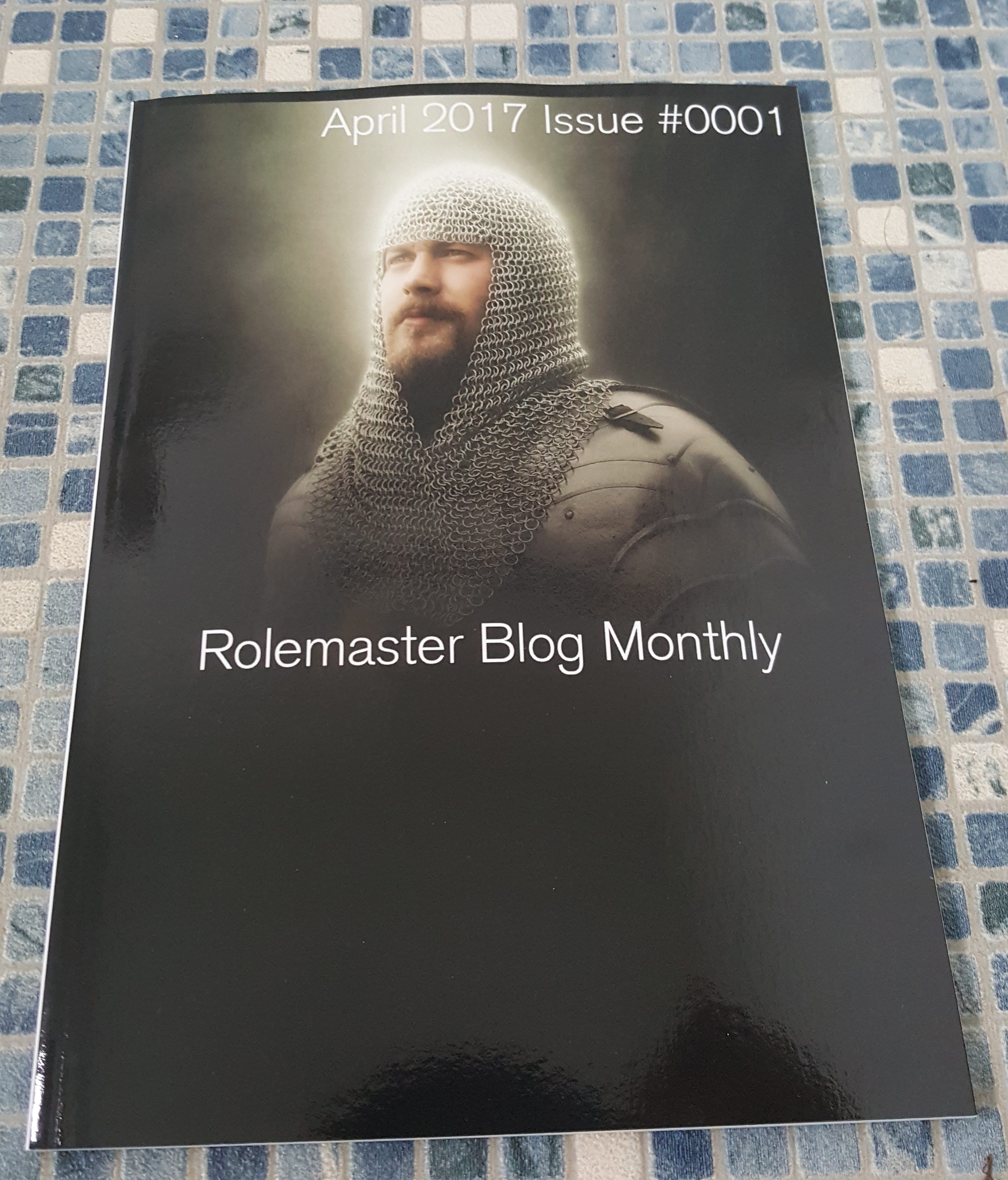
I recently had an idea. I thought I could repurpose some of the blog posts here and create a Rolemaster Fanzine. It would take almost no time to copy ‘n’ paste a selection of blog posts into a word document and a quick editorial pass to resolve links into the actual addresses for people to use. So I did it. I created a RolemasterBlog Monthly as a PDF on RPGnow.

Then I thought PDFs are all very well but if you are reading it on screen you may as well read the same articles on the blog and that way you get all the comments and links too. The blog is a much richer experience in my opinion. Unless you love physical books that is.

So I make a print on demand version. This was the first document I had ever done the complete layout for print on including the cover design.

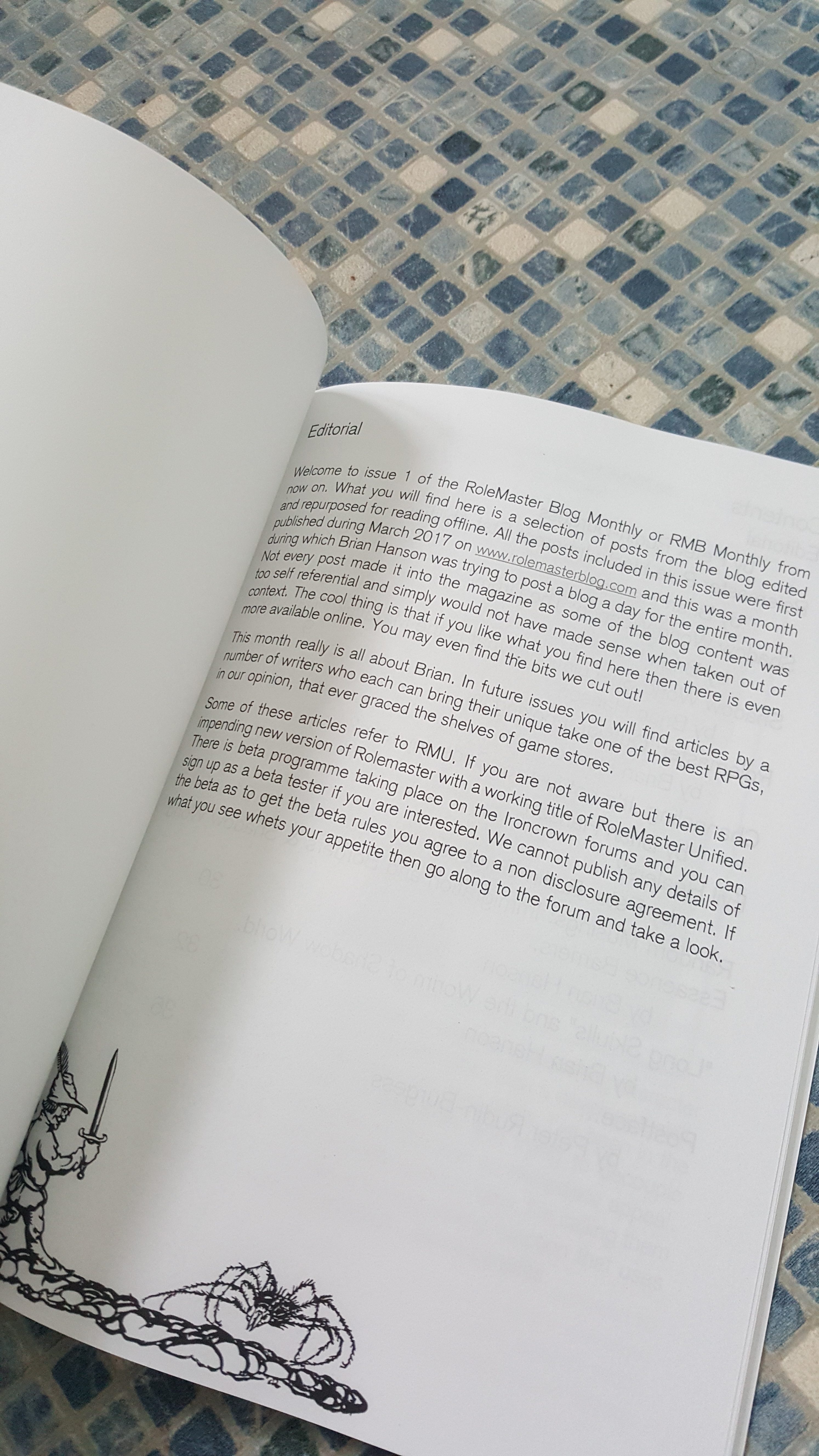
I have on my desk right now the first proof copy of the first edition of the RolemasterBlog Monthly, the Rolemaster fanzine. 
This was a mile stone for me. To have a real physical book. I have noticed a couple of layout problems with the proof but I fixed them last night and I have uploaded the corrected print files.

Despite that, it is lovely and glossy and feels nice. At 36 pages (A5) it is no mammoth tome but then it is only intended to be a fanzine. Everything I learn in producing this I will apply to all future issues and so on.

I honestly hope to have the final print copy on sale (you cannot do free books on RPGnow) within 10 days.

With the actual launch I will announce it first here. If you love the touchy, feely experience from dead trees then I hope you like the RMB Monthly!

This post currently has 8 responses


“Let the Wookie Win”: Turning a group loss into a campaign positive.

I recently read this blog and it got me thinking about the standard adventure and campaign progression. It also immediately brought to mind this scene and quote from an Indiana Jones movie.

Single adventures usually follow a linear narrative that provide a final challenge or battle that the players want to, and should win. But what about longer campaigns? Is it a series of wins, each providing experience and levelling up or is it a campaign of fits and starts? Can the players and groups lose at the end of a chapter? How about at the end of the novel? Gaming should be both fun and rewarding and few GM’s want to end a long running campaign with failure but significant set backs and even tragic losses during the campaign will make the eventual triumph that much sweeter.

An early blog I wrote was on “Newmans“–long running adversaries for the PC’s. If these adversaries are less enemies and more competitors it’s natural that they should succeed as well. But what about the opponent of “ultimate evil” or “mob boss”–should they put some points on the scoreboard or get a major win?

Of course a GM may want to build some early losses into an extended campaign–but those are intentional and meant to control the narrative. What about unpredictable losses? In RM the critical system and open ended rolls works both ways. Short of TPK, can a GM turn a unexpected tragic encounter into a positive for the campaign? Of course: most fantasy RPG’s have some form of resurrection, Rolemaster has healing spells for almost every unimaginable injury and equipment and items can be replaced eventually.

Anyone have thoughts? Have you turned a catastrophe into something better?

This post currently has 7 responses


BASiL Deep Dive: Automaton Spell List

Part of my deconstruction of Spell Law was to come up with simpler rules for various alchemical processes that could be more easily used “in game”. One of the appeals of original RM was the framework for creating magic items, but the time and effort involved in making items needed to occur outside gameplay. The alchemist was better as an NPC or the spells should have been shifted to Closed lists (like the detailed healing spells lists in the Channeling Realm).

What sort of alchemical processes could be simplified to be usable in actual game play?

  1. Simple Alchemical Formulae or Devices:  acids, grenades, glues, glow lanterns etc that can be made in hours or a day.
  2. Single use simple embedded items: charms, candles, elixirs, salves, lotions, oils, powders that are consumed when activated.
  3. Basic constructs: drones, miniatures, robots, engines, machines that can be powered and controlled.

With #3 above in mind, one of my favorite new spells lists is “Automaton”, a Closed Essence list I created as part of my BASiL project. My intent was to create a very simple and flexible spell list that allowed for basic automata: motive power (movement), direction (control), and agency (sensory data). Basically simple robot capability with a few lines of programming code.

All of my BASiL spell lists include 1-2 pages of GM/player notes that provide more detailed direction on use and limitations but I didn’t include those in my file uploads to date. I’ve had a few questions about this list and we’ve grappled with some in game usage with one of my players so I thought I would dive deeper into the list as I envision it.

  1. First, the list isn’t just limited to a “robot” or stereotype anthropoid construct found in RM “Creatures and Treasures”. This spell list could function on any mechanical or compound device: a propeller, pulley, wheel axle etc.
  2. The spells do not create structural integrity or range of motion–functionality must be built into the object or target. For instance, animate dead might create a skeleton undead and it’s assumed that the spell “binds” the bones together into a coherent form again. These spells do not do this: cast on a stone statue it wouldn’t imbue flexibility or fluidity to solid stone. However, this spell could animate a corpse. A GM will need to adjudicate some items. For instance its conceivable that a paper origami dog has flexibility to move it’s legs, neck  or wag it’s tail.
  3. The strength and durability of the target is not improved or increased by this spell. (The paper dog would be destroyed if it got wet, a glass rod would still shatter if exposed to hard surface or torque).
  4. Tasks and Triggers should be seen as simple computer code. “And”, “If” and a few word sentence. This spell does not impart sentience or even basic A.I.
  5. Animate has a duration, otherwise it could create a perpetual motion machine or free work. Because of this duration (and perhaps spell list accessibility) it isn’t practical for a primary drive system in skyships, airbarges, paddle boats etc.
  6. Animate spells are constrained by the size of the object powered–not by the size of the moving part only.  So you can’t use a Animate I to power a TINY engine to drive a 120′ warship. Basically I’m trying to tie in concepts of HP & torque into the RMU size framework.

One of my players has really been clever with this spell list and while occasionally he pushes it’s use, I feel the size and duration limitations balance it out well and make it useful for in game play.

You can download the list here (Peter still haven’t figured this file thing out yet)

Automaton


This post currently has 6 responses


Mentalism and Water Memory

This is just an idea I have. In our world there is the idea of Water Memory and is popular with some supporters of homeopathy. the principle is that you can dilute a solution of a healing herb extract so much that there is in probability not a single molecule of the herb extract in any one sample of the water but the water retains a memory or imprint of the herb being there and retains the healing properties of the herb.

Now mentalism allows one to both manipulate water (Liquid Manipulation) and memory (Mind Mastery).

Could a mentalist develop a spell list that allowed them to create single dose potions by imprinting spells into vials of water? Essence allows casters to create runes from 3rd level and channelling allows stones to be enchanted using symbols (Symbolic Ways) from 4th level.

Could a mentalist be able to create 1st level spells as potions from 5th level?

I can see that this would make the realm of mentalism much more powerful. The potions are portable in a way that standing stones are not and can be drunk by anyone without skill unlike runes that require a level of education investment.

An alchemist can create a 1st level potion at third level so it would take something away from the alchemists profession if other people could also make potions.

I am a great supporter of players researching their own lists and spells and think it should be encouraged. So we are talking about a fairly big investment in development points as well as time. A 5th level spell takes something like 5 weeks of meditation to research. Higher level spells to create 2nd and 3rd level potions would take at least 3 months if not years.

Would you consider allowing a player to create such a list?

This post currently has 10 responses


Rolemaster Kids- Magic

I remember, it was maybe two years ago, there was a very active discussion on the forums about marketing RMU and there was a general consensus that there should be a Lite version of RMU to encourage people to give it a go. The point where people diverged was more on how do you make a light version of Spell Law? How many spell casting professions, how many lists and two what level?

Rolemaster Kids would face the same issues. I am convinced that just two realms are needed and one profession for each. The magician and (lay) healer are so different in every aspect that they make for a real nice choice for a potential player. So that takes care of the how many professions and which questions.

So how many lists and to what level?

I am thinking ten and ten. Ten lists to tenth level for each profession. Just like RMU I will fill every slot.

I have a really strong urge to not use the spells in Spell Law though. I want to create these ten lists myself to encapsulate what the realm and profession does well. I also think new and more interesting spell names could add a lot of colour and imagery to the game. It is intended for a younger audience after all. Light I, Light II and Light III are hardly inspiring.

Looking at the open and closed Essence and Mentalism lists there is a huge amount of cross over with both realms being able to produce the same effects. Essence is of course bigger, stronger, longer, faster than Mentalism but that is only in comparison to each other.

In a similar way to how the RM2 Warrior Mage combined all the bolt and ball spells from all the magician base lists into one I think something similar could be done with the base lists for the lay healer. Just so of the ten lists available they do not have to buy five healing list, I think we can safely skip prosthetics. I would like to include telekinesis, delving, detections and scrying (sense mastery) type magics into the available lists for mentalism

As long as the magician can fly, cast fireball, create illusions, go invisible and put guards to sleep that would satisfy most peoples basic magician needs. I think unbarring ways is cool and dispelling magic should be part of a magicians remit. I think one can lost Earth Law, Water Law and Ice Law and it doesn’t leave a massive hole in the magicians functionality.

Making the magic system work falls into two mechanism. Directed spells would be exactly like the combat cards I mentioned in the first post. Base attack rolls would be more akin to the skills cards I think with attack roll, success/failure (including spell failure effects!) and resistance rolls all on one card.

I know that is a pretty sketchy outline but have I missed any importance considerations?

This post currently has 3 responses


Rolemaster Kids – Skill Points?

I am building some real enthusiasm for this idea now. I think it is certainly achievable with a target age down towards the 10yrs old mark or even lower. Hero Kids goes down as far as 4yrs old and I just don’t think that is viable for any sort of Rolemaster-esque game. Just think of the sorts of sums we do adding open ended rolls, adding OBs, adding and subtracting positional modifiers, adding a negative DB and applying percentage based penalties from criticals or faster actions. That is beyond any reasonable expectation for someone below the age of 10 unless they were unusually gifted.

It is also almost impossible to remove those things as to not give a bonus for sneaking up behind your target before attacking is illogical as is expecting someone with a broken arm to just as good at fighting.

So to knock this idea about a bit more if the starting point for skill costs tends to be 2/6 and a 50 DPs seems to be the starting point then we can half both figures to make the numbers smaller and more friendly 25 skillpoints and one rank in a skill costs 1 skill point , every additional rank after the first each level costs 3 skill points. The 1/3 progression will vary from profession to profession but I am only planning on have 4 professions Fighter, Thief, Magician and (Lay) Healer. A fighters weapons skills would most likely cost 1/2 skill points (that is one stroke two not a half)  whereas a Healers would be 4 points and the magician’s 5 per ranks.

I don’t think cultures are overly complicated and can just give a range of skills to make first level characters rounded.

The skills they would be buying would be just a core of skills without all the specialisations. This will keep the number of skills down and make real Rolemaster a much richer experience when people move on.

Skill resolution could be simplified down to partial success at (try again next round at +20) at 76 or more; success at 101 or more; absolute success at 176 or more.

I would make skills ‘rolls’ a card based system with the roll printing on the card as long with a simplified skill resolution table. Different types of cards would be available for different types of skills so the the results could be themed to provide added colour. Such as: “Partial Success: You keep talking and your audience is still listening. Try again next round at +20” for a social or influence type skill.

Intothatdarkness brought up the issue of lost or missing cards and that is easily avoided by making the cards all free PDFs that can be printed at home either on stock card or by using a glue stick to paste them on to standard playing cards.

I think that that would be simple enough to be understood by a ten year old but also Rolemaster enough for there to be a natural progression.

Opinions?


This post currently has 10 responses


Encumbrance

This is a topic I have touched on once or twice in the past but it must be a year or more since last time. It was also something that Intothatdarkness mentioned in a comment yesterday.

I do not use the Encumbrance rules as written. Initially I just junked them and left it at that. Then when I was reading the players character sheets in preparation for a gaming weekend I realised that a couple of the characters would barely be able to walk and the both the warrior mage and the sorcerer probably could not cast a single spell with the amount of metal they were hauling around.

I needed a way of reining it in but without slapping the players with the full encumbrance rules out of nowhere.

I did this in three stages. Firstly I got the players to note the location of each piece of equipment on their equipment lists. When they got to the third sword they started to see the problem. Suddenly their horses were carrying a lot of spare equipment.

Secondly, I tallied up the amount of metal I thought the spell casters were carrying and just started to mention that they had a penalty on their BAR rolls. I did it casually once or twice as if I had always applied this.

What had actually prompted this in the first place as a habit one of my players has. He detests the book keeping element of RPGs and seeing as he is Dyslexic I completely understand his not wanting to write much. When it comes to the party loot his aversion to bookkeeping had him suggest that the party just keep a common list of what the party had found rather than constantly updating their character sheets with things that they were going to sell or dump as soon as they had had time to appraise them. The other players all thought this was a good idea so I had no objections at that time.

Two or three sessions on I had a thief NPC who wanted to steal a particular item from the party. This item was on the common treasure list as no one had claimed it as their own. Not all the party were together when the item was stolen so I just randomly rolled which character had the item and my roll said it was with the characters that were being targeted. Well the theft went unnoticed at the time and the item taken. Immediately afterwards when they were all together again and they got to someone who could appraise the item they couldn’t find it. I described that they found a pouch that had been obviously cut open on a seam and the item was gone. At that point the players all protested and claimed that the item was always safely with the character who had remained behind and could not have been stolen.

I just said that if it was with a specific person then they should have it on their equipment list.

That made me question the common loot list and a glance told me that there was a further 200lbs of kit that was unaccounted for on that sheet. I made a simple sheet up that was divided into sections for each character and that now serves as the common loot list. It saves them constantly having to change their personal equipment lists. Whenever there is a short break in play I look at the loot list if it has changed and jot down a quick guestimate of the weight of each persons share.

Now this hodge podge solution works for us but I freely admit it is not ideal and would never suggest it as an alternative for other GMs. My group only gets together a couple of times a year and as such there is a lot of pressure to spend as little time as possible on character maintenance and book keeping as possible.

The only encumbrance rules I apply are those from table 10.4 Static Actions and the encumbrance penalties there. I don’t do all the body weight calculations. That of course is just what works for my game and group.

So does encumbrance play a big part in your games?

This post currently has 7 responses


Just a thought…Diceless and bookless RM?

This was prompted by an idea that edgcltd put out there this week. He mentioned Hero Kids and the success it has achieved in bringing RPGs to a very young audience. Its very existence is great for our hobby. I honestly do not think you can make a viable Rolemaster for the 4yr to 10yr old market…”Sweep lays foe out and heel strike
to foe’s sternum collapses the ribcage. Foe is helpless and dies in 4 rnds.”…is the sort of thing that makes Rolemaster great and I just cannot translate that into fluent 4yr old.

But how about 12yr old?

I was fettling about with a spreadsheet last night and came up with something that looks like a playing card. In the top left is an open ended dice roll. You can add your OB to that and deduct the opponents DB. below that is a 5×3 table with the attack roll down one edge and three armour types across the top. They are unarmoured, soft leather/light mail and rigid leather/heavy mail and plate. The body of the 5×3 table has the damage and critical result for that weapon against that armour for that roll. A row would look something like this.

Slice to foes chest. +12 hits and bleeding 2 hits per round. Stunned no parry 1 round.-10% to all actions Cut to foes chest. +9 hits and bleeding 1 hits per round. Stunned no parry 1 round. Cut to foes chest. +8 hits and bleeding 1 hits per round. Must Parry 1 round.

There would be a pack of cards for each weapon, the result above is from a Dagger card on a total roll of 100, so it retains the unique weapons. The cards retain the A-E criticals and the location specifics. Some critical include armour breakages, fatal wounds and witty comment that we all know and love.

It gains armour by the piece as you can see each card is tied to a location so if you opponent has no leg armour then you apply the No armour column. If you strike him on the head and he has a full helm then you apply the heavy armour column.

The cards are generated by spreadsheet and can build in all the features of the Arm Law specifications such as slash criticals against lighter armours and crushes against heavy mail.

Using the same methodology I can make static actions and moving manoeuvre cards with a themed dice roll plus a simplified Absolute Failure to Absolute Success. One pack of cards for influence skills, one for perception and tracking, another for picking locks and disarming traps.

Initially I thought you would need too many packs of cards but then it would be no more complicated than the board game Talisman and my group love that game.

I could imagine each player would buy their own sets of cards. If their fighter uses a broadsword then you would want the broadsword pack, it they used a heavy crossbow then you would want the crossbow pack. Later on there may even be a market for additional packs to give different and new criticals.

Taking onboard other comments from the last couple of weeks then I would write a completely open source/ OGL simplified character generation set of rules.

What I am looking at is a really simple feeder game to try and attract a younger audience into Rolemaster. The mechanisms will be familiar the skill system will work the same way, combat will work the same way but the natural progression will be from cards to the ICE rulebooks.

I would like to keep the entire rules down to about 40 pages or less as Hero Kids which is the most successful of model has a 39 page rulebook including sample characters, stand up figures and first adventure. I am aiming at a slightly higher age range but we wouldn’t want to be accused of being rules heavy would we?

So the question is, if you could be 12 again and there was a version of Rolemaster just for you what would it be like? What would any feeder version NEED to have?


This post currently has 9 responses