Rolemaster Review: Initiative.

I was ready to post pt 2 of my blog series on high level adventures, but recent discussions on the forums and discord server about initiative caught my eye and I had a few thoughts.

Initiative.

While I’m shying away from writing about rules (everyone has their own strongly held beliefs), I’ve always felt that initiative was a critical, but overlooked, component to Arms Law. One of my best working house rules was adopting a d100 initiative system and including it into the allocation of OB process. I wrote about it back in 2016. We use the allocated skill bonus all the time, but my rules around “combat spheres” is only used for 1 on 1 combat with disparate weapon reaches due to it’s complexity with multiple combatants.

In the RM combat system, attacking first can be the difference between winning or losing a battle. In many cases, a good hit and critical will be the result of a very high or open-ended role and the first to inflict a stun or similar effect is going to give the advantage. Thus initiative is no less important than the OB or the allocation to defense for parrying. The balance between attacking fast, attacking hard or defending can be real player strategy. For my players, the process is so intuitive and natural they probably assume it was baked into RAW.

Opportunity Action is also Lost Opportunity.

The second aspect to our initiative system that we’ve fiddled with is in regards to “Opportunity Action”. In our game, a player can delay their action until later in the tur, but it will cost them 50%. (-50 penalty). This not only reflects the lost time in waiting for in turn developments (we use a 5 second round) but also the precious seconds in processing unfolding events and then deciding how to respond. Allowing the player full action later, or at the end of the round, might risk them getting attacked but gives them too much agency. I don’t know if this our own invention or something I picked up from a early companion or someone’s house rules, but it works very well.

Initiative in High Level Play.

Ultimately, this touches upon our own analysis of high level play. At 50th level, the allocation of OB between initiative, offense and defense can make the difference between success and failure.

Rolemaster High Level Play. Pt 1.

There has been some continued chatter in the RM channels about high level play, and recently some “D&D” blog post topics as well so I wanted to weigh in again. A few recent blogs about high level D&D play may be worth checking out:

https://grodog.blogspot.com/

First let me clear in my position: I believe d100 systems like Rolemaster are better suited for high level play than systems like AD&D. That may seem a curious stance to RM players who feel that higher level RM play isn’t workable at all, OR, at least isn’t embraced by the community as a whole. It’s been my experience that high level Rolemaster is not much different than lower level play; which ultimately may not be a selling point! For AD&D you can at least say that high level play is doable, but it can be almost a different game.

Let’s examine a few elements of Rolemaster that may affect the perception that it’s not suitable or appealing for high level play:

  1. Game Rules Support Low Level Play. Perhaps RM is seen as “gritty” or “low fantasy”. Copper coins, exhaustion points, and workman like magic items and realistic/verisimilitude mechanics lend itself to this perception and to lower level play.
  2. The Hero’s Journey. Many players, myself included, enjoy the challenge to get the PC to a level that’s at least survivable and have some effective skills and spells. Higher levels may seem just “more of the same”.
  3. Lethality. If low level combat seems deadly, then it’s easy to assume that high level combat is even worse.
  4. Complex Large Scale Encounters. Big bad buys aren’t going to single handedly confront the PCs. It’s expected that high level encounters could include dozens of combat participants including retainers, summoned creatures, armies and followers. Admittedly this can be quite a lot of work to track and make for a smooth running combat session. Why not just avoid it!
  5. Arms vs Magic Gap. Like many RPG systems, an abilities gap occurs between fighter types and magic users. By 20th level, a RM spellcaster will have all of their Base lists, all of the Open and most of the Closed. Their spell abilities will cover virtually every skill set needed: offense, defense, analysis, movement, control etc.

These are just general perceptions and in my experience haven’t been borne out in actual high level gameplay. I’ll explore this more in depth in future posts.

So, are D&D style games subject to the same perceptions? The Expert system introduced the Companion rules (covers characters levels 15 – 25); Master rules from 26 – 36; Immortal rules from 37 on up. Some of that ruleset and rule philosophy bled into AD&D and Gary even acknowledged that the next steps of high level AD&D should be in extra planar environments. But in general are the AD&D rules also seen as cumbersome or problematic for higher level play? My perceptions:

  1. Even at high levels, average hit point attrition makes almost any combat worth engaging in: if things go downhill you can usually disengage. This greatly reduces risk.
  2. Spell powers are GREATLY enhanced at higher levels. Wish, Globe of Invulnerability etc completely changes gameplay .
  3. Many professions get special level abilities that are real power enhancers that impact play balance.

Most seasoned gamers’ exposure to high level adventures comes from early AD&D modules: Vault of the Drow, Tomb of Horrors or Isle of the Ape. These were very much “railroad” style adventures with very specific challenges matched to PC skills, abilities, resources and powers. It feels like the best way to handle high level play is in very specific, carefully defined adventures like modules, but can high play work in a open world, “sandbox setting”?

We don’t have much guidance for high level Rolemaster play, but you could extropolate the Grand Campaign into a very high level adventure and much of the material in the Emer books could require high level PCs. I’ve commented elsewhere that one of the most common criticisms of Shadow World is that it’s a high level setting, and yet, no one seems to lean into that and play high level!

I’m going to explore this more in future posts but I wanted to get everyone thinking about this and perhaps offer your own comments. What do you think works or doesn’t work at higher level play?

Perhaps, after some examination, one appeal of the Rolemaster system is it’s useability at all player levels?

Pilot RPG Playtest!

So this is a re-run of how I set up Navigator RPG. Today I have put the Pilot RPG draft up on DTRPG as a Pay What You Want download. You can grab it for free, and any money it does raise will go back into developing the game.

https://www.drivethrurpg.com/product/462737/Pilot-RPG–Playtest-Edition?affiliate_id=730903&src=RMB

I am a fan of putting things on public playtest, unlike RMu that has put behind a registration wall. The more eyes on the game the better, as far as I am concerned.

This game is covered by the OGL Open Game License. This means that you can grab it and hack it however you wish, and you can add community content. In this book, the Unarmed Attack Table and its condensed Claw Law were both community contributions, as was the Logo you can see on the cover (bottom left).

This is the Bare Metal Edition [BME] logo, which you can find on Github as a project. The idea is that all the rules, spells, monsters, items, etc. that I create as I iterate through genres will all feedback to a central public repository. In theory, anyone should be able to download the BME source files and build whatever they want.

This game builds on and extends Navigator RPG.

If you don’t have that game, you can grab it from DTRPG here:

https://www.drivethrurpg.com/product/288954/Navigator-RPG?affiliate_id=730903&src=RMB

In both these games there is a lot of content you will recognize, both as being rolemaster-esque, and as being straight from Rolemaster’s great grandparent D&D. All I did was follow the same process, going from the d20 source to the open-ended game mechanics that we know and love.

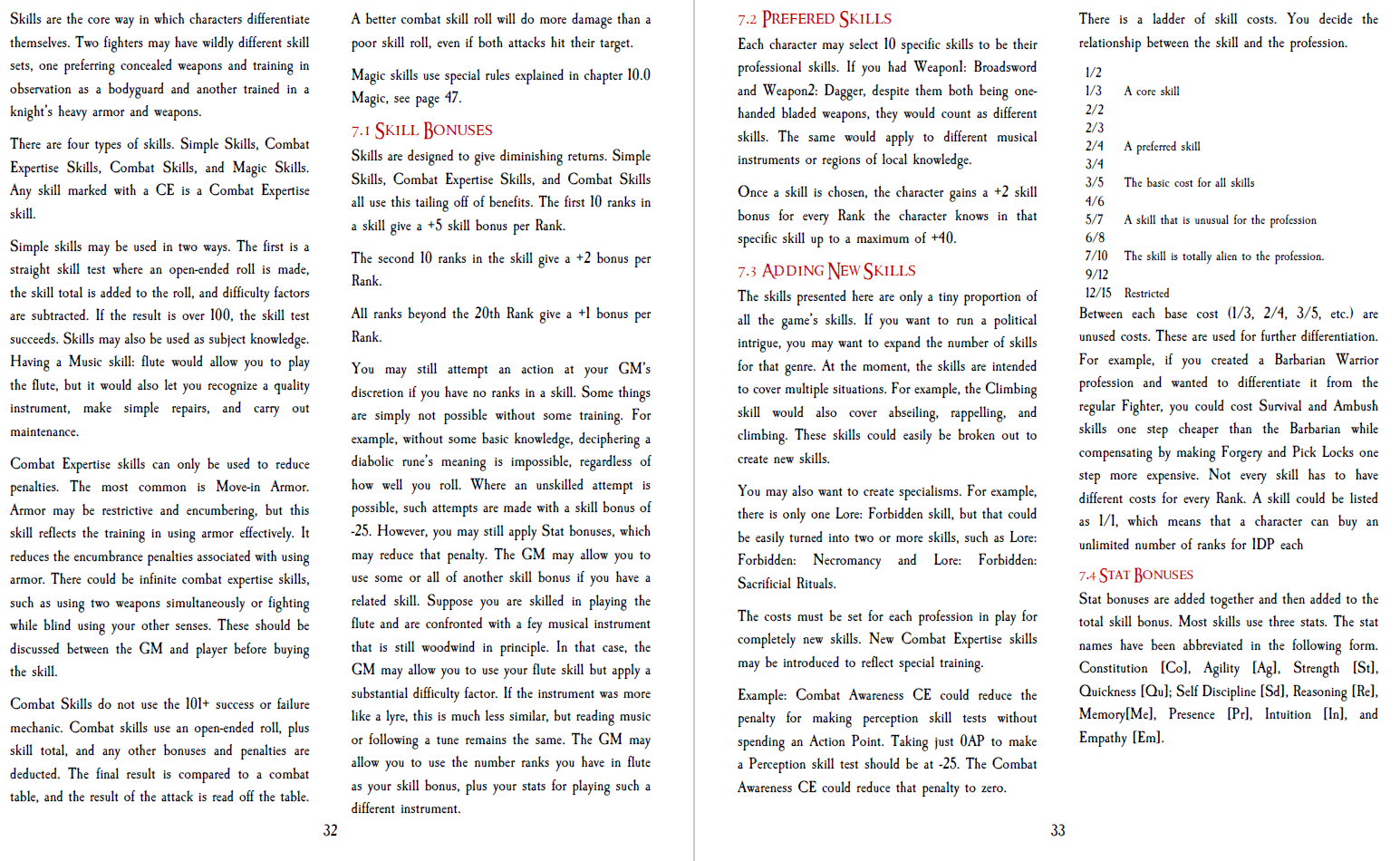
I you look at the screenshot above (from Pilot RPG) you will recognize the skill cost progression, and the numbered paragraph structure. I wanted to keep the numbered paragraphs because they make drop-in house rules incredibly easy to share. You just replace one paragraph 7.3 with a new 7.3 and everything else remains the same.

If nothing else, these OGL versions of the game mean that should ICE go bust again, there is a free alternative version of the game, now both fantasy and science fiction, that will live on, and one that anyone can write adventures for and companion material.

Finally…

It is unfortunate, but all titles that are released on DTRPG for free or Pay What You Want get hoovered up en masse. They are then bulk rated at 2* or if you are lucky 3*. These star ratings are then used by the site as a ranking metric.

If you download either or both games, if you get an automated email prompting you to rate your purchase, please could you give it a half decent rating just to offset the trolls?

Pilot RPG Update#2

I am pleased to say that I have finished the monsters, or at least I have finished the core monsters. There are some OGL monsters that I would like to include, but they are most definitely bells and whistles and not a requirement.

As I was doing the conversion, I noticed that Pilot monsters have OBs on a par with RM monsters, but they tend to have lower DBs and #hits. Essentially, they hit hard, but they are much easier to put down, a bit of a glass jaw.

My first reaction was to fix that, but upon reflection, I want to leave it. It will be much easier to adapt the thousands of OSR adventures to Pilot RPG than it would be to convert them to RMu.

It gives a Pilot RPG character a more heroic feel, and you can put more creatures down with #hits even if you cannot roll a decent critical to save your own skin.

OSR adventures tend to use larger numbers of monsters, and the way they have converted over means that you are likely to be able to use those encounters as written.

The other thing I have done is get stuck into the treasure tables. I have converted over 10 or so today and I have another 13 pages to go. The changes are minimal, converting each +1s to a +5 and so on. Things that were doing a d6 of fire damage become an A fire critical, etc. These are minor tweaks to each item.

That is thirteen pages of items and then a big block of random encounter tables for each biome. Then, I need to finish off the missing attack tables.

None of these are a lot of work; they are just repetitive. I think the most time-consuming single task is getting tables written for d6s, d8s, and d12s into d100 tables.

I does look like it is possible to get the first draft of the game on DTRPG for Tuesday as a playtest edition.

Pilot Update

You may see a lot of these between now and the end of the year. They help keep me on track as I feel that if I commit to telling the world about how much I have done, then I need to do something to justify it, and by telling the world how much remains to be done it motivates me to get it done.

Since the last post, I have started up all the monsters I have (basically the D&D SRD monsters) from B [Banshee] to D [Dryad]. There were no A monsters in the game book I am converting. If I have time for bells and whistles later I may try to add in more monsters, but no promises there.

I have copied across the weapons from Navigator RPG, and have found a list of 13 attack tables and so far 1 critical table that the fantasy rules have that the Sci Fi rules didn’t. I have made one attack table, and one critical table, Morning Star and Cold criticals.

Fantasy monsters are often poisonous, and I didn’t have any poison rules, so I have written those up.

In a completely unrelated subject, I have decided that the World War II version of the game is going to be called Ranger. That follows the theme Navigator/Pilot/Ranger and the US Army Rangers are also dead on the genre. I imagine that I will be able to get some public-domain imagery from the period that I can use for illustrative purposes.

You may ask why I am worrying about the WWII version of the game when I haven’t even finished the fantasy edition, but it was because I was having to cut out the firearms and grenade rules, and that started the mental ball rolling.

I have converted 25 monsters so far, and I have 77 more to complete. Following them are two big sections, a small one on converting monsters and creating your own monsters plus random encounter tables, and treasures and magic items.

Those will be the rules; then I have to circle back and complete any further combat tables and critical tables and then read Navigator RPG and Pilot side by side to check that there are no contradictions between the two systems.

The writing is the hard part, that is then followed by art direction, listing the images that I would like, finding what I already have, and sourcing art for the images I don’t have.

Then we go to layout.

Then we go to playtest.

Last time, I put the rules up for public playtest as a Pay What You Want download and made the commitment that the rules would always be free. It is my intention to do the same again and probably do the same for all of the books in the series.

Doing it this way means that I can go live before I have sourced all the art and reinvest PWYW donations to pay for the art. I can get playtest feedback, update the PDFs, and iterate until done.

That is enough rambling for today, I am now going to get back to monster converting.

Peter

Navigator RPG & Pilot

I have been away for far too long, and there multiple reasons for that, but my own tardiness aside, what I want to write about today has its origins back in 2014.

When I started this blog, someone was asking where was all the playable material online. There were no free adventures or anything for someone running an RM game that was short of time to grab and run.

I also honestly believed that RMu was about to be released. I think we were all given that impression.

Five years later and there was still no sign of RMu, but we were told that there was definitely no plans for an SMu, or Space Master Unified.

I was pretty frustrated, as were many of us, and as I prefer SF to fantasy, that was a real pity.

My reaction was to ‘do a Rolemaster’. The origin story for Rolemaster is one of taking D&D and converting it to the D100 system that we all know and love. These days there are plenty of D&D retro-clones built off of the D&D System Reference Document and the Open Game License [OGL].

Some of these retro-clones step outside of the fantasy genre and one of them, White Star was a FS version of D&D that borrowed heavily from Star Wars and Dr Who, and countless other classic TV and movies, you got Jedi, Cybermen and countless others. All of that was under the OGL and free to hack however you wanted as long as credit was given.

I wrote a bit of software that could make critical tables for me, and a formula to turn D&D damage dice into RM-esque attack tables, and I was 90% of the way there.

D&D had discrete spells whereas RM had spell lists, but I was a fan of HARP style spells with scaling. So I turned D&D spells into the bastard children of HARP but where D&D used per level as a common scaling device, I started using per rank or scaling. I compressed related spells (think cure light wounds, cure serious wounds and so on) into single spells but with scaling, etc.

There were some cool ideas in RMu, such as Combat Expertise, all potentials being 101, and the Vocational skill and some cool suggestions that seemed to fall on deaf ears, like stat bonuses of (Stat-50)/3.

All in all I kept what I liked about RM2/RMC. I adopted what I liked from RMu, and I imported stuff that I liked from elsewhere. The result was Navigator RPG.

That game is virtually backwards compatible with all existing SpaceMaster materials and at the time, if ICE had failed again, it would have kept the Space Master game alive. In the spirit of keeping the game alive I a) made the game free as in free speech – it is OGL so you are free to hack it as you wish, and b) made it free as in beer. The game is PWYW so you can download it for free. It is available in print soft and hardback and you only need to pay print and shipping. I make nothing if you pay the minimum price.

https://www.drivethrurpg.com/product/288954/Navigator-RPG?affiliate_id=730903&src=RMBlog

I also promised a Pilot RPG, a fantasy version of the same game. In theory, that should have been even easier to create.

This is where things went sideways. Firstly, it is never a good idea to think “This will be easy!” Secondly, Terefang from this blog and the RM forums had a brilliant idea. In the spirit of open gaming, we could abandon the OGL/D&D parts, write an absolutely minimal RM system, make it modular, so character stats was one part, skills another and so on, and then create a github for it so anyone could fork off to make their own games or contribute to the project. This was called Bare Metal Edition or BME.

As with many projects, it started with a lot of enthusiasm while we did the easy bits and then floundered when it became work and progress slowed.

That also consumed the time I had free that I had earmarked for Pilot RPG.

So Pilot RPG ended up on the backburner of eternal inactivity.

Skip forward now until November this year. Knaz started talking to Brian and I via the blog and email. The subject of Navigator RPG came up and it got me starting to think about Pilot again. The stumbling block last time around was the magic system. For Navigator RPG, I had made the Star Knight (read that as Jedi) meditations (read as mind tricks/force) by kind of eyeballing it and making a best guess. With BMI, Terefang had noted that the HARP spells had little or no rhyme or reason behind their math but had shared some stuff with someone I cannot remember the name of (sorry!), and between them, they had a balanced system. When I read the BME magic rules, I didn’t understand them, and they seemed pretty incomplete, or I was missing something.

What I didn’t want to do was bash out a wonky, eyeballed system when there was an open and balanced system out there.

With Knaz’s interest, and not understanding what we had written for BME, I thought ‘sod it!’ and I dug out my draft of Pilot, and my OGL source game, and then this week, I started keyboard bashing.

All of the character creation is done, and the dreaded spells are done (in my best cobble-it-together eyeballed version). Most of the weapon and combat tables are done.

Much I can import from Navigator RPG as the rule system is the same and then just fantasize it.

The last biggest task remaining is converting all the monsters and magic items. Converting big lists of items is a chore, but in principle, it is not a huge amount of work. The monsters will be a lot of work, though.

I honestly think I can get this done before Christmas.

Considering that we still don’t have all of RMu yet, I am only 4 years late, in RM terms that is but a blink of an eye.

I will get this finished.

I will ensure that it will always be free.

I will let it all be added to BME so anyone else can build their own game off it.

If you end up downloading it, and you like it, you can thank Knaz, it is their fault, they poked the bear.
New Magics in BASiL

One of my frustrations to completing ongoing projects is that I tend to jump from one work product to another. I started on my “Channeling Chronicles” but got distracted into BASiL Mentalism and then I started reworking BASiL Essence. The positive news is that I continue to create content, but I would rather finish one off, post it up and then move on to the next rather than having 5 projects going all partially complete and moving slowly. I had asked Terry about this when I did my interview with him; I wanted to get a sense for his work flow, motivation and even writers block but we didn’t dive too deep into it. From his own public comments he seemed to have a patchwork approach to his own projects: he was working on Wurilis, moved to Emer IV, stopped to do Green Gryphon Inn, etc.

Anyway, while revamping BASiL (I think I’m going to put up final, revised versions on DTRPG in d100 format) I wanted to formalize some spell casting structures that were still a little loose in all versions of Spell Laws: Power Analysis and Delayed Casting.

Power Analysis.

Broadly speaking, I’m referring to a number of spell abilities that allow casters (or “sensitives”) to interpret power and spells. This could include detecting and visualizing the “Essaence”, Auras, Power Perception, Colors of Magic, and various “Analyze” or “Detect” Spells found in Spell Law or BASiL (Power Analysis).

RM has 3 different mechanisms that can impart information about spells or power:

  1. Passive w/ no latent ability. By allowing spellcasting emanations to be colored by Realm/aspect anyone watching a caster will be able to determine some information about the spell and/or the caster. This allows anyone, even without casting ability or magic skills to visually learn information from someone casting.
  2. Inherent Ability. Some races have or could have the ability to see, feel or detect the Essaence. (Lords of Essaence, some magical creatures, some high Elves?)
  3. Active Spell Ability. All the realms have Detection or Delving spells that can be used to detect the presence of power, or determine the spells effects, level, source or creation.

Like much of RM and Spell Law, it’s a bit of a hodgepodge without any underlying logical framework. Fine. I think that all works, but there is a side to this that hasn’t been fully explored: Caster Signatures. I see this as similar to the Mentalism spells around “Mind Typing”. Basically, every caster leaves a signature, their own flair or style to their casting, that can be detected, stored and analyzed. Much like a fingerprint. So higher level spells like “Spell Analysis” doesn’t automatically provide who the caster is unless the analyzing caster has encountered the target caster’s work before, has “typed” it and the target caster hasn’t hid their spell signature in any way.

This doesn’t add much for real mechanics to Spell Law, but provides a playing dynamic that can add depth to the game. Yes, new spells would include “Spell Typing” or “Store/Recall Spell Signature” and there is a need for counter spells “Hide Signature”, “Distort Signature” or even “Counterfeit Signature” that would utilize another spellcasters casting style. This also adds a clear mechanism for “Evil” casters to hide behind a facade–like Priests Arnak. Currently they are provided this cover with a simple handwave–they all possess a magic ring that hides their evil nature. Bah.

Delayed Casting.

There are a number of “Delayed” spells: Runes, Wards, Symbols, Glyphs, Store Spell and Trigger Spell. Again, I feel it’s a confusing bunch, some of which have individual mechanics that feels more like AD&D then Rolemaster. They are all just slight variations on the same idea: Delaying a spell effect until some variable is met. In BASiL these types of spells are grouped into a different “Realm” due to their similarity and the idea that their casting mechanics, use, rules are VERY different than traditional Essence/Mentalism/Channeling spellcasting. Even moving them into another realm is still confusing. What’s the difference between a Rune and Weapon Rune? Is a Glyph different than a Sigil? How/Why?

Sometimes it’s easier to create a new mental model that acts as a bedrock foundation for spell lists, powers and mechanics. I’m working now on a concept of “Shells” or “Cocoons” to represent this concept. Does it really change anything or does it just help to unify all of these types of inscribed magics? The basic spell concept is the creation of a vessel (shell or cocoon or any other name, culturally or professional) that wraps around another spell and holds it inactive. At lower levels that spell vessel may be visible, may need to be “attached” or anchored (like a rune or symbol) or at high levels float in the air (like a Glyph or Sigil). They can be triggered by simple to complex stimuli and it’s the wrap itself that holds the spell for X time–with that duration growing in spell level. Basically a Spell Bomb Shell.

With “Spell Shells” (say that 3 times fast) you can separate the soft mechanics of Imbedding, Storing and Delaying/Triggered. Right now there is some cross pollination that confuses the situation.

One other possible benefit is that it puts delayed spells back in the normal casting framework, you can stylize it to fit the peculiarities of each realm and you don’t need to have Glyphs, Runes or Symbols with any particular power, it’s the wrapped spell that provides the effect.

Alternatively, it can be just another spell list that adds variety, complexity to BASiL, either as a open or closed list.

Just a few thoughts as a modify, edit and expand upon BASiL. What’s new with you?

Predictive Spells in Spell Law

Some recent comments on the Forums or Discord had me collecting my thoughts on all of the predictive spells in Rolemaster. I’ve always had trouble incorporating comprehensive divination/augury in my games. My experience has been that I go one of two ways:

  1. Make the divination result vague enough to be virtually meaningless
  2. I have to build the spell result into my game, either by incorporating that content into the game world, or by bending the game results to meet the predicting outcome.

I find neither are good choices and I’ve also struggled with those personal biases when designing BASiL. So purposes of this blog post, I’m going to ignore various “Finding Spells” which provide information about a thing or a topic. Most of the spells are poorly designed, but ultimately those spells help provide necessary exposition; useful in a dense world build like Kulthea!

Instead, let’s delve into predictive or forward looking spells that provide information about an event. The first spells that are troublesome are found on the Astrologers Time Bridge list. I already wrote about Astrologers HERE, and since then, several others have tackled a redesign of this admittedly cool profession concept.

Guess. The first level spell just biases the players choice by 25%, perhaps a bit much for a 1st level spell and might encourage guesstimating actions, but it works well in a random rolling game system.

Intuition. Now we start down a slippery slope, with each successively higher level version looking further into the future: 2nd level peers 1 minute into the future while 15th lvl can look ahead 1 min/lvl. How should one DM that without having the “fix in”? Sure, it’s easy to match a few minutes into the future with a quickly generated answer, but isn’t this just predetermination?

Spell Anticipation. This type of spell really makes me feel constrained. First, I actually try and write out spell casting preferences for my NPC’s when designing an adventure: this was common in earlier AD&D modules (see the Slavelord series) but it’s harder to do in RM when RAW can have a spell user with 150 spells by 10th lvl! There is a lot that happens in RM combat, lots to track and NPCs and critters should be played intelligently and to the best of their ability. How can I as a GM lock a spellcaster into a particular spell they may cast in the future? And if I lock it in, how much can that tilt the balance of the combat to the PC’s favor? And is that bad?

Dreams. This is the grand daddy of railroading a party. This literally enables a GM to guide and direct the party exactly as needed: hints about which direction to go? check. Background info on a foe or item? no problem. Provide the party advice on resources and assistance? Sure, they “dreamed” that.

Thinking back, these spells are cool and I probably enjoyed and appreciated them more when I was much younger and starting out in RPG’s. And looking back at the early version of Spell Law it’s easy to see some of that influence: what D&D established, what works for a dungeon crawl, railroad vs. sandbox. But now, these spells are a real hindrance for my GM style and feel very much deux a machina.

How about you? How often do you use predictive spells in your game?

I would like my $279Million Please.

Stolen credit?

Brian, what the hell are you talking about? Well first, there is no such thing as a new idea and certainly there are brilliant writers and developers in Hollywood…but..some of us at the Rolemasterblog might have stumbled upon some of the “plot sauce” that backed the largest grossing movie: Avengers: Endgame.

First, I typically charge a 10% success fee for my work, or a “finders fee” which I will happily share with my Rolemasterblog contributors. Avengers: EG grossed 2.79 BILLION so I think my ask is modest at best.

So how did we earn such a high sum? Well, direct your attention to a blog I posted in 2017. (note bold emphasis)

The idea worth hundreds or millions of dollars?

There is some great commentary but a few that stand out:

Peter, using Voice to Text or similar had this to offer:

Many of the problems with time travel are the same as ghost posed with the forest owl edge spells

Ha Ha, I’m just messing with Peter (who runs this blog and can shut me down anytime). Thanks Peter.

In all seriousness, in response to Voriig’s comment I responded thus:

I’m thinking time travel will be the necessary ingredient to the Grand Campaign–probably via Jinteni tech. I see the GC more and more as a Grand Heist–or stealing back some objects (northern eye, heart of agoth) that has already been stolen. 

So there you go. A world saving disaster, a time travel solution and a complicated heist of needed artifacts. Yep, I completely solved the MCU corner they had backed themselves into. 2 years prior to the movie release.

You are welcome. (And thanks can be expressed with the purchase of our products on DTRPG).