Revenge is inevitable. The blowback of a murder hobo party.


Today I wanted to talk about unintended consequences of game play and connect two previous blog posts about “Newman Groups” and “Murder Hobos“.

Let’s be honest, PC’s in Rolemaster and other RPG’s kill a lot of people and creatures! Even if you focus on role-playing and noncombat situations, most game mechanics support adversarial and violent action. In our last session alone, the group killed (or incapacitated, maimed or left for dead) over 20 creatures–and that wasn’t a particular violent session. Not all of their opponents were purely evil or non-sentient; in fact, most were sentient humanoids or thinking creatures–they just happened to oppose the players or obstructed their goals. These opponents may have had family, friends or compatriots that would feel anger or loss, and probably want some sort of justice or revenge on the PC’s.

Now multiply that ten-fold or more. By the time a player is 20th level, they’ve probably killed THOUSANDS of people, creatures, monsters and animals.  In reality, the adventuring party is constantly creating new groups of enemies that might want to hunt them down.

I’m not making a moral point; Rolemaster is predicated on a detailed combat system with sometimes brutal or gruesome criticals. Killing is normal and common. But should there be consequences for years of endless murder and mayhem?


Dividing loot. An early RPG mechanic.

For those taking note, my blog volume has decreased substantially over the last month or two. Luckily, we have new bloggers that can help fill the gaps as well as bring different perspectives to all things Rolemaster and RPG’s. Unfortunately, my schedule doesn’t free up for another month or two and I’m going to limit myself to shorter posts that are geared towards generating discussion rather than me presenting my own solutions.

Let’s talk about dividing loot. I was meandering through some old D&D material and realized that they actually developed some rules on how players should divide up treasure. I had never given it much thought and in all the years of playing, dividing treasure always seemed fairly simple and intuitive.

Here is the original text from the Players Handbook.

APPENDIX V
SUGGESTED AGREEMENTS FOR DIVISION OF TREASURE

Agreements:
1. Equal shares (share and share alike) is a simple division by the total
number of characters involved.
2. Shares by level is a division whereby all* character levels of
experience are added and the total treasure divided by this sum.
One share of treasure is given for each experience level.
3. Equal shares plus bonus is a method to reward excellence and
leadership. Treasure is divided by the sum of all characters, plus
two or three. The outstanding character or characters, as
determined by vote, each gain one extra share.
*For multi-classed characters add one-half of the lesser class(es)
levels to the greater class levels to determine total experience
levels for the division of treasure. Characters with two classes
receive shares for the class levels they are permitted to employ (cf.
THE CHARACTER WITH TWO CLASSES).

Modifiers:
1. Non-player characters who are henchmen of a player character
count as one-half character or for one half of their levels and
cannot gain bonus shares.
2. A character incapacitated or killed (but subsequently brought back
to life) is eligible to share only in treasure gained prior to such
incapacity or death.
3. Characters who are uncooperative, who obstruct the party, attack
party members, or are the proximate cause of the incapacitation or
death of a party member shall forfeit from one-quarter to all of
their share(s) as penalty for their actions.

Magical Treasure:
While it is a simple matter to total coins and precious items which can be
sold for an established amount of money, the division of magic items is far
more difficult. It is therefore necessary for party members to determine
how magic will be divided. As the number of items which will be gained is
unknown, selection of a system of division is not possible until after the
adventure is concluded.
1. If but one or two items of magic are gained these can be grouped
singly or paired to equal  share of treasure. If one is of relatively
small worth, it can be grouped with money to equal one share.
2. Three or more magic items:
a) best item
b) next best item
c) third + fourth items
d) “x” amount of money as compensation for not getting any
magic items
3. Three or more magic items, alternate method:
a) best item
b) second item + “x” amount of money
c) fourth item + “3x” amount of money

Magic items thus parceled are then diced for, the character with the
highest roll selecting first, and then the second highest scoring character
choosing next, etc. It is suggested that each character be given a number
of rolls equal to his or her level of experience, the highest of these rolls
being the one retained. Non-player character henchmen are typically
allowed but a single roll.
Variations on the above systems are, of course, possible. Systems should
always be established prior to the inception of the adventure whenever
possible.

To me, these rules are a curiosity- a remnant of D&D’s wargaming roots. I wonder if any game since has actually created or quantified a similar system of loot division? A few thoughts I had:

  1. It seems impersonal in a game generally played by a group of friends in a cooperative group. For a convention game or playing in a group of strangers it might make sense?
  2. While it may seem impartial rules would reduce group conflict, shares by level or equal shares with a bonus are begging for player disagreement. The modifiers seem a bit qualitative as well.
  3. I like the fact that it’s mentioned that henchmen get a share as well. That reinforces the importance of henchmen and retainers in D&D that isn’t really found in Rolemaster.
  4. The “shares” reminds me of loot and spoil agreements used by pirates, freebooters and privateers.

I suppose in a game system that quantifies everything and uses 1gp = 1xp, having hard rules about dividing treasure makes sense. Is this a legacy of a simpler time in RPG’s or a needless complexity that has been ignored by most other game systems since? Did you ever use official loot splitting rules for your group? Do these rules foster teamwork and collaboration or create problems? In a game that is based on group problem solving, is it strange to lay out these rules? Maybe it’s just quaint but unnecessary now–like wearing hats in the old timey days.

What other original D&D rules are “outliers” or seem obsolete now?

Revisiting Spell Law: Spell Casting Mechanics Pt. 4 Notational Magic

Welcome to the fourth part of my Spell Law Series.  In Pt. 1 I discussed Spell Law and BASiL in overview. In Pt. 2 I delved into the mechanics of the Essence realms, Pt. 3 into Channeling and now is Pt. 4 I wanted to discuss “Notational” Magic, or written/inscribed magic. Rather than offer my own solutions, I want to open the conversation up from a deconstructive standpoint.

So what is Notational Magic? It’s any magic that requires pictograms, symbols, drawing or writing as part of it’s mechanic; in short, “written or inscribed magic”. In Rolemaster that could include Runes, Glyphs, Sigils, Heiroglyphs, Circles, Magical Tattoos, Blade Runes, Marks, Signatures, Signs and Wards. Over time with various optional rules, settings and companions, many of these words have been used interchangeably and muddied the rule mechanics. For instance, typical “Runes” are written on special paper, can be used to learn a spell or can be cast which then depletes the Rune. Battle or Weapon Runes (RMCI) are temporary spell charges that are cast on weapons and armor. Obviously these are two different mechanics with differing functions, but both are called “Runes”. However, these Runes and the other types listed above share a single trait: all imply a functionality  based on a written/drawn parameter. This similarity is be enough to group these types of magic under a cohesive mechanic, rather than shoehorn it into Essence, Channeling or even Mentalism.

Rolemaster Companion II officially tackled part of the issue with rules around Summoning Circles. While the spells themselves followed standard casting mechanics (SCR, Class I-III etc), there was an acknowledgement that drawing a 10′ diameter circle of arcane symbols might take longer than the 30 seconds it might take to cast a Class III spell. But don’t Runes, Glyphs, Symbols or Sigils need to be “drawn” as well? Or do you feel that the spellcasting itself creates the resulting shapes or symbols?

But stepping back a bit further, we should ask what is actually being drawn or written? A written language? Forms that hold/create power? Power symbols? Is it a written magical short-hand? Something else? Is the shape or form of “scroll runes” different than Glyphs or Symbols? How can a channeling spell be imbedded into an object or rune paper if the spell requires the basic consent of a God? Doesn’t that amount to a work around? If each is it’s own language do casters need to learn different written forms similar to magical languages?

For me, the number and type of the above questions indicates that there is already a massive gap in the rule constructs for written magic. Essence we can subscribe to chanting and waving hands, Channeling to prayer and Mentalism to mental focus and concentration but the similarities AND the established differences in these varying types of magic require quite a bit more organization work.

Finally, if a rune or symbol spell requires writing or drawing, shouldn’t the spellcasting roll be based on the casters skill in writing or drawing? As previously argued regarding magical languages, you can’t use magicial languages to cast high level spells if you have a 1st grade ability in a magical language. Shouldn’t the same be true for written magic? If you can’t draw, write cursive, do calligraphy or draft how can you effectively draw a working summoning circle?

What are other possible issues around notational magic?

  1. Surfaces. What can notational magic be used on? Runes require a special paper. Glyphs can be written on a flux: fluid or air? Symbols require a large heavy stone, blade runes require a weapon but depends on size. Basically it’s all over the place.
  2. Mediums. Is there a medium needed to inscribe the spell? Ink? Paint? Oil? Blood? What about acid etching, chiseling, carving or tattoos? How does the strength or permanency of different mediums interact with the spell, spell casting for general duration? Should it matter?
  3. Analysis. If notational magic has structure should a skill like Runes or Rune Language allow someone to interpret the rune or similar symbol? Should they be able to decipher the rune, it’s power, effect or level?
  4. Visibility. Which types of notational magic or visible to the naked eye? Do they glow, do they fade until triggered?
  5. Casting Time. How long should it take to write and cast notational magic? It should probably depend on the type of writing, the surface and the medium, right? That means a varied system of casting times that break out of the standard Spell Law mechanic. In some respects this is closer to the rules around ritual magic.

Compared to other realms, notational magic has some real disadvantages: needed materials, complexity, casting time etc. This should be offset by some advantages: duration, power or flexibility. That will need some thought.

Finally, last thought. This is really setting dependent but there are opportunities to create some really unique magic styles that could differentiate your campaign. So what are your thoughts? If you could start from scratch (deconstruction) would Runes and similar types of magic work differently than the 3 realms? What other types of notational magic can you think of?


Bone Weapons in Rolemaster & Shadow World

Figure 1.

Last October I posted up some of my work with “Special Armor“: cultural armor that utilizes special materials that is specific to various Shadow World cultures or groups. Since then, I’ve been building on this idea with weapons, and specifically weapons made of bone.

While bone may seem too fragile or may splinter too easily to make good weapons, there are historical precedents. The picture at the top are human bone daggers utilized by tribes in New Guinea. Not only is the idea of human bones cool/grim, the “Runes” carved into the daggers lends itself to a fantasy RPG setting. The tribes also made daggers from bones of the Cassowary, a large flightless bird similar to an Ostrich. For inspiration, check out this article on real weapons made from animal components. Some of these are quite intimidating!

Figure 4.

While scientists have concluded that the human thigh bone has excellent properties for use as a piercing weapon, a fantasy game setting opens up the opportunities for bone weapons made from magical creatures: Dragons, Shards etc.  So let’s take it one further: combining magical bone with Weapon Runes. These become totemic cultural weapons that can help define a unique culture. Special bone weapons are common in other game systems and fantasy computer games, but not really represented in Shadow World. I added  a tribe for my Shadow World campaign:

Igata – Triangle Glyph. Outer islands. The Igata are a reclusive tribe living on the long island south of the Demon Gap. They will trade with passing ships but their isolation from the mainland makes them cautious of strangers. The Igata consider themselves caretakers of the waters of the Ssoei’dawass and the Sea Serpents that travel to the sheltered bay to spawn, and eventually, die. The Igata collect shell fragments and bones from the bay and carve them with powerful runes and fashion them into potent weapons. Their main hall is framed with the rib bones of an enormous serpent.

The Igata skills combining Sea Serpent bones with ritual and inscribed magic (Runes and such) to make charms, weapons, staves, rods and other powerful items that are sought after. The magically infused and unnaturally strong Sea Serpent bone lends itself to enchantment. (see my post and chart on enchantment and material strength; I use a single number for both material strength and enchantment capacity). While bone items may be better for Crushing or Piercing weapons,  I also allow the magical properties of special bone to be used for Slashing as well–or alternatively by utilizing an  “Edging” Weapon Rune.

With so many cool magical metals and alloys in Shadow World, it probably doesn’t seem necessary to add enchanted bone weapons, but I think it adds a lot of cultural flavor to the game. Have you used Bone Weapons? What SW or RM creature would have “good bones” for use in these weapons?


Rolemaster Deconstruction: Familiars. How should they work?


Familiars are not only a staple of fantasy fiction but a core visual ingredient of Rolemaster book covers–specifically the ongoing series of Angus McBride covers from earlier RM books that featured a cast of PC’s with several small animal Familiars.

Familiars had a more sinister aspect in early fiction; most often a demonic imp, crow or other dark-aspected animal tied to an evil antagonist. Early D&D applied this concept to any M-U, and broadened it to a simple servitor or animalistic henchmen of a spell-caster.

First, let’s differentiate between “animal control” spells and “familiars”. Animal control spells are featured in the Animist, Beast Master, Druid and similar professional lists in Spell Law and Companions. These are spells that summon/call, control/master and sometimes allow the caster to sense through a controlled animal. These are all powerful affects, in in some ways SUPERIOR to the limitations and penalties associated with Familiars. So how does Rolemaster deal with Familiars? Fairly easily, in fact, so easy that it behooves a caster to immediately have one.

So why would a caster have a Familiar?

Familiars have a symbiotic connection to the caster where animal control is just a magical charm or affect on a creature. So what is the symbiotic relationship? What benefit does it provide besides cinematics? How does it work, mechanically via the rules?

The basic premise is that there is a REAL benefit to the caster, but at the cost of INVESTITURE. In other words, if the relationship is severed there is a real, physical or psychosomatic cost to the caster. Otherwise isn’t it just easier and less risk to control creatures when needed?

So what is the benefit, or possible benefits, of a familiar that differentiate it from other animal control spells? Here are a few ideas:

  1. Communication. The Familiar bond should allow for free two way communication between the caster and creature. This may not be actual “language” but at least a strong empathic bond.
  2. Awareness. The caster and familiar should have some base awareness in terms of location/distance of each other at all times.
  3. Shared Awareness. With concentration the caster might be allowed to project sensory ability and awareness through their Familiar.
  4. Control. The caster, with concentration, should be able to have some control over their familiar or, at least, give simple instructions for a Familiar to execute.
  5. Shared abilities. A caster might gain some extra-abilities through the Familiar relationship. Perhaps better vision, languages, strength, sensory etc. On the flip side, a Familiar could gain some intellectual ability bestowed by the Familiar bond.

Most of these benefits mirror other animal control spells. But those are temporary spell effects; a Familiar is permanent.

My belief is that GM’s are reluctant or adverse to Familiars. Why? Familiars are really NPC’s for the benefit of the PC’s. That really complicates the narrative.  GM’s not only have to manage normal NPC’s but a constant stream of Familiars that can upend the storyline unless the GM takes the Familiars into consideration!!! At that point, who is the audience? Additionaly, Familiars can change the challenge/reaction of normal adventures–familiars act as scouts or agents with heightened senses that can off-set the normal challenge-balance. At the least, Familiars can be the “canary in the coal mine” and alert the group of traps or other imminent obstacles.

Some additional thoughts:

  • Familiars are GM agents. You can better control the narrative through them.
  • They should be of animal intelligence. They may act with pro-forma intelligence via their caster, but their base ability should be simple animal intelligence.
  • Size. Should they be of smaller size? Should a caster have a bull as a familiar? Probably not. I would restrain the spell limits using the size rules to Small or less.
  • The penalty for losing a familiar should be EXTREME, or at least cautionary. The tie that binds should snap back accordingly and in proportion. This could be loss of temp CO. or even a permanent CO pt, a general activity penalty and even worse.

Again, this goes back to risk/reward. No GM wants to manage intelligent Familiars that run the unknown gauntlet, trip the traps and distract the monsters. At that point, who is playing? Familiars should be carefully hoarded resources–a cool benefit that needs to be defended! Are familiars a great resource in you game?

Of course, if easy and beneficial, every player will have a Familiar. But if the risks and rewards are balanced, would it be different? Maybe the whole concept should be reduced to a simplified, professional agnostic “Animal Bond” mechanic and spell list. That eliminates the whole D&D Magic-User familiar trope and become a generic but specific rule-set that could be used by a variety of PC’s or classes: Magician, Animist, Druid, Beast Master, Barbarian etc. What are your thoughts?


Two philosophies of RMU: rebuild or reorganize?

While it’s  much too late to change the course of events, there are still a number of detailed conversations going on at the RM Forums regarding the RMU Beta test.

For me the endless rules debates became too deep a rabbit hole that I didn’t want to go down any longer and there are still many players who are fiercely engaged. So rather than discuss actual rules, I thought I would discuss the rules making process. A bit of a meta-debate if you will.

I think the RMU development process has become a rorschach test for the RM community. It’s clear that there are variety of differing and strongly held beliefs about the rule resolutions and they are mostly the product of an individual’s ideas on versimilitude and their own tolerance for complexity. I discussed Chargen complexity in a previous POST, but I wanted to broaden the scope of my question into 2 parts. First, does RMU rebuild the ruleset or just reorganize and streamline it? Second, are peoples suggested rule changes a rebuild or a reorganize?

I think the answer to the first question is easy. RMU stayed “inside the box” and merged, streamlined and tinkered with core mechanics without any significant rebuild. Perhaps the only rebuild mechanic that was introduced was the size rules and those were discarded after community input.  Arms Law still kept weapon tables, crit charts and the basic combat structure. Does the round sequence or initiative rules rise to the definition of a rebuild? I think it was evolutionary, but certainly not revolutionary. Spell Law was left almost as-is, with some spell mechanics rewritten or clarified, spell slots filled but little else. Character Law seemingly reduced RMSS skill bloat (but not really) and added to the Chargen process with pages and pages of talents and flaws–rules for rules!

So my second question–are your solutions rebuilding or just tinkering around the edges? It seems like many rule suggestions (including mine) are just an attempt to get RMU to adopt house rules in some fashion. But are these suggestions meant to truly revise RM or are you painting within the lines? I think RMU met it’s name: it’s attempted to unify a diverse community within the established mechanics.

But did RMU need more? If so what?

Did rule changes take you out of your own comfort zone?

Are proposed rules to the benefit of growing the community or appealing to the current user base?

Do RMU rules advance the system into the contemporary gaming community?

I negotiate for a living and a saying in my profession is that the best possible deal is when both parties walk away somewhat dissatisfied.


Adding “dark things” to your Rolemaster and Shadow World games.

Poisons, diseases, curses. Oh my. In the earliest days of D&D, adventurers not only had to avoid traps, navigate mazes and defeat monsters, they had to contend with other insidious agents like poisons, level drains, curses or cursed objects, petrification and the diseased touch of the Mummy.  Not really a safe vocation when you really think about it! While much of the Saving Throw/Resistance Roll mechanic was built around these attack types, how often do GM’s really use these “dark things”? How often do you introduce poisons & diseases in your campaign?

D&D made many challenges fairly simple. Curses could be countered with a particular spell, poisons could be Saved or cured etc. They were designed to be yet another discrete challenge that has to be overcome. A binary mechanic: effect vs. cure. D&D didn’t bother with specific poison antidotes (unless part of the narrative) or even causation (what is a curse and why so prevalent in D&D). You Saved and you were good, you failed and you had to seek out a singular solution.

Rolemaster introduced a more realistic system for many of these challenges; and poisons were definitely more detailed! Not only were there many poisons, they were defined into 5 types, had specific antidotes, and had varying levels of effects. A similar approach was taken with diseases and whole spell lists were devoted to varying curses whose effects spanned the realm of imagination.

A few years ago I took a critical look at my own campaign and GMing proclivities. I realized that I rarely used diseases, never used curses (or at least hadn’t for many years) and was reluctant to delve into poisons.  Now I see these interesting affects as not just a quick add-on but great additions to my narrative toolkit. Let’s take a look:

  1. Poisons. Many GM’s are reluctant to use poisons due to their variety, unpredictable effects AND some sort of ethical standard (maybe established by D&D class restrictions). I think that’s just wrong and leaves a whole layer of complexity to gaming. Putting our own social norms aside, the widespread use of herbs in the RM/SW world clearly lays a path for the common use of harmful herbs and agents as well. I just finished then newest Mark Lawrence book that prominently featured the use of herbs and poisons–it really inspired me to add more depth to poisons and an added value to the skill. Luckily, RM and SW already has a comprehensive list of substances that I collated into a MASTER LIST. I also left Poison as a meta-skill that covers identification (by taste, smell, symptoms etc) preparation, application and use, and as part of our system that provides a benefit for ranks, the # of ranks in Poison is also added to any RR vs poisons.  (This models the idea of a poisoner taking low doses over time to build up their resistance). So now poisons are like spells, with varying effects, methods of delivery and counter-antidotes. To facilitate poison (and similar substances) it helps to use a variety of mediums: paste, liquids, powders, oils that have varying effect times and for pre-prepared antidotes to the most commonly known agents. And poisons don’t just have to kill, they can paralyze, knock a person out, make them dizzy etc, so they aren’t just a deadly, unethical or cowardly attack only favored by assassins and “low men”. Poison preparation also shoehorns into our alchemy rules and can be combined with various substrate delivery systems. I’ll be expanding on this in an upcoming blog or RMBlog fanzine edition in the near future.
  2. Diseases. I think my reluctance to use diseases is multi-fold. First, diseases are generally slow acting so they don’t create a sense of urgency. Second, Elves and even half-Elves are basically immune to diseases so in SW much of the population doesn’t eve worry about it. Finally, Spell Law healing makes curing diseases fairly simple and implies most societies are not going to have problems with disease in general. Besides having a disease as a core plot point to an adventure, I think diseases only work well if they have affects measured in days or weeks and not months or years. That may only be magical diseases. Like poisons, I avoided using diseases for many years, but now I like them a lot–especially the slow, sapping type. Perhaps it’s reduces Str & Co 1 pt a day or week, or there is a slowly increasing fatigue penalty. That hits home with the affected player as it directly impacts the game play–they’ll want to deal with it!
  3. Curses. I still can’t remember when I last used a curse. I specifically reduced “Curses” down to a single spell list in BASiL (and even then it was difficult to rank them by level) and I don’t think I’ve used a cursed object in RM or my SW campaign. I feel that curses are very setting driven and probably generated from Channeling/Diety. In Rolemaster, Curses are more “ill effect” than the common idea of curses that tend towards future effects and augury.  Traditional curses are too open ended and hard to fit into the gameplay. I’m open to ideas, so happy to hear other peoples experience with them.

But “dark things” are not just limited to poisons, disease and curses. Beyond these traditional agents, Shadow World may provide a bevy of interesting taints, attacks and complications that can add to your campaign. Here are a few thoughts and ideas:

Demonic Possessions. I’ve blogged about the problems with summoning and demonic possessions should be based on the particular setting. But Shadow World does have Demons, so it’s possible to have Demonic possessions beyond the thematic demons introduced by Terry. Having a player possessed could make for interesting sessions: Demons may not have any particular agenda beyond being a chaos agent and maybe they even impart some Demonic powers (like Frenzy).

Mental Illness. Introducing a mental illness to a player really relies on their roleplaying skills, but can add a interesting twist to group dynamics. Traditional Mentalism spells can cause mental illnesses, but how should they work and manifest in game play. Serious illness beyond phobias and violent tendencies are going to be metagamed by the player, but a players that really commits to it can be a lot of fun even if it gets the group into trouble.

Unlife Taint. There has been several attempts to mechanize Unlife taint in past GC’s and some other thoughts on the Forums. Obviously there needs to be corruption rules for SW. Should this work as a player accesses “Dark” spell lists? In my own campaign I differentiate between “dark” lists (that are the result of the Gods of Charon) and “Unlife” spell lists which tap into an alien, malevolent power. These lists are the various Priest Arnak lists I posted up on the RM Forums, and the lists Terry made for the Steel Rain and other Unlife organizations. Ideally, the Unlife lists should be really different from standard SL lists and more powerfully to justify and entice spell users to explore and experiment with them–and start down a slippery slope. Unlife corruption should be a core rule mechanic for SW. The concept of players “flirting” with learning and casting powerful Unlife spells and risking being corrupted or subsumed by the Unlife is a great fantasy theme.

Channeling Block. A priest who defies their god, behaves in a inappropriate way or similar should be punished. The quickest and most obvious is to sever them from their spell casting ability until they make atonement for their actions. This atonement process is a natural trigger for an adventure or quest!

God Cursed. Similar to the disfavor in a channeling block, a character could get a “mark” that shows they are cursed, outcast or disfavored by a god. This could be in the form of a birthmark, shaped scar, change in eye color, or symbol that can be seen in the person’s skin (excommunication). This would be an ill omen in most cultures, and make it difficult for the player to interact with society.

Just a few ideas that I need to explore in more detail or finalize as rule mechanics. RMSS and RMU have introduced Flaws that are similar to these, but I like for fluidity to these more than CharGen mechanics to offset talents. What has been your experience with “Dark Things“?


Thoughts on ancient structures in fantasy RPG’s and Shadow World.

We dropped anchor in the deep bay west of the Sullen Mountains. A solitary volcanic cone, trickling a faint plume of smoke from its summit loomed above us. The swells chopped but the water was relatively calm compared to the weather we had faced the past few weeks. To the north we beheld the Sunken City, the natives call it the City of Giants, but a cursory inspection of nearby structures indicated the occupants were most certainly mortal in size. The tops of huge blocks, broken towers and chipped obelisks worn down by the millennia spread as far as the eye could see. There must have been leagues of crumbling ruins above the water, but I could only imagine what secrets lay beneath the dark waves.

Travel Journals of Malco Teves, Merchant Captain of the Storm Sea Free Traders

Ancient castles, dark crypts, lost cities. Exploring ruins and structures is a key component in fantasy roleplaying, and if your games are similar most of these “ancient structures” are in fact really not that “ruined”.  I recently visited the Yucatan Peninsula and 4 different Mayan sites: Chitzen Itza, Coba, Tulum and a small complex on Cozumel. In some ways, Coba was the most interesting as much of the huge site (home to 55,000 people) is still buried under the jungle.  As I walked through the jungles, I definitely had my GM hat on, and thought about the experience through a roleplaying session. Peering into the jungle you can see numerous, huge, mounds covered in scattered stones, undergrowth and trees.  These are all buildings that not only haven’t been excavated, they are probably just piles of rubble. Most of the iconic buildings we see at these sites or in pictures are the result of complete rebuilding–often times done multiple times to either repair shoddy work or to correct architectural mistakes as archaeologists gather new information.

In other words, many untouched ancient ruins in real life wouldn’t make good adventure settings! Over time ancient structures degrade: they are buried under strata, collapsed in cataclysms or earthquakes, looted, stripped of cut stone for new buildings or leveled by conquering forces. In jungles, foliage quickly cover buildings and root systems crush and grind the buildings to dust. This reality is in sharp contract to our expectations as adventurers. Rarely do parties have to dig for days or weeks to uncover a tomb entrance or hire a work force to lift and move thousands of cut stones of a collapsed building. Many structures might not even resemble buildings as much as mounds of rubble or small hills which doesn’t work well for a cinematic approach to your game. I think we all tend towards “ruins lite” in our games: basically recognizable and functional structures with some crumbling around the edges.

But what if the buildings are much, much older than Earth comparables?  Right now the oldest constructions on Earth are 10,000 to 12,000 years old (Gobleki Tepi and Jericho) and GT was purposefully buried in 8000 BC to protect it! The 3 Eras in Shadow World span more than 100,000 years with many distinct high tech cultures and of course immortal Elves. These cultures left behind remnants of their civilizations across the planet.

Priest King of Shade (the opening vignette was taken from that) includes the ruins of a 1st Era Althan city. Over 100,000 years old, partially submerged and continuously explored and looted by subsequent cultures I had to think about how it would have survived or what it’s present state should be. Since we don’t have anything to compare to here and it was a city of advanced tech I had to guess at it. And what about other ancient lost ruins that may not date to the 1st Era but are still TENS of thousands of years old. Should we expect them to be intact, structurally sound and playable? Maybe hand wave their condition away due to “magic”?

I’m curious if anyone else has thought about this, introduced standard archaeology or excavation in any of their adventures or have thoughts on this topic?

Current Affairs: Thoughts on Magical Languages in Rolemaster and Shadow World.

Warning: this might be a whisky rant as well.

A recent THREAD at the Rolemaster Forums is discussing Magical Languages. Since I have some opinions on this subject I thought I would write a quick post. For those following my discussion on BASiL or have downloaded the spells probably know that I use a “no profession” system for my own Shadow World campaign.

After reading lots of comments I realize that most people only understand my reference to “no profession” as a direct reference to the RM system “no profession”. That’s not it at all! My players have profession names–but those are descriptors driven by the sum of skills and abilities of the character. With BASiL I allow access to all the realms (but  I have no hybrid realms which break logical mechanics). Professions and classes do reinforce group roles, but again, Rolemaster mostly broke that a long time ago…AND…that’s why players liked it! So having broad access to all realms has the appearance of unbalance but it’s really just the case of applying “free market” principles to control player skill selection. Early on, I decided to use pre-requisite lore skills to gain access or use certain spell lists. This would be similar to requiring advanced math to do astronomical calculations or basic anatomy for healing skills (spells or otherwise). So BASE lists might require more lore ranks to learn while OPEN lists only need a few ranks. To me that made sense. But BASiL is a work in progress and participation in the Rolemasterblog and RMForums has introduced me to new ideas.

So lately I have backed off on the Lore skill pre-req approach. It added too much to my skill offering and was not tight enough. Instead I have changed my approach to the use of Magical Languages. It’s such a simple, elegant mechanic and solves a lot of problems.

In the past, Magical Languages have been a “bolt-on” mechanic; introduced in Companions and referenced in SW for added casting bonuses etc. Spell casting requires certain mechanics: verbal, gestures, focus, components whatever. But what is that verbal and gesture component? Should it have an underlying science behind it? Is the verbal component linguistically diverse? Can a French person speaking french or a German speaking German recite the same words in their own particular language to cast? That makes NO sense! Immediately, it would be argued that they aren’t speaking French or German but reciting “arcane sounds”. Exactly!!–casting requires a power language of some time that is divested of speaking languages. Once that is accepted the conclusion follows the logic: spells need be cast using a magic vernacular, a magical language. This doesn’t have to be just verbal recitation but gestures, body motions, chants or katas.

If you accept that, than building a number of magical “languages” becomes a powerful tool to limiting spell list access rather than arbitrary “professions”. An Elemental Language might allow casting element spells, while another may allow for Illusions, Arcane or other.

From a mechanics standpoint, I use the Magical Language skill bonus for the SCR. How can anyone cast a high level spell if they have a kindergarten mastery of a language needed to cast the spell? Mastery of magical language is mastery of casting. Creating numbers of “Power Languages”  that are needed for certain types of magic limits a casters ability to learn a wide range of spells and therefore reinforces “class tropes”. (on a side note, to me, the very people that argue for professions LOVE the Arch-mage, Warrior-Mage, and other unbalanced classes).

I.C.E. Deep Dive. Loremaster Series Review pt.4: The Shade of the Sinking Plain.

We are at the last chapter of my reviews of the original Loremaster module series. I wish I could say I saved the best for last; but that’s not really the case. While Shade of the Sinking Plain has occupied a place of curiosity, appeal and mystery for decades, it’s not that great. Basically a D&D module re-purposed for Rolemaster.

Despite it’s arguable quality, it’s generally seen as a “rare” book, at times on par or even more than the price of The Court of Ardor. SotSP can fetch hundreds of dollars or more in excellent condition. But has anyone read it or even used it in an adventure? A quick but not exhaustive search via google and I couldn’t find a single review of the Shade of the Sinking Plain!

First off, SotSP is a “Loremaster Adventure from North Pole Publications, Inc.” and prominently says so on the cover and ToC.  Interestingly, North Pole Publications did at least two other products: The Serpent Islands and Tome of Mighty Magic and there may be MORE. I don’t have time to hunt them down, but it would be interesting to find out more on the company. The credits can be found in the back. Apparently the author was Roger Walker with development credits to Terry, Douglas Bohlman and Rober Walker.  The remainder of the credits for art, production, editing and play testing seems a mix of North Pole and ICE.

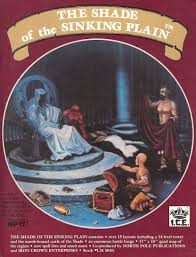
The Cover.

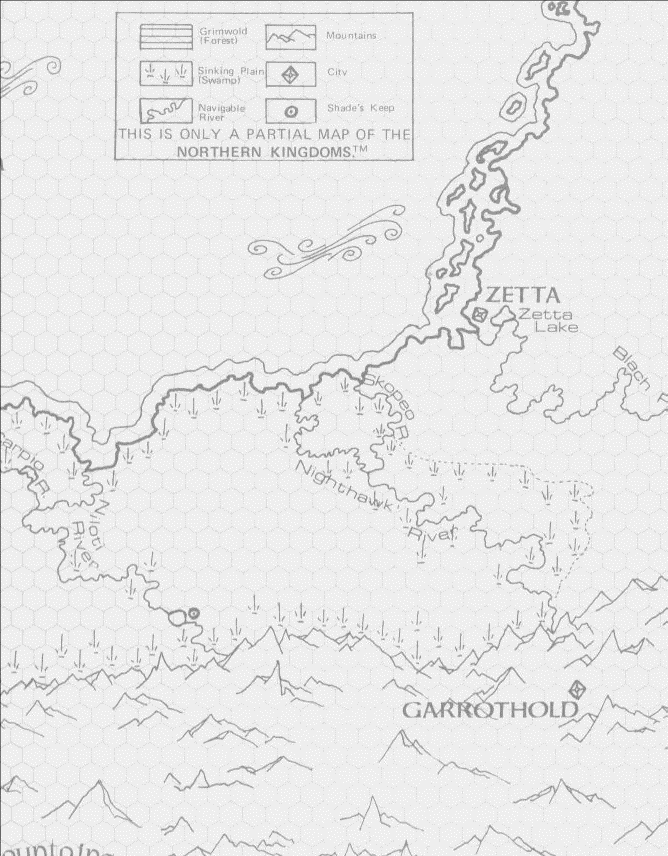
The cover art quality is average but the scene itself is compelling.  A robed figure sits on his throne while slaves or pirates present treasure and booty. Skulking behind the throne is a Demon of some sort. The art appears to be done by Victoria Wheeler in 1983. The back side of the 1 piece cover is a large hex map of the “Northern Kingdoms” (which is Trademarked apparently). It’s a fairly simple map with only major geographic features, the location of the Shade’s keep, a few cities and that’s about it. Pretty sparse and in no way the quality of the Iron Wind or Cloudlords. (or Vog Mur for that matter). Again, we get the sense that this is an outlier. More Judges Guild for D&D than a curated ICE/RM product from Terry, Pete and crew.

Table of Contents.

The ToC looks like an attempt to bend the modules material into the standard Loremaster organization: section 1 is on the world of Loremaster, 2 is a general overview, 3 is Politics and Power, 4 is a physical overview, 5 is people of note, 6 is layouts, 7 is a gamemaster guide and 8 is scenarios/adventures. I’ll get more into the actual content, but it feels like there was a half-hearted attempt to “Loremasterize” some of the material by North Pole.

Material starts at page 2 and the font type immediately feels like Judges Guild or Midkemia Press than an ICE product with a smaller more distinct font. There is 1 page of the standard “world of loremaster” copy and then some definitions/glossary with RPG terms and historical people and items. Page 5 has a short general overview: basically the land of the Sinking Plain is an enormous marsh. That’s it in a nutshelf. A paragraph on inhabitants: the only humanoids are Trolls. The cities are mostly Common Man. The woods have Elves. The foothills have Goblins, Orcs and Dwarves. This is all very generic.

Politics and Power.

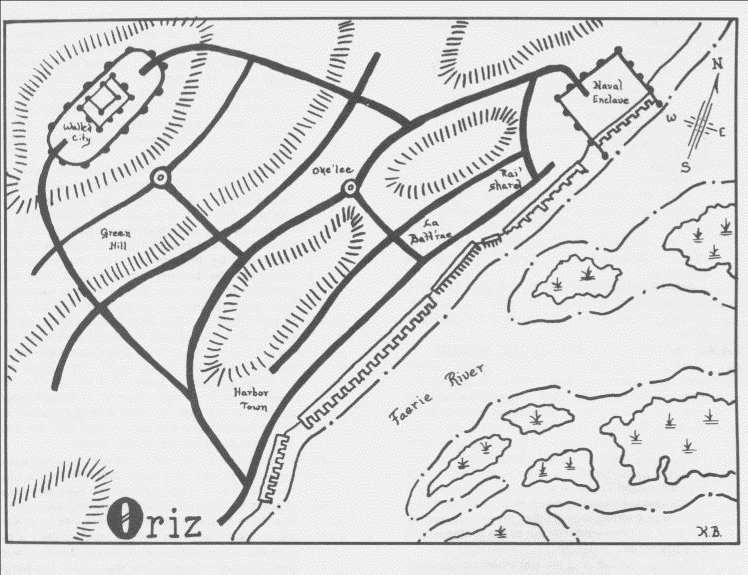
This section is an overview of the three cities: Zetta, Garrothold and Oriz, but the majority of the section focuses on Oriz. Why it’s called “Politics and Power” is beyond me. Zetta and Garrothold only have the briefest of material so the GM will have to fill in a lot of information for the cities to be useful in the game. Oriz gets a small hand drawn map (see above), lengthier material on different city districts, a rumor chart and some notes on the monetary system.  Strangely, each of the 8 districts are covered twice, first as descriptions and then again under a sub-category “Economy”.  Overall there is 5-6 pages covering the 3 cities and it’s sparse. The last section is a Vignette–a short first person narrative used to introduce the Shade. I’m curious whether this was written by Terry or an ICE staff member as the quality of the writing is much better than the rest of the module.

Physical Overview.

This section is short and a bit puzzling. First there is the crappy map you see above–my drawings are pretty bad, but that one looks like it took all of  minutes to draw. Unlike the other Loremaster/MERP and SW books which feature excellent maps, Shade just doesn’t keep up. Then there is a short section that describes the Shade’s keep and his Bronze Barge.  The barge is very cool, but this material should have just been inserted in the later “Layout” section. Finally there are some encounter tables that don’t work well inserted into the page layout–they should have been structured as actual tables in the back. Again, the organization of this module is poor and really breaks up the flow of information.

Peoples of Note.

This is really the “Politics and Power” section as it covers the key NPC’s and there history. This is the core of most ICE modules as it provides an overview of the dynamics and backgrounds of the key people. This section is a bit more comprehensive (punched up by Terry or ICE?), and covers the “Shade”, Aaron the pirate captain, Prince Arndre W’ricke ruler of Zetta, Danel Silens an advisor, King Y’rage, Smiley a war lord, and finally Lito Extempler prelate of the truth. Most of the section is spent on the Shade, as it’s the key NPC opponent for the players.

Layouts.

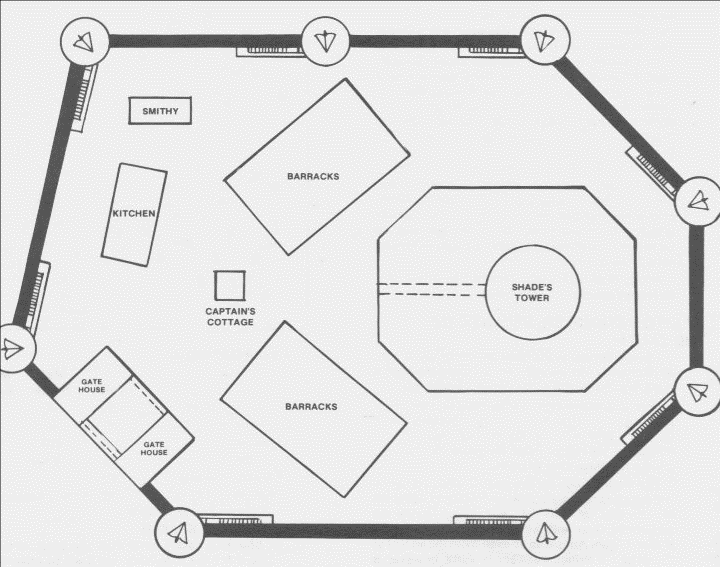
Section 6 covers the layouts of the key locations. First is the Shade’s keep:

It’s basic but serviceable. Then there are some detailed drawings of the portcullis winch system and piping used to disperse a variety of fluids: oil, acid, paralysis and “moron oil”. These oils are keps in cauldrons that run along ceiling tracks. Compared to the rest of the module, this is very specific and detailed and feels like Terry or Pete had a hand in this.

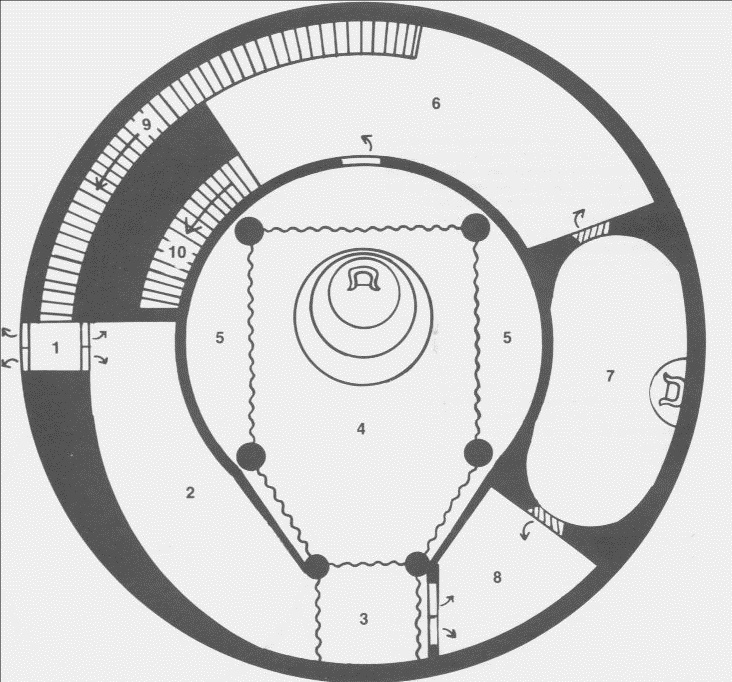
The next layout is the Shade’s tower:

This is a great layout and the layout key was definitely written by Terry or ICE. There are great traps, descriptive text and there are 14 levels in the tower. The Shade’s tower layout is really the best part of the module and a great drop-in to any campaign. In fact, it would be a great fortress for Roth Naku, the Lich that resides in the Thanor Stand (p. 68 Emer II).

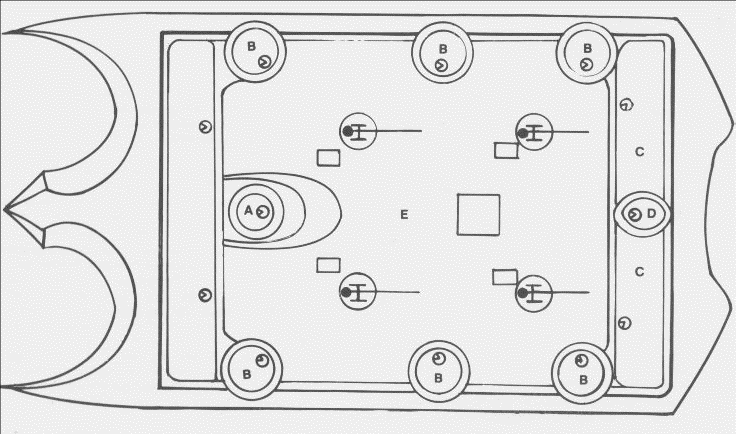
The next layout is the Shade’s bronze battle barge.

The barge is huge, with multi story battle towers, rams, catapults and driven by an Elemental Engine. Very cool so far, but here is the kicker for me: the 380′ barge can be reduced to toy size and put in a storage bottle due to a spell “Boat in a Bottle”. I was never a fan of shrinking castles and ships and it doesn’t feel very Rolemaster.

Game Master’s Guide.

Section 7.0 is a mixture of material. The first part covers the “adventure phases”–basically the writer sees this module as a linear adventure rather than a sandbox setting like the other Loremaster books. It’s a short story in 4 parts: gather info, travel to the keep, the battle, return and collect reward. The next part introduced new magic items. There are a few good ones included but one in particular is like the barge: it’s a marble cube that transform into a 13 level fortress including forming a hill as it’s base.  Again, I’m not keen on the concept; it seems more whimsical magic than the more grounded magic found in Rolemaster. After the magic items, we have a number of new creatures: some Demonic creatures, some hybrids, snakes and giant spiders. Nothing to revolutionary or creative. Next are new spells. This IS interesting as North Pole Publications also did a Tome of Mighty Magic. Listed are individual spells that name lists and level so they can be incorporated into existing Spell Law lists. Many of the spells are more suited to d20 games but there are few goods ones:

Tangle Weed. Basically allows plants to attack using Large envelope. Plant attacks weren’t found in the first iterations of Spell Law (either Animist or Ranger) and seem pretty obvious in hindsight.

Alaup’s Zufferooma. I’m not a fan of “named” spells, but this one is pretty funny. It creates an almost indestructible, horrid, camel that is constantly surrounded by a sand whirlwind.

Healing Sleep. This is a good one. It basically sends the target into a deep sleep but also provides accelerated healing.

Hey Bartender. Yes, this spell summons a magical bar and bartender.

Elemental Summons. RM didn’t have any elemental summons for quite a while. The module has 6 summon and control spells that can be inserted into Gate Mastery. That’s a good add if you are using 1st edition RM.

The next few pages are the master charts: Personalities, NPC’s of Note, suggested player characters (thief, rogue, ranger, bard, magician, cleric), Master military, creatures, movement/travel rate chart, and several price charts.

Scenarios.

The final section breaks down the adventure path with very specific If/When conditions.  Again, the intent here is a standard linear adventure, the the GM is coached here to keep the train on the tracks. But in this section is something interesting: a simple large scale combat system. Basically this is used for a infantry or siege battle with 30 minute phases, morale checks, archery mechanics, fortifications and charts  for Attack Conditions, Heavy Weapons, Ship Capabilities and troop training. I’m not familiar with War Law, but someone should check these rules out and see if they make sense. They only take up about a page or two and it might be a nice little mechanic for troop actions in RM.

Overall impressions and thoughts. At it’s core, Shade of the Sinking Plain is a short, basic adventure. The efforts to expand it’s scope with cities and regional maps just fall short in quality and there is so little there it’s basically meaningless anyway. However, the Shade’s keep and battle barge are cool and interesting and the NPCs can be easily fleshed out. There are some good spell ideas and that battle mechanic may be useful for a quick and dirty mechanic. Ultimately, the most useful and well done section is the Shade’s tower and that definitely has a RM/SW feel to it.

Finally, for clarification, my module The Priest King of Shade WAS meant to be a re-imagining of Shade of the Sinking Plain. I kept the best “kernels” of Shade and expanded it into a more traditional Shadow World regional module located in SW Argyra.

Thus ends my 4 part blog on the original Loremaster series! Thanks for reading.