Character Creation Time

Today I finally got around to posting the character creation guidelines for my online game.

The only real break from the RAW is that I am giving more development points per level than listed. At each level characters will get 70 DPs rather than the standard 50DPs.

This should give the players a bit more wriggle room for buying skills. The No Profession is a bit more expensive than any one of the dedicated professions so the 70DPs will not go quite as far as you would imagine.

The game is set at a Heroic power level so the additional knack (+20) will also give a bit of a boost to the starting.

I hope that with the information I have given the players they should now be able to start creating their PCs.

If you have been waiting on this then I sincerely apologise for my tardiness! 2018 is turning into a rather fun but busy year so far!

This post currently has 7 responses


Cabin in the woods!

I love this adventure hook! I am not going to tell you much about it as it could spoil the surprise if your players got wind of what is actually going on.

What I like about this particular publication is that it is one of the most substantial documents. You get a one page adventure hook but also full colour printable battle maps. You print off the twelve pages and join them together to get the layouts for the adventure. It seems to me that we are ever inching a little closer to producing a really full on adventure module.

In The Cabin in the Woods, the characters may have been hired to deal with a group of bandits or otherwise have heard of them.

The bandits have a cabin in a clearing in the woods but the characters are not the only party looking for the bandits, and it is possible that the characters, and the other party, are both disguised as bandits, leading to several potential outcomes when the actual bandits arrive.

This post currently has no responses


It Lives! Muhahah!

I am running terribly behind this month by the looks of things!

I completely failed to get a post out on Sunday and despite really wanting to complete more of my lingering projects in 2018 I am, if anything, falling further behind.

So last Saturday we published It lives! Muhahah! which is a take on the classic Frankenstein story but for those that like a bit more role play over hack and slash there is a potential bit of investigation and plenty of NPC interaction. This adventure was one of my mine, so of course it is brilliant!

At some point this week I will update the side bar with links to the 1-10 bundle and all the latest adventures. If you have bought any of the earlier adventure hooks you get a discount on the bundle, or so is my understanding!

This post currently has 9 responses


I.C.E. and early Dragon Magazine Ads

Like many of you, my first exposure to Iron Crown Enterprises was through advertising in Dragon Magazine. Looking back at the ads, they seem simplistic and perhaps crude in their execution, but then they were strangely compelling. A combination of ad copy and art effectively conveyed the “gritty” and “realistic” feel of Rolemaster.

I thought it would be interesting to go through some of the very first ads in Dragon and explore how they changed and progressed over time. One thing to note–ICE had page #3 for all of their ads so it was one of the first things readers saw. That probably helped alot.

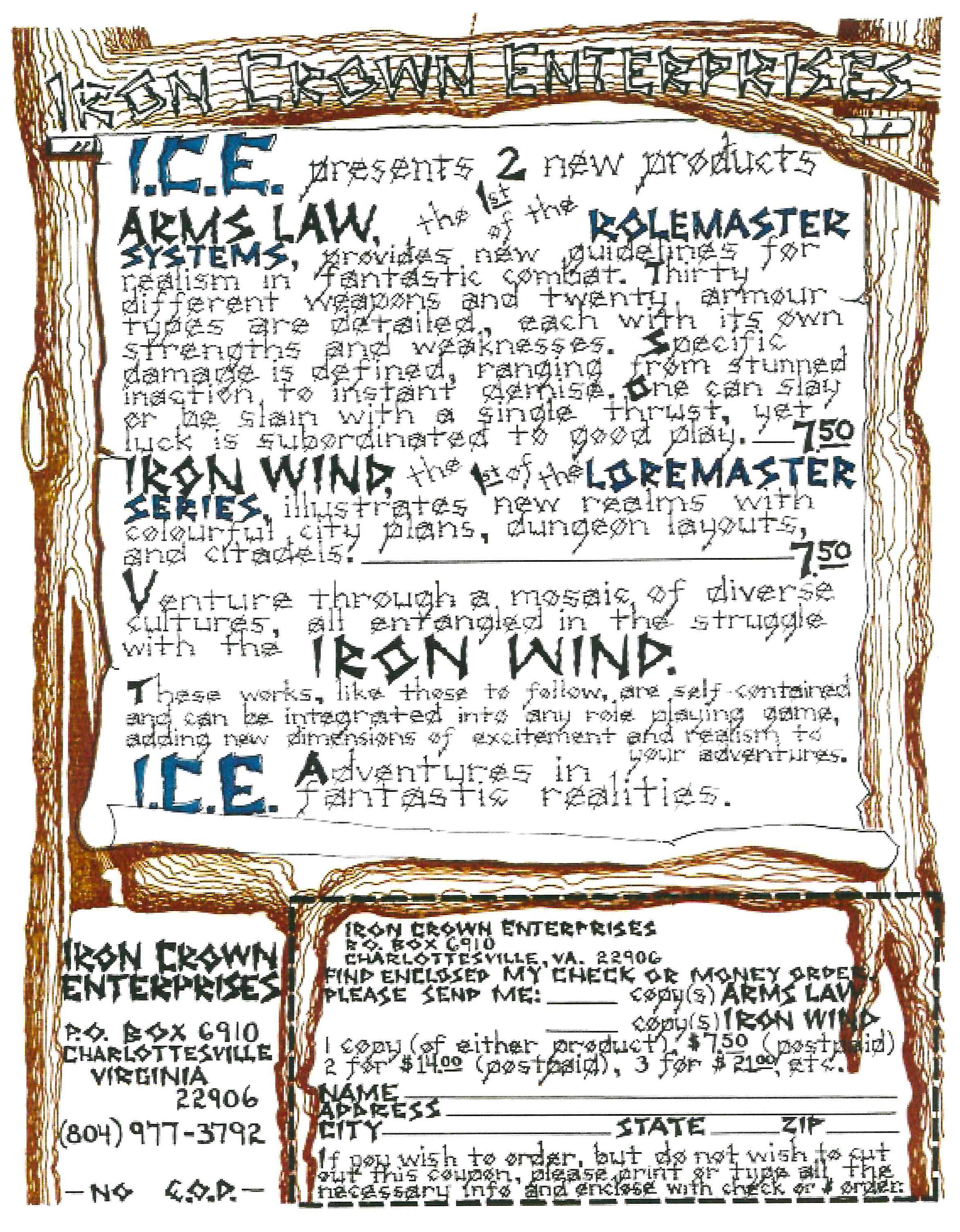
August 1980. #40
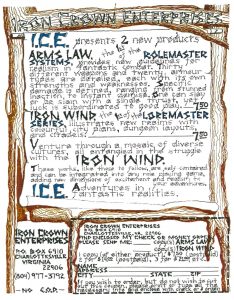
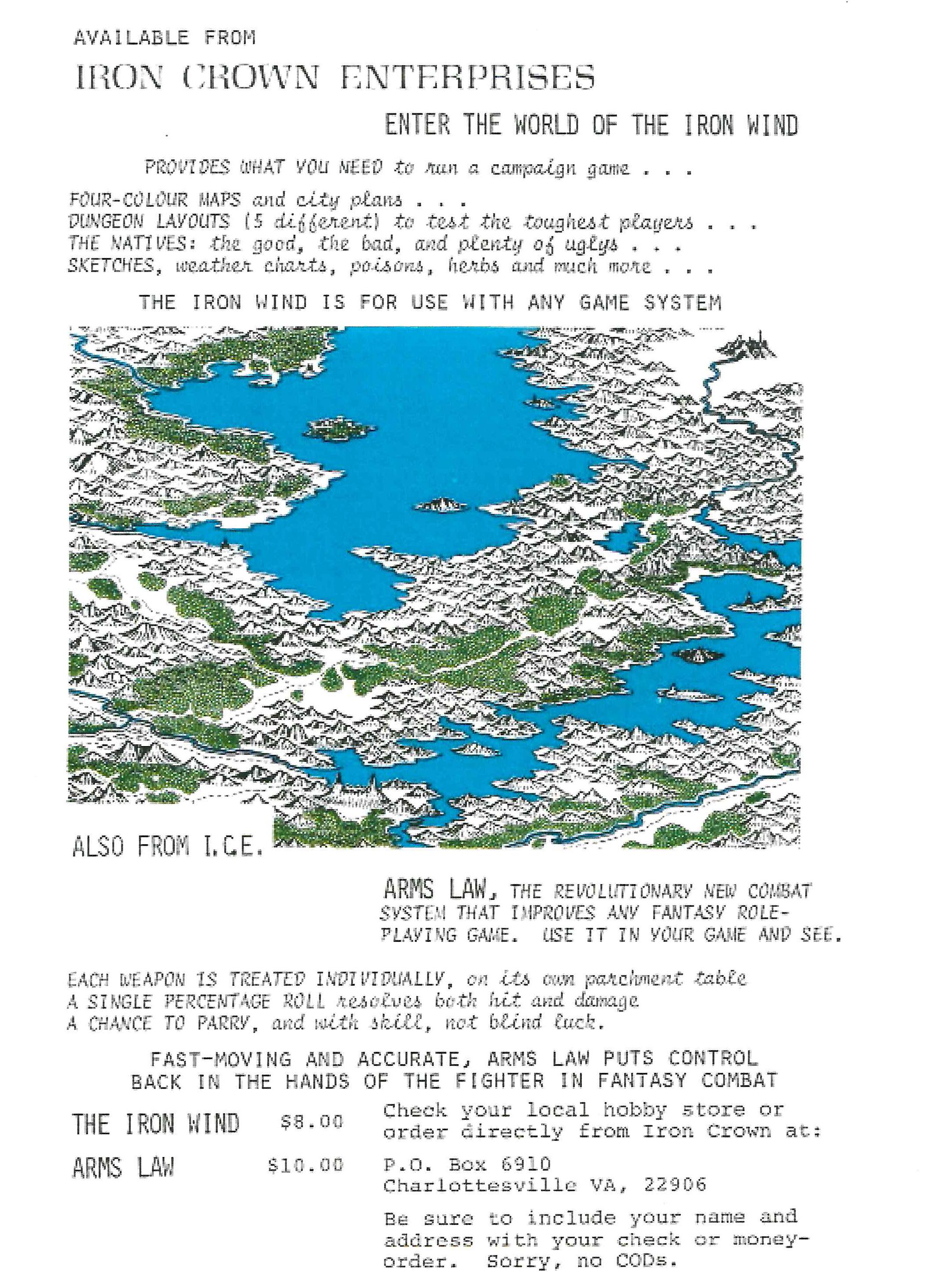
Iron Crown Enterprises very first ad was in Dragon Magazine #40 from mid 1980. I don’t recall this one as my very first Dragon was #46. Obviously hand drawn and colored using the runic script that ICE had in their early product versions (arms law, spell law, iron wind). Interestingly,  this ad featured both Arm’s Law and the Iron Wind. Two things of note: this is only 1 of 2 ads that incorporated color and this first ad did not have their Iron Crown graphic.

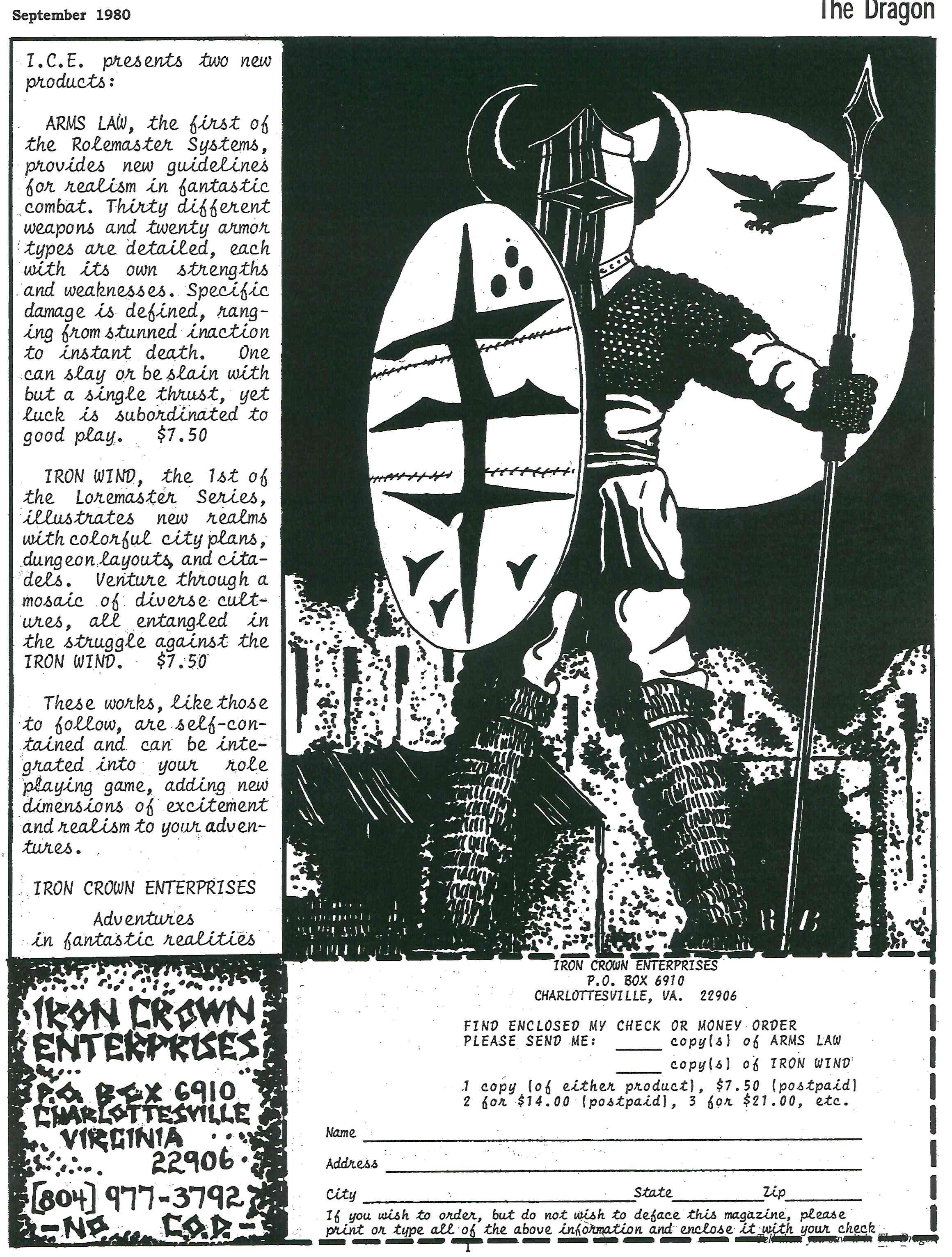
September 1980. #41
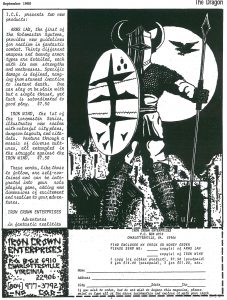
This ad is just awesome! The large warrior, the hawk in the background, a spear and wooden shield. It’s very similar to the Syrkakar warrior in the Iron Wind and I’m guessing it’s the same artist. This ad adopts the bleak black/white aesthetic that ICE maintains for almost all their Dragon advertising. Just cut out the order form, include a check and mail it off! Those were the good old days. Still no Crown Logo though…

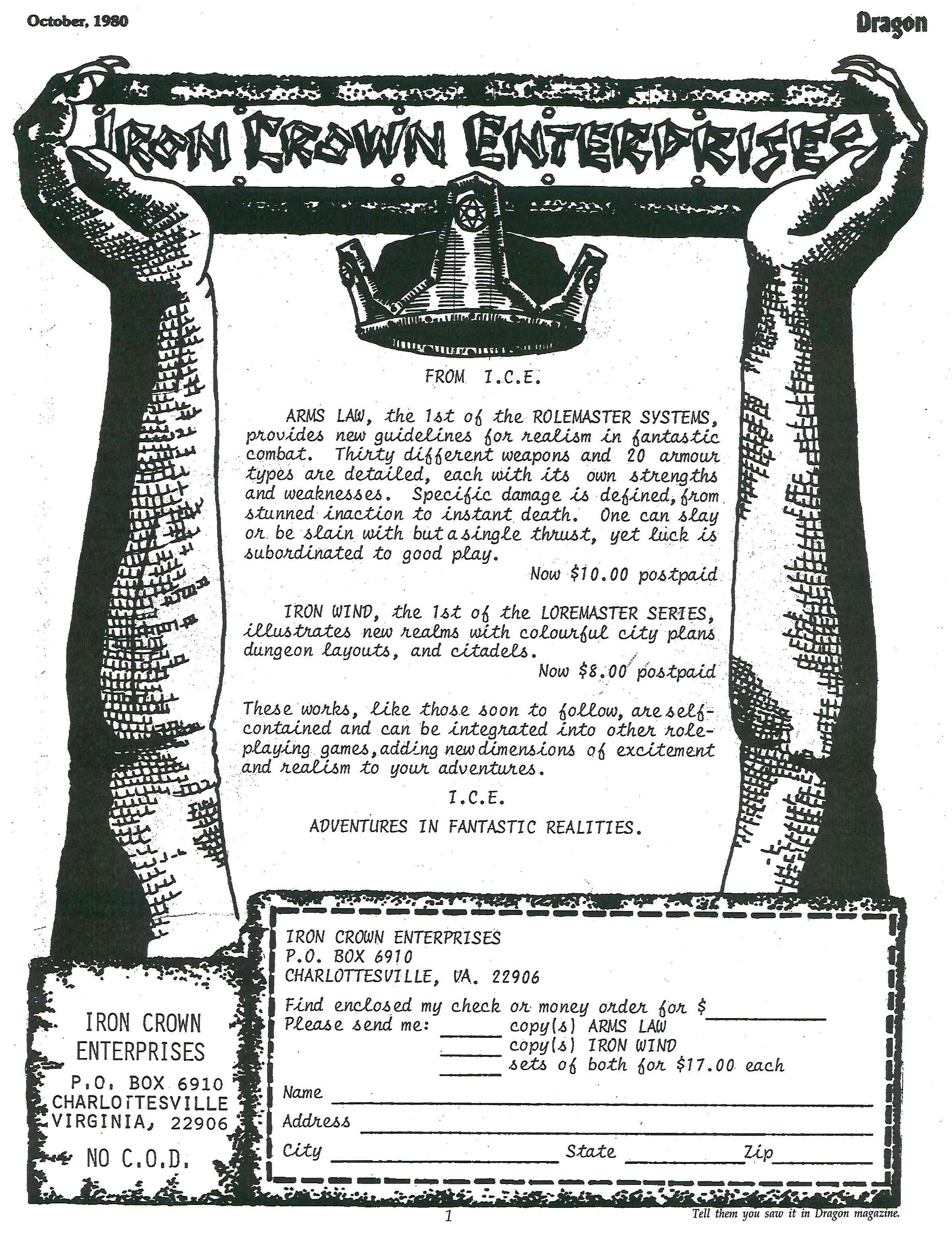
October 1980. #42
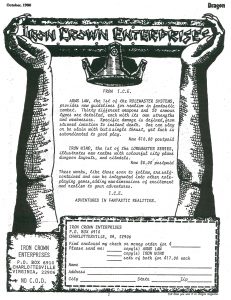
And there it is…the Iron Crown logo!!! This is mostly the same ad copy as the previous month. I find the ad a bit bland but you start to see the logo and company name style being established. Notice the talons on the hands holding the logo.

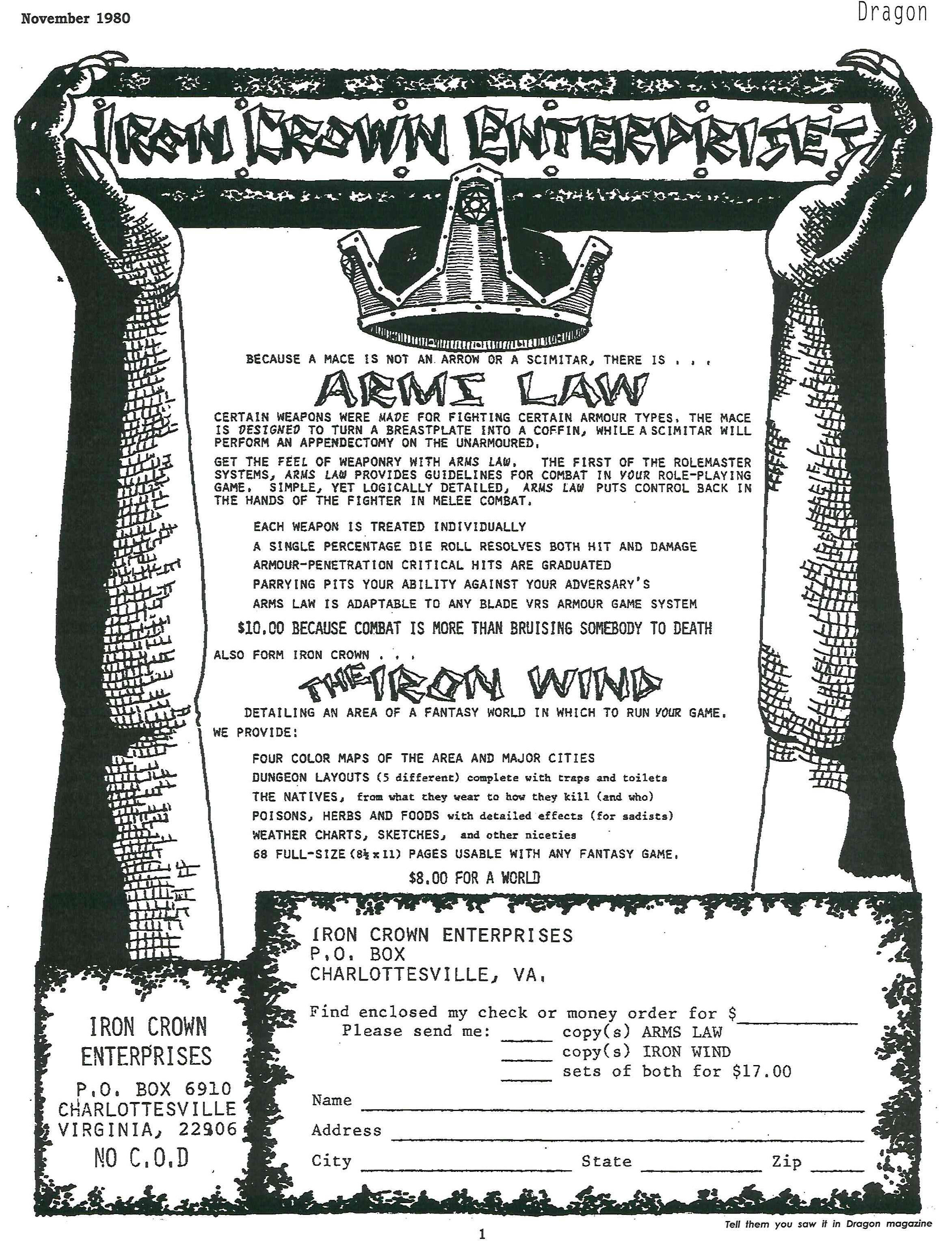
November 1980. #43
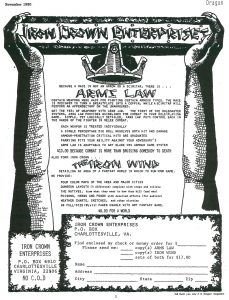
This is a slight variation on the previous month but it starts to highlight some RM rule differentiation. But first, it’s the first use of the Arms Law tag line (below the crown, may be hard to read):

“Because a mace is not an arrow or a scimitar, there is …”

December 1980. #44
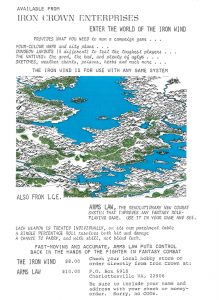
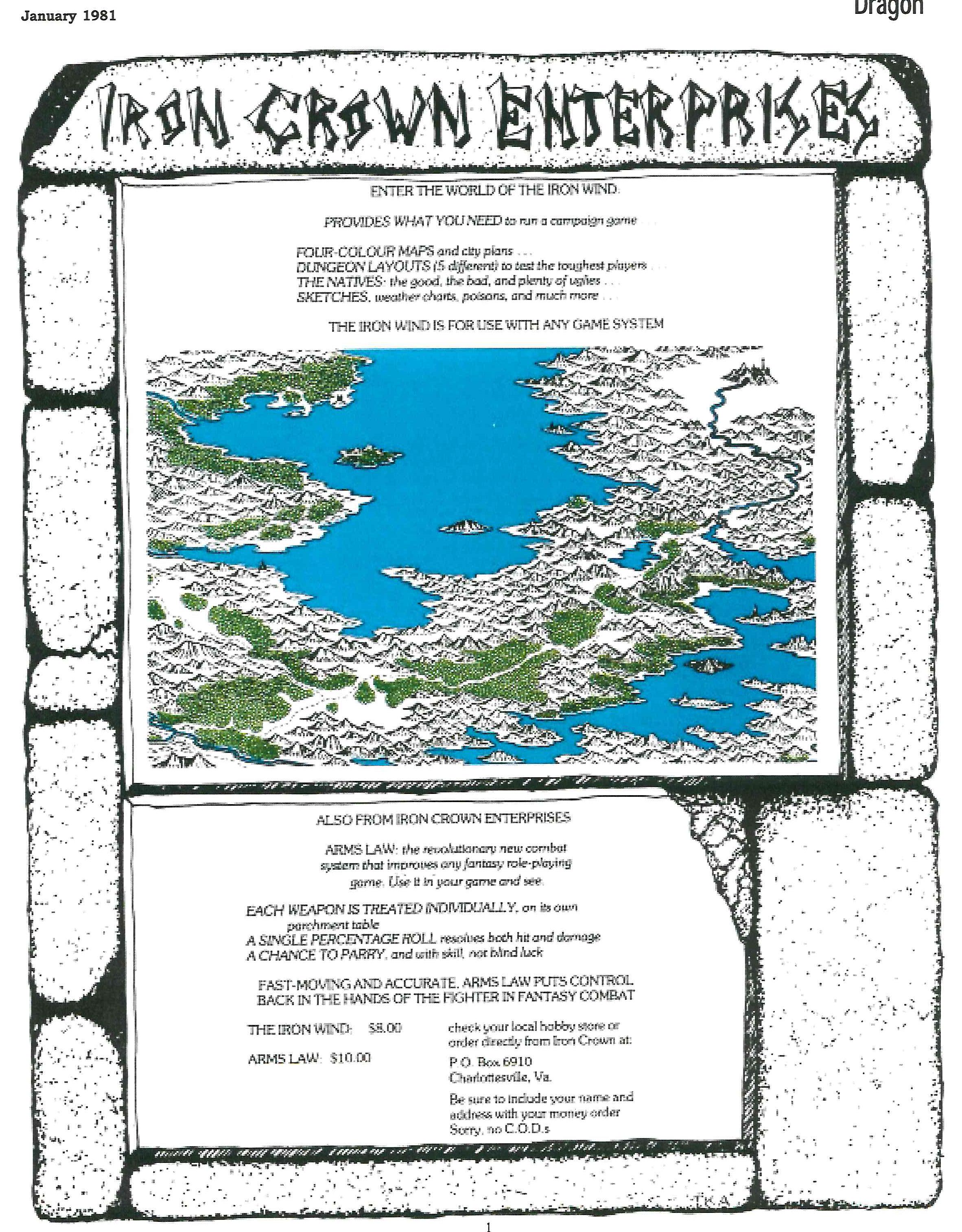
So this is only the second ad that uses color in Dragon Magazine. This is notable because it features Pete Fenlons cartography style and evokes the topographical Tolkien style map. A huge leap from the cartoonish hex maps being used in D&D. Notice that they dropped the Iron Crown graphic.

January 1981. #45
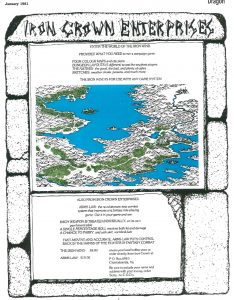
Similar to the previous month, but shows the growing professionalism in ICE’s ad design. The monolith border frames the ad and eliminates the blank margins and the copy is mostly done in typeset fonts rather than script style. This ad does not include the Iron Crown graphic.

March 1981. #47
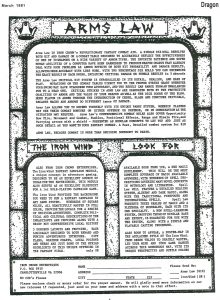
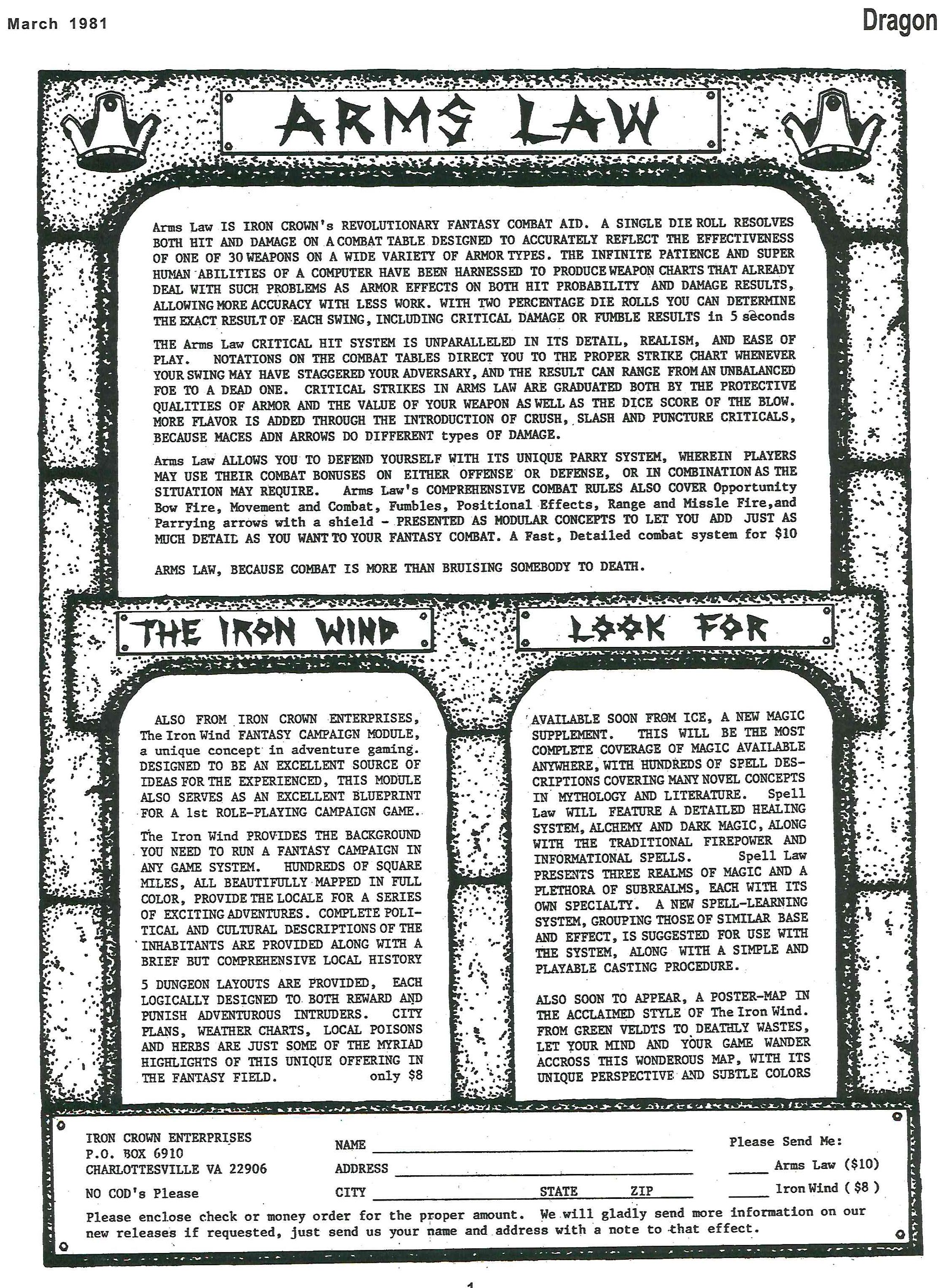
This feels like a step back. Although the stone borders evoke the early Arms Law cover it’s all copy and no real graphic. It seems like ICE wanted more space dedicated to explaining and describing their rules and setting. A lot to read!  2 Iron Crowns though!

April 1981. #48
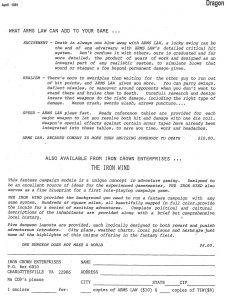
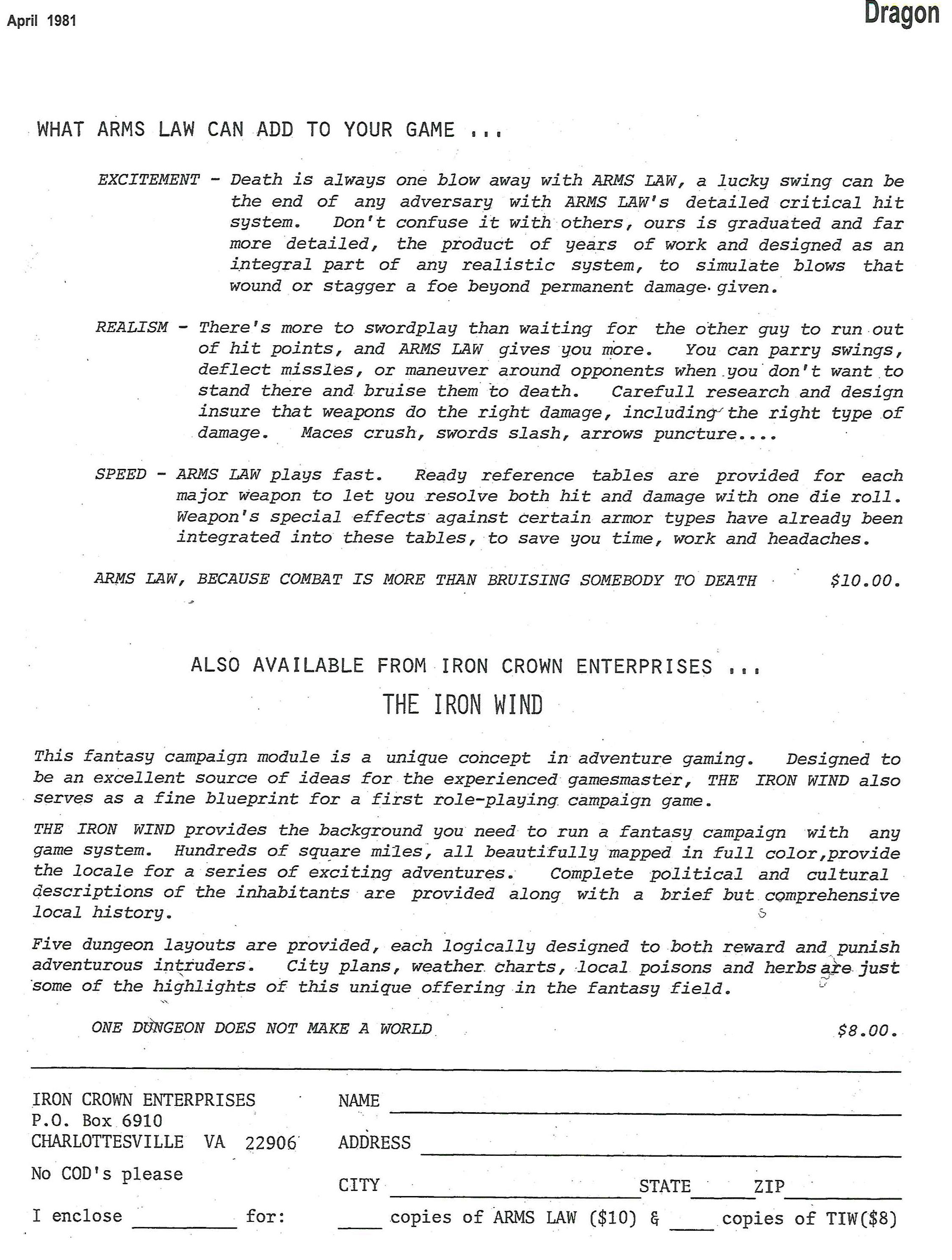
Ughh…what happened here? This seems like someone just wrote some stuff with a typewriter and mailed to Dragon. No graphics, art, logos… Terry, if you read this do you remember how ad design decisions were made? Why not just repeat a previous ad?

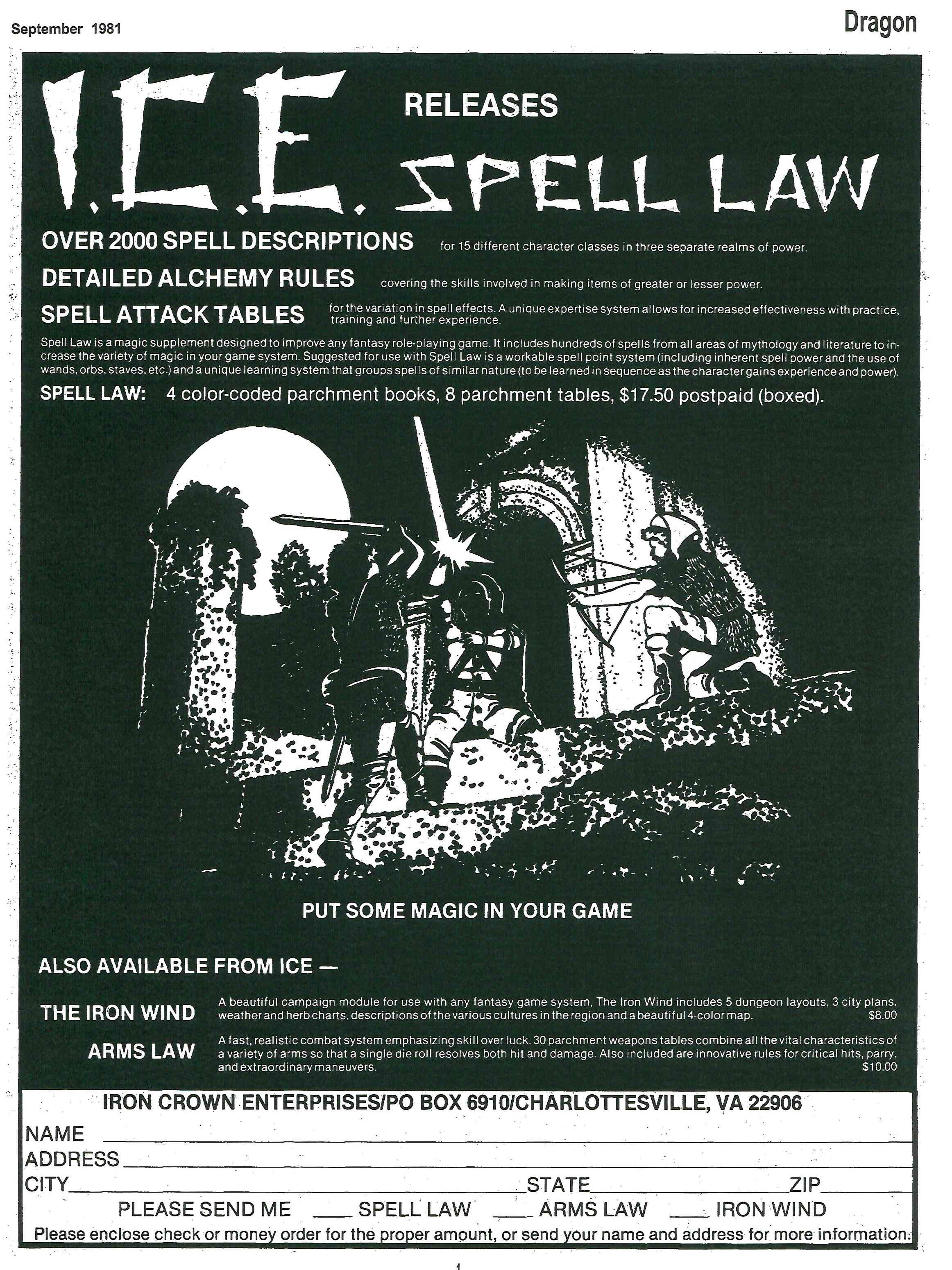
September 1981. #53
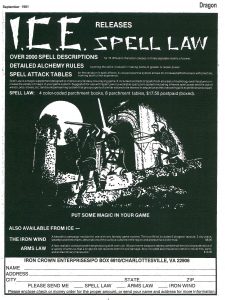
After several months of repeating past ads, ICE used this ad for the introduction of Spell Law.  OVER 2000 spells!!!!!! I know that caught my eye back then. This was the first of a series of ads that used white lettering and dense combat vignettes on a deep black background for contrast. Love this art–anybody know who did them?

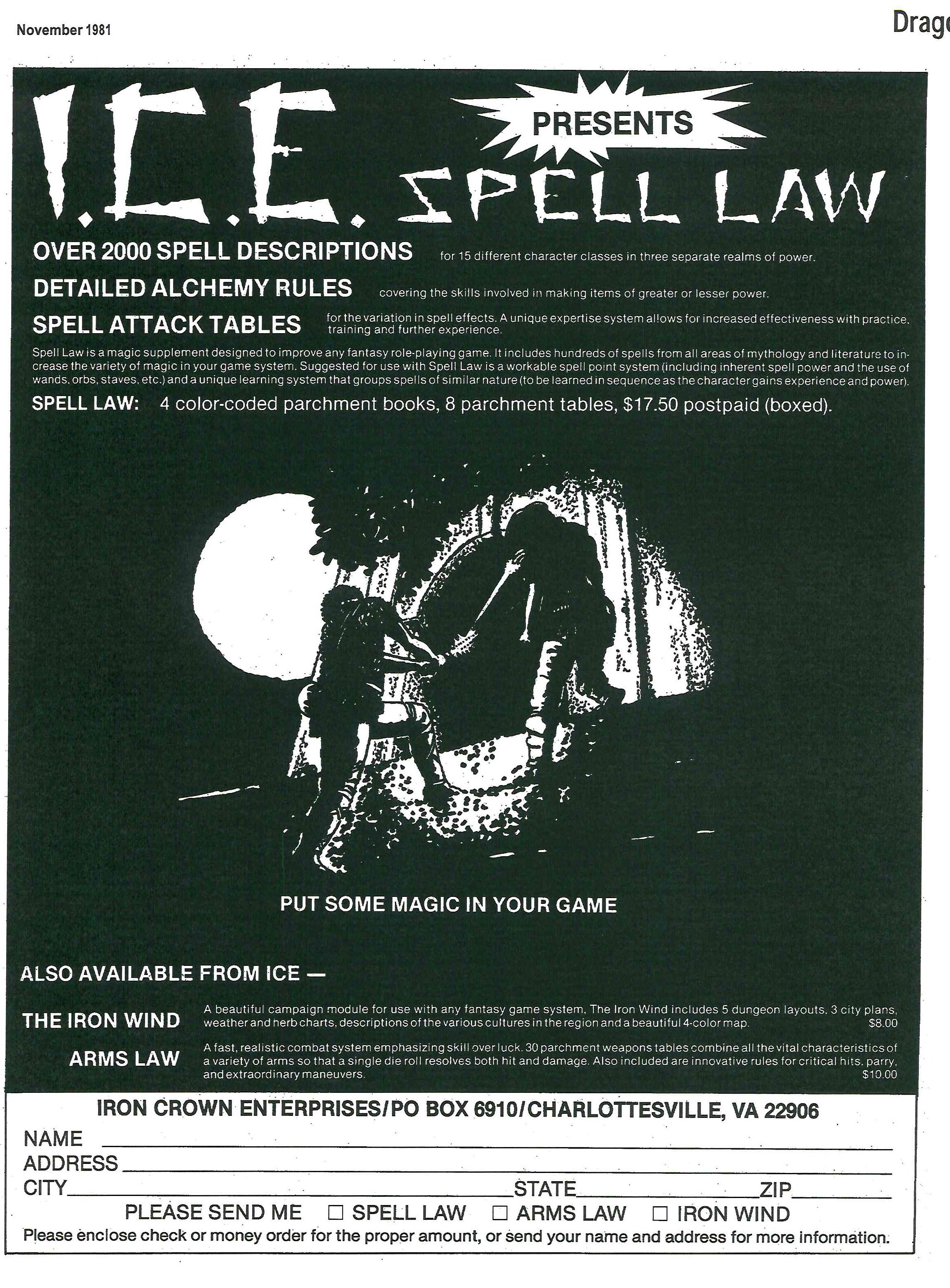
December 1981. #56
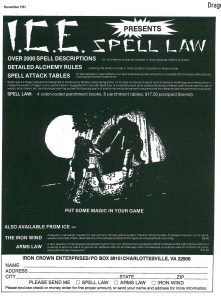
The next month a similar ad with slightly different art. I like this because it shows the character on the right casting a spell onto the other figures sword! Simple but implies so much about the RM spell system.

March 1982. #59

Updated. 1/12/2020.
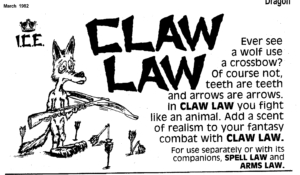
Not sure how I missed this, but what a curious, non I.C.E. advertisement. Looking at subsequent Dragon editions, this appears to be a filler ad for space above the 2/3 page for Hobby Game Distributors. My guess is that Claw Law was being introduced but they didn’t have a full page ad ready yet. The staff at Dragon put this together using the line drawing “cartoon aesthetic” common at the time.

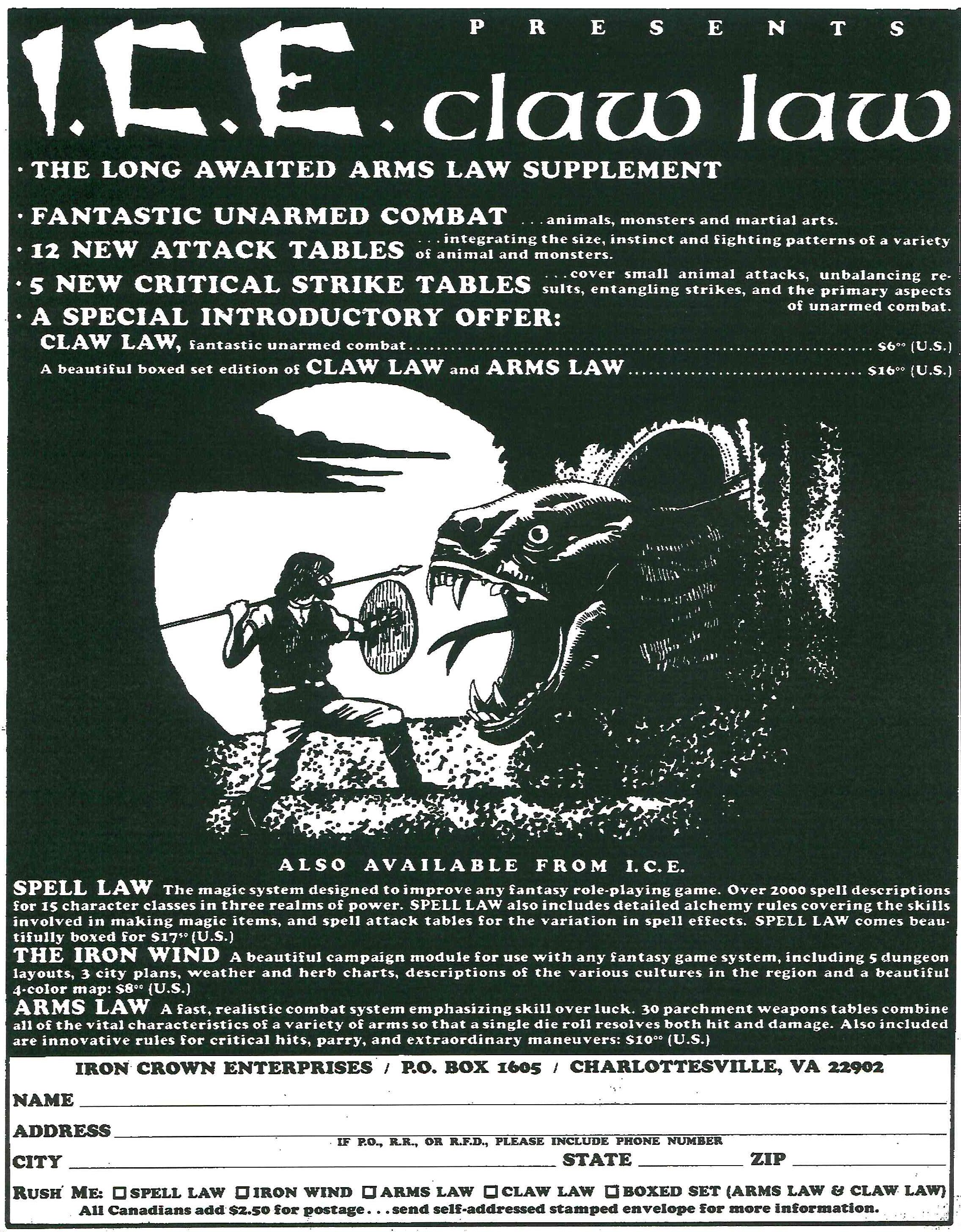
May 1982. #61
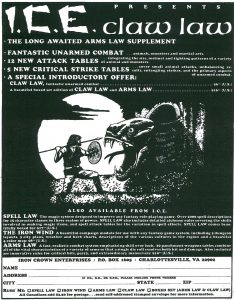
For me, this was one of I.C.E.’s most iconic ads. Again the sharp white on black background contrast. A single warrior against a pretty formidable looking foe. The large moon in the background. Of note is that like many of ICE’s artwork the warriors presented seem rather under-equipped. No platemail armor, huge swords, glowing magic items. Mostly spears and wooden shields. I thought that also implied a lot about the game mechanics and really intrigued me before I started playing RM.

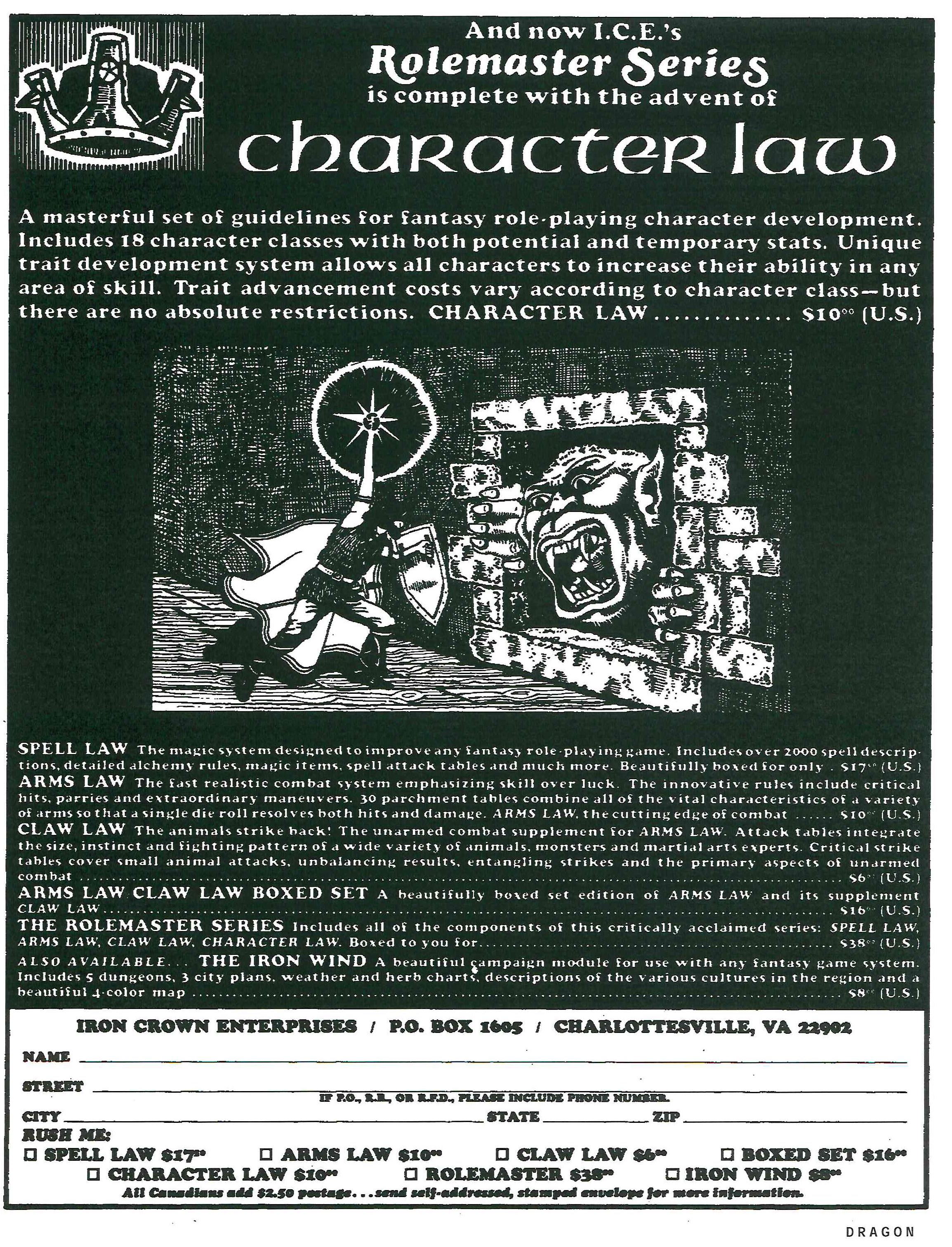
August 1982. #64
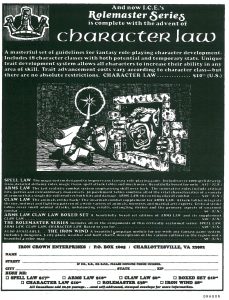
The last piece of the Rolemaster system: Character Law! Plus this ad is the permanent return of the Iron Crown logo. This artwork feels very “D&D”: a more traditional armored warrior with a shield and a funny looking monster. hmm.

So that’s a quick look at some early ICE advertising in Dragon Magazine over a 2 year period. Later ads introduced MERP modules, and the Loremaster series. The Loremaster ads was interesting because it announced Cloudlords of Tanara as the first module in the “new line” with upcoming modules being the Iron Wind, Vog Mur and Shade despite the Iron Wind having been one of ICE’s first products.

What’s your favorite I.C.E. ad?
This post currently has 6 responses


A Definitive Shadow World Master Atlas. What should it contain? Pt. 3

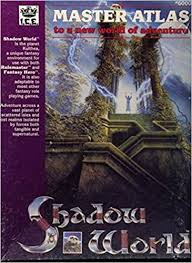
From the earliest days of the 1980 World of Greyhawk Folio, it’s been expected that comprehensive fantasy settings include a “Master Atlas” or a “Gazetteer” to set the tone and include fundamental information about the world. Nine years late, ICE introduced Shadow World: Master Atlas Boxed Set.

The first Master Atlas set the stage for the new Shadow World line–an expansion of the original Loremaster Series published between 1980-1984.  SW was now a professionally published product with a glossy presentation. The original boxed set included to books: the World Guide & Inhabitants Guide plus a poster size color map of the hemisphere. It was a great start to world building, but it never felt complete until combined with Jaiman: Land of Twilight and Emer: The Great Continent. Between those 3 products (all written by Terry Amthor) a GM could piece together a coherent and in depth profile of Shadow World augmented by the original Loremaster books (Iron Wind, Cloudlords of Tanara & Vog Mur). Since then, Terry has expanded SW Canon with 3 Emer regional books, Powers of Light and Darkness, 2 city books (Haalkitaine & Eidolon) plus Xa’ar in NW Jaiman. In the queue are Wurilis (NE Jaiman) the final Emer regional book and a re-write of Jaiman. Once those are completed, GM’s and gamers have an extremely robust overview of the two “main” continents: Jaiman and Emer.

It’s difficult to say if Terry will ever be able to tackle a third (or more) continent in such a comprehensive way with multiple books, but no one could argue that there isn’t enough material for years or even decades of game play with existing Shadow World material. And even with all the current SW books, both Emer and Jaiman have plenty of room for new material, short adventures, city books  and smaller regional supplements.

However, despite 4 editions of the SW Master Atlas, these books are hardly comprehensive. “World” level information is often found scattered throughout the other regional SW books, important cultural information is left unaddressed and various topics could use more campaign level information. In Pt. 2 and Pt. 3 I covered a number of these items that could be included, but I thought I would print off the Table of Contents for my own “Master Atlas” to show what could be in new version. I actually have 40-50 more pages that I haven’t incorporated into the master file, but this one is 281 pages.

Click below to download my own “Definitive Master Atlas Table of Contents” :

DMA ToC

This post currently has 2 responses


Shadow World. What would a definitive Master Atlas look like? Pt. 2

There has been endless speculation about adapting Shadow World to the RMU ruleset, but every year that goes by only makes the task of converting all the Shadow World books into the new format less and less likely. On top of that Terry is methodically going through older source books and updating them and adding new content still using the RM2 ruleset. A third iteration of that process seems hard to imagine.

So where does that leave a new, revised Master Atlas? Last spring I wrote a blog post on this subject, but now with the Rolemasterblog having new readers and another year gone by in the RMU development process I thought I would revisit this topic.

To me, it seems unlikely  that SW will ever have a comprehensive reformat to fit the RMU rule set–that would be over a dozen books? But that doesn’t mean that there can’t be a final Master Atlas that creates a definitive baseline for Shadow World and any or all future projects. In my mind, the DMA (Definitive Master Atlas) would set SW Canon, tackle a lot of the unaddressed issues and become the road map for any third party books (if that ever occurs). Of course, as egdcltd commented, you could also make the DMA system agnostic. To me, that’s a very interesting idea!!!

If you’ve followed my “Misc SW Material” thread on the RM Forums, you may realize that many of those partial files are part of a much larger document–our own, in house, DMA we’ve been adding to for 30+ years. Our own book is around 350 pages and that doesn’t include charts, illustrations/art, graphics or any Flora/Fauna material. A strong pass-through edit and I’m fairly confident that a DMA could be 500 pages. Is that possible to publish or print in hard copy format? I personally have no idea, so please weigh in on that.

Ok, so what would a DMA include? There should be guidelines on what material qualifies as “world spanning”, “canon” or appropriate for a Master Atlas and not just a regional source book. Should it incorporate some of the material found in the original Gamemaster Law? The Shadow World Players Guide was well received: although it was mostly collated content, the presentation, art and production value were topnotch. A definitive Master Atlas might only need 100-200 pages of new material, culling of 50-100 pages (timeline removed?) and the addition of 100 or so pages of material found in other source books that are better suited for a MA. I think much of the Powers could be incorporated into the DMA while information on the Iron Wind, Raven Queen or Silver Dawn should be more regional in nature.

What would be on your list for a Definitive Master Atlas?

  1. Should the ever changing timeline be removed and handled elsewhere?
  2.  Should there be a final Essence Flow & Greater Foci map of the hemisphere?
  3. What organizations  or content are “world-spanning” and what is “regional”.
  4. Is there any material in other SW books (canonical) that should be moved to a DMA?
  5. What topics or material should be included or expanded upon?
  6. Should a DMA be all encompassing or should it be a multi-book endeavor. For instance, it could be 3 parts: a MA, a Flora/Fauna supplement and a Gazetteer with a variety of maps and keys  that expands upon the geographical chapter in the current MA?
  7. A box set with hardcovers?
  8. A map supplement that has every map every printed for SW–new detailed maps of all the continents with key locations, some poster maps. Some enlarged city maps?
  9. Could this be a Kickstarter project to fund great artwork, mapmaking, a wiki  and project management?

Yes, there are already 4 versions of the Master Atlas, so is this even possible or worth discussing? I think the only issue is new content that would need to be written or approved by Terry. The rest, much like the Players Guide, would be editorial and organizational.

Any thoughts?

This post currently has one response


Anatomy of an online game

I have reached the point with my Play By Post game where I am adding the players and starting to upload the information they need to create their characters.

The way that RPOL works is with a collection of discussion threads with restricted permissions. This means that players can only read or add to their own threads but can also see threads set to ‘public’.

Each player will have access to two threads, one is their story where everything is ‘in character’ and a second thread where they can ask my, the GM, questions or for clarifications. The characters story thread then reads like a piece of LitRPG.

So I am adding setting information known to everyone to the public threads as well as the character creation rules.

All the chargen rules will be straight out of the beta Character & Arms Law. I am actually trying to keep house rules to an absolute minimum just to make it a viable play test.

On the topic of play test, I wonder if it is actually even worthwhile now? I get the real impression that Character Law, especially, is pretty much ready to ‘go to print’ and if that is true then any feedback is of limited value. This s probably just an RMU game for the sheer fun of playing Rolemaster!

On the other hand…

PBP games are amazing playtest tools. The reason for this is that absolutely everything is trackable. Every dice roll is recorded (in RPOL this is the case) and the whole narrative there as a permanent record. In no other game format could you replay an entire scene and have everything identical.

So hopefully by tomorrow I will have all the Chargen rules up for the players to start creating their PCs.

This post currently has no responses


The Hermit of Castle Ruins

This week’s 50 in 50 adventure hook is The Hermit of Castle Ruins.

The Hermit of Castle Ruins is a small, drop-in location. In a ruined building near a port town lives an old hermit, believed to be a monster or even an undead creature by the locals, who have tried to kill it once already. They are still offering a reward for the creature’s destruction. The characters can investigate, and perhaps claim the reward.

Monsters

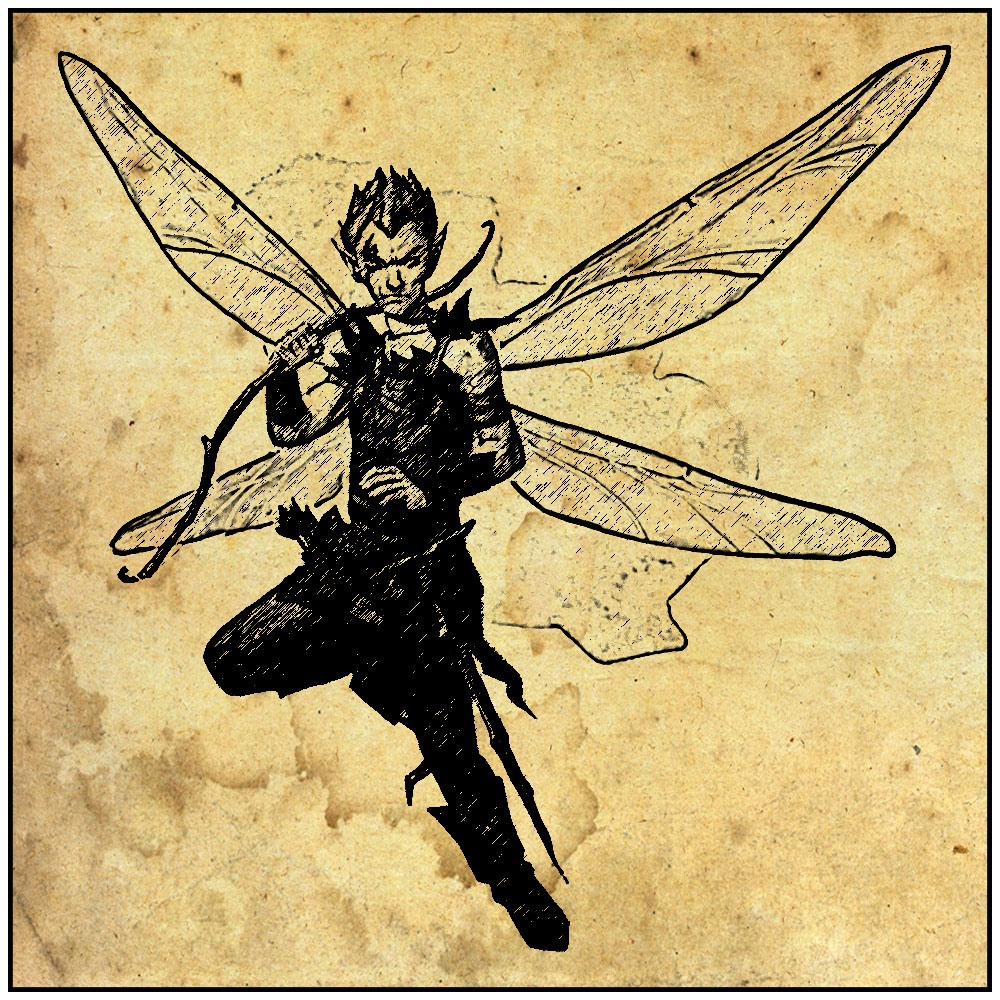
I am getting better at remembering to update the monster wiki with new monsters as and when I create them. This week I have added Sprites, as a humanoid/fey and the Kraken under Monstrosities. We also have our first ‘normal animal’ being the Aurochs, a great big bison type of cattle. The Aurochs is probably limited in usefulness but better to have it and not need it than need it and not have it. There is no Aurochs in C&T so I genuinely needed to create that creature for an adventure.

Please remember that anyone who is logged in should be able to add to or edit the monsters in the wiki. If you want them to have skills or professions or create new variations then feel free and get stuck in!

So that is this weeks round up of publications.

This post currently has 4 responses


This post currently has one response


Reconsidering the Magician

I’ve never really warmed to Rolemaster’s archetypal blaster, the Magician. In the spirit of full disclosure, I should add that I’ve never liked any character that concentrates primarily on ‘blasting’, in any system, unless the blasting is interesting, like firing a swarm of wasps or an ethereal bolt that causes the target to blink in and out of their current dimension.  My problem with the Magician, however, is more specific: at the risk of sounding pompous, I feel that the Magician does violence to the richness and potential of the elements. One of the things I really liked about the Elemental Companion was the wide and fascinating range of elemental effects available to players (although the generic nature of the lists represented, I felt, an opportunity lost).

The thing with the elements is that they provide a window to a whole system of symbolism, psychology and metaphysics. I find myself thinking here of crossovers between the classical elements and astrology, elements and humoral theory, elements and cosmology (as per Thales, for example). If one accepts the idea of elements as metaphysical building blocks of varying complexity, and adds to that the notion that a certain level of mastery of a particular element in its raw form grants access to more ‘metaphysical’ expressions of that elements sphere of influence, then you can move beyond bolts, balls and walls to…anywhere, really.

So, what elements to use? Rolemaster has traditionally concentrated on the classical four elements with Ice and Light thrown in (more bolts and balls!). My own campaign’s take on this is that the classical four plus four others are the starting point and the basis of all further elaboration. The four other key elements form two dichotomies: one represents that between Law and Chaos, Order and Entropy, whilst the others could be represented by Death and Life, Good and Evil, Void and Being or Negative and Positive. There are also several anomalous ‘elements’ or forces that stand somewhat outside of these eight fundamentals. Here are contained such conceptual forces as Time, Mind, Dream and the binding/linking force of the Ether.

All of these elements are sourced from their own plane, a dimensional zone where they reign supreme, and each of these dimensions, whirling in the intricate and infinite geometries of the multiverse ‘rub’ against one another, producing small hybrid dimensions I call ‘niches’. Fire and Water, for example, create the Niche of Steam. The list of potential combinations is fairly large, especially given that each Niche can then contact each other, spawning ever more complex creations. The Niche of Wood is created by the intersection of Life, Earth, Water and Light (itself a product of Fire and Ether). When this Niche is then contacted by that of Decay (Time and Chaos), the Niche of Rot comes into being.

This is the general structure, but it has comparatively little bearing on the standard RM organisation of spell lists, which may be considered to operate at a level that does not require much knowledge or application of the underlying metaphysics. It is only when planar travel and specific summoning (“By all that is holy! This situation calls for a Rot Elemental!”) are required does this lore become a necessity, and only a few sages (and my updated version of RoCo IV’s Astral Traveller) are privy to it.

Back to the Magician: if the elements are as complex and fundamental as the above model assumes, then Magicians, as the primary manipulators of basic elemental matter, ought conceivably to have a command of both the aggressive/defensive manifestations of the elements but also the more metaphysical aspects of the elements. This degree and style of learning requires that Magicians have ‘primary’ access to one – and one only – element, in which they can potentially master all the power an element provides.  Thus a magician might specialise in Fire: they gain lists that manipulate the transcendent aspects of Fire (the chosen list here is Fire Law) and the immanent aspects. I used the list Fire Forms from RoCo VII and the list Fire’s Influence from the January 2009 Guild Companion. So that’s three of six Base Lists. I also gave them Elemental Summons (RoCo II), with the proviso that only Fire Elementals could be summoned using the list. Fire Magicians also gain a ‘metaphysical’ list linked to the element: I selected the Paladin list Inspirations (RoCo II) to represent the courage and inspiration that Fire grants. Finally, I gave the list Mage Sign (RoCo VII) to all Magician’s regardless of elemental selection, to reflect a basic training that all Magicians receive.

I did retain the six elements of the original Magician and added ‘Dark’ as a seventh – more because I wanted to draw on the existing material in the Core and Companions rather than spending the rest of my life concocting spell lists for all of the basic elements and the Niches. One of these days, I’d like to give the system my full attention and create a set of lists that appropriately reflects the juiciness of the underlying concept (without following the rather generic path of the Elemental Companion).

This post currently has 14 responses