A Fate Economy

This is a purely theoretical post for me as I am not a fate point user.

So the basic idea of fate points is that each character starts with a few fate points. You can spend a fate point to try and avoid a fatal wound by re-rolling a critical. You can earn fate points by extremely good role playing or by forcing the end of level boss to spend a fate point to save himself from you.

So spending a fate point is a big issue and gaining a fate point is a big issue.

If you think of a whole fate point as being a Silver Dollar I want to talk about dimes and cents.

This is not my idea, I have stolen it from a variety of other games that use similar mechanisms.

So imagine you ask a character to make a skill roll and you, as GM, really want them to make the roll. The success would be fun, would help advance the story or generally be a ‘good thing’. They roll the dice and fail. So you either suck it up or scrub the roll and let the player try again. I suppose it depends mostly on your style of GMing.

Fate cents are a mechanism to let you let a player make a second chance roll but maintain game balance.

What you do is every time you give the players a re-roll, or even if you fudge a dice roll yourself, you keep a tally of these minor adjustments and then ‘spend’ them at a later point to balance books.

Ways of spending them could adding an additional opponent to a minor skirmish latter, letting a villain make a re-roll if they fail a roll. nudging up a skill by a rank for a named NPC. If the player fumbles an attack then add +5 to the fumble roll for each cent outstanding.

Ideally, at the end of each game session the net balance will be zero or at most at the end of each adventure. You would not let the players ignore every inconvenient roll and never pay the consequences. I could easily have called this post ‘Rolemaster Karma’ because it is that sort of thing. If you are having to bend the rules to help the players then it will come back to bite them and sooner rather than later.

I do not use fate points as I don’t need them. I can see the attraction, RM is extremely dangerous and character creation is extremely complicated. Keeping the characters alive and the story advancing is of value to both GM and players. Limiting fate points maintains the danger of the system and consequently the sense of danger going into every fight.

Fate cents are meant to be much less significant and more about increasing the fun element for both GM and players. It makes players more capable because they have the option of taking a second bite of the cherry when a roll is failed and for the GM it means there is a balanced option for making the players character pay for every time you have to help them out.

What do you think?

This post currently has 16 responses


Mating Season – Publication Round Up

This week’s 50 in 50 adventure hook is Mating Season. I wrote this one so obviously it is brilliant.

We wrote these adventures as a block many months ago now and to be honest when I saw the email saying that Mating Season has been published I didn’t actually remember writing it. I downloaded and expected to see one of Brian Hanson’s adventures.

Most of my adventures has slightly silly, or hopefully witty, titles so I should have guessed that this was one of mine! If you like to give your monsters a bit more background then you could well enjoy this one.

In Mating Season the king of the hill giants has died and the other giants are courting his widowed queen so that they can become the new king. Part of this courting process involves the bringing of gifts, and these gifts have got larger and more impressive. Until finally one giant’s gift is the characters. The PCs will need to escape or become a short-lived part of the new king’s coronation.

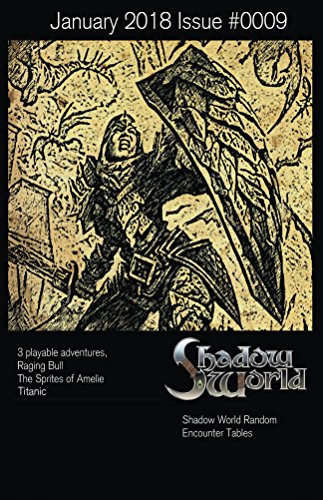
Elsewhere, rather belatedly, January’s fanzine issue is now available on Amazon.

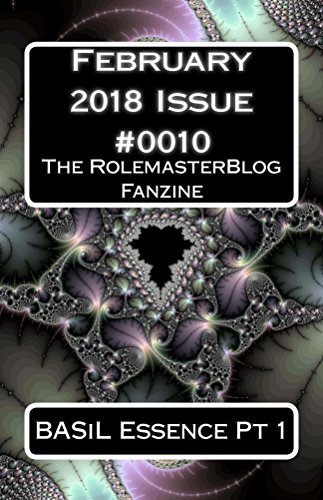
I am also just putting the February edition together. I hope to have that issued by this time next week.

This post currently has no responses


TIP FOR PLAYERS: CONTAINING SPECULATION

I read this yesterday and I know that my own group of players could certainly do well to learn this bit of advice…

Investigative scenarios often bog down into speculative debate between players about what could be happening. Many things can be happening, but only one thing is. If more than one possible explanation ties together the clues you have so far, you need more clues.

Whenever you get stuck, get out and gather more information.

So that comes directly from the Gumshoe rules I am reading. My players frequently bog down into endless circular speculation. Not always about clues but maybe the best way to attack a fortified position, or how to try and sneak past a guard and so on. It is almost like they want the ‘perfect’ plan but either have insufficient information for making that plan or it simply doesn’t exist.

Whether it is about investigations and clues, planning an attack or escaping from a goblin hold it is really good advice for players to ‘get out there and do something!’ As a GM if the players turn inward and debate about things between themselves there is little that us as GMs can do about it. It doesn’t move the story on. If you get out there and interact with the world then we can give the players the clues they need, or the way into the castle or whatever.

Let’s face it, as GMs we want the characters to solve the mystery, defeat the bad guys or escape certain death as that is what their story is made of and that makes the game fun for everyone. They may not escape every time and it shouldn’t be easy or there is no sense of achievement or reward but likewise doing nothing but talking in circles also brings no sense of achievement or reward.

In the last game session I upset my players as their characters were in the middle of a market, I was describing the traders and the folk hanging about, including a secret police spy trying to get close to them when the players started a massive debate about what they were going to do next including sharing all sorts of information that only the individual characters would know. I did mention that people were taking an interest but the players were so engrossed they mostly missed it. When the bad guy turned out to be completely au fait with their plans they got very upset but I pointed out that they had discussed them at length in public they were adamant that they would never have done that if they had realised people could over hear them. I do not like meta gaming, it is cheating which ever way you look at it but the point is the debate achieved nothing as they were none the wiser at the end of it than they were at the start. RPGs are mostly an action game as in ‘action movies’ and if you do not act then the story does not progress.

Anyway, I thought that was a good bit of player advice so I thought I would share it.

This post currently has 3 responses


The compelling fantasy art of JB Clark.

One of the obstacles in creating high quality RPG supplements is access or affordability of quality artwork. Consignment artists may be too pricey for a small publisher or individual and clip art may not give your product the polish that you’d like to create. Some publishers revert to using “open domain” art–oftentimes older art no longer protected by copyright.

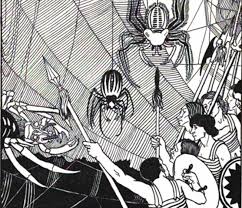
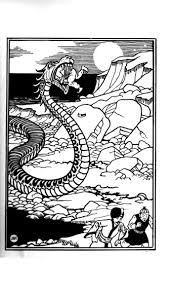
During a recent search for cool, older artwork I came across some sketches by JB Clark. At first I thought this was fairly recent artwork, but incredibly, much of it is dated to the 1890’s! JB collaborated with William Strang and together they illustrated the Adventures of Baron Munchausen, Ali Baba and Sinbad. Of course these were all fantasy/fantastic adventures and their illustrations captured that classic fantasy feel we often call OSR art style. JB is particular compelling and did some great illustrations for translations of some writings of Lucian of Samosata.  One of Lucians more known works is True Story. This was meant to be a tongue and cheek work of science fiction and fantasy. It deals with outer space, interplanetary lifeforms and interplanetary warfare! Not bad imagination for a writer in c. 150 AD! Reading through it I realized it would make a crazy and highly stylized fantasy campaign.

I find this art so similar to the pen/pencil line art common in early RPGs. They feature “action” or “movement”, the characters are often armed and it features strange, fantastic creatures.

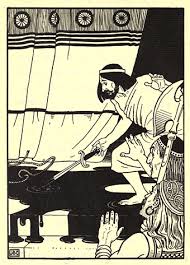
Check out the art above…is the top figure reaching for a sword stuck in blood? Is he prodding the liquid? It looks like the other two figures are calling to him to stop!  This feels like an image out of an old D&D module doesn’t it?

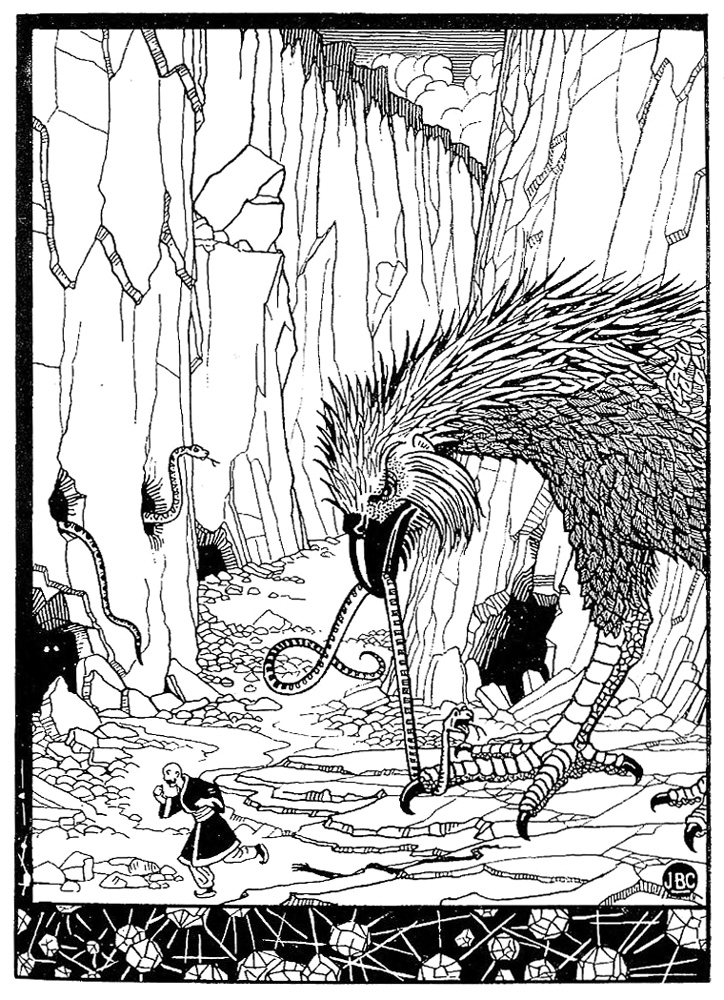
How about the picture below. A ship is in the background and it looks like the crew has disturbed a Roc nest!

Here is one more–pretty self-explanatory!

Do you know of any older artwork from the 19th century or earlier that would work in modern fantasy RPGs?


This post currently has 2 responses


Be Prepared!

If there was a sliding scale from simulationist games to purely narrative games then I think Rolemaster, especially a fully loaded RM2 or RMSS game, would be very much on the simulation end of the scale. Games like FATE would be right up the other end.

My simplification approach has had the somewhat unintentional effect of shifting my brand of RM into the centre ground and I would describe it as on the simulation side of centre.

I think this is somewhat inevitable. If you are going to amalgamate a dozen skills into one meta skill then you have unavoidably lost some granularity or detail.

In my meandering gaming reading this week I have been reading some Gumshoe rules. In that I came across a new skill I had never considered before.

My position right now is that this is a step too far, even for me, but the more I think about it the more it starts to appeal.

Here is the skill definition. You will have to skim over the references to PDAs and laptop computers etc. and other skills as this is copied directly from the rules.

PREPAREDNESS

You expertly anticipate the needs of any mission by packing a kit efficiently arranged with necessary gear. Assuming you have immediate access to your kit, you can produce whatever object the team needs to overcome an obstacle. You make a simple test; if you succeed, you have the item you want. You needn’t do this in advance of the adventure, but can dig into your kit bag (provided you’re able to get to it) as the need arises.

Items of obvious utility to a paranormal investigation do not require a test. These include but are not limited to: note paper, writing implements, laptop computer, a PDA with wireless Internet access, mini USB drive, cell phone, various types of tape, common tools and hardware, light weapons, flashlights of various sizes, chem lights, batteries, magnifying glasses, thermometer, and a no-frills audio recording device.

The utility of traditional anti-supernatural accoutrements such as crucifixes, holy water, and silver bullets is a matter of great debate within the Ordo Veritatis. Whether you choose to include them in your basic kit reveals your attitude toward the supernatural. Is it purely the work of the Esoterrorists, or are there other unnatural forces out there? Decide for yourself, and pack wisely.

Other abilities imply the possession of basic gear suitable to their core tasks. Characters with Medic have their own first aid kits; Photographers come with cameras and accessories. If you have Shooting, you have a gun, and so on. Preparedness does not intrude into their territory. It covers general-purpose investigative equipment, plus oddball items that suddenly come in handy in the course of the story.

The sorts of items you can produce at a moment’s notice depend not on your rating or pool, but on narrative credibility. If the GM determines that your possession of an item would seem ludicrous or and/or out of genre, you don’t get to roll for it. You simply don’t have it. Any item which elicits a laugh from the group when suggested is probably out of bounds.

Inappropriate use of the Preparedness ability is like pornography. Your GM will know it when she sees it.

Instinctively I want to reject this but with a moment of reflection it occurred to me that to a great extent I tend to hand wave the buying of mundane supplies anyway. Half the time the characters are so rich that the buying of a few supplies is of no significance. The only input I would tend to make would be describing the sorts of foods or goods if I felt it added something to the cultural background and a bit of local colour.

I also do not use the encomberance rules. I do tend to ‘once over’ the character sheets and if I think they are overloaded I will apply a manoeuvre penalty and tell them it is because they are overloaded. The players will soon lop off some unneeded kit.

So does forcing players to maintain a meticulous equipment list add anything to the game? There are certainly times when it does. I have had an issue in the past were the players just maintained a communal treasure list until such time as they divie it up and people claim ownership of specific items. This seemed to work just fine, the advantage is that character sheets do not become worn out from constantly adding and rubbing out of items of equipment and loot. The issue we had was that one of the characters was pick pocketed and I just randomly picked who was carrying are particular gem stone. It happened that the victim of the robbery was the gem holder. The players then protested that someone else was carrying the loot and they certainly would never have taken precious stones into such a rough tavern. Well, tough, if they had taken any precautions like that they should have told me about them. I bet if I had robbed their tavern room they would have insisted that the gem was with them.

Going back to the Preparedness skill, that would remove a lot of dross from the character sheet and a lot of pointless equipment resource management. I would still want the players to keep a list of significant items, their arms and armour but things like balls of wax so they can take an impression of a key or balls of string for whipping up a quick trap could all be done away with.

I can see a real analogy to the Vocation skill from RMU. You do not need to detail the thousand and one individual, little used, lore skills that everyone in that job would have, one catch all skill that can be applied as and when does the trick.

Is Preparedness that different? Is it a step too far in the direction of Narrative rpgs?

This post currently has 13 responses


Character Creation Time

Today I finally got around to posting the character creation guidelines for my online game.

The only real break from the RAW is that I am giving more development points per level than listed. At each level characters will get 70 DPs rather than the standard 50DPs.

This should give the players a bit more wriggle room for buying skills. The No Profession is a bit more expensive than any one of the dedicated professions so the 70DPs will not go quite as far as you would imagine.

The game is set at a Heroic power level so the additional knack (+20) will also give a bit of a boost to the starting.

I hope that with the information I have given the players they should now be able to start creating their PCs.

If you have been waiting on this then I sincerely apologise for my tardiness! 2018 is turning into a rather fun but busy year so far!

This post currently has 7 responses


Cabin in the woods!

I love this adventure hook! I am not going to tell you much about it as it could spoil the surprise if your players got wind of what is actually going on.

What I like about this particular publication is that it is one of the most substantial documents. You get a one page adventure hook but also full colour printable battle maps. You print off the twelve pages and join them together to get the layouts for the adventure. It seems to me that we are ever inching a little closer to producing a really full on adventure module.

In The Cabin in the Woods, the characters may have been hired to deal with a group of bandits or otherwise have heard of them.

The bandits have a cabin in a clearing in the woods but the characters are not the only party looking for the bandits, and it is possible that the characters, and the other party, are both disguised as bandits, leading to several potential outcomes when the actual bandits arrive.

This post currently has no responses


It Lives! Muhahah!

I am running terribly behind this month by the looks of things!

I completely failed to get a post out on Sunday and despite really wanting to complete more of my lingering projects in 2018 I am, if anything, falling further behind.

So last Saturday we published It lives! Muhahah! which is a take on the classic Frankenstein story but for those that like a bit more role play over hack and slash there is a potential bit of investigation and plenty of NPC interaction. This adventure was one of my mine, so of course it is brilliant!

At some point this week I will update the side bar with links to the 1-10 bundle and all the latest adventures. If you have bought any of the earlier adventure hooks you get a discount on the bundle, or so is my understanding!

This post currently has 9 responses


I.C.E. and early Dragon Magazine Ads

Like many of you, my first exposure to Iron Crown Enterprises was through advertising in Dragon Magazine. Looking back at the ads, they seem simplistic and perhaps crude in their execution, but then they were strangely compelling. A combination of ad copy and art effectively conveyed the “gritty” and “realistic” feel of Rolemaster.

I thought it would be interesting to go through some of the very first ads in Dragon and explore how they changed and progressed over time. One thing to note–ICE had page #3 for all of their ads so it was one of the first things readers saw. That probably helped alot.

August 1980. #40

Iron Crown Enterprises very first ad was in Dragon Magazine #40 from mid 1980. I don’t recall this one as my very first Dragon was #46. Obviously hand drawn and colored using the runic script that ICE had in their early product versions (arms law, spell law, iron wind). Interestingly,  this ad featured both Arm’s Law and the Iron Wind. Two things of note: this is only 1 of 2 ads that incorporated color and this first ad did not have their Iron Crown graphic.

September 1980. #41

This ad is just awesome! The large warrior, the hawk in the background, a spear and wooden shield. It’s very similar to the Syrkakar warrior in the Iron Wind and I’m guessing it’s the same artist. This ad adopts the bleak black/white aesthetic that ICE maintains for almost all their Dragon advertising. Just cut out the order form, include a check and mail it off! Those were the good old days. Still no Crown Logo though…

October 1980. #42

And there it is…the Iron Crown logo!!! This is mostly the same ad copy as the previous month. I find the ad a bit bland but you start to see the logo and company name style being established. Notice the talons on the hands holding the logo.

November 1980. #43

This is a slight variation on the previous month but it starts to highlight some RM rule differentiation. But first, it’s the first use of the Arms Law tag line (below the crown, may be hard to read):

“Because a mace is not an arrow or a scimitar, there is …”

December 1980. #44

So this is only the second ad that uses color in Dragon Magazine. This is notable because it features Pete Fenlons cartography style and evokes the topographical Tolkien style map. A huge leap from the cartoonish hex maps being used in D&D. Notice that they dropped the Iron Crown graphic.

January 1981. #45

Similar to the previous month, but shows the growing professionalism in ICE’s ad design. The monolith border frames the ad and eliminates the blank margins and the copy is mostly done in typeset fonts rather than script style. This ad does not include the Iron Crown graphic.

March 1981. #47

This feels like a step back. Although the stone borders evoke the early Arms Law cover it’s all copy and no real graphic. It seems like ICE wanted more space dedicated to explaining and describing their rules and setting. A lot to read!  2 Iron Crowns though!

April 1981. #48

Ughh…what happened here? This seems like someone just wrote some stuff with a typewriter and mailed to Dragon. No graphics, art, logos… Terry, if you read this do you remember how ad design decisions were made? Why not just repeat a previous ad?

September 1981. #53

After several months of repeating past ads, ICE used this ad for the introduction of Spell Law.  OVER 2000 spells!!!!!! I know that caught my eye back then. This was the first of a series of ads that used white lettering and dense combat vignettes on a deep black background for contrast. Love this art–anybody know who did them?

December 1981. #56

The next month a similar ad with slightly different art. I like this because it shows the character on the right casting a spell onto the other figures sword! Simple but implies so much about the RM spell system.

March 1982. #59

Updated. 1/12/2020.

Not sure how I missed this, but what a curious, non I.C.E. advertisement. Looking at subsequent Dragon editions, this appears to be a filler ad for space above the 2/3 page for Hobby Game Distributors. My guess is that Claw Law was being introduced but they didn’t have a full page ad ready yet. The staff at Dragon put this together using the line drawing “cartoon aesthetic” common at the time.

May 1982. #61

For me, this was one of I.C.E.’s most iconic ads. Again the sharp white on black background contrast. A single warrior against a pretty formidable looking foe. The large moon in the background. Of note is that like many of ICE’s artwork the warriors presented seem rather under-equipped. No platemail armor, huge swords, glowing magic items. Mostly spears and wooden shields. I thought that also implied a lot about the game mechanics and really intrigued me before I started playing RM.

August 1982. #64

The last piece of the Rolemaster system: Character Law! Plus this ad is the permanent return of the Iron Crown logo. This artwork feels very “D&D”: a more traditional armored warrior with a shield and a funny looking monster. hmm.

So that’s a quick look at some early ICE advertising in Dragon Magazine over a 2 year period. Later ads introduced MERP modules, and the Loremaster series. The Loremaster ads was interesting because it announced Cloudlords of Tanara as the first module in the “new line” with upcoming modules being the Iron Wind, Vog Mur and Shade despite the Iron Wind having been one of ICE’s first products.

What’s your favorite I.C.E. ad?

This post currently has 6 responses


A Definitive Shadow World Master Atlas. What should it contain? Pt. 3

From the earliest days of the 1980 World of Greyhawk Folio, it’s been expected that comprehensive fantasy settings include a “Master Atlas” or a “Gazetteer” to set the tone and include fundamental information about the world. Nine years late, ICE introduced Shadow World: Master Atlas Boxed Set.

The first Master Atlas set the stage for the new Shadow World line–an expansion of the original Loremaster Series published between 1980-1984.  SW was now a professionally published product with a glossy presentation. The original boxed set included to books: the World Guide & Inhabitants Guide plus a poster size color map of the hemisphere. It was a great start to world building, but it never felt complete until combined with Jaiman: Land of Twilight and Emer: The Great Continent. Between those 3 products (all written by Terry Amthor) a GM could piece together a coherent and in depth profile of Shadow World augmented by the original Loremaster books (Iron Wind, Cloudlords of Tanara & Vog Mur). Since then, Terry has expanded SW Canon with 3 Emer regional books, Powers of Light and Darkness, 2 city books (Haalkitaine & Eidolon) plus Xa’ar in NW Jaiman. In the queue are Wurilis (NE Jaiman) the final Emer regional book and a re-write of Jaiman. Once those are completed, GM’s and gamers have an extremely robust overview of the two “main” continents: Jaiman and Emer.

It’s difficult to say if Terry will ever be able to tackle a third (or more) continent in such a comprehensive way with multiple books, but no one could argue that there isn’t enough material for years or even decades of game play with existing Shadow World material. And even with all the current SW books, both Emer and Jaiman have plenty of room for new material, short adventures, city books  and smaller regional supplements.

However, despite 4 editions of the SW Master Atlas, these books are hardly comprehensive. “World” level information is often found scattered throughout the other regional SW books, important cultural information is left unaddressed and various topics could use more campaign level information. In Pt. 2 and Pt. 3 I covered a number of these items that could be included, but I thought I would print off the Table of Contents for my own “Master Atlas” to show what could be in new version. I actually have 40-50 more pages that I haven’t incorporated into the master file, but this one is 281 pages.

Click below to download my own “Definitive Master Atlas Table of Contents” :

DMA ToC

This post currently has 2 responses